Houston announces the distance before it explains the destination. Downtown towers, bayous, freeway interchanges and low horizons unfold across a Gulf Coast plain; the human-spaceflight campus lies well to the southeast, near Clear Lake, rather than behind a museum door in the civic centre. The original podcast recognizes that friction. It asks whether a traveller should combine a Houston orientation with transport to the space centre, and whether a self-guided museum can justify a guided day around it.
Those are useful questions, but the answer does not live in a price comparison or a list of exhibits. It begins with a distinction that travel shorthand often erases. Space Center Houston is a nonprofit museum and learning centre, the official visitor centre of NASA’s Johnson Space Center. Johnson Space Center is the federal working campus next door: the home of Mission Control, astronaut training, spacecraft simulation, engineering and flight operations. A tram can cross the boundary under controlled conditions. General admission does not turn the whole campus into an open museum.
Once that distinction is clear, the day acquires an argument. The Saturn V is no longer merely “a very large rocket”; it is a staged answer to the problem of carrying mass away from Earth. The Apollo control room is not a green-console film set; it is the preserved visible surface of a distributed decision system. The shuttle on the 747 is not an improbable stunt; it is a solution to the geography of reusable spacecraft. The training floor is not a collection of replicas; it is where bodies, procedures and hardware are tested before a mistake becomes distant and expensive.
The best visit therefore moves between three scales: Houston as the city that absorbed a national programme, the campus as a living technical system, and the artifact as evidence of a specific engineering decision.

01 · Houston systems
Start with the distance between Houston and “Houston”
“Houston” means at least two things in the spaceflight story. It is the radio call sign embedded in public memory, shorthand for the people and systems on the ground. It is also an enormous metropolitan landscape whose daily life cannot be understood from Mission Control alone.
The federal campus was placed about 25 miles southeast of downtown on land made available through Rice University near Clear Lake. NASA’s 1961 selection criteria were practical: water transport for unusually large loads; access to an all-weather airport; telecommunications; universities and industrial support; water supply; and a climate thought suitable for year-round work. The decision tied the new Manned Spacecraft Center to an existing Gulf Coast network of ports, petrochemical engineering, aviation, contracting and research. It did not simply drop a monument onto an empty field.
The location also made the space programme a force in the growth of the Clear Lake area. Staff moved from Virginia while permanent buildings were still being designed and used temporary sites across southeast Houston. Homes, roads, schools, suppliers and new communities followed. The road to the visitor centre now passes through the legacy of that regional expansion: employment clusters, wide corridors and low-density development that make distance routine for residents and consequential for visitors.
Downtown tells a different but related story about climate and movement. Houston’s official account of its tunnel system describes several miles of air-conditioned passages connecting shops and food services beneath the streets. Access normally follows weekday working life; it should be checked before planning an underground walk. Its importance here is interpretive. Houston has repeatedly built around heat, humidity, heavy rain and automobile access. A traveller who sees empty pavements at midday has not necessarily found an empty city; activity may have moved below grade or behind climate-controlled doors.
The city stops in the podcast give that regional diagram some history. River Oaks was developed in the 1920s by Michael Hogg and Hugh Potter with a master plan from the landscape architects Hare and Hare. Underground utilities, planted esplanades and controlled street connections helped create a deliberately composed residential landscape. The Texas State Historical Association’s account also records the exclusion of Black, Jewish and other minority residents through an informal agreement. The attractive setting therefore raises a question about access as well as design: who was allowed to inhabit the ordered landscape that money and planning produced? A drive through can show the physical arrangement, but that history needs to be understood alongside it.
Sam Houston Park, near City Hall, presents another kind of selection. The Heritage Society formed around the effort to save the Kellum–Noble House as older buildings were being demolished during Houston’s mid-century expansion. It subsequently relocated and restored other structures in the park. The collection ranges from an 1823 cabin to an 1891 immigrant church and a 1905 mansion. These are particular surviving buildings assembled for interpretation, rather than an intact old neighbourhood. Look for differences in room size, construction and household work: the park can make daily life legible across a city whose development often removed its earlier fabric. The question anticipates Mission Control, where preserving a workplace also involves choosing what survives and how it is presented.
City Hall turns civic government into architecture. Joseph Finger received the design contract in 1937, and the building was completed in 1939. The city’s own history records a disagreement over his modern design: Mayor R. H. Fonville wanted conformity with neighbouring buildings, while Finger argued that those neighbours already differed. Cast-aluminium doors, marble finishes and reliefs depicting industry and government made administration visible through materials and symbols. The useful stop is more than a photograph of a façade; it asks how a growing city represented authority, labour and modernity before the lunar programme arrived.
At Discovery Green, the contrast is land use. The twelve-acre park opened in April 2008 beside the George R. Brown Convention Center, on a site that had become two large parking lots and a strip of green space. The city and philanthropists, including Maconda Brown O’Connor and Nancy Kinder, developed the project through a public-private partnership and public consultation. As the Conservancy’s history explains, landscape architect Mary Margaret Jones led the design effort for Hargreaves Associates, with architects, artists and local landscape specialists. The park shows that a city organized around vehicles can choose to make room for gathering, shade, art and walking. The convention building beside it anchors the area’s visitor economy; the green space changes how that district can be used between scheduled events.
That is why a one-hour drive-by of civic buildings cannot stand in for understanding Houston. River Oaks, City Hall, Discovery Green, the convention district and the tunnels are not points in a scavenger hunt. Together they raise harder questions: Who can move without a car? Which public spaces remain comfortable in severe heat? How did highways connect and divide neighbourhoods? What did the space programme add to a city already shaped by energy, medicine, shipping and migration?
A combined city-and-space-centre day can provide orientation, but only if it admits its limits. A vehicle window offers a regional diagram. It does not deliver neighbourhood history, food culture or the social geography of a metropolis. Travellers who want Houston rather than only its aerospace identity should protect separate time for the city.
02 · Houston systems
The first exhibit is an institutional boundary
Space Center Houston opened in 1992 because NASA had a major public story and no suitable public museum in which to tell it. The Manned Space Flight Education Foundation, a nonprofit organization, developed the visitor centre without using the working campus as a conventional walk-in attraction. Today it operates the museum, cares for artifacts, runs educational programmes and connects visitors to selected parts of Johnson Space Center.
That relationship is close, but it is not sameness. Inside the visitor centre are galleries, theatres, demonstrations, flown spacecraft, trainers and the Independence Plaza shuttle-carrier display. Across the controlled line are offices, laboratories, Mission Control rooms and training facilities whose first obligation is current work. A tram tour can enter approved routes; NASA can change or close access when operations, safety, weather or facility needs require it.

This boundary corrects three common expectations. First, a general-admission ticket is not a backstage pass. Second, seeing a working building from an elevated path does not guarantee that astronauts or engineers will be present. Third, Historic Mission Control has its own tightly managed visitor format and is not simply included because a page or product uses the word “NASA.”
The distinction also changes how artifacts should be read. A museum can conserve a control room at a chosen historical moment. The active rooms nearby must replace hardware, update software and adapt procedures. A museum can open a shuttle replica for interpretation. A working programme uses test articles and mockups until their configuration changes. Preservation tries to hold evidence still; operations must keep moving. The most revealing day notices both imperatives.
03 · Houston systems
A centre built for a deadline became a long-lived system
NASA formed the Space Task Group at Langley in 1958 to manage the young agency’s human-spaceflight work. Project Mercury was already demanding new facilities when President John F. Kennedy committed the country in May 1961 to landing a person on the Moon and returning them safely before the decade ended. The lunar goal required far more than a larger office. It required an organization capable of spacecraft development, astronaut selection and training, flight planning, medical research, simulation, communications and control.
Houston was selected that September; the Manned Spacecraft Center was formally established in November. Construction at Clear Lake began while teams occupied temporary buildings around the city. The permanent campus became operational in stages. By Gemini IV in June 1965, control of an American crewed mission had shifted to Houston. Four years later, the same institutional system coordinated Apollo 11’s flight while the landing itself unfolded nearly 240,000 miles away.

The achievement deserves admiration without turning the programme into a frictionless national legend. Apollo was a Cold War project supported by extraordinary public spending, military-derived technology, contractors and a workforce whose public image centred overwhelmingly on white male astronauts and controllers. Thousands of less visible engineers, technicians, nurses, secretaries, human computers, draftspeople, fabricators and support staff made the system function. NASA’s Johnson oral-history collection records technical work alongside personnel, administrative and equal-opportunity roles. The agency’s wider history also includes racial and gender barriers: Mary Jackson’s path to engineering at Langley required special permission to attend segregated classes. Langley and Houston are different places, but the institutional history reaches across them. A room full of famous controllers represents only part of the workforce and only part of its opportunity.
The deadline also created risk. Apollo 1’s 1967 cabin fire killed Gus Grissom, Ed White and Roger Chaffee during a ground test, exposing failures in design, materials, procedures and communication. NASA’s account of the investigation and redesign explains how a pressurized oxygen atmosphere and flammable material allowed the fire to spread rapidly. The difficult hatch was replaced, wiring and materials were reconsidered, and procedures changed. That history belongs beside the triumphs because it reveals a defining truth of human spaceflight: engineering quality is institutional. Hardware, testing, reporting lines and the willingness to stop all matter.
After Apollo, the centre adapted to Skylab, Apollo–Soyuz, the space shuttle, the International Space Station and commercial crew operations. It was renamed for Lyndon B. Johnson in 1973. Today its work includes mission operations, astronaut training, Orion, Gateway and other human-exploration systems. The names and vehicles change, but the campus retains its central question: how can people on Earth prepare for, monitor and recover from complex work performed far away?
04 · Houston systems
Mission Control is a conversation with rules
The restored Apollo room is visually irresistible. Rows of consoles face large displays. Pneumatic tubes, rotary telephones, ashtrays and binders fix the room in the material culture of the late 1960s. The temptation is to treat the consoles as magical objects that somehow flew the mission.
They did not. Mission Control worked because the room sat inside a much larger information architecture. Telemetry arrived from the spacecraft. Specialist controllers watched propulsion, guidance, electrical systems, environmental control, trajectory, activities and communications. Support rooms behind them carried deeper technical expertise. A flight director integrated the evidence and owned the operational decision. The capsule communicator, or Capcom, normally provided the single disciplined voice to the crew.

The architecture reduced noise without eliminating disagreement. Controllers did not need one person to know everything; they needed each role to know what evidence it owned, how to report uncertainty and when to escalate. Simulations rehearsed failures precisely so teams could discover weaknesses before flight. The famous clipped language was not theatre. It was a method for keeping decisions legible under pressure.
Apollo 13 offers the most familiar demonstration. After an oxygen tank failed, teams in Houston and contractor facilities analysed power, consumables, trajectory and procedures. The lunar module became a lifeboat while the command module was shut down to conserve resources. Returning to Earth required bringing that cold spacecraft back to life with very little electrical margin. NASA’s mission account describes controllers developing the power-up procedures in three days instead of the usual three months. The cabin was damp with condensation, adding concern about electrical short circuits; safeguards introduced after Apollo 1 helped protect the systems. Capcoms conveyed tested instructions, and flight directors shifted teams across days of cold, fatigue and uncertainty. The survival story is compelling because expertise was distributed and procedures could be rebuilt under pressure.
The restored room also poses a conservation question. Apollo Mission Control is a National Historic Landmark. Years of public access wore its seats and carpet; equipment and finishes required research and repair. The restoration returned the room to its Apollo-era appearance while preserving original material where possible. Visitors look through the same separation that once allowed dignitaries and journalists to observe without interrupting controllers. They are seeing a conserved operational environment, not the active room currently managing the International Space Station and other flights.
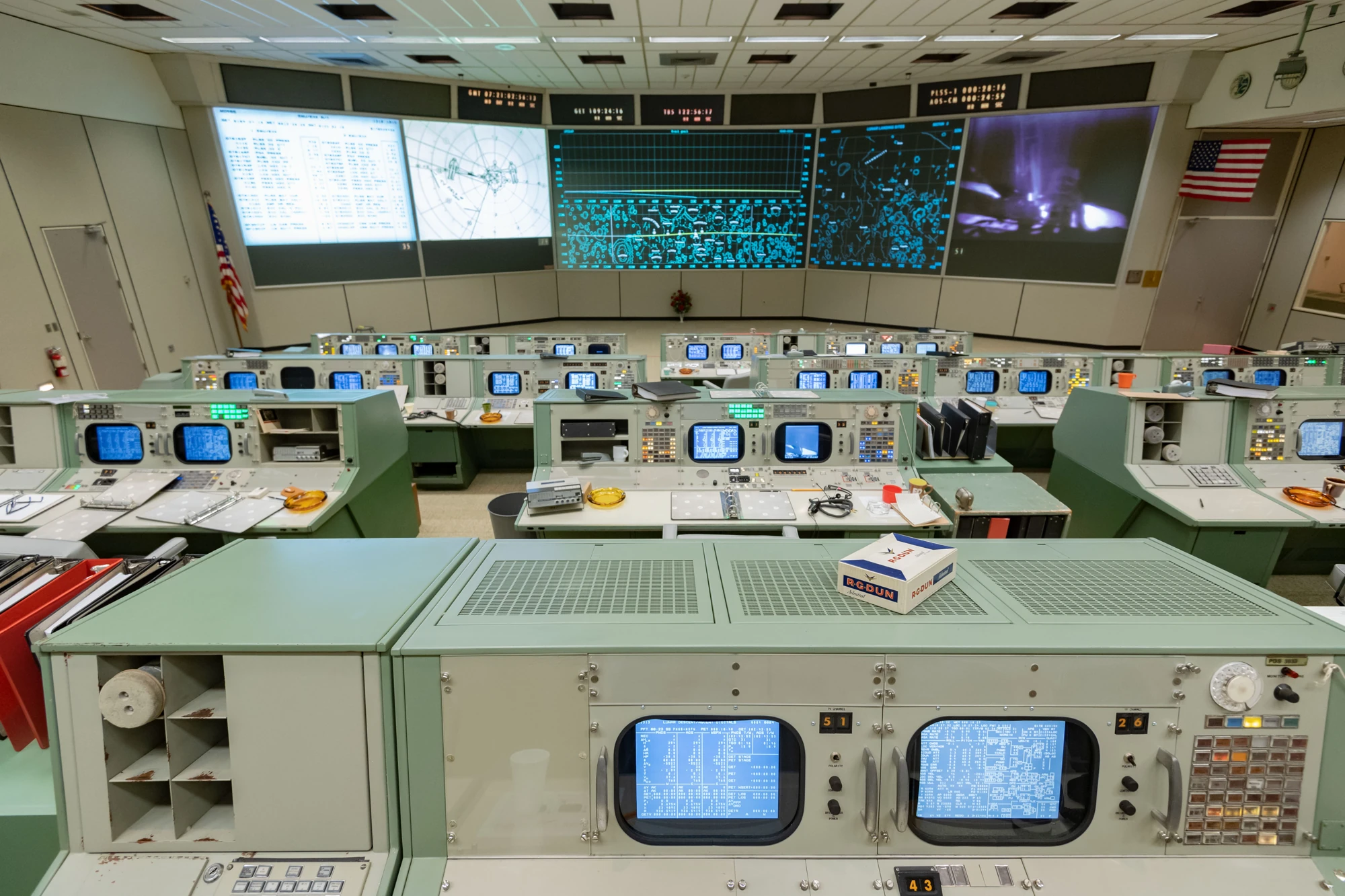
The details were reconstructed through patient detective work. In NASA’s interview with preservation officer Sandra Tetley and project lead Adam Graves, they describe examining photographs and moving footage to establish what appeared on the screens and consoles. Period cups, lighters and even an unused coffee pot were found through online resale. The display combines Apollo 11’s landing, lunar walk and recovery with the consoles’ later Apollo 15 configuration, chosen to preserve the mature technology of the Apollo era. That distinction makes the room a researched interpretation rather than a single untouched instant. Clocks, screens and recovered audio had to agree so that the presentation would tell a coherent sequence. Even apparently ordinary objects mattered: work was conducted by people who read, drank coffee, smoked and passed messages within that technical system.
That is why Historic Mission Control should be planned deliberately. Space Center Houston currently sells it as a limited, additional tram experience tied to general admission, while other campus trams follow different boarding rules. The room’s scarcity is not a manufactured puzzle: it is small, historically sensitive and located inside a working federal site. A traveller who cares most about it should secure the correct official product before building the rest of the day around an assumption.
05 · Houston systems
Read the Saturn V from the engines forward
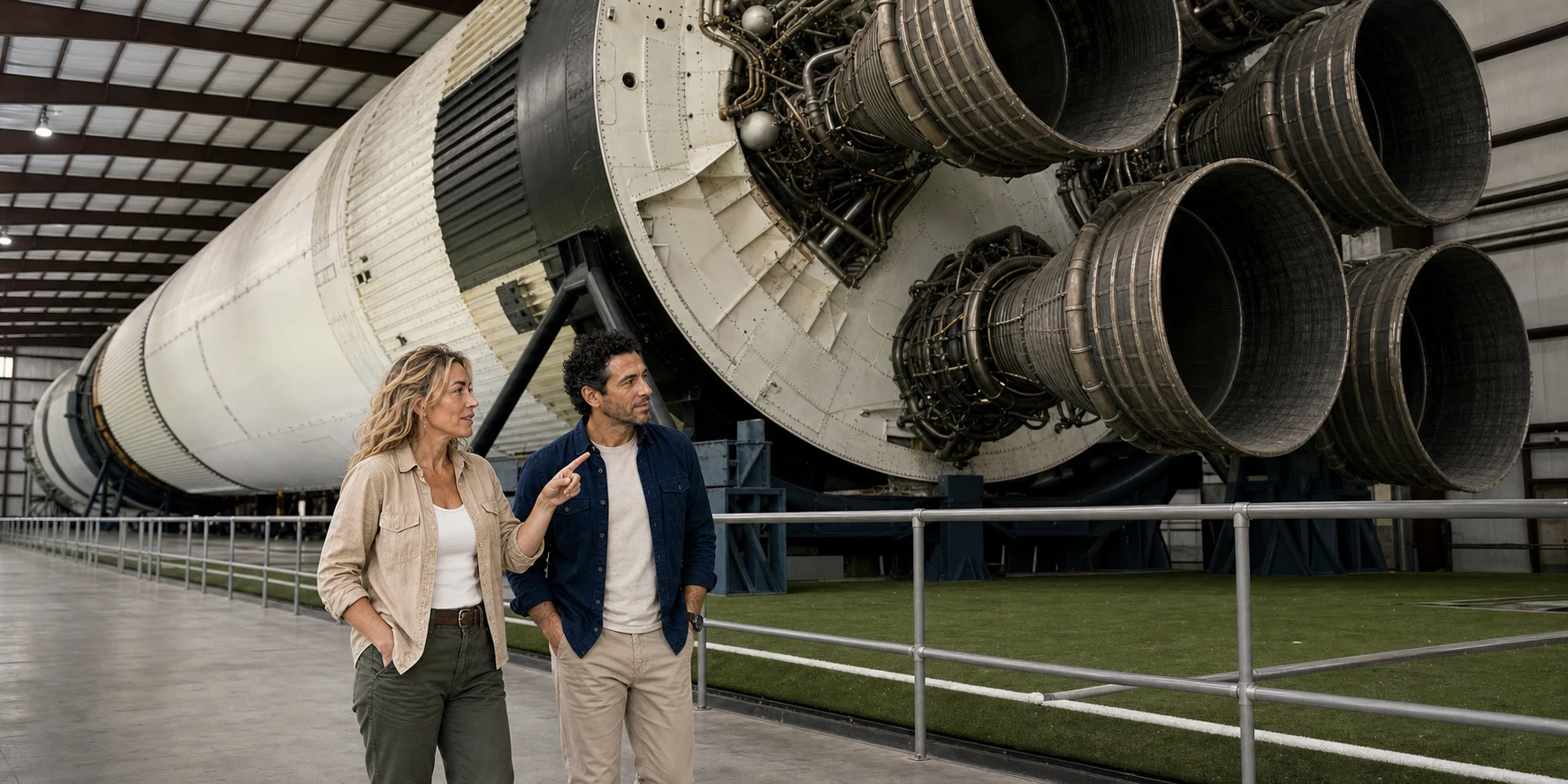
At Rocket Park, the Saturn V lies horizontally under cover. Orientation changes comprehension. On a launch pad, height dominates. On the floor, a visitor can walk from the five F-1 engine bells along the first and second stages toward the third stage, instrument unit and Apollo spacecraft geometry. The machine becomes a sequence rather than a silhouette.
The Saturn V stood 363 feet high when assembled and developed roughly 7.5 million pounds of thrust at liftoff. Those numbers impress, but staging explains the design. The first stage used five F-1 engines to lift the fully fuelled vehicle through the densest lower atmosphere. Once its propellants were spent, carrying the empty tanks and engines would have been wasteful. The stage separated. A second stage with five J-2 engines continued the climb. A third stage first completed Earth-orbit insertion and later restarted to send Apollo toward the Moon. Above it, the instrument unit coordinated guidance and control while the crewed spacecraft performed yet another set of jobs.

The engines make scale physical. Each bell shaped expanding hot gas into thrust, while pivoting the outboard engines steered the vehicle. Control also depended on carefully sequenced burns and cutoffs. During Apollo 13’s ascent, the second stage’s centre engine shut down more than two minutes early after severe oscillations. The other four engines burned 34 seconds longer, and the third stage burned nine seconds longer, compensating sufficiently to reach orbit. It was a specific response by the launch vehicle’s control system, rather than evidence that any engine failure would be harmless. A rocket engine is a managed flow system: turbopumps, valves, injectors, combustion chambers, cooling passages and control logic must turn chemical energy into predictable force while the vehicle vibrates and accelerates.
Apollo 4, the first flight of the complete Saturn V, used an “all-up” test philosophy: all three stages and the spacecraft were flown together rather than advancing through a long sequence of partially complete launches. It was a bold schedule decision carrying enormous technical risk. Its success did not mean the rocket was simple; it meant testing on the ground, configuration control and systems engineering had made a highly integrated first flight possible.
Houston’s displayed Saturn V is assembled from flight-certified stages that were never launched. Space Center Houston’s Rocket Park account makes that distinction clear. This is real hardware built for flight, with its engineering interfaces available to inspect; it is not a recovered rocket that returned from the Moon. Staging left most of each launched Saturn V behind along the way. The museum’s horizontal assembly lets visitors reconstruct a vehicle whose operational design deliberately dismantled it.
The displayed vehicle is therefore most useful when the visitor resists two shortcuts. It is not proof that 1960s engineers possessed effortless genius, and it is not an obsolete brute-force ancestor of “smart” modern rockets. It is a record of trade-offs made under a particular mission, deadline, industrial base and tolerance for cost. Walk slowly enough to see where one system ends and another begins.
06 · Houston systems
Capsules, samples and trainers make scale human again
After the Saturn V, Starship Gallery brings the journey back inside the vehicle. Its objects include Mercury 9 Faith 7, Gemini V, the Apollo 17 command module America, a Skylab trainer, Lunar Module Test Article 8, lunar samples and a lunar rover trainer. Together they show that “spacecraft” is not one stable object. It changes with duration, crew size, destination and the work expected on board.
Mercury made room for one astronaut and tested whether a person and a recoverable capsule could operate in orbit. Gemini expanded the problem to two people, longer missions, rendezvous, docking and spacewalks—capabilities Apollo required. The Apollo command module carried three people through launch, deep-space coast and atmospheric return, while the lunar module was optimized for the airless Moon and could not survive re-entry. Skylab turned a converted rocket stage into an orbital workplace and made habitability, exercise, food, observation and long-duration medicine more visible.
The Apollo 17 command module is especially powerful because it is not a replica. Named America, it carried Eugene Cernan, Harrison Schmitt and Ronald Evans on the final Apollo lunar-landing mission in 1972 and returned through the atmosphere before splashing down in the Pacific. NASA transferred ownership to the Smithsonian in 1974; it remained at Johnson and moved into Space Center Houston when the visitor centre opened. Its heat-shielded cone compresses an enormous journey into a cabin small enough to circle on foot.
The artifact also carries the scientific ambition of Apollo 17. Schmitt was a geologist as well as an astronaut. The crew worked in the Taurus–Littrow valley, collected samples and deployed instruments; some Apollo material remains the subject of new laboratory analysis decades later. A sample in a case is therefore not merely a souvenir from a distant place. It is part of a research archive whose value depends on documentation, contamination control, careful allocation and the possibility that future instruments will ask better questions.
Museums often make hardware look inevitable because the failed prototypes, test articles, manufacturing problems and abandoned alternatives are harder to display. LTA-8 and the trainers help correct that. They show how full-size hardware can be built to test structure, systems, fit and procedure without ever becoming a flight vehicle. The distinction between flown artifact, test article, trainer and replica is not pedantic. It tells the visitor what kind of evidence the object can provide.
07 · Houston systems
NASA 905 solved the shuttle’s problem after landing
Independence Plaza is visible before many visitors enter the museum: a shuttle shape mounted on a Boeing 747. The pairing seems to violate intuition because both vehicles are large and each appears complete. The crucial detail is that they performed different parts of the transport chain.
The space shuttle orbiter launched vertically with external propulsion, operated in orbit and returned as an unpowered glider. It could land far from Kennedy Space Center if weather or mission needs required. It then needed a way back to its launch and servicing infrastructure. NASA converted two Boeing 747s into Shuttle Carrier Aircraft. NASA 905 was the first.

The conversion removed most interior furnishings behind the forward doors, strengthened the fuselage and added three external attachment points. Two extra vertical fins at the ends of the horizontal tail improved directional stability when an orbiter disturbed airflow over the carrier’s normal vertical stabilizer. Flight crews monitored the combined system, and a streamlined tail cone could reduce drag on ferry journeys. Range and altitude were lower with an orbiter mounted, so long trips required planned fuel stops.
NASA 905 first helped test the entire shuttle concept. In 1977 it carried the prototype orbiter Enterprise for captive flights and then released it for unpowered Approach and Landing Tests. Those flights verified that the orbiter could separate, glide and land. During the operational programme, the carrier returned orbiters from alternate landing sites and moved them for servicing, modification and eventual museum delivery.
The exhibit preserves the original carrier aircraft but places a high-fidelity replica, Independence, on top. Visitors can enter both. That distinction matters: the 747 flew the ferry missions; the shuttle above it did not fly in space. The exhibit structure is itself an engineering project. Space Center Houston had NASA 905 disassembled at Ellington Field, moved in sections through city infrastructure and reassembled beside a tower that provides accessible public entry. The combined display must behave both as an aircraft artifact affected by heat and expansion and as a building expected to carry visitors safely.
Read it from below before boarding. The three attach points reveal where the orbiter’s loads entered the 747. The extra tail fins show an aerodynamic problem solved with visible geometry. Inside, the absence of an airliner cabin becomes evidence: carrying an orbiter required the aircraft to stop being a passenger jet.
08 · Houston systems
Training hardware is allowed to be wrong
The Space Vehicle Mockup Facility can look like an aerospace warehouse, but its organizing principle is rehearsal. Full-scale modules, part-task trainers, cockpit systems and hardware interfaces allow astronauts, flight controllers and engineers to practise operations that would be dangerous, expensive or impossible to learn for the first time in orbit.

Training is only one role. Engineers use mockups for fit checks, stowage, cargo transfer, maintenance, emergency procedures, camera positions, human factors and the placement of controls. A full-size representation reveals problems that a drawing or virtual model can miss: a suited hand cannot reach a latch; two people cannot pass in a narrow volume; a maintenance bag blocks an escape path; a display demands the wrong head movement under acceleration.
Mockups can also support missions already under way. If a crew encounters an unfamiliar problem, teams on Earth may reproduce the configuration, test tools and verify a procedure before sending instructions. The hardware is valuable precisely because it can be changed, instrumented or deliberately placed in a failed state.
NASA’s current facility description includes International Space Station modules, Orion hardware, commercial-vehicle representations, air-bearing equipment and partial-gravity systems. Configurations evolve with programmes and testing needs. A visitor on the elevated path may see training or engineering activity, but should not expect a particular astronaut, rover or lunar lander. The honest promise is access to the logic of preparation, not a guaranteed performance by the workforce.
This is where the historical and contemporary campus connect most clearly. Apollo teams used simulators to practise abnormal situations. Today’s crews and controllers continue to train through malfunction scenarios because spaceflight still punishes ambiguity. New software and materials do not remove the need for bodies to rehearse decisions together.
09 · Houston systems
Build the visit around the least flexible experience
Space Center Houston contains enough material to reward a full day, while a combined city-and-space itinerary may give the museum only part of one. The correct sequence depends less on a universal “crowd-beating” trick than on the official boarding rules for the date.
The official tram page distinguishes four formats. Historic Mission Control requires an additional advance booking alongside general admission. Astronaut Training Facility and NASA Campus tours are offered to general-admission guests without an additional charge, subject to availability; obtain their on-site boarding passes at Guest Services. The Rocket Park route also has no additional charge, but visitors join its boarding queue without a physical pass; the Campus route can include a Rocket Park stop. On-site passes for these routes are not booked online. Confirm the current format before departure, because access remains subject to NASA’s working-facility requirements.

That produces a durable planning method:
- Before leaving Houston, check the official visitor and tram pages. Confirm the museum entry time, the current tram options and whether the experience you most value requires advance purchase or an on-site pass.
- On arrival, resolve the tram before drifting into galleries. If an on-site boarding pass is needed, Guest Services is more important than the first artifact in view.
- Use gallery time in blocks. Starship Gallery rewards chronological attention; Independence Plaza rewards engineering comparison; films and demonstrations can absorb fixed intervals.
- Leave margin for transitions. Security screening, walking, queues, tram loading and travel between buildings are part of the day, not theft from it.
- End with one object rather than a final sprint. A command module, engine bell or carrier attachment can hold more meaning after the systems around it have been understood.
Bring a modest bag, expect security inspection and follow the institution’s current prohibited-item list and photography instructions. Bags are not permitted inside Historic Mission Control to protect its original furnishings. Use restrooms before boarding a tram, where access is very limited, and plan for the fact that strollers remain in the designated parking area. Water in a closed-lid container is useful for the open-air journey; food is not permitted on the tram. Working facilities may prohibit photographs even when the museum permits them elsewhere.
Food is a time and energy question, not a verdict on a café. The Food Lab gives visitors an on-site option, but a constrained itinerary should decide in advance whether to eat a full meal, carry permitted small items or schedule food before and after the visit. Do not build the day around a named barbecue stop unless the transport provider confirms it. Houston’s food culture deserves more than being treated as a tour add-on.
10 · Houston systems
Gulf Coast weather reaches inside the itinerary
Air conditioning can disguise how much of this museum day occurs outdoors. The tram is open-air. Rocket Park, Independence Plaza approaches and the distance between vehicles and buildings can expose visitors to heat, humidity, rain, wind and lightning. A weather interruption is not evidence that the institution failed; it is a consequence of placing public access inside an active Gulf Coast campus.
Houston’s climate should be handled with the same systems thinking as the exhibits. Check the National Weather Service Houston/Galveston forecast and alerts close to departure. Wear shoes appropriate for substantial walking and surfaces that may become wet. Carry water in a closed container where permitted. Choose light clothing for outdoor heat while remembering that galleries may feel cool. If thunder is heard, seek a substantial building or enclosed hard-topped vehicle rather than an exposed tram stop or tree.
Summer heat, thunderstorms, flooding and tropical systems can each change how a Gulf Coast journey works. Check the local National Weather Service forecast close to travel, and follow staff instructions about outdoor access. For lightning, the Weather Service recommends substantial shelter and waiting at least thirty minutes after the last thunder before returning outside. Build enough flexibility to remain indoors rather than treating every outdoor stop as an obligation.
The same principle applies to traffic. Houston’s road network can produce long or highly variable transfers, but no fixed “rush half-day” rule is reliable. Travellers should inspect the route near departure, allow recovery time and avoid scheduling a non-refundable flight or hard appointment immediately after a campus visit. The city’s scale matters more than a boast about how cleverly one guide defeats it.
11 · Houston systems
Accessibility is the whole chain, not the museum door
Space Center Houston states that its theatres, exhibits and attractions are wheelchair accessible, including Independence Plaza. Trams have ramps that visitors can request at boarding. Accessible restrooms, sensory backpacks, a quiet room on request, sensory guides and periodic reduced-stimulus events expand the ways people can use the centre. Service animals are admitted under the institution’s stated policy, with an exception for motion simulators.
Those provisions are important, but they describe the visitor centre—not every transport product or every individual day. A complete access plan begins at the hotel or home and continues through vehicle boarding, travel time, parking or drop-off, security, queues, rest, tram loading, outdoor exposure, exhibit sound and light, food, toilets and the return journey.

For a wheelchair user, the key question may be whether an organized vehicle has a lift and securement—not whether the museum has ramps. For someone who cannot stand for long, timed tram loading and gallery seating matter. For a traveller sensitive to sound or crowds, a sensory guide and an early entry may be more useful than an ambitious exhibit list. For a family with a stroller, the official rule that strollers do not board tram tours changes the handoff plan even though the main museum accommodates families.
Ask the institution directly about site accommodations. Ask the transport provider separately about vehicle steps, lifts, securement, storage, assistance, pickup boundaries and what happens if the group’s timing changes. A general statement that a tour is “accessible” cannot answer both sets of questions.
12 · Houston systems
Choose the format by where you want the expertise
The visitor centre is largely self-guided; that does not make every independent journey equal, and it does not make a driver a museum guide. The choice is about where a traveller wants help.
An organized city-and-space-centre day can reduce the work of navigating a dispersed city and add a concise Houston orientation. It suits travellers with limited time who value a known return vehicle. Its weaknesses are dependence on the group’s pace, uncertain depth in the city, and product-specific questions about pickup, capacity, schedule and access that must be confirmed before booking.
A self-drive visit offers the most control over arrival, meal timing and departure. It can preserve a full day at the museum and allow a Clear Lake or Houston stop on the return. It also places traffic, parking, weather and driver fatigue on the traveller. The person driving should not be expected to absorb a museum day and immediately perform a high-stress cross-city transfer.
A rideshare or hired transfer removes parking and the need for one traveller to drive, but pickup reliability and return cost can vary. Confirm the pickup location and network coverage rather than assuming the same conditions that existed downtown will apply at closing time.
A museum-first independent plan is strongest for visitors whose priority is Historic Mission Control, a specific tram, family learning or sustained attention to artifacts. Book directly through the official visitor centre, then solve transport around the confirmed entry and boarding times. This separates the museum decision from a seller’s description.
The city-orientation component should be judged on its own promise. A traveller arriving for a convention who wants a quick map may value it. Someone who already understands Houston or wants six hours with the collection may prefer to go directly southeast. Someone interested in Black history, immigration, bayou ecology, architecture or food should not pretend that a freeway loop and a few civic landmarks constitute a Houston education.
No format is automatically more authentic. The better choice is the one that makes the least flexible part—campus access, mobility, child needs, weather tolerance or return timing—explicit before money and time are committed.
13 · Houston systems
Listen: the Houston and NASA field notes
The original Travel Podcast episode is most useful when it identifies the traveller’s objections. Houston is spread out; the museum is self-guided; Mission Control creates strong expectations; weather reaches the tram; and the scale of the Saturn V and shuttle carrier deserves explanation. Those questions provide a human route into the subject.
Across its twenty-three minutes, the conversation moves from the city transfer to the museum’s scale, then to the shuttle carrier, tram and choices about spending limited time. Hear it before planning to identify which part of the day matters most to you: city orientation, flight hardware, the control room or the working training campus. The article’s route can then turn that interest into a sequence with room to look closely.
Listen to “NASA Space Center Day Trip with Private Houston Tour” as field notes for the journey.
14 · Houston systems
Leave with a system, not a checklist
The danger of a space museum is scale without explanation. A 363-foot rocket, a lunar capsule and a shuttle on a 747 can become a row of superlatives: tallest, first, last, only. Houston offers something better because the artifacts sit beside the institution that made their work possible.
The Saturn V teaches staging: change the job, discard mass, continue. Mission Control teaches distributed authority: specialist evidence becomes one operational decision and one clear voice to the crew. NASA 905 teaches infrastructure: a reusable orbiter still needed a way home after landing. The mockup facility teaches rehearsal: a replica can be more valuable than a relic when it exposes the mistake before flight. The restored control room teaches conservation: even modern technical heritage wears out and requires interpretation.
Houston adds the outer frame. The campus depended on land, universities, transport, contractors, housing, climate control and a metropolitan region capable of absorbing thousands of workers. The public museum depends on a nonprofit institution that can preserve objects while respecting the limits of a federal worksite. The traveller depends on a chain of roads, tickets, weather, mobility and time.
That chain is the real exhibit. Read it well and “Houston” stops being a cinematic reply from a green console. It becomes a place where human spaceflight was—and still is—organized on Earth.
15 · Houston systems
Reporting links
- Space Center Houston: visitor information
- Space Center Houston: current NASA tram-tour formats
- Space Center Houston: accessibility options
- Space Center Houston: Starship Gallery
- Space Center Houston: Independence Plaza
- NASA: history of Johnson Space Center
- NASA: how Houston was selected for the Manned Spacecraft Center
- NASA: Mission Control at Johnson Space Center
- NASA: Space Vehicle Mockup Facility
- NASA: Shuttle Carrier Aircraft fact sheet
- National Park Service: Apollo Mission Control Center
- NASA: restored Mission Control photograph, 25 June 2019
- NASA: images and media usage guidelines
- National Weather Service Houston/Galveston forecast