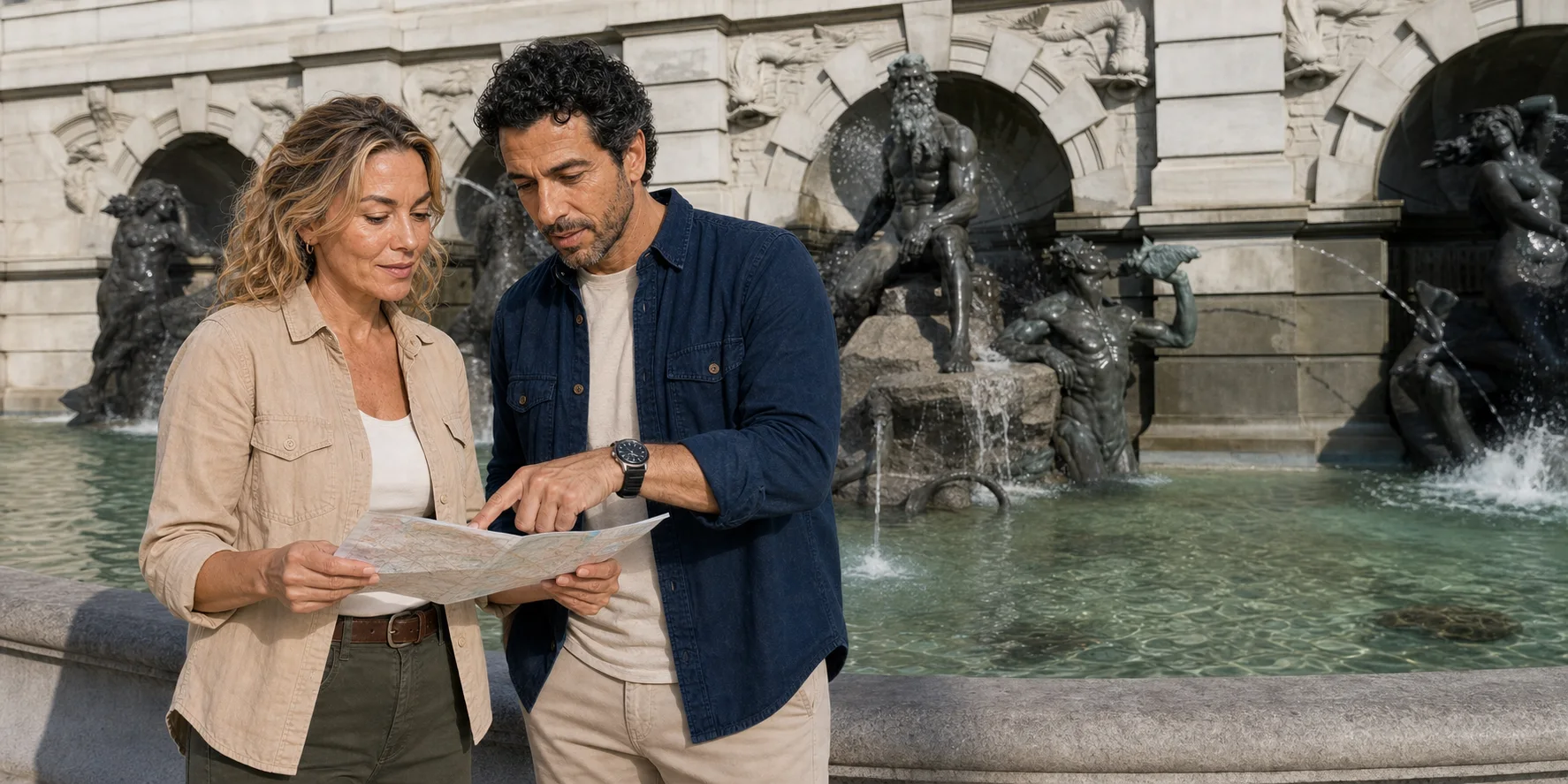
The most revealing introduction to Washington’s civic institutions may be a fountain full of sea gods. Outside the Library of Congress, Neptune rises above bronze tritons and sea nymphs while water crosses an elaborate stone basin. Beyond him, the Thomas Jefferson Building’s arches, columns and sculpted faces turn a library entrance into a declaration of abundance. Across First Street stands the U.S. Capitol, where laws are argued, votes counted and political ceremonies made visible. Farther west, the National Archives presents records as national relics beneath a temple-like portico.
The familiar shorthand is seductive: the Capitol creates power, the Library gathers knowledge, and the Archives preserves memory. A walk through all three quickly complicates it. Congress also writes the rules that shape collecting and preservation. The Library does not merely store knowledge; it classifies it, chooses among deposits and serves lawmakers. The Archives does not preserve everything; it appraises federal records, controls access and helps determine what evidence will remain usable. Each institution is a working system wrapped in monumental architecture.
That is the thread to carry from Capitol Hill to Federal Triangle. The buildings tell a national story in marble, paint, books and parchment, but they also expose the decisions behind that story: whose labour built the stage, which images became official, who could vote for the lawmakers inside, which publications entered a collection, and which government files survived long enough to be questioned.
01 · Washington, D.C.
1. Before the monumental city
Washington’s monumental core can create the illusion that the capital began as a diagram. It did not. The Potomac and Anacostia watersheds were Indigenous homelands and travel corridors long before the federal district. National Park Service research places Nacotchtank settlements along the eastern branch of the Potomac—the river now called the Anacostia—and connects the people of this landscape to the wider Piscataway or Conoy world. European colonisation, disease, conflict and displacement remade that geography before a presidential commission began drawing the permanent seat of government.
Pierre Charles L’Enfant’s 1791 plan did give the federal city its powerful spatial grammar. A grid met broad diagonal avenues. The Capitol and President’s House occupied separate high points, connected by Pennsylvania Avenue and by lines of sight. Andrew Ellicott’s revised engraving helped make the plan usable. The large open grounds and radiating streets turned movement through the city into a lesson about the new republic.
But the plan should not be credited with arranging today’s complete civic ensemble. The current Library of Congress Jefferson Building opened in 1897; the Supreme Court building arrived in 1935; the National Archives occupied its building in the 1930s. L’Enfant established axes and ceremonial relationships, not a frozen set of present-day institutions. The city accumulated around his framework through later political, architectural and bureaucratic decisions.
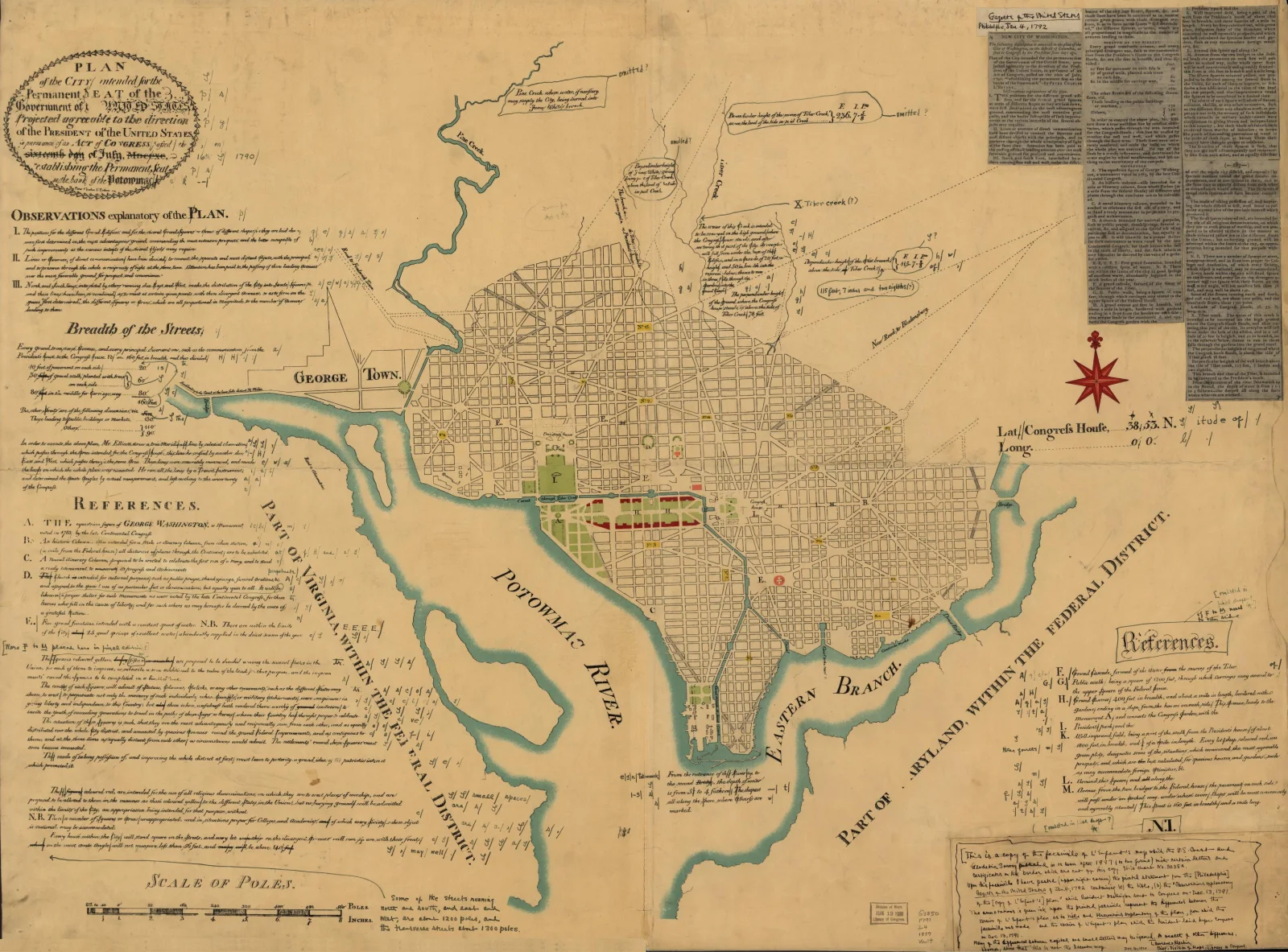
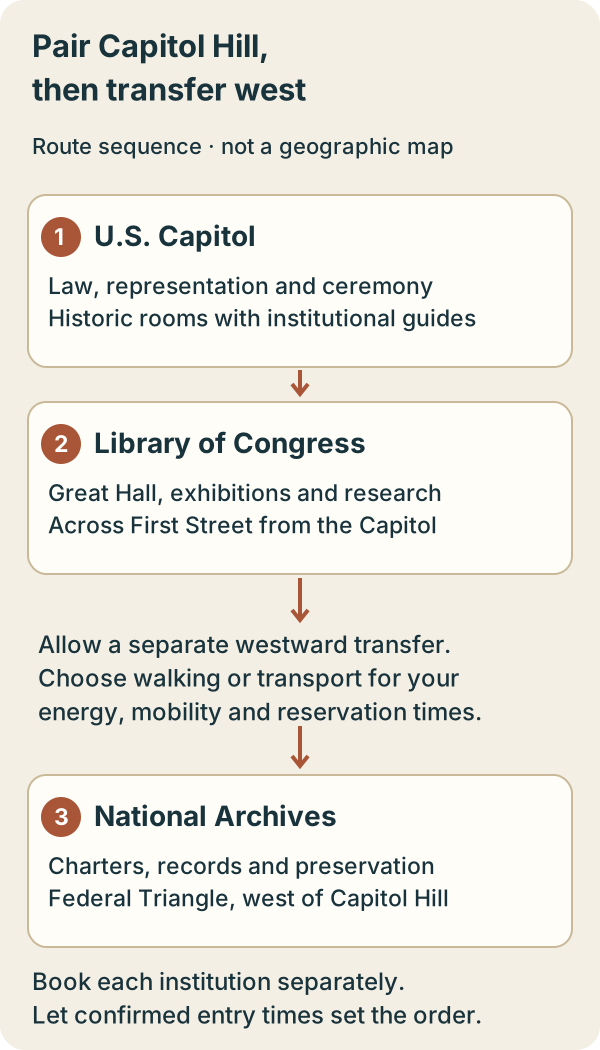
That distinction matters on the ground. The Capitol and Library sit within a few minutes of one another on Capitol Hill. The National Archives is roughly a mile and a half to the west, closer to the White House side of L’Enfant’s institutional axis. Walking between them turns the plan from an aerial abstraction into gradients: hill to avenue, legislature to executive landscape, nineteenth-century Capitol complex to twentieth-century Federal Triangle.
02 · Washington, D.C.
2. The Capitol was built, burned and rebuilt
The U.S. Capitol does not have a single origin story. Its present silhouette is the result of competition, destruction, expansion and engineering change.
In 1792, a public design competition produced William Thornton’s winning proposal. President George Washington laid the cornerstone in 1793. Benjamin Henry Latrobe and Charles Bulfinch subsequently altered and completed major portions. British troops burned the building in August 1814 during the War of 1812, leaving a damaged shell that had to be reconstructed. As the country added states and legislators, the building grew again: new House and Senate wings made the original dome look too small, and Thomas U. Walter designed the cast-iron dome that now defines the skyline.
The clean sequence of architects can hide the worksite. Enslaved Black labourers cleared land, quarried and cut stone, sawed timber and performed other heavy work in the early construction. Payroll and administrative records often name the people who received payment for their labour rather than the workers themselves, a documentary structure that reproduces ownership. The House’s historical office describes hundreds of enslaved men contributing to the building. Their presence is not an optional correction to an otherwise complete architectural story; it is part of how the institution became physically possible.
The later dome carries another labour history. Philip Reid, an enslaved craftsman at Clark Mills’s foundry, used his expertise to help disassemble the plaster model of Thomas Crawford’s Statue of Freedom and worked on the bronze casting. Reid became free in 1862 after the District of Columbia Compensated Emancipation Act. The statue was raised above the dome in 1863, while the Civil War continued. Its name and its production therefore sit in deliberate tension: a figure called Freedom, made possible in part by a man whose freedom had been legally denied.
Expansion also changed how the old building worked. The original House and Senate chambers became interior historic spaces after legislators moved into the new wings. Circulation grew more complex; a building conceived for a small republic accumulated offices, committee rooms, mechanical systems and security boundaries. The visitor sees a classical composition, while the institution operates more like a small city. Even the east–west question is political. The east front was long treated as the formal arrival façade, but the west front now faces the National Mall and supplies the vast stage used for inaugurations. A change in city growth changed which side reads as the public face.
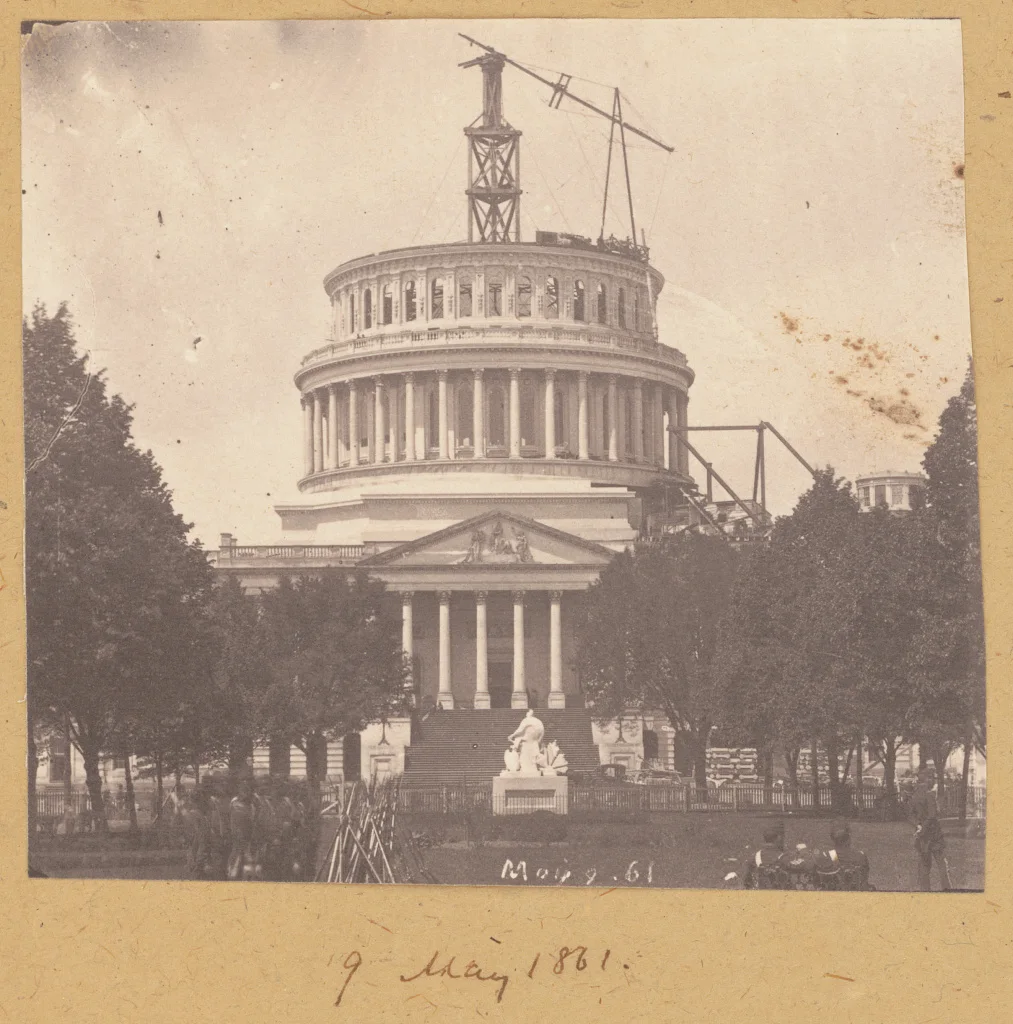
Stopping construction during the war would have been practical. Continuing it was political, but it also began as a contractor’s decision. After Fort Sumter, engineer Montgomery Meigs ordered the work stopped. The ironworkers of Janes, Fowler and Kirtland carried on without pay because they feared the material would be lost or damaged if the site fell idle. Congress renewed the contract in May 1862. The Senate’s account of the dome thus connects national symbolism to an immediate worksite calculation. The expanding dome made continuity visible even as the Union fractured. Cast iron carried the larger profile, while its classical appearance concealed industrial production behind monumental language.
03 · Washington, D.C.
3. Inside the Capitol: structure, ceremony and productive myths
The standard public tour usually moves through the Crypt, Rotunda and National Statuary Hall, although the Capitol Visitor Center warns that routes can change. These rooms reward precise looking because their popular stories are often almost true.
The Crypt is not George Washington’s empty tomb. It is a circular ground-floor room whose forty sandstone columns support the Rotunda floor above. A separate tomb chamber was built two levels below the Rotunda, following an early plan to place Washington’s remains at the Capitol. His family honoured his wish to remain at Mount Vernon, and the chamber was never used for him. The word “crypt” remained attached to the columned room, allowing architecture and disappointed intention to collapse into one memorable label.
Above it, the Rotunda performs national synthesis. The dome, historical paintings, sculpted reliefs and ceremonial use ask visitors to experience the republic as a coherent story. Constantino Brumidi’s Apotheosis of Washington places the first president among allegorical figures high overhead. Paintings on the lower walls frame exploration, settlement, revolution and state-making.
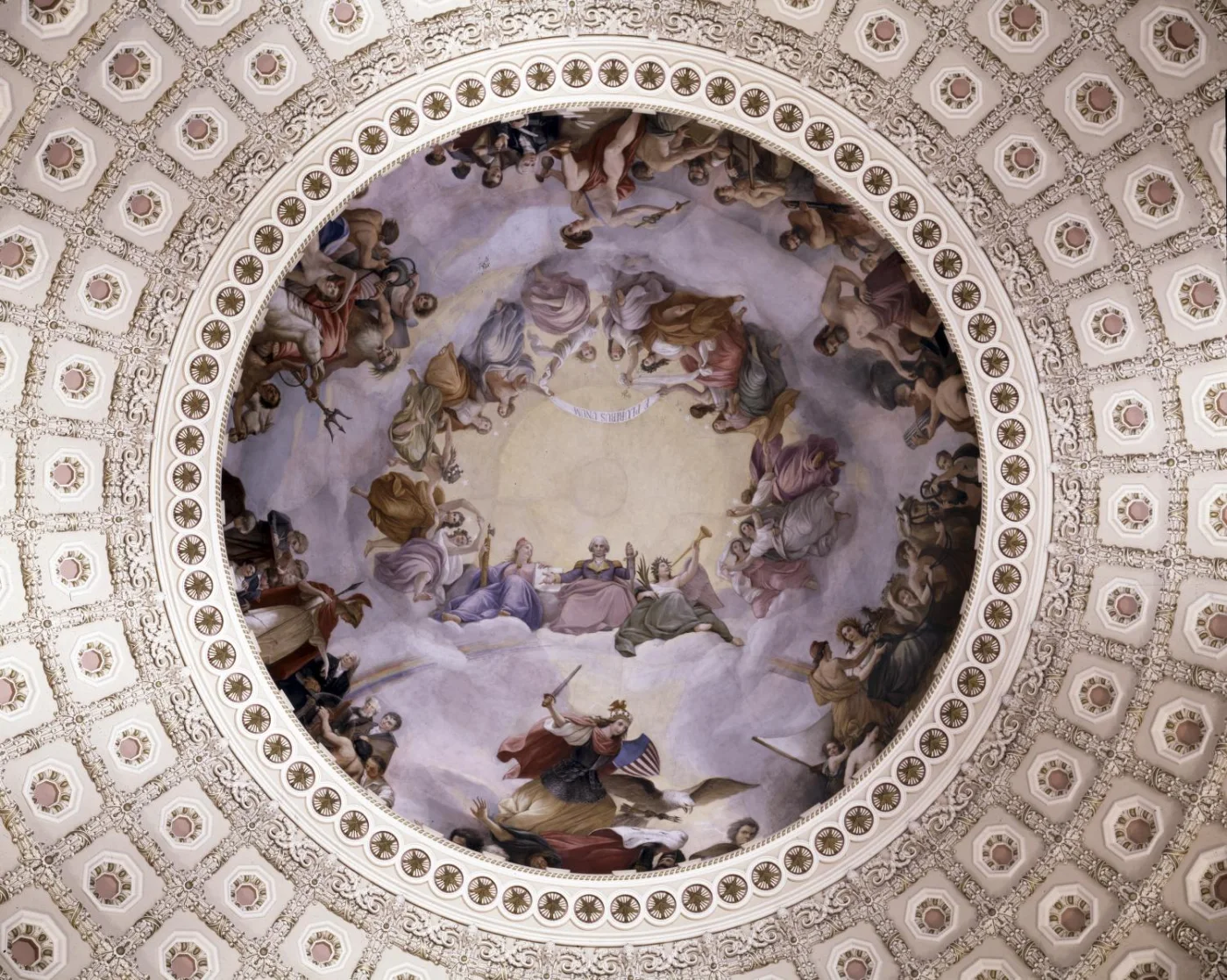
Coherence is not neutrality. Several Rotunda works imagine Native peoples from the viewpoint of nineteenth-century expansion. The Capitol Visitor Center’s Indigenous interpretation project brings Native Nation voices into conversation with that art and identifies how images of “discovery” and westward movement can naturalise dispossession. The point is not to avert one’s eyes from historical paintings. It is to ask what political work their composition performs: who acts, who watches, who yields, and which future appears inevitable.
National Statuary Hall makes selection even more visible. The chamber served as the House of Representatives from 1807 to 1857, then became a display space for statues donated by states. Its unusual acoustics are real: sound can carry unexpectedly across the room. The favourite claim that John Quincy Adams exploited a precise “whispering spot” to eavesdrop on opponents is best treated as a legend attached to a genuine acoustic effect, not a demonstrated routine.
The statues themselves are not permanent verdicts. States can replace their contributions, and substitutions reveal changing ideas of public honour. The collection therefore operates less like a sealed pantheon than a slow political conversation. A statue’s removal does not erase the old choice; it documents that the choice became untenable or incomplete.
The Rotunda paintings make a comparable claim through arrangement. John Trumbull’s scenes of revolutionary politics show recognisable participants gathered around documents and decisions. Four other large canvases imagine Columbus’s landing, Hernando de Soto’s encounter with the Mississippi, Pocahontas’s baptism and the embarkation of the Pilgrims. Together they shift from political history into an older national epic of arrival, conversion and territorial destiny. Because the works share one ceremonial ring, their different evidentiary status can disappear. A visitor should separate the documented event, the artist’s later reconstruction and the ideology of the period in which each painting was commissioned.
This is why updated interpretation matters more than a label that supplies title and date. Native viewers have pointed out that Indigenous figures frequently appear as obstacles, witnesses or people entering a European religious order rather than as nations with their own law and diplomacy. The Capitol’s official Indigenous interpretation project does not change the canvas. It changes the questions considered legitimate in the room.
04 · Washington, D.C.
4. A legislature in a city without equal representation
The Capitol’s grandeur can obscure the simplest democratic question: who is represented inside?
Residents of the District of Columbia elect a delegate to the House of Representatives, but that delegate does not vote on final passage in the House. The District has no senators. Congress also retains constitutional authority over the federal district and reviews D.C. legislation. Washingtonians pay federal taxes and live beside the national legislature without the same voting representation in Congress as residents of the states.
The position developed in stages. Congress assumed direct control of the District in 1801, severing residents’ former voting relationships with Maryland and Virginia. The Twenty-third Amendment, ratified in 1961, allowed the District to participate in presidential elections. Congress restored an elected nonvoting House delegate in the 1970s and passed the Home Rule Act, which established an elected mayor and council while reserving federal oversight. Each reform expanded participation without producing state-equivalent representation.
This is not a side issue to append after the architecture. It changes how the building reads. The Capitol stages representative government in a jurisdiction whose residents experience representation differently. The tension is visible in local licence plates and political campaigns, but it belongs inside the institutional history of the site.
The building is also an active workplace, not a completed monument. Votes, hearings, protests, inaugurations, lying-in-state ceremonies and security decisions continually alter its meaning. On 6 January 2021, an attack breached the Capitol while Congress met to count electoral votes. Official investigations documented failures before and during the attack as well as the effort to interrupt a constitutional transfer of power. That event belongs neither to a timeless patriotic story nor to architectural tourism alone. It showed that the building’s symbolic value depends on vulnerable procedures performed by people.
The most useful Capitol visit therefore shifts between four scales: stone and iron; images and statues; labour and exclusion; procedure and present use. Any one scale by itself produces a thinner institution than the one actually operating.
05 · Washington, D.C.
5. Across First Street: why Congress needed a bigger library
The Library of Congress began in 1800 with a practical purpose: to supply the new legislature with books. Its early collection occupied the Capitol. British troops destroyed it in the 1814 fire. Thomas Jefferson then offered his personal library, which Congress purchased in 1815: 6,487 volumes for $23,950.
Jefferson’s books changed more than the collection’s size. Their wide range supported his belief that legislators might need knowledge about almost any subject. The organising principle was expansive rather than narrowly legal. His catalogue adapted Francis Bacon’s division of knowledge into memory, reason and imagination, producing a subject arrangement rather than a simple alphabetical list. On the shelves, however, Jefferson also arranged books by size. The Library’s exhibition of his catalogue exposes the difference between an intellectual system and the physical business of fitting volumes into a room. Classification begins with an argument about knowledge and ends in decisions a reader actually encounters. Yet the collection was not secure merely because Congress had bought it. A Christmas Eve fire in 1851 destroyed nearly two-thirds of Jefferson’s books, another reminder that collecting without preservation is temporary possession.
The Jefferson collection also carries the contradictions of its owner. His intellectual range and arguments about liberty coexisted with his lifelong enslavement of people. Treating the books as a democratic seed should not turn their former owner into an uncomplicated patron saint of knowledge. The collection is valuable because of its content, provenance and influence; provenance includes the political economy that made private collecting possible.
By the later nineteenth century, Librarian Ainsworth Rand Spofford pressed for a separate building. The library’s responsibilities and holdings had expanded, especially after copyright law made deposit an important stream of material. Congress approved a new structure in 1886. The building that opened in 1897—later named for Jefferson—announced that the United States could rival European cultural institutions in materials, art and technical sophistication.
The current mandatory-deposit system still connects copyright and collecting, but it does not mean every deposited item automatically becomes a permanent Library holding. The Copyright Office receives copies under legal rules; the Library selects materials for its collections. That boundary between intake and retention is fundamental. A national collection is produced by law, resources, professional judgement and changing formats, not by an indiscriminate funnel.
The building itself was another long negotiation. John L. Smithmeyer and Paul J. Pelz developed the early design; Pelz carried much of it forward; Brigadier General Thomas Lincoln Casey and engineer Bernard Green oversaw completion after the project transferred to the Army Corps of Engineers. That sequence helps explain why the Jefferson Building feels both like a unified artwork and a coordinated industrial undertaking. Electric lighting, book-moving systems, iron stacks and environmental control supported the decorative programme. Technology was not the opposite of monumentality. It was what allowed the monument to function as a modern library.
06 · Washington, D.C.
6. The Jefferson Building: knowledge as spectacle
The Thomas Jefferson Building is extravagant even by Gilded Age standards. Its Italian Renaissance-derived exterior gives way to a Beaux-Arts interior crowded with marble, mosaics, inscriptions, painting and sculpture. The Great Hall does not merely house visitors on the way to books. It turns knowledge into a civic spectacle.
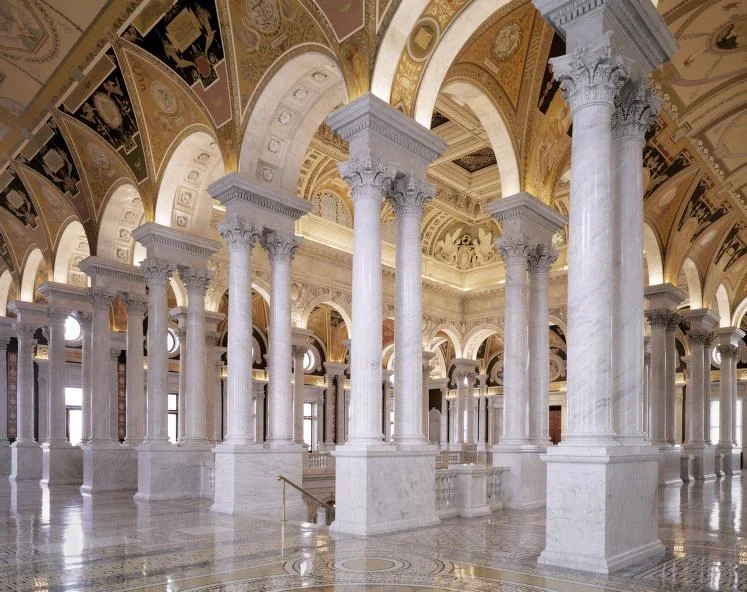
Its programme is encyclopaedic. Named writers and thinkers appear beside allegories of disciplines and quotations about learning. Elaborate surfaces insist that the library belongs in a lineage of accumulated civilisation. The Main Reading Room, viewed from above on most visitor routes, arranges desks beneath a dome as if research itself were a public ritual.
But encyclopaedias have borders. The exterior includes “ethnological heads,” sculpted figures meant to represent racial types as understood by late-nineteenth-century anthropology. Today they read as evidence of how an institution that gathered knowledge also reproduced hierarchical categories. The same building can celebrate universal learning and embody a taxonomy that treated people as specimens.
That contradiction should not be resolved by calling the ornament merely “of its time.” Categories have consequences: they influence catalogues, displays, funding priorities and whose intellectual traditions look central. Libraries are powerful precisely because their classifications can disappear into routine. A call number, subject heading or collection policy may feel technical, yet it shapes what can be found and connected.
The building’s richness also reflected the United States’ growing industrial and imperial confidence in the 1890s. Materials and artisans came together in a programme intended to demonstrate national maturity. The Court of Neptune outside belongs to that performance. Its bronze sea gods turn the approach into theatre, while the fountains and carved arches compress European references into a new federal landmark.
The contrast with the Capitol is purposeful. The legislature’s dome proclaims one central institution. The Library’s Great Hall disperses authority across authors, disciplines, materials and inscriptions—then reunites them within a federally commissioned programme. It says that knowledge is many things while the building decides how those things fit together. Visitors can enjoy the craftsmanship and still recognise the act of curation.
07 · Washington, D.C.
7. What the public sees—and what researchers do
A visitor and a researcher use the Library of Congress differently. The public route foregrounds the Great Hall, exhibitions, overlook and architecture. Researchers use reading rooms, catalogues and staff expertise to work with collections under specific access rules. The institution serves Congress first but also operates as a national and international research library.
That difference matters for planning. A short timed-entry visit is not equivalent to using the collection, and a view into the Main Reading Room is not an open invitation to occupy a desk. The Library periodically offers limited Main Reading Room floor walkthroughs, but those windows are operational and can change. Anyone whose central goal is research should begin with reader registration and collection-specific guidance rather than a general visitor ticket.
The Library’s enormous scale is often described with a single number. Exact totals date quickly and can mislead because the holdings include manuscripts, maps, recordings, photographs, newspapers, websites and many other formats, not only books. The more durable insight is functional: collection growth creates preservation, description and access obligations. A digital file is not self-preserving, and a rare object is not useful if its condition or catalogue renders it unreachable.
After the Capitol’s chambers of law and ceremony, the Jefferson Building offers an overwhelming decorative field. A visitor can slow that shift by choosing one artwork, one architectural detail and one collection question rather than trying to absorb every inscription. A guide can help make those choices, but an independent visitor can make them too. Pacing changes what remains intelligible after a dense morning.
08 · Washington, D.C.
8. West to the National Archives
The transfer from Capitol Hill to the National Archives is not dead time. It crosses the landscape that made Washington’s plan legible: the Capitol’s west front, Pennsylvania Avenue and the federal buildings gathered between legislative and executive centres.
The Archives building emerged from a twentieth-century problem. Federal records were dispersed in offices and storage conditions never designed for durable preservation. The 1926 Public Buildings Act enabled a major construction programme, and architect John Russell Pope designed a monumental home for the nation’s records. Work displaced Center Market, a busy commercial building whose removal reminds us that the Federal Triangle was made by clearing an existing urban economy, not by filling an empty ceremonial space.
The Archives began occupying the unfinished building in 1935, one year after the National Archives was established as an agency. Massive Corinthian columns and sculptural groups turn recordkeeping into temple architecture. The inscriptions speak about history, judgement and the permanence of the past. Inside, Barry Faulkner’s murals imagine the presentation of the Declaration of Independence and Constitution. They are not eyewitness records of those events; they are twentieth-century compositions that give founding moments a solemn, ordered visual form.
Pope’s design had to reconcile symbolism with storage. Public ceremonial rooms occupy the visible centre, while stacks and work areas support the less photogenic business of custody. The allegories divide between two façades: Past and Future stand at the Pennsylvania Avenue entrance; Heritage and Guardianship belong to the Constitution Avenue side. “Study the Past” accompanies the male figure; “What Is Past Is Prologue” accompanies the female figure of the future. The Archives’ account of the sculptures makes their placement clear. Their messages make research sound morally straightforward. Actual archival work is slower: establish provenance, preserve original order where it survives, document interventions and accept that gaps may never be repaired.
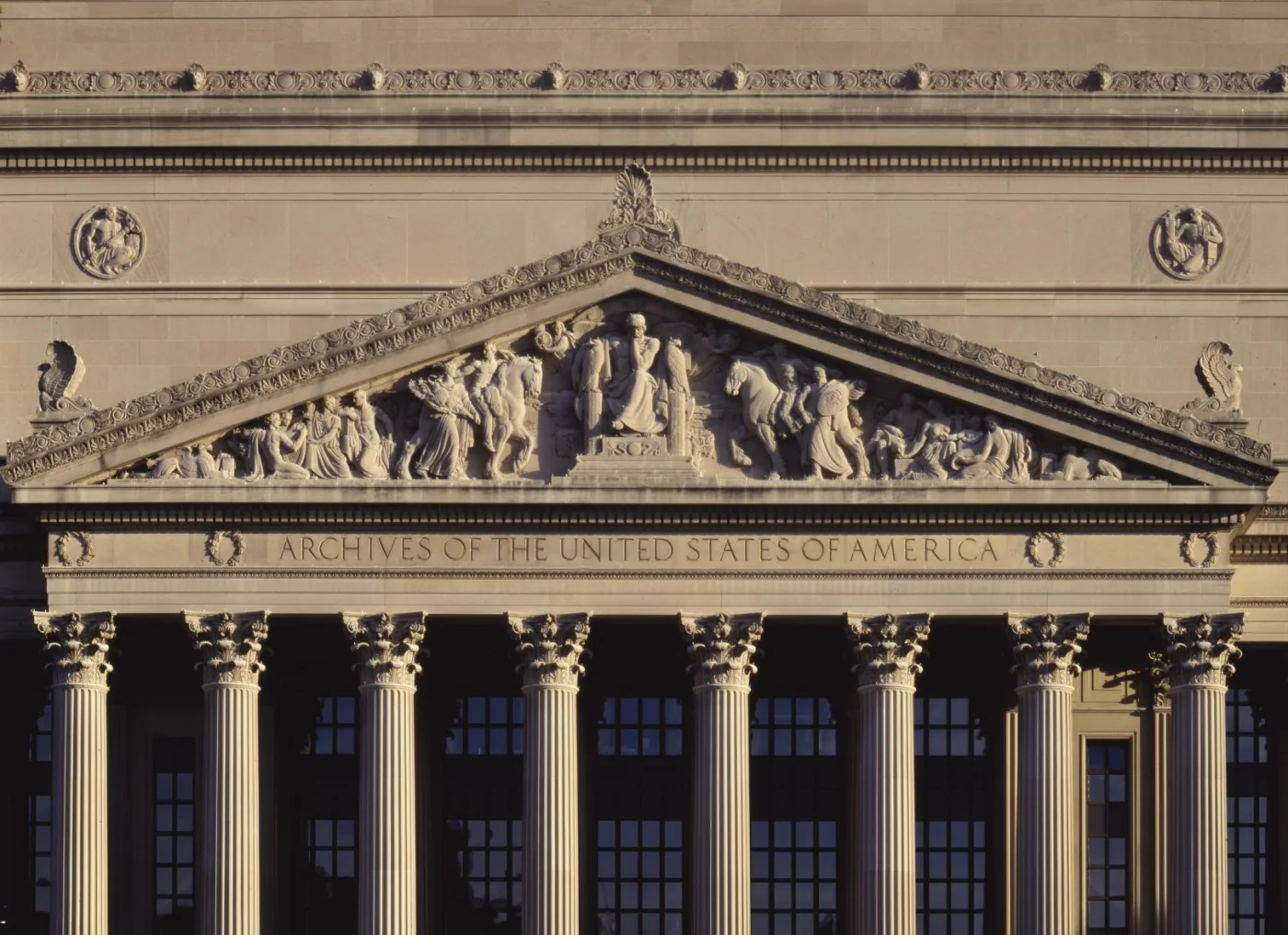
The building therefore performs two jobs before a visitor sees a document. It solves a storage and administration problem, and it elevates records into symbols. Those jobs can support each other, but they are not identical. Preservation needs controlled environments, skilled staff, budgets and repeatable procedures; a grand façade cannot do that work by itself.
09 · Washington, D.C.
9. In the Rotunda: read the Charters as arguments
The Declaration of Independence, Constitution and Bill of Rights moved into permanent display at the National Archives in 1952. Together they are called the Charters of Freedom. The Rotunda’s low light, guarded cases and formal procession encourage reverence.
Reverence should not stop reading.
The Declaration asserts equality while the new nation continued slavery and denied political rights across lines of race, sex, property and status. The original Constitution created a durable framework while incorporating compromises that protected slavery, including the three-fifths formula for apportionment and a fugitive-slave provision. The Bill of Rights emerged from demands that the new federal system state protections more explicitly, yet the reach and enforcement of rights have always depended on law, institutions and struggle.
To say this is not to dismiss the documents as hypocrisy or to accept them as fulfilled promises. It is to read them as political instruments with language powerful enough to be claimed by people whom the founding order excluded. Abolitionists, suffragists, civil-rights organisers, lawyers, legislators and citizens have argued both from and against these texts. Their authority has been constructed through use.
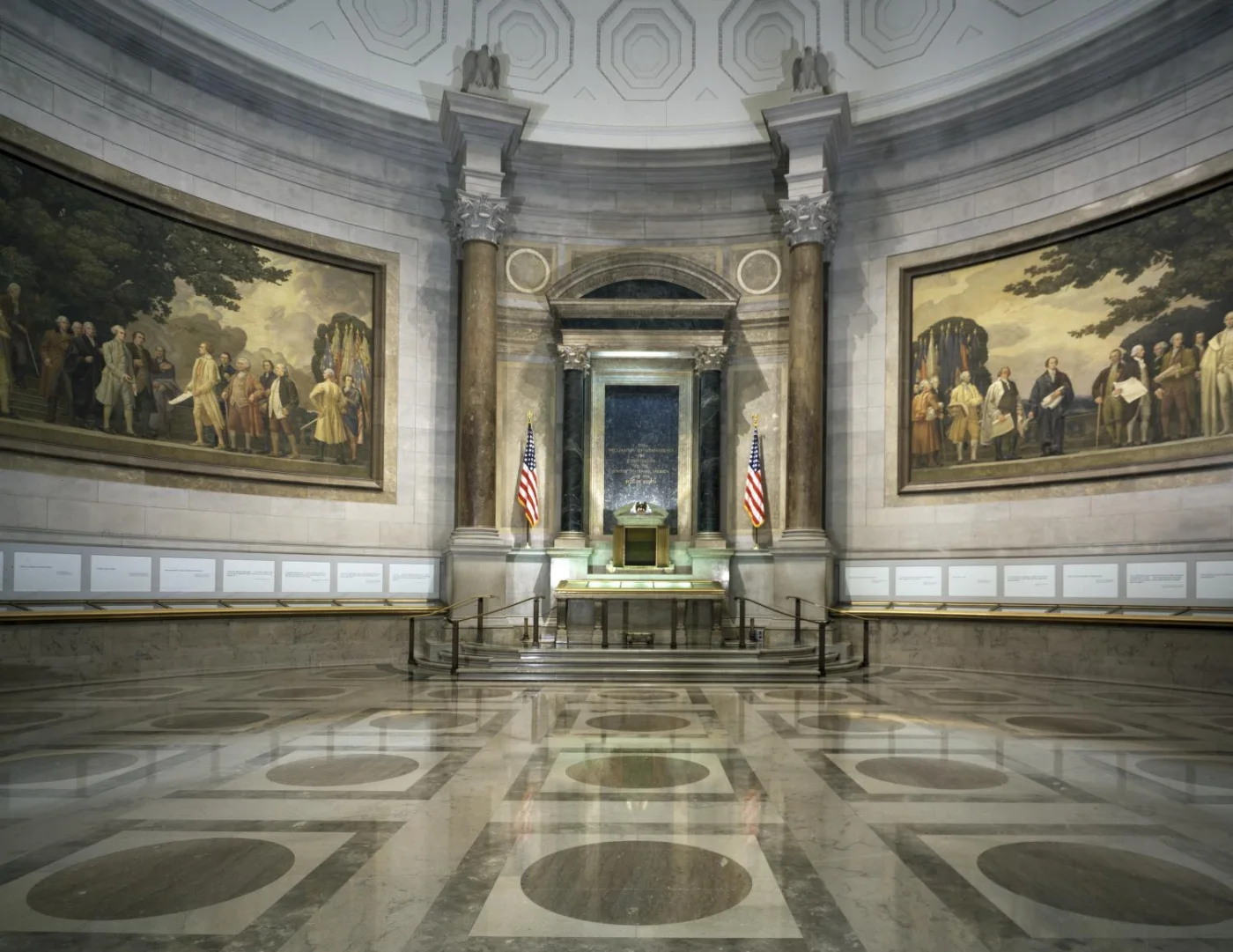
The display cases are part of the story. Earlier preservation methods gave way to encasements installed in the early 2000s. The documents rest in sealed, monitored environments filled with inert argon gas. The cases can be opened and resealed by specialists. Light, temperature, humidity, oxygen and material compatibility are conservation questions, not background technology.
That engineering changes the visitor encounter. The parchment is visible because an invisible system manages risk around it. What looks like permanent access is carefully limited exposure.
The documents have travelled through several regimes of care. Before the Archives existed, custody moved among government offices and display methods reflected the science available at the time. The 1952 installation used helium-filled cases. By the end of the twentieth century, specialists had evidence that components of the system needed replacement and designed the present encasements. Preservation here does not mean keeping an object untouched forever. It means observing conditions, revising methods when evidence changes and leaving a record of what was done.
10 · Washington, D.C.
10. The Archives is much larger than its shrine
The Rotunda can make the National Archives seem like a museum for three famous objects. Its core work is far broader: helping federal agencies manage records, appraising what has enduring value, taking legal custody of selected records, preserving them, describing them and providing access subject to law.
Not every federal record becomes permanent. Selection is unavoidable because government produces information at immense scale. Appraisal asks which records document rights, decisions, accountability and historically significant activity. Destruction schedules are part of records management, not necessarily evidence of concealment. The essential democratic question is whether rules are lawful, transparent and competently applied.
Digital records intensify the challenge. File formats become obsolete; storage media fail; databases depend on software and relationships; email attachments lose context; websites change; encrypted or proprietary systems can become unreadable. The National Archives maintains a preservation framework that tracks risks across more than 700 digital formats. The number matters less than what it represents: preservation is a continuing migration and documentation process, not a one-time act of saving.
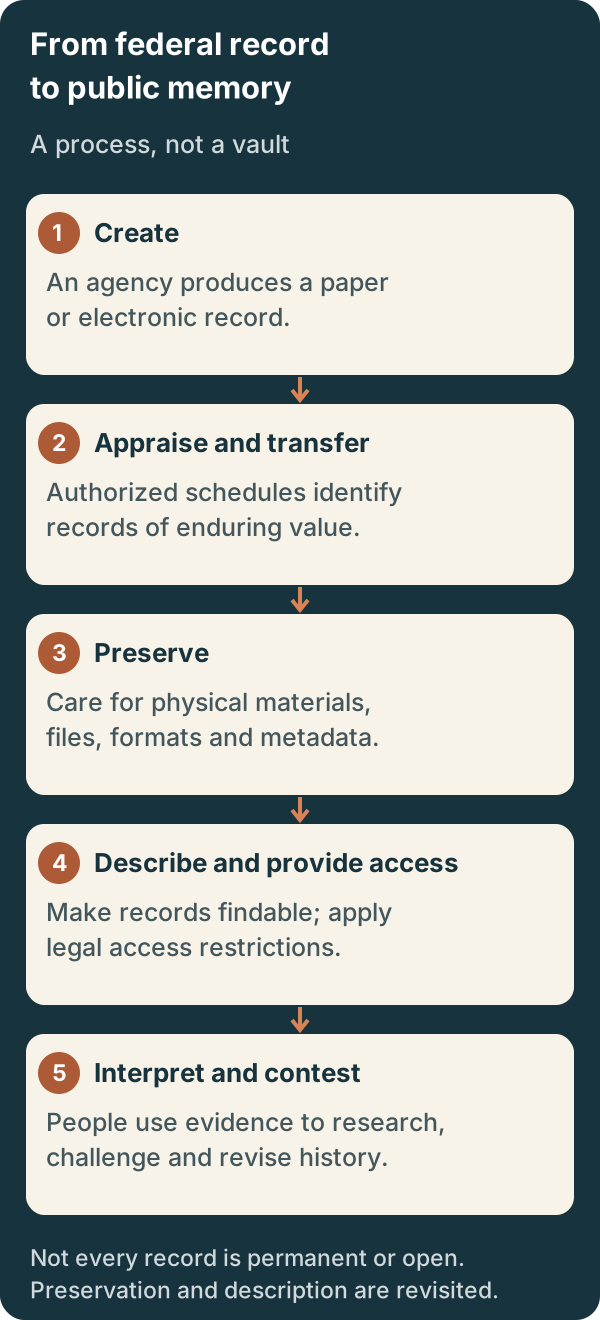
Paper poses its own problems—acid, mould, unstable inks, folds, light and handling—but it can often be inspected without recreating a lost technical environment. A digital file may remain physically present and logically inaccessible. Archivists therefore preserve information about the file as well as the file itself: format, provenance, relationships, rights and actions taken over time.
Access adds another layer. Some records are open; others remain restricted for privacy, national security, law-enforcement or statutory reasons. Declassification and disclosure can be slow and contested. The presence of a box in federal custody does not guarantee immediate public access, just as the absence of a record from an online catalogue does not prove it was destroyed. Researchers often need series descriptions, agency history, transfer information and staff guidance before a useful file emerges.
Archival silences are not evenly distributed. Powerful institutions tend to produce abundant official records. People subject to those institutions may appear only through a form, charge, census line or third-person report. Reading “against the grain” means asking what purpose created a record, whose categories it uses and which experiences it could not capture. That practice connects the Archives back to the Capitol’s payroll records and the Library’s classifications: documentary systems are evidence, and they are also instruments.
This is where the route’s three institutions become inseparable. Congress writes laws and oversees agencies. Agencies create records while implementing those laws. The Library collects publications and supports legislative research. The Archives preserves selected evidence of federal action. Researchers, journalists, courts and the public use that evidence to test official claims. National memory is not produced by one vault. It is an ecosystem of authority, documentation and challenge.
11 · Washington, D.C.
11. How to plan the three institutions now
A same-day route is possible, but it is not one booking. Each institution controls its own entry and security, and mutable details must be checked against the official pages on the day you plan.
Capitol
The Capitol Visitor Center currently describes interior visits as guided tours rather than self-guided wandering. Reservations are recommended, walk-up spaces may be available, and the tour is free. The usual historic rooms do not include the House and Senate galleries; gallery access follows separate rules. Routes can change when Congress or the building requires it.
Security is airport-like but governed by its own prohibited-items list. Oversized bags, food, drinks and many everyday objects are restricted. Do not rely on a general Washington packing list: check the Capitol’s current list before leaving your accommodation. The Visitor Center publishes accessibility services, including wheelchair availability and accommodation guidance.
Library of Congress
The Thomas Jefferson Building currently requires free timed-entry passes for general visitors. The Library releases advance and same-day inventory on its stated schedule, and visitor days and hours are not the same every day of the week. The popular Main Reading Room floor walkthrough occurs only in limited windows and should be treated as a bonus, not the fixed centre of a three-stop plan.
For photographs, distinguish a spontaneous personal snapshot from a staged session. Informal personal photography is allowed under the Library’s visitor rules; formal portraits, directed shoots and commercial photography need specific permission. An ordinary timed-entry ticket does not supply that permission. Follow posted limits and staff instructions. For access accommodations, contact the Library ahead of the visit so support can be arranged alongside the entry reservation.
National Archives
General admission to the National Archives Museum is free. Visitors can walk up, reserve a free general-admission ticket or use the optional timed-entry service; check the official ticket page for the current fee and available slots. A general ticket and a timed Rotunda reservation serve different purposes, so read the reservation you select. Waiting can take place outdoors. Allow at least ninety minutes for the exhibit galleries if the Charters are only part of your visit.
The Archives is west of the Capitol Hill pair. If energy, heat or mobility are concerns, use Metro, a taxi or rideshare for that transfer rather than turning the day into an endurance test. The Archives publishes an accessibility page and entrance guidance; confirm the current accessible route before travel.
A resilient order
For most first-time visitors, start with the hardest timed commitment, usually the Capitol or Library. Pair those neighbouring buildings, pause for food only after clearing their security-dependent blocks, then transfer west to the Archives. The exact order should follow the reservations you can actually obtain.
Do not promise yourself complete mastery of all three. The Capitol tour can run roughly an hour before security and orientation; the Library rewards at least an hour if an exhibition matters; the Archives recommends about ninety minutes. Add walking, screening, rest and the mile-plus transfer. A half-day guided route necessarily curates. An independent day can go deeper, but it benefits from fewer objectives. At the Capitol, the institution’s own guides control the historic-room tour; hiring a private guide does not let a party set its own pace inside every room.
12 · Washington, D.C.
12. Independent or private?
All three institutions can be visited without buying a private tour. The decision turns on structure, pacing and interpretation. A small-group walk can offer shared questions and a clear timetable, but stops and transfers must accommodate the whole group. Ask how much continuous walking and standing the route involves and whether there are planned rests. A smaller group does not, by itself, establish an accessible route or guarantee more time in a controlled interior. A private format allows more discussion around the institutional visits, while their own admission rules and tour schedules still apply.
Choose independently if you enjoy managing separate reservations, want to spend much longer with one collection, or prefer to divide the institutions across two days. This is the strongest option for researchers, architecture specialists and visitors who know exactly where they want to linger.
A private guide becomes useful when the central goal is connection. The value lies in interpretation and sequence: deciding when another inscription deepens the argument, when a popular legend needs correction and how one institution changes the meaning of the last. Treat any guided itinerary as interpretation around three separate institutions, not as a combined admission pass. Confirm with the provider exactly which reservations it arranges, where the route begins, how the transfer to the Archives works and what access support is available before committing.
The best guide does more than recite dates. They manage cognitive load, distinguish a documented fact from a popular legend, and help one building revise the meaning of the last. After the Archives, the Capitol’s paintings look more like selected records. After the Library, the Archives looks less like passive storage. After confronting D.C. representation, the word “representative” on Capitol Hill becomes less abstract.
13 · Washington, D.C.
What to carry out of the route
Washington’s civic monuments are designed to outlast the people moving through them. That scale can make institutions feel inevitable. Their histories show the opposite.
The Capitol grew through contested designs, fire, enslaved labour, industrial iron, national expansion and procedural crisis. The Library moved from a legislative book room to a vast collecting and research system whose classifications carry intellectual power. The Archives turned scattered government files and founding documents into a preservation programme, a public museum and an infrastructure for accountability.
None of the three simply “contains” power, knowledge or memory. People make rules, build catalogues, select records, preserve objects, replace statues, reinterpret paintings and request access. The monumental shells matter because they stage those choices for the public. The choices matter more because they decide what a future public will be able to see.
That is why the route works best as an argument rather than a checklist. Begin with the sea gods outside the Library. Notice the ancient visual language wrapped around modern bureaucracy. Cross between institutions. Ask who built, who selected, who was represented and what survived. Washington becomes more interesting as soon as its marble stops looking silent.
14 · Washington, D.C.
Listen to the field notes
The Travel Podcast follows the three-institution route and the choice between shared and private guiding. Listen for the changing scale of the day: the fountain and monumental streets, the Capitol’s historic rooms, the Library’s decorated spaces and the quiet encounter with the founding documents.
Continue through Washington after dark in the National Mall’s memorial landscape, explore the United States, follow the road from revolutionary alarm to public memory in Lexington and Concord, compare another civic landscape in New Orleans’s French Quarter, or follow how national memory changes across Pearl Harbor and historic Honolulu. For a national museum where a Civil War painting, conservation records and collection design become another public argument about memory, compare the Reina Sofía beyond Guernica.
Listen to the route
Three institutions in one Washington day
Follow the transition from chambers of law and ceremony to collections, reading rooms and the documents held in the Archives.
Plan your visit. Consult each institution’s official entry, security and access guidance for your travel date.