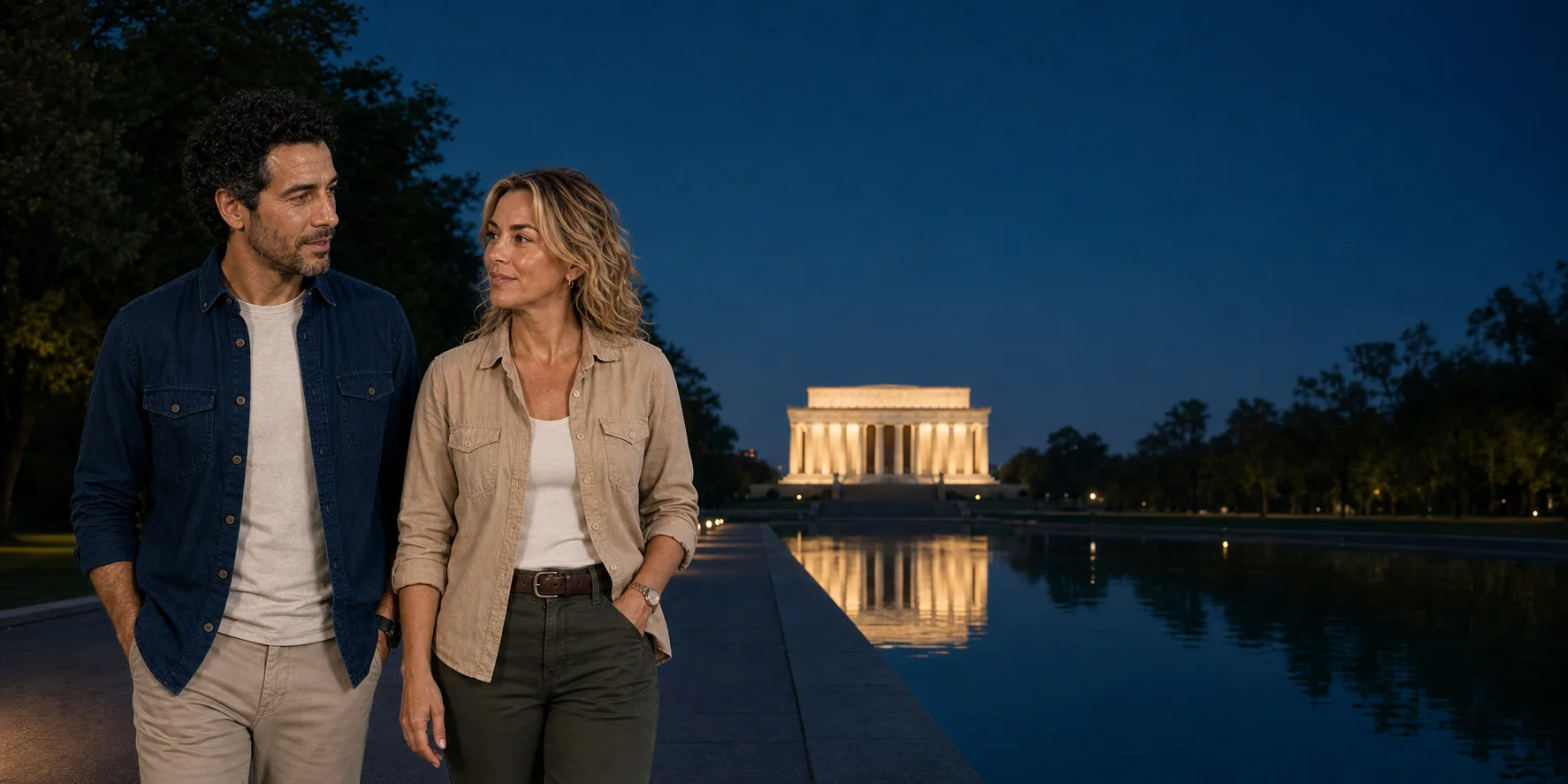
The bright objects are easy to name. The Lincoln Memorial forms a luminous room at the west end of the Reflecting Pool. The Washington Monument becomes an illuminated vertical mark. The World War II Memorial gathers light around water and pale stone. Jefferson’s rotunda appears across the Tidal Basin. But a night visit is not simply a daytime checklist with prettier exposures. Darkness changes the hierarchy of the city.
Light edits. It separates a column from the landscape, brings one inscription forward and leaves another unreadable, turns polished stone into a mirror, and makes a distant civic building feel adjacent even when roads and lawns intervene. It can support orientation and access. It can also produce glare, conceal kerbs, flatten material texture, disturb wildlife and encourage the false idea that a national memorial offers one settled meaning.
The useful question is therefore not whether Washington is “better” at night. It is what the lighting system asks you to notice, what the memorial’s design asks you to do, and what history remains outside the beam.
1 · Washington night field guide
1. Begin with a landscape, not a string of monuments
Washington’s monumental core works through long relationships. The Capitol and Lincoln Memorial hold the principal east–west Mall axis. The Washington Monument interrupts that line and supplies a visual pivot. The White House sits north of the monument, while the Jefferson Memorial occupies a separate southward relationship across the Tidal Basin. War memorials, civil-rights memorials, roads, playing fields, gardens and waterside paths arrived across different political eras. A moving vehicle may join them in three hours; it does not make them one historical project.
Pierre Charles L’Enfant’s 1791 plan combined a street grid with diagonal avenues, circles, squares and reserved sites intended to stage a federal capital. The Mall’s present form is not a literal survival of every L’Enfant line. The 1901–02 Senate Park Commission—usually called the McMillan Commission—reasserted a formal monumental axis, removed or displaced later uses, and helped set the framework for the Lincoln Memorial and Reflecting Pool. Twentieth- and twenty-first-century memorials then occupied this inherited ground, sometimes reinforcing its ceremonial logic and sometimes arguing with it.
The familiar claim that Washington was “built on a swamp” is too blunt. The early city included firm ground, creeks and low areas; tidal mudflats and marshy edges became more prominent as development altered drainage. Large areas along the Potomac were later reclaimed and shaped into parks. That history matters at the Tidal Basin, where water, settling ground, cherry trees, seawalls and paths are not decorative margins but maintained infrastructure.
The memorial core described here is on the District side of the Potomac. Virginia monuments and overlooks can be separate journeys, with their own river crossings and return plans. For an evening focused on the Mall, compact clusters provide a better starting point than treating every landmark in the metropolitan area as one walk.

2 · Washington night field guide
2. What a three-hour vehicle format can and cannot do
A three-hour vehicle circuit can connect the Capitol grounds, Lafayette Square, the western war memorials and part of the Tidal Basin without turning the evening into one continuous long walk. That convenience is real, but it does not produce three hours inside monuments. Driving, unloading, crossings, regrouping, toilets and photographs all consume the same clock.
A credible route therefore distinguishes three kinds of encounter. A drive-by supplies orientation; an exterior stop creates time to read the building in its setting; a memorial visit requires a path from the unloading point to the work itself. Ford’s Theatre, the National Archives, the Capitol and White House may appear as views rather than visits. Jefferson, Martin Luther King, Jr., Korean, World War II, Lincoln and Vietnam demand different walking distances and reading time even when a vehicle joins the clusters.
This changes how to judge any short night circuit. Count the places where everyone leaves the vehicle, not the number of landmarks in a title. Ask whether the route preserves a coherent historical sequence and whether the shortest stop still allows the least mobile traveller to reach the subject. A ten-minute White House viewpoint and half an hour at Lincoln are different kinds of encounter; neither should be disguised by a long landmark list.
A guide and vehicle can reduce the largest transfers, restore chronology and prepare a group before each stop: which surface to notice, where names begin, how long the walk takes and when facilities appear. They cannot eliminate kerbs, uneven ground, road crossings, weather, crowds or the distance between a legal unloading point and a memorial. The useful comparison is not transport versus walking in the abstract, but how each format allocates attention and friction.
3 · Washington night field guide
3. Light is an operating system
The National Capital Planning Commission’s 2019 draft lighting framework treats illumination as both identity and infrastructure. The most prominent federal symbols—the Capitol, White House, Washington Monument, Lincoln Memorial and Jefferson Memorial—form an upper tier intended to remain legible across the monumental core. Memorial surfaces, pedestrian routes, roads, trees and waterside edges require different levels and different kinds of control. The framework describes a hierarchy; it does not provide a measured brightness comparison for a particular evening.
More light is not automatically safer or more informative. A very bright façade can make the adjoining path appear darker while eyes adapt. An exposed fixture can create disabling glare. Flat frontal lighting may reveal mass but suppress carving. Light aimed upward can spill into the sky. A lamp that is difficult to reach or unique to one site becomes a maintenance problem; inconsistent colour and ownership across agencies make the landscape feel fragmented.
Commission of Fine Arts records show how specific these judgments become. In its 2004 review of Lincoln’s lighting, the commission asked for more even illumination above the entrance columns, less brightness on the statue and less direct light on the walls behind it. Those are three separate adjustments: the eye needs to read a room, rather than a white figure isolated by overpowering light. Jefferson relighting was praised for illuminating more of the memorial with substantially less energy. Later planning debates addressed cooler and warmer streetlight, dark landscapes, LED maintenance and the fact that several agencies own adjacent fixtures.
Conservation belongs inside this argument. Lamps, housings, conduits and attachment points can affect historic fabric. Heat, ultraviolet exposure and maintenance access matter. So do insects, birds, bats and the broader night environment. The NPS night-sky program treats shielding, direction, intensity, colour and timing as management questions, not merely aesthetic preferences. The goal is not to make a capital dark; it is to illuminate deliberately.

4 · Washington night field guide
4. Washington Monument: a city-sized measuring stick
The Washington Monument’s simple geometry disguises a complicated construction history. Work began in 1848 under the Washington National Monument Society and stalled in 1854 after money, politics and control faltered. Federal funding in 1876 restarted the project, but the shaft itself did not begin rising again until 1880, after engineer Thomas Lincoln Casey strengthened the foundations. New quarry supplies produced a different stone colour. The monument was completed in 1884 and dedicated in 1885; it opened to the public with a passenger elevator in 1888. The luminous outline compresses decades of fundraising, interruption and engineering into one apparently simple object.
At night, exterior illumination lets the obelisk function as an orientation device from several parts of the core. The visible colour change in the marble is still a record of interrupted construction; it should not be treated as a lighting error. The object gathers attention from a distance, but the Washington Monument interior is the important exception to the general statement that Mall memorials are outdoors and open around the clock. Timed entry, security screening, elevator operation and weather can affect access. A night-tour sighting is not an interior visit.
The obelisk also exposes the difference between line of sight and walkable line. It may appear close from the White House, World War II Memorial or Tidal Basin, yet lawns, roads, fences and the monument grounds mediate the approach. A guide who names the building is offering orientation; a guide who explains why its stone changes, why construction stopped and how its verticality organizes later memorials is offering interpretation.
5 · Washington night field guide
5. White House and Lafayette Square: an exterior is still political space
Most night routes offer exterior views of the White House, not admission, commonly from Lafayette Square to the north. That distinction prevents a common category error: a short stop at a security perimeter is not a White House tour, and a guide cannot guarantee a particular fence line, illumination state or unobstructed photograph.
Lafayette Square is not merely a camera position. Its ground has held a racecourse, a graveyard, military encampments, public buildings, private residences, a market where enslaved people were sold, and a long history of assembly and protest. The park’s statues place European figures of the American Revolution around Andrew Jackson. In the twentieth century, preservation arguments helped save the surrounding townhouses from wholesale clearance. In the present, security design and demonstrations continually renegotiate public proximity to executive power.
Night lighting can make the White House seem visually detached from those histories: a symmetrical white object beyond a dark foreground. A better stop reads the foreground first. Where may the public stand? Which barrier is temporary? What does a demonstration change? Who owns the pavement, park and roadway? Public protest is not an interruption of a neutral view; it is one of the ways this landscape has been used.
The Capitol may appear elsewhere on a route as a grounds stop or exterior viewpoint. Its dome closes the Mall axis, but this feature does not repeat the building’s interior, the Library of Congress or the National Archives. For those institutions, use ExcursionPass’s separate guide to the Capitol, Library and Archives. Here, their night role is geographical: they establish the civic frame within which the later memorials claim national attention.
6 · Washington night field guide
6. A chronology of monuments is a chronology of arguments
The Mall does not tell history in order. A nineteenth-century obelisk, a 1922 temple, a 1943 rotunda, a 1982 wall, a 1995 landscape, a 2004 plaza and a 2011 civil-rights memorial appear within a few kilometres. Artificial light makes them present at once. Interpretation must put time back in.
That chronology also prevents “the war memorials” from becoming one category. The Lincoln Memorial addresses the Civil War and Union through a president, inscriptions and classical architecture, then acquired new meaning through civil-rights assembly. Vietnam centers individual names and a descent into the earth, later joined by figurative statues. Korean places patrol figures in a landscape, faces in stone and, since 2022, a wall of names. World War II stages collective victory and sacrifice in a central plaza. Martin Luther King, Jr. uses a figure, a carved mountain metaphor and selected words to memorialize a movement leader in dialogue with Jefferson and Lincoln.

7 · Washington night field guide
7. World War II Memorial: victory occupies the center
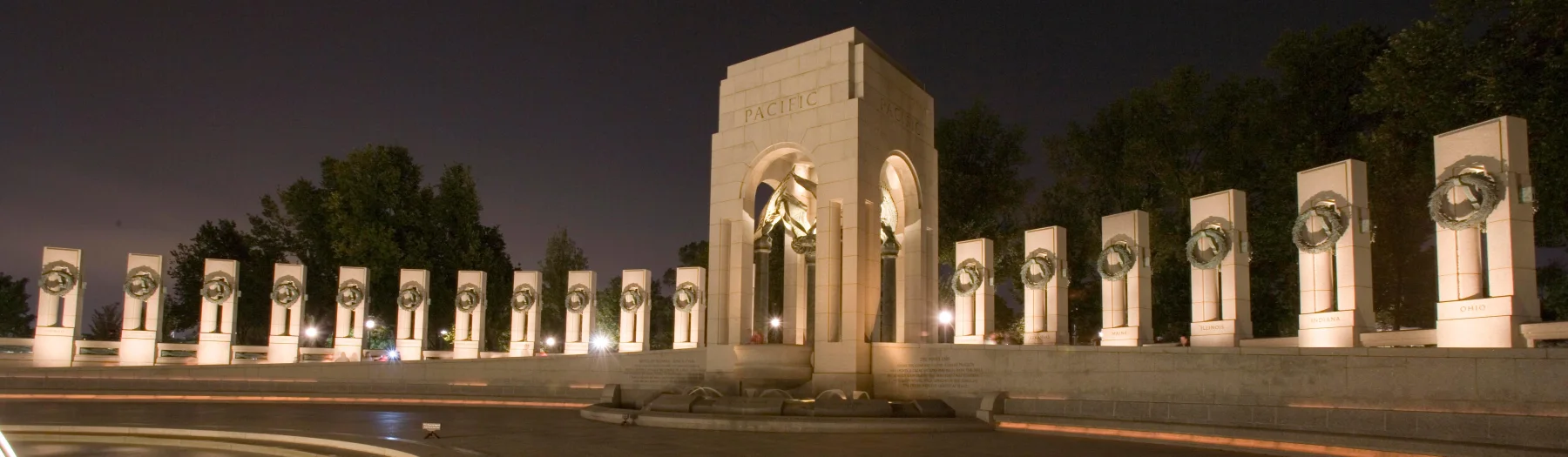
The World War II Memorial opened in 2004 on the former Rainbow Pool site between the Washington Monument and Lincoln Memorial. Architect Friedrich St. Florian organized a sunken oval plaza around a rebuilt pool. Two triumphal arches name the Atlantic and Pacific; 56 pillars represent the states, territories and District of Columbia at the time; bronze work by Ray Kaskey and inscriptions develop military, industrial and home-front themes. The Freedom Wall’s field of gold stars stands for American military deaths, with each star representing 100.
Its central placement was controversial. Critics argued that a large, formal memorial would interrupt the open visual relationship between Washington and Lincoln and impose a triumphal object on a civic landscape. Supporters argued that the generation and national mobilization deserved a prominent place. The built design partly answers the sight-line concern by lowering the plaza, but it does not dissolve the political question of what occupies the center.
The official interpretation also acknowledges omissions and compressions. “The Greatest Generation” can hide unequal service and unequal citizenship. The armed forces were segregated. Japanese Americans served while family members were incarcerated by the government. Women entered military and industrial roles under constrained recognition. Colonial territories, Allied nations, civilians and the Holocaust cannot be represented adequately by one American victory plaza.
At night, water, arches, wreaths and pale stone become the dominant visual frame. The effect can feel ceremonial without proving that the site is quiet or emotionally uniform. Read the bas-reliefs closely enough to ask who appears, then read the gold stars without converting them into a decorative background. A fountain can produce atmosphere and still be part of an argument about national scale.
8 · Washington night field guide
8. Lincoln Memorial: temple, room and public stage
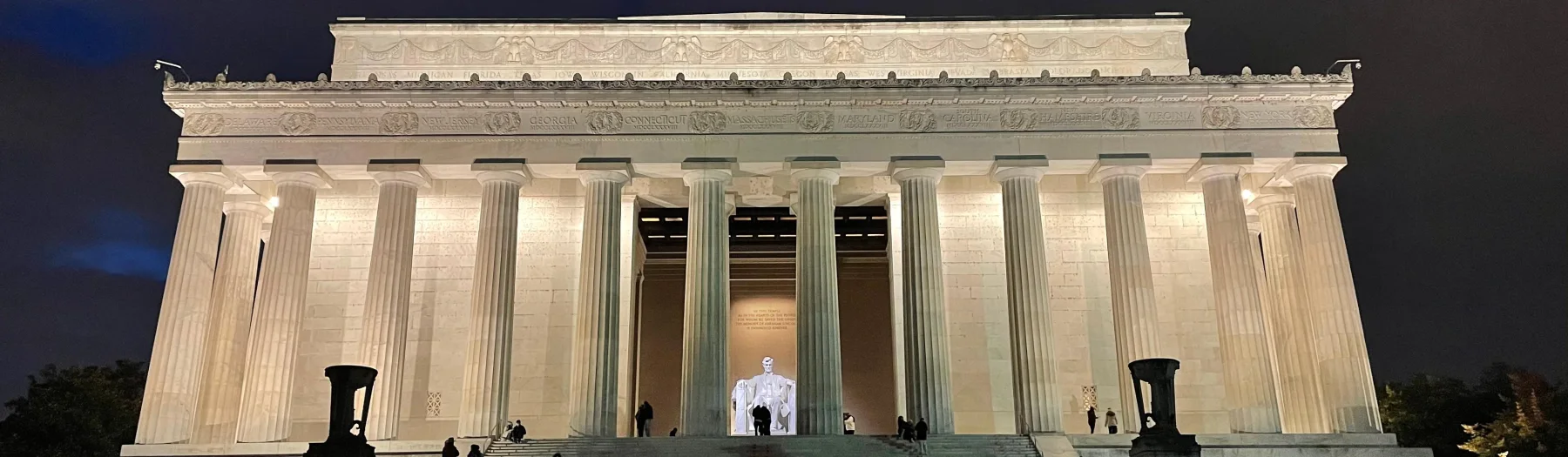
Henry Bacon designed the Lincoln Memorial as a Greek Doric temple. Daniel Chester French created the seated Lincoln, carved by the Piccirilli brothers. Jules Guerin painted the murals above the Gettysburg Address and Second Inaugural inscriptions. Materials came from several states, reinforcing a program of reunited nationhood. The 36 exterior columns represented the states at Lincoln’s death; state names and dates on the building extend that national roll.
The architecture is not a neutral container. The immense seated figure, inscriptions and temple form elevate a president into a civic symbol. The 1922 dedication exposed the limits of the unity being staged: the audience was segregated. In 1939, after the Daughters of the American Revolution denied Marian Anderson Constitution Hall, she sang from the Lincoln Memorial steps. In 1963 the March on Washington culminated there with Martin Luther King, Jr.’s “I Have a Dream” address. A monument conceived around emancipation and reunion became a platform from which Black Americans demanded rights the nation had not delivered.
Night light usually draws the eye inward to French’s figure while the columns form a bright outer frame. This can make the chamber feel separate from the steps and Reflecting Pool. But the civil-rights history is spatial: speakers faced east, crowds occupied the axis, and the memorial’s authority was repurposed by public assembly. A guide should not end at the statue.
Below the classical enclosure, the undercroft reveals the concrete support structure and interprets the memorial’s construction and civil-rights history. It changes the way to read the building: the white temple depends on a much less ceremonial structural space beneath it. This is a separate, timed-entry exhibition with screening and its own operating hours; an evening view of the chamber does not include admission below. Reserve through the official NPS planning page when that deeper encounter matters to the visit.
The outdoor memorial is generally accessible around the clock, while ranger services, exhibitions, restrooms and lifts have their own operating arrangements. The Lincoln accessibility page distinguishes the chamber elevator, south-side street restrooms and additional facilities inside the ticketed undercroft. A tactile model with audio description at the south-side plaza and captioned interpretation below also broaden how the memorial can be experienced. Plan the approach, the particular space you want to enter and the return as one route; an elevator symbol cannot describe all three.
9 · Washington night field guide
9. Vietnam Veterans Memorial: names before narrative
Maya Lin won the national design competition as a 21-year-old architecture student. Her two polished black-granite walls meet at a low point and extend toward the Washington and Lincoln memorials. The visitor descends as the wall rises, then ascends again. Names are ordered by date of casualty, not alphabetically, so an individual is placed inside the chronology of the war. A directory is required to locate a name.
The design produced intense controversy. Critics objected to abstraction, black stone, descent and the absence of a conventional heroic figure. Race, gender, age and Lin’s Chinese American identity entered the attacks. The compromise added Frederick Hart’s Three Servicemen statue and a flagpole nearby; Glenna Goodacre’s Vietnam Women’s Memorial followed. Those additions did not replace the wall. They made the site a visible record of disagreement about how the nation could represent a divisive war.
Polished granite creates a literal overlap between a visitor’s reflection and inscribed names. That optical effect is documented and observable; it should not be turned into a prescribed emotion. Some visitors come to mourn a specific person, make a rubbing or leave an object. Others encounter a war they know only through family memory, politics or media. The order of names resists a simple victory story without announcing a single verdict on the war.
Night introduces practical limits. Low contrast, reflections and adjacent bright sources can make names harder to read. A phone flashlight aimed across the surface can disturb other visitors and produce glare. Use a directory, shield the light, keep flash away from people, and give anyone tracing a name room. Objects left at the wall enter a managed collection; they are not litter or props.
10 · Washington night field guide
10. Korean War Veterans Memorial: patrol, image wall and later names
The Korean War Veterans Memorial sets sculptor Frank Gaylord’s 19 stainless-steel figures in a triangular field. They represent an ethnically diverse patrol drawn from several service branches, wearing ponchos that give the group a weathered, forward-moving character. A polished granite mural wall carries sandblasted photographic faces. Reflected figures can visually suggest a larger formation, while the Pool of Remembrance and inscriptions establish a ceremonial terminus.
Representation here is distributed among sculpture, landscape, reflected image, words and water. That complexity can be reduced at night if illumination turns the figures into a dramatic spectacle detached from the war’s history. The Korean War involved Korean civilians and armed forces, United Nations forces, Chinese intervention, division, displacement and an armistice rather than a peace treaty. An American memorial cannot carry all those histories, but a guide can name the limits of its national frame.
The site was rehabilitated in 2021–22. The project added the Wall of Remembrance with names of U.S. service members and Korean Augmentation to the United States Army personnel who died in the war, repaired landscape and memorial elements, and updated lighting with LEDs. The addition changes the site’s grammar: a memorial originally organized around anonymous representative figures and photographic faces now also asks visitors to read individual names.
That evolution matters to the wider Mall. Memorials are not frozen at dedication. New constituencies, scholarship, deterioration, technology and political pressure can produce additions. “Original design” and “current memorial” may be different objects.
11 · Washington night field guide
11. Four memorials, four ways of asking you to move
A night route becomes more intelligible when architecture is treated as choreography. World War II brings visitors down into a central plaza and distributes attention around a fountain. Lincoln asks for an ascent to a frontal chamber, followed by a turn back toward the axis. Vietnam descends along names and rises out again. Korean disperses life-size figures through a field before gathering attention at wall, pool and inscriptions.
Those movements affect access and interpretation. Steps concentrate spectacle but demand an alternative route. A polished wall rewards close reading but becomes sensitive to glare. A field of figures encourages oblique views but cannot be entered. A fountain creates sound and reflected light but can complicate communication. “Seeing the memorial” is therefore not one threshold; it is a sequence of approach, surface, reading position and return.

12 · Washington night field guide
12. Martin Luther King, Jr. Memorial: a civil-rights figure in the presidential frame
The Martin Luther King, Jr. Memorial opened in 2011 on the Tidal Basin. ROMA Design Group developed the design, with sculptor Lei Yixin creating the Stone of Hope. Visitors pass through a cleft Mountain of Despair toward King’s figure emerging from a separate mass, a spatial metaphor adapted from the “I Have a Dream” speech. Inscription walls use selections from King’s speeches and writings.
The figure’s scale, pose, sculptural authorship and inscription choices produced debate. One paraphrased quotation on the Stone of Hope made King appear to call himself a “drum major for justice.” Critics, including Maya Angelou, argued that the compression distorted his meaning. The inscription was removed in 2013. That episode is more instructive than a list of inspirational phrases: editing is representation, and permanent stone does not prevent revision.
The memorial’s position creates a deliberate triangle with Lincoln and Jefferson. King spoke from Lincoln’s steps and demanded that the nation honor democratic promises often associated with Jeffersonian language, while Jefferson enslaved people and profited from their labor. The night view can turn the three sites into a harmonious composition. Historical interpretation must keep the contradiction visible.
Light also changes the Stone of Hope’s sculptural effect. Shadow can deepen the separation between figure and rock, while direct lighting can flatten the carved surface. That is a description of form, not proof that night produces a stronger emotion. Visitors bring different relationships to King, the movement and the memorial’s official selections.
13 · Washington night field guide
13. Jefferson Memorial and the Tidal Basin: beauty rests on infrastructure and conflict
John Russell Pope designed the Jefferson Memorial as a circular classical rotunda; after his death in 1937, Otto Eggers and Daniel Higgins completed the design. Construction began in November 1938, the cornerstone ceremony followed in 1939 and dedication took place in 1943. Keeping those stages separate matters: a ceremonial date is not always the beginning of work. Its Tidal Basin site required foundations in made ground, with additional pilings needed when caissons proved difficult to drive through deteriorated rock. The project also threatened cherry trees. Women marched with a petition and chained themselves to a tree at the construction site in November 1938, an episode remembered as the “Cherry Tree Rebellion.” A presidential monument was already a landscape dispute before it opened.
Inside, a bronze Jefferson by Rudulph Evans is surrounded by selected words. The architecture and inscriptions place Jefferson inside a narrative of liberty and religious freedom. A complete account also names slavery, Indigenous dispossession and the gap between political language and life at Monticello. Memorial text is curated evidence of commemoration, not a full biography or historical consensus.
Across water, illumination and reflection make the rotunda especially legible at night. The Tidal Basin is not a perfect mirror guaranteed on demand: wind, water level, algae, maintenance, weather and crowds change the view. Nor is the path an ornamental loop without constraints. The rebuilt seawall uses deeper foundations, a wider accessible walkway and a more resilient edge after decades of sinking ground and tidal flooding. Infrastructure, not scenery alone, makes this celebrated view possible.
The relationship to water also explains why this stop can consume more time than its map position suggests. Drop-off, path access, crossings, surface conditions, photographs and the move into and out of the rotunda all count. A 25-minute stop can offer an architectural overview or a close reading of inscriptions, rarely both at leisure.
14 · Washington night field guide
14. Darkness does not guarantee silence, solitude or cool weather
The Mall is public space in a working capital. Night can include school groups, runners, demonstrations, maintenance crews, sirens, aircraft, traffic, ceremonies and other tours. Crowd levels vary with season, weekends, events and weather. A patriotic ceremony, a protest and private mourning may occupy adjacent ground. None has automatic ownership of the whole landscape.
Washington nights can remain hot and humid. Thunderstorms can arrive quickly. Open lawns and waterside paths expose visitors to rain, lightning and insects. Pale stone can retain heat; an air-conditioned vehicle can feel cold after humidity. Carry water and a light layer or rain protection suited to the forecast. Weather is a same-day decision, not an evergreen promise.
Personal safety deserves practical preparation without fearmongering. Use marked crossings, stay aware of turning vehicles and bicycles, keep children close near roads and water, and agree on a regrouping point. Avoid staring at a map while standing in a cycle lane or roadway. Keep a charged phone and share the return plan. NPS safety guidance directs emergencies to 911 or the United States Park Police emergency number, 202-610-7500.
Photography etiquette is part of access. Tripods can obstruct narrow reading positions. Bright screens and flashes affect dark adaptation. Do not arrange people against a name wall where someone is mourning, climb barriers, touch sculpture, or make a veteran or demonstrator into unsolicited foreground. Reflections are optical conditions, not permission to photograph every person within them.
15 · Washington night field guide
15. Accessibility is one continuous chain
An accessible memorial does not make an accessible multi-stop evening. The chain begins with the first pavement or transit platform: curb cut, sidewalk grade, traffic, seating and weather cover. If a vehicle is involved, it continues through boarding, door and step geometry, restraint or securement, mobility-device storage, companion placement and communication with the guide. At every stop it includes the distance to the memorial, surface, slope, crossing time, lighting, crowding, benches, toilets and the return leg.
The major outdoor memorials have wheelchair routes, but site-specific details and outages differ. At Lincoln, the chamber elevator and the separate timed-entry undercroft must be planned individually; confirm the particular route and lift status before travelling. Vietnam’s descending route and Korean’s paths require surface and grade attention. Tidal Basin conditions can change after construction or weather. The White House view depends on an active security perimeter. A stroller policy, if one exists, would not prove wheelchair access.
Restrooms are distributed rather than continuous. NPS lists facilities near Lincoln, Jefferson, Martin Luther King, Jr., Franklin Delano Roosevelt, World War II, Constitution Gardens and Washington Monument Lodge, but evening operating status and temporary closure matter. “Bathroom stop” should be a named facility at a named point in the sequence. Water fountains may be seasonal or out of service; carry water you can independently reach.
Sensory access also matters. A guide who speaks while the group spreads across a noisy plaza may be inaudible. Bright façades next to dark paths can produce visual stress. Crowds, sirens and repeated boarding can exhaust travellers. Braille, tactile and audio interpretation varies by site. Ask whether the guide has a microphone or assistive listening option, whether written stop summaries are available, and whether a traveller may remain in the vehicle without losing contact or being left in unsafe heat.
Families need an equally exact chain. Vehicle restraint and seating rules, when relevant, belong in the plan rather than in an assumption. A three-hour evening can overlap meals, medication and bedtime. Stop clocks are unforgiving when a child needs a toilet after the group has reloaded. A shorter self-guided loop may be more generous than a small vehicle, even if it covers fewer icons.
Before choosing a format, map five links: the first boarding point; any vehicle or station access; the longest step-free distance at a stop; the facilities along the route; and the alternative if a lift, curb or security perimeter changes the plan. A private accessible vehicle, a shorter loop or a visit during ranger hours may offer a stronger chain than a broader itinerary.
16 · Washington night field guide
16. Build a realistic self-guided night instead of chasing every icon
A practical self-guided evening begins with the memorials that deserve the most time, then works back to the approach and return. Break the landscape into clusters rather than trying to collect every illuminated icon.
The western memorial cluster can join World War II, Lincoln, Vietnam and Korean. It still requires substantial walking, road awareness and time inside each site. Add Martin Luther King, Jr. only if the group’s energy and return plan support the Tidal Basin transfer. Jefferson is better treated as its own southern commitment than as a casual final photograph.
The northern civic cluster can pair Lafayette Square and the White House exterior with a distant Washington Monument orientation. It is not a substitute for the war memorials. Security conditions may change the approach, and the Smithsonian or Federal Triangle streets between zones are not empty pedestrian corridors.
Metro plus short loops reduces some transfers but does not deliver travellers to each memorial door. Smithsonian station serves the central Mall, while Foggy Bottom is about 0.8 miles from Lincoln by the route NPS describes; Smithsonian is roughly 1.2 miles from Lincoln. Station lifts, last-train timing and the walking gap must be included. Use NPS’s approach directions with the current WMATA journey planner to include the station-to-memorial walk and the last return connection.
A bicycle can connect distant zones efficiently where riding is legal and safe. Lights are essential at night, and some memorial interiors or crowded paths require dismounting. Secure parking and the return ride belong in the plan. Use a white front light and a red rear light, and check DDOT’s bicycle rules and the permitted route before setting out. Do not rely on a reflector alone to make yourself visible beside traffic.
A split visit is often the deepest choice. Use daylight or ranger hours for inscriptions, museums, lifts and material detail. Return to one or two sites after dark to compare the lighting hierarchy. Repetition is not inefficiency when the subject is how a place changes.

17 · Washington night field guide
17. What a guide can add—and what a guide must not invent
A good guide curates time. The value is not simply transport between illuminated objects. It is the ability to restore chronology, explain why a stop is positioned where it is, distinguish design intent from later use, and know when not to fill a memorial with speech. In a compressed route, the guide can prepare a group before unloading: which surface to look for, where names begin, how long the walk takes, and when the toilet opportunity occurs.
That role carries boundaries. A guide should distinguish documented history from folklore, leave room for different reactions and explain any change to the walking route. A quiet atmosphere and an unobstructed viewpoint are conditions, rather than guaranteed features of a public landscape. “People say” is not a source. A dramatic claim about a hidden symbol needs design or archival evidence.
Night can encourage myth because details are hard to inspect. Lincoln’s hands do not secretly form authoritative initials; Confederate faces are not intentionally carved into the back of his head; architectural coincidences do not become design documents because a guide repeats them. The Park Service’s account of these myths points instead to French’s use of casts of Lincoln’s hands and to the deliberately different hand positions. The sculpture already contains an argument about strength and repose without a secret code.
The strongest narration also admits when the route offers only a view. Driving past the National Archives after closing may orient the building; it cannot show the Charters of Freedom. Seeing the Capitol dome is not a chamber tour. A White House fence stop is not access to the executive residence. The line between encounter and reference protects both the visitor and the place.
18 · Washington night field guide
18. A same-day checklist for a changing city
Check these points on the day, in this order:
- NPS alerts and site-specific pages. Look for construction, lift or restroom outages, temporary barriers, lighting work and event closures. Outdoor sites are generally available around the clock, but services and interior spaces are not.
- District roads and demonstrations. A security event can change vehicle loading and pedestrian approaches without closing the memorial itself. Keep an alternative crossing or cluster ready.
- Weather. Review heat, humidity, thunderstorms, rain and lightning through the National Weather Service. Carry water and do not use a three-hour listing as evidence of safe conditions.
- Start and end points. Pin both on the map, including the correct side of a large building or station and a safe return route.
- Access chain. Review boarding, lifts, surfaces, crossings, benches and the longest step-free link. A site-level access symbol does not describe the whole evening.
- Stop types. Distinguish drive-bys, exterior viewpoints and places you will enter on foot. Protect time for the subjects that matter most.
- Facilities and return. Name toilet opportunities, water access and the plan if the route changes. Preserve enough phone power to navigate independently.
Parking is not a simple fallback. NPS describes limited metered and accessible parking across the broader park area, while demand, time limits, works, special events and road rules can remove the apparent advantage. If driving, identify the legal space and return route before the first stop.
19 · Washington night field guide
19. Choose the format by friction, not landmark count
Choose a small-group vehicle when the group wants a broad first orientation, values live interpretation, accepts repeated boarding and is comfortable with short stop clocks. The format is especially useful when the largest distances would otherwise consume the evening. It is less suitable when one person needs a slow close reading, long-exposure photography, a predictable toilet schedule or freedom to leave early.
A long walk offers the most control and the closest contact with the landscape, but it spends energy on transfers. Metro plus short loops reduces some distance while preserving flexibility. A bicycle joins clusters efficiently for confident night riders. A split day-and-night visit gives the strongest comparison between material detail and illumination. None is universally superior; each moves friction to a different part of the evening.
The best choice protects the needs of the least mobile traveller and gives the most important memorial enough time to work as more than a photograph. A drive-by can be useful orientation. It should be named honestly.
20 · Washington night field guide
20. Listen: a different pace after sunset
The conversation follows the practical questions behind an evening circuit: the walking between landmarks, the energy left after a day in the city, the need for water and toilets, and the value of a guide who helps several generations share one pace. Those questions are useful whether the final choice is a vehicle, a short loop or two separate visits.
Listen to Washington DC Small-Group Night Tour, then plan around the memorials you most want to understand. An evening can be worthwhile with fewer stops when it preserves time to read a name, look back down the axis and get home comfortably.
21 · Washington night field guide
The final reading
Washington after dark is not a city made pure by white stone. It is a maintained landscape in which light allocates attention. The illuminated icons depend on dark foregrounds, working fixtures, repaired seawalls, accessible routes, road rules, public budgets and human judgment. Their meanings depend on designers and officials, but also on veterans, families, civil-rights organizers, critics, protesters and visitors who have challenged what the monuments say.
Move through the Mall slowly enough to notice the edit. Ask why one building can be read from a kilometre away while one name requires you to bend close. Ask why a victory plaza sits at the center, why a wall descends, why figures patrol a field, why King faces a landscape shaped by Jefferson and Lincoln, and why an executive residence is viewed through a public square with a history of protest.
Then plan the return. Daylight restores inscriptions, materials, services and context that darkness suppresses. Night reveals the hierarchy that illumination constructs. Neither view is complete. The value lies in the comparison.
Reporting note. Official links throughout the story remain closest to current access, safety and service conditions. The article’s history, design and route analysis is complete here.