Rome does not become legible when you collect more landmarks. It becomes legible when the ground between them starts to matter: a circus in a valley, an ancient rotunda hidden behind a conventional portico, a stadium surviving as the shape of a piazza, and aqueduct water turned into Baroque theatre. A small electric vehicle can expose those relationships quickly—but only if the route is honest about what must still be walked, entered and understood slowly.
01 · Rome street-scale field guide
The city is the subject, not the vehicle
The promise of a Rome overview sounds simple: connect famous places while saving the traveller from a punishing day on foot. The Colosseum, Circus Maximus, Pantheon and Trevi Fountain are good places to test it. Between them, the ground changes from an imperial valley to dense streets and public squares. Understanding that change can be more useful than accumulating another photograph of a familiar façade.
An electric tuk-tuk overview offers one way to connect those places, subject to lawful road access and the route agreed for the departure. The important question is what a compact moving overview can teach that a taxi transfer, bus ride or line of map pins cannot.
The answer is scale. A small, relatively open vehicle keeps the street in the frame. It can reveal how the Colosseum occupies the low ground beside the Forum and Palatine; how Circus Maximus is held between the Palatine and Aventine; how the dense centre suddenly releases into a piazza; how a classical temple front can conceal a round interior; and how water arriving through a repaired ancient aqueduct became an instrument of early-modern urban power. The route is valuable when it makes those transitions visible.
It is weak when motion replaces attention. A driver cannot stop wherever a photograph would be convenient. A kerb is not automatically a legal or safe drop-off point. A view of the Pantheon portico does not reveal the dome. Passing Trevi does not guarantee access to the fountain's lower basin. Electric propulsion does not create a blanket right to enter restricted streets. A canopy does not turn an open vehicle into climate control. The honest version of this tour is therefore not “Rome without walking.” It is a first map of Rome that can reduce some continuous walking while identifying where walking and entry still matter.
02 · Rome street-scale field guide
First lesson: Rome is made of occupied valleys
Rome's famous seven hills are often presented as a memory test. Their more useful function is to explain the spaces between them. Valleys carried water, roads, markets, political assemblies and spectacle. Hills offered defensible ground, breezes, residences and commanding views. Ancient engineers altered both with drains, embankments, foundations, aqueducts and enormous substructures, but they never made the terrain irrelevant.
The Colosseum sits in a valley transformed by imperial politics. Part of Nero's palace landscape and artificial lake had occupied the area after the fire of 64 CE. The Flavian dynasty later placed its amphitheatre there, beginning under Vespasian and opening under Titus in 80. It was not simply a large entertainment building. It was a claim that a space associated with a condemned emperor had been returned to public use—while the new dynasty displayed the wealth and organisation of empire.
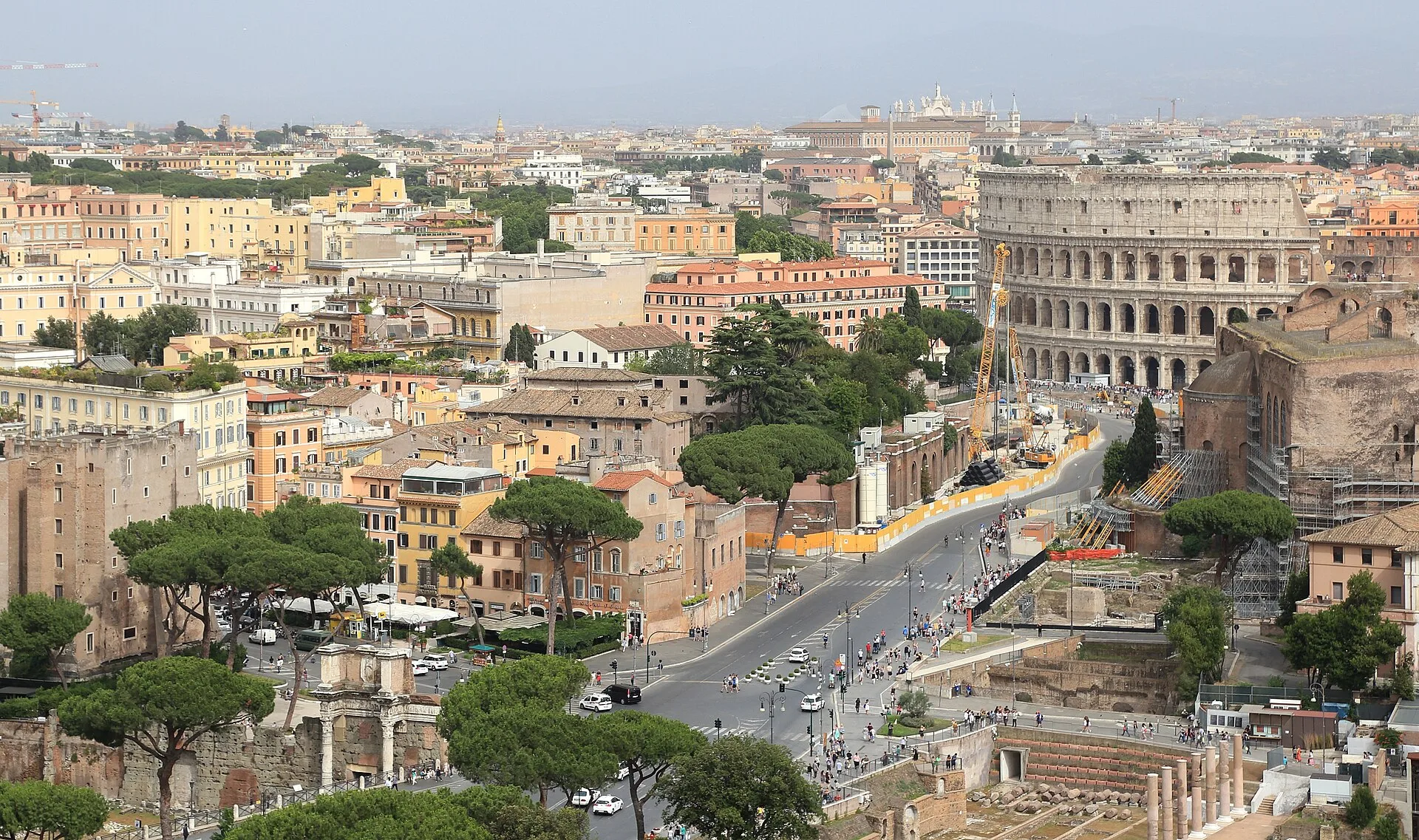
From a vehicle, the best lesson is exterior and relational. The surviving ellipse becomes a measure of the valley; the slopes and remains of the Palatine rise behind; the Forum begins to the west. The façade's repeated arcades advertise order, but the interior once used corridors, stairs, seating divisions and an arena floor to sort bodies by status and conceal the labour beneath spectacle. A street overview can establish that system's scale. It cannot replace the evidence visible inside.
Inside the archaeological complex, the contrast sharpens: the arena organised spectators and violence, the Forum gathered civic and religious life, and the Palatine placed imperial residences above both. Give that relationship a separate walking visit rather than squeezing it between vehicle stops. For preparation, Rome's Arena, Forum and Palatine: How Power Learned to Stage Itself follows those spaces through archaeology, audience, coercion and conservation.
The road itself deserves attention. Rome's grand twentieth-century axes can make antiquity appear as a sequence of isolated ruins displayed beside traffic. Yet the archaeological areas were once neighbourhoods of buildings, lanes, drainage, worship, business and residence. A moving traveller should notice the modern carriageway as another historical layer—not mistake its sightline for the original Roman city.

03 · Rome street-scale field guide
Circus Maximus: understand the void before the monument
Circus Maximus is a powerful antidote to monument collecting because much of its meaning lies in space. The long valley between the Palatine and Aventine was shaped over centuries for chariot racing and public spectacle. Seating, starting gates, a central barrier and imperial viewing arrangements changed repeatedly. What survives at ground level is fragmentary compared with the amphitheatre's standing shell.
That apparent emptiness is precisely the lesson. The site teaches how topography became infrastructure. The valley supplied the elongated form; construction enlarged and formalised it; the Palatine connected spectacle with imperial residence above. Looking from the open floor toward the palace ruins, a traveller can understand that political power did not merely own separate buildings. It controlled relationships among residence, public entertainment, movement and view.
The Circus also refuses the easy equation “less surviving stone, less history.” After ancient racing ended, the valley acquired other uses. Soil accumulated, buildings and industries occupied parts of it, archaeological work exposed selected areas, and the modern city continued around it. The present lawn and paths are not the untouched floor of an ancient stadium. They are a public landscape produced by loss, burial, excavation and reuse.
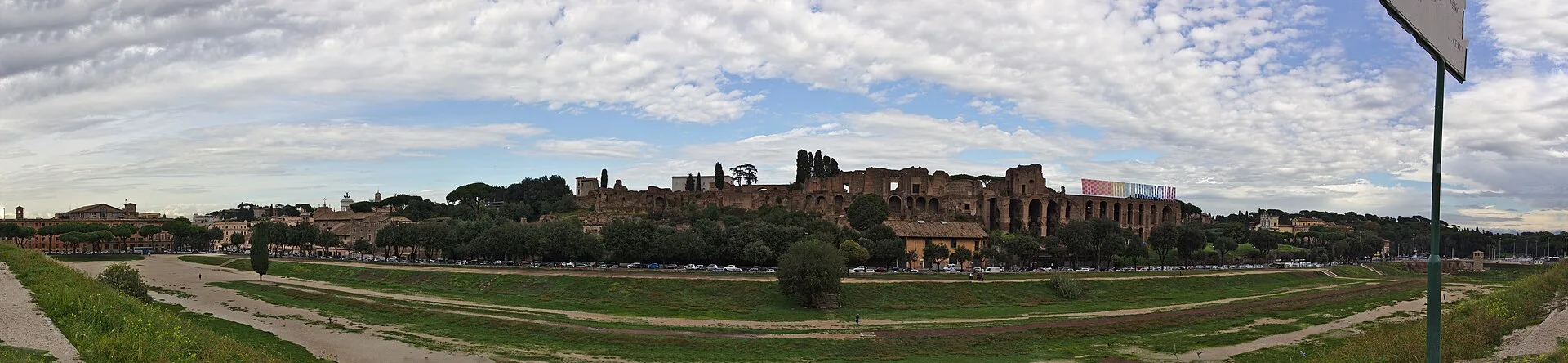

There is a practical consequence. A guide who points only to “the biggest chariot stadium” delivers a superlative but not an interpretation. A stronger explanation asks the group to locate the long axis, the hill edges and the likely position of spectators. It distinguishes surviving fabric from reconstructed form. It then connects the view upward to the Palatine and onward to the denser centre. The value of the stop is not a staged photograph. It is the recovery of a city-scale shape.
04 · Rome street-scale field guide
From open ground to street canyon
The transition toward the historic centre changes the reading conditions. Around the imperial monuments, large archaeological clearances and broad roads produce long sightlines. In the dense centre, buildings press close, streets turn, façades arrive obliquely and a landmark may remain hidden until the final approach. This is not visual clutter surrounding the “real” sights. It is the city that kept living around ancient fabric.
Medieval Rome did not preserve classical monuments as a museum. Buildings became churches, fortifications, workshops, houses, sources of stone and anchors for new streets. Some ancient routes persisted; others narrowed, shifted or disappeared. Renaissance popes and patrons repaired aqueducts, laid out streets, created fountains and connected religious or ceremonial destinations. Baroque architects then used curves, façades, obelisks, light and water to turn movement through the city into theatre.
UNESCO's account of Rome's historic centre treats this as an urban landscape extending across ancient, Christian, Renaissance, Baroque and modern layers. That framework matters because it prevents a false choice between “authentic antiquity” and “everything added later.” Rome's integrity lies partly in the accumulation. At each change of scale, ask which layer is visible and what it did to those before it.
A small vehicle can make the change of scale vivid because the body remains close to walls and pavement. It can also make detail harder to retain. A carved doorframe, reused column, shrine, drain or sudden glimpse down an alley may vanish before anyone has located it. This is why a good overview needs pauses and a clear interpretive question. Speed without selection produces a slideshow. Selection turns movement into comparison.
05 · Rome street-scale field guide
Pantheon: the exterior deliberately withholds the interior
Piazza della Rotonda offers a near-perfect test of what surface viewing can and cannot do. From the square, the Pantheon presents a deep portico with granite columns, a triangular pediment and the inscription of Marcus Agrippa. Behind it sits the enormous drum of the rotunda, but the conventional temple front controls the first impression.
The surviving structure was completed under Hadrian in the second century CE, following an earlier monument. Brick stamps suggest work began under Trajan, so an exclusively Hadrianic origin is debated, as are its ancient function and exact design authorship. Consecrated as a church in the early seventh century, it remained in use rather than becoming only an excavated ruin. Tombs, chapels and Christian worship are therefore not interruptions that can be peeled away to reveal one pure Roman moment. They are part of why the structure endured.
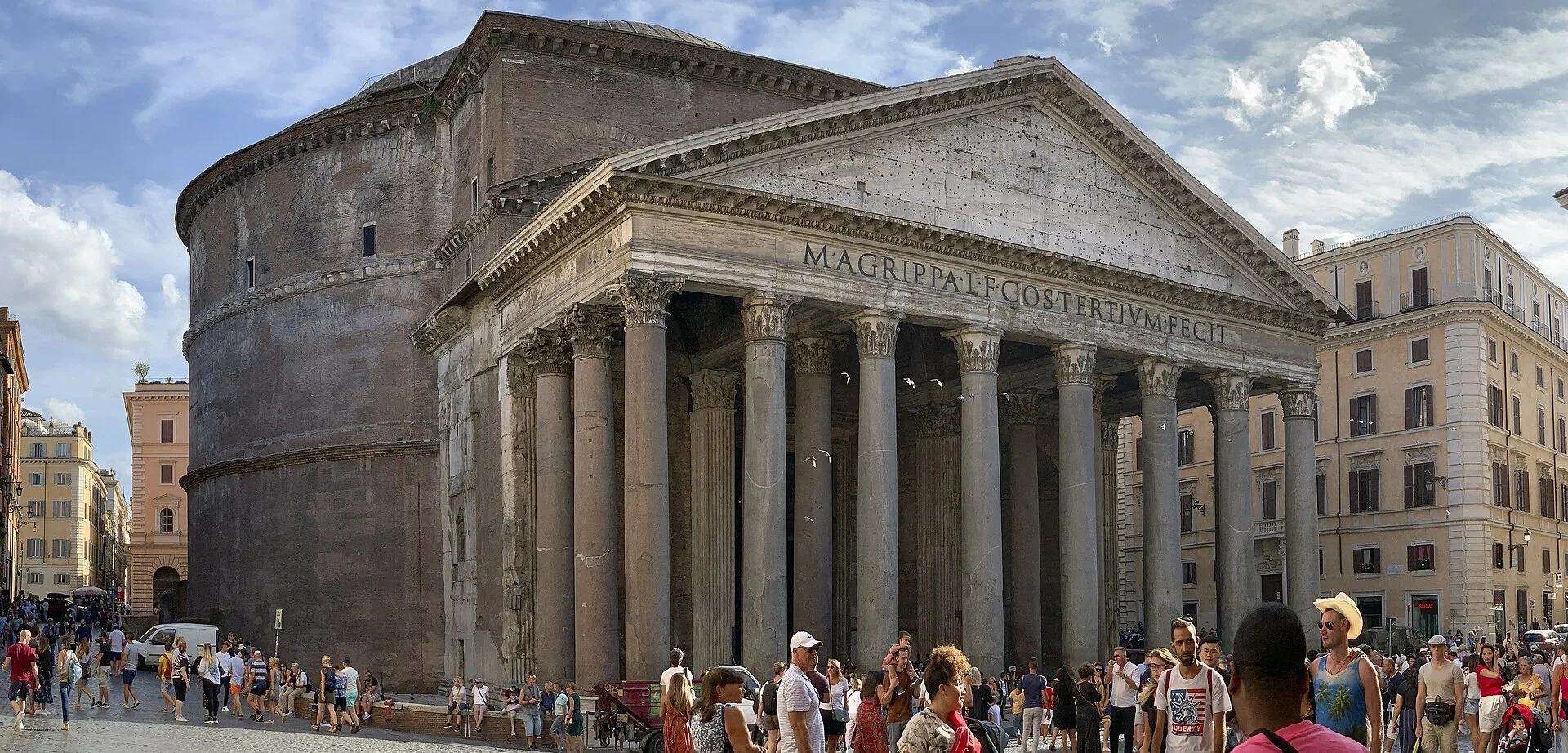

The decisive architectural experience is inside. A cylinder supports a hemispherical dome whose diameter and interior height create a powerful geometric unity. Coffers reduce weight as they rise, and the oculus opens the centre to daylight and weather. The moving patch of light makes the building feel less like a static shell than a calibrated instrument. None of that can be inferred fully from the portico.
The square adds another layer. After the Acqua Vergine water supply was restored in the sixteenth century, a fountain designed by Giacomo della Porta brought public water and civic display together. Later alterations, including the obelisk, changed its appearance. The juxtaposition is not “ancient Pantheon plus decorative fountain.” It is a relationship between Roman engineering, early-modern water policy, papal display, daily supply and a public space repeatedly redesigned around a monument.
The practical distinction is explicit. The Pantheon is both a state-managed monument and a basilica where worship takes priority. The official Pantheon visitor page lists standard adult admission at €7 from 1 July 2026, timed and nominative tickets, and no skip-the-line product. Services, religious celebrations and institutional needs can alter access. The accessible entrance uses a ramp on Via della Minerva, but an individual should confirm the full path and assistance needed. A tuk-tuk overview does not include an interior merely because it reaches the piazza.
That limitation can improve the day. If the dome is a priority, reserve enough time to enter independently and treat the vehicle as arrival context. If the route is only an orientation, note the portico–rotunda mismatch and return later. The wrong choice is to call the Pantheon “seen” after a moving photograph and then repeat facts about an interior nobody experienced.
06 · Rome street-scale field guide
Piazza Navona: an ancient stadium becomes a Baroque public stage
Piazza Navona survives because later Rome occupied an ancient form. Its long, rounded outline follows the footprint of Domitian's first-century stadium. Archaeological remains sit several metres below the modern level, and access to them is separate from standing in the square. At street level, the stadium is most legible not as exposed seats but as the stubborn shape imposed on later buildings and movement.
That transformation is central to Rome's history. The space supported markets, processions, festivities and neighbourhood life. In the seventeenth century, Pope Innocent X Pamphilj made it a setting for his family palace, church and papal authority. Bernini's Fountain of the Four Rivers, unveiled in 1651, joined an obelisk, a rocky void, river personifications and water into a composition designed to be approached from changing angles. Borromini's façade for Sant'Agnese in Agone participates in the same charged urban scene, though the popular story that the fountain figures recoil from the church fails the chronology: the fountain preceded the façade.
The four figures make the claim concrete. The Danube stands for Europe, the Ganges for Asia, the Nile for Africa and the Río de la Plata for the Americas: a four-continent view of the world in papal Europe. The Nile's covered head refers to its source being unknown to that audience, rather than disgust at a rival architect. The obelisk came from the Circus of Maxentius, while the dove above it joins a Christian symbol to the Pamphilj emblem. In this setting, the water display reads as a claim to connect ancient Rome, Christian authority and a wider world. Walk around it; a single frontal photograph flattens those relationships.
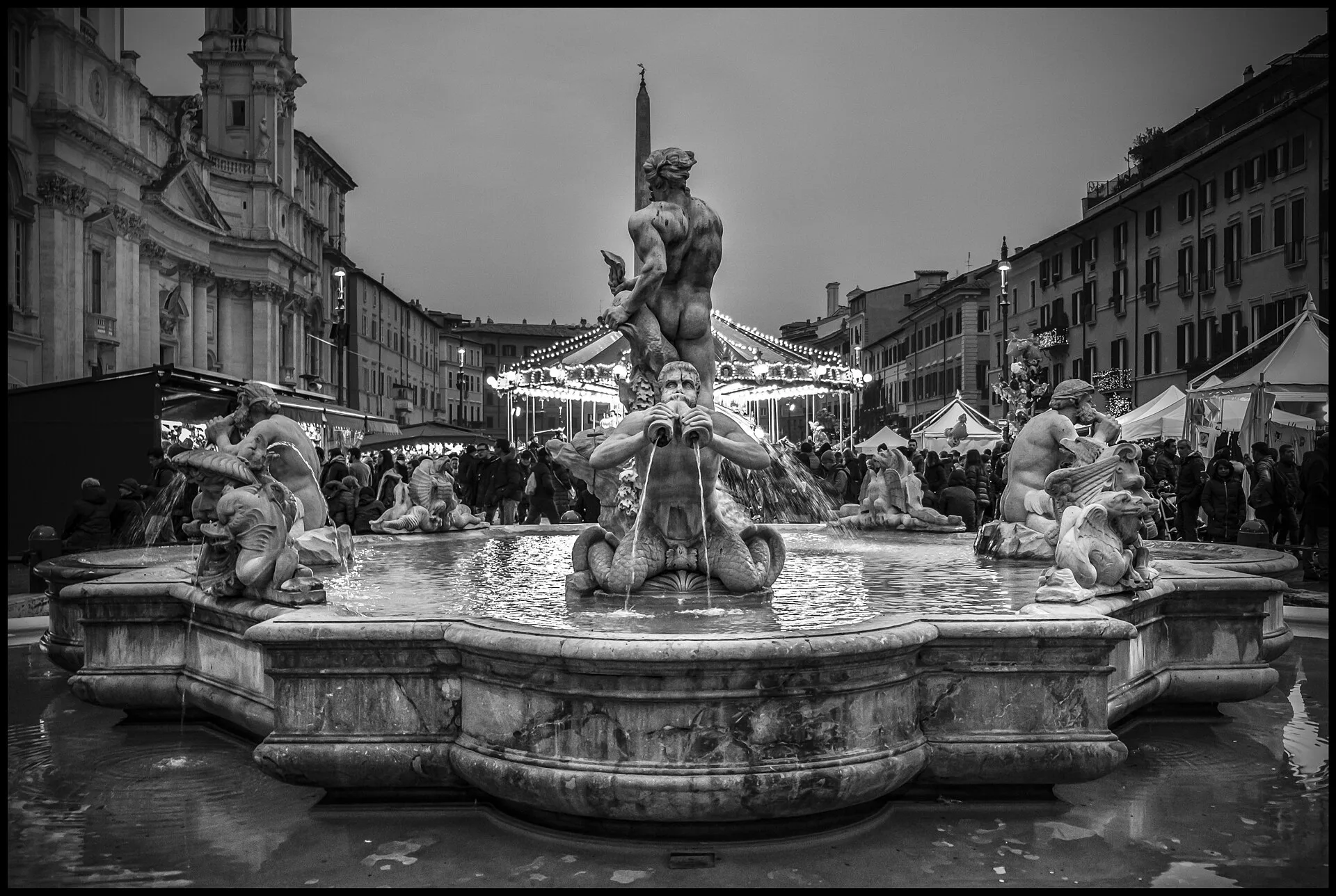

Piazza Navona is a rewarding independent continuation from the Pantheon area. The square explains the same city-scale principle as the rotunda and Trevi: Rome preserves infrastructure through later use. Look for the stadium outline, level change, water and papal urban theatre. Allow time to walk the perimeter and compare the fountains, rather than treating the square as one more guaranteed vehicle stop.
This is also where a compact vehicle can become a poor viewing platform. The central space is pedestrian-dense, and the important experience is lateral: walking the long axis, approaching the fountains, looking back at the enclosing façades and noticing how the curve continues around the ends. A responsible driver may need to stop at a legal edge rather than deliver a cinematic pass through the centre. That is not a failure. It is the street working as public space rather than scenery.
07 · Rome street-scale field guide
Trevi: water arrives before the photograph
Trevi Fountain is often reduced to an arrival ritual and a coin. Its deeper story begins with water infrastructure. The Acqua Vergine, the early-modern successor to the ancient Aqua Virgo system, helped supply Rome after restoration in the Renaissance. By the eighteenth century, Nicola Salvi's design transformed the terminus into a monumental façade and basin integrated with Palazzo Poli. Oceanus stands at the centre of a sculptural drama in which water seems to break architecture open.
The achievement is urban as well as artistic. A working supply system becomes public theatre. The restricted square forces the monument close to the viewer; there is no grand park or distant approach. The water's movement and sound compete with conversation. The pale stone, palace façade and basin form one composition. Seen carefully, Trevi explains how papal Rome used ancient engineering, modern repair, sculpture and crowded public space to claim continuity.
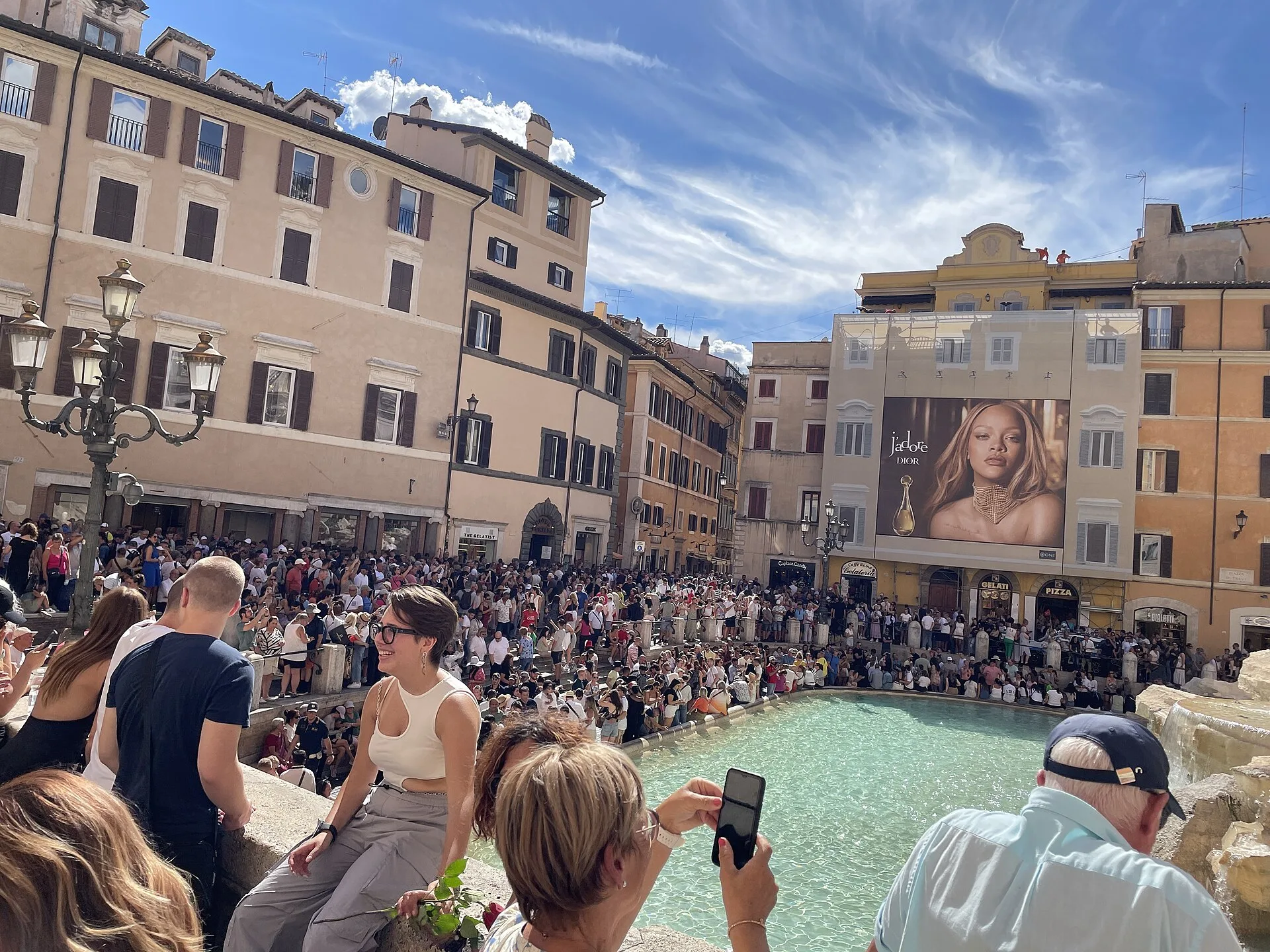

Visitor management changed in 2026. From 2 February, tourists and non-residents need a €2 ticket to enter the lower basin area during managed hours; qualifying residents and other listed groups are exempt, and the fountain can still be viewed from the surrounding square without that basin ticket. Trevi's official visitor information lists Monday and Friday access from 11:30 to 22:00 and other days from 9:00 to 22:00, with final entry at 21:00. Check its current hours for the day you plan to enter.
That distinction matters to a surface tour. “Trevi Fountain” may mean a view from the square, a short stop near an accessible edge or separate entry to the basin. It should never imply that the vehicle parks at the water or bypasses the managed queue. A road route can be altered by pedestrian control, security, events or traffic. The correct pre-booking question is not “Do we see Trevi?” but “On this departure, where is the legal stopping point, how much walking is expected, and does the plan include only the public square view?”
08 · Rome street-scale field guide
A moving overview needs an interior plan
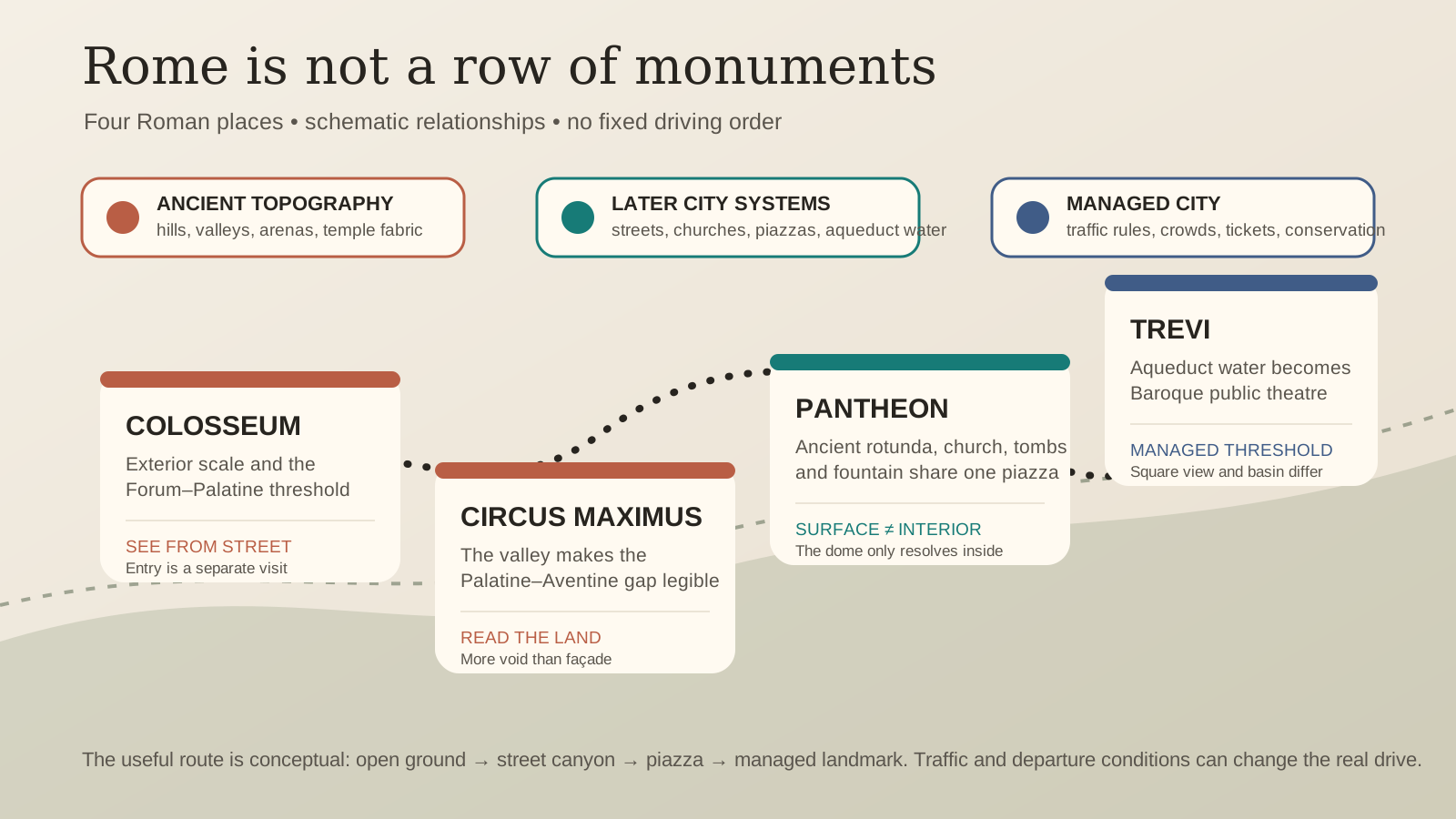
The Colosseum, Pantheon and Trevi expose three different thresholds. The Colosseum's archaeology lies behind controlled entry and security. The Pantheon's geometry resolves inside a living church. Trevi's square view and lower-basin access are now distinct. A private surface route can connect all three conceptually without including any of those admissions.
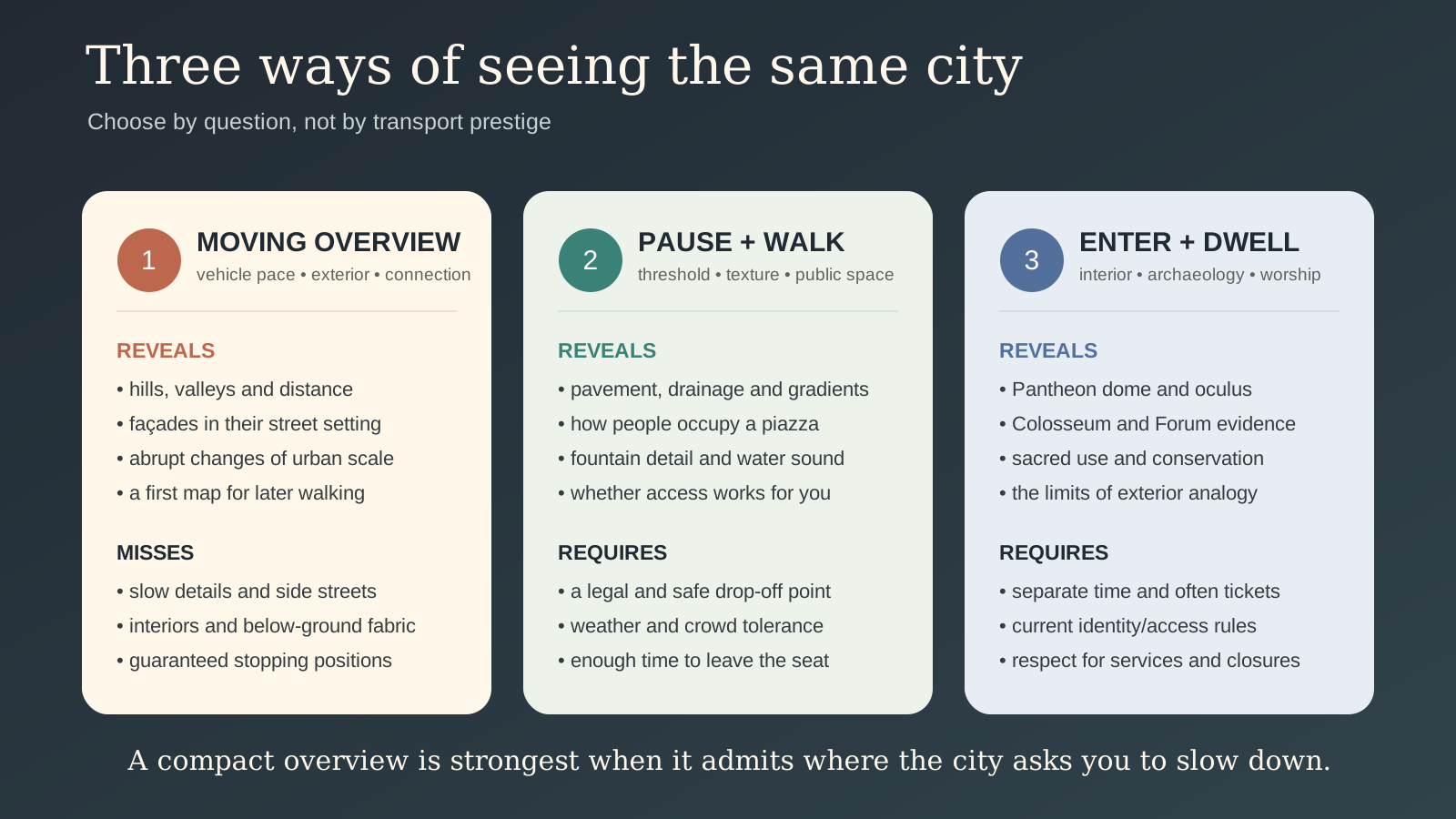
This suggests a practical way to structure a first Rome day:
- Use the vehicle overview to build a mental map: ancient valley, hill edge, dense centre, piazza, fountain terminus.
- Choose one priority interior, not every possible admission. The Pantheon is a natural companion because its exterior conceals its central architectural idea; the Colosseum complex deserves a much longer separate block.
- Choose one slow public space to walk after the route. Piazza Navona, the Pantheon–Trevi corridor or the Circus valley can supply the street detail lost in motion.
- Treat viewpoints as conditional until the operator names them. “Scenic terraces” in commercial copy does not prove a particular Aventine, Janiculum or Pincian stop.
The division is not about downgrading the tour. It protects the tour's real strength. An overview should orient, compare and provoke return. When it claims to replace entry and walking, it turns the city's depth into a defect.
09 · Rome street-scale field guide
What the electric tuk tuk changes—and what it does not
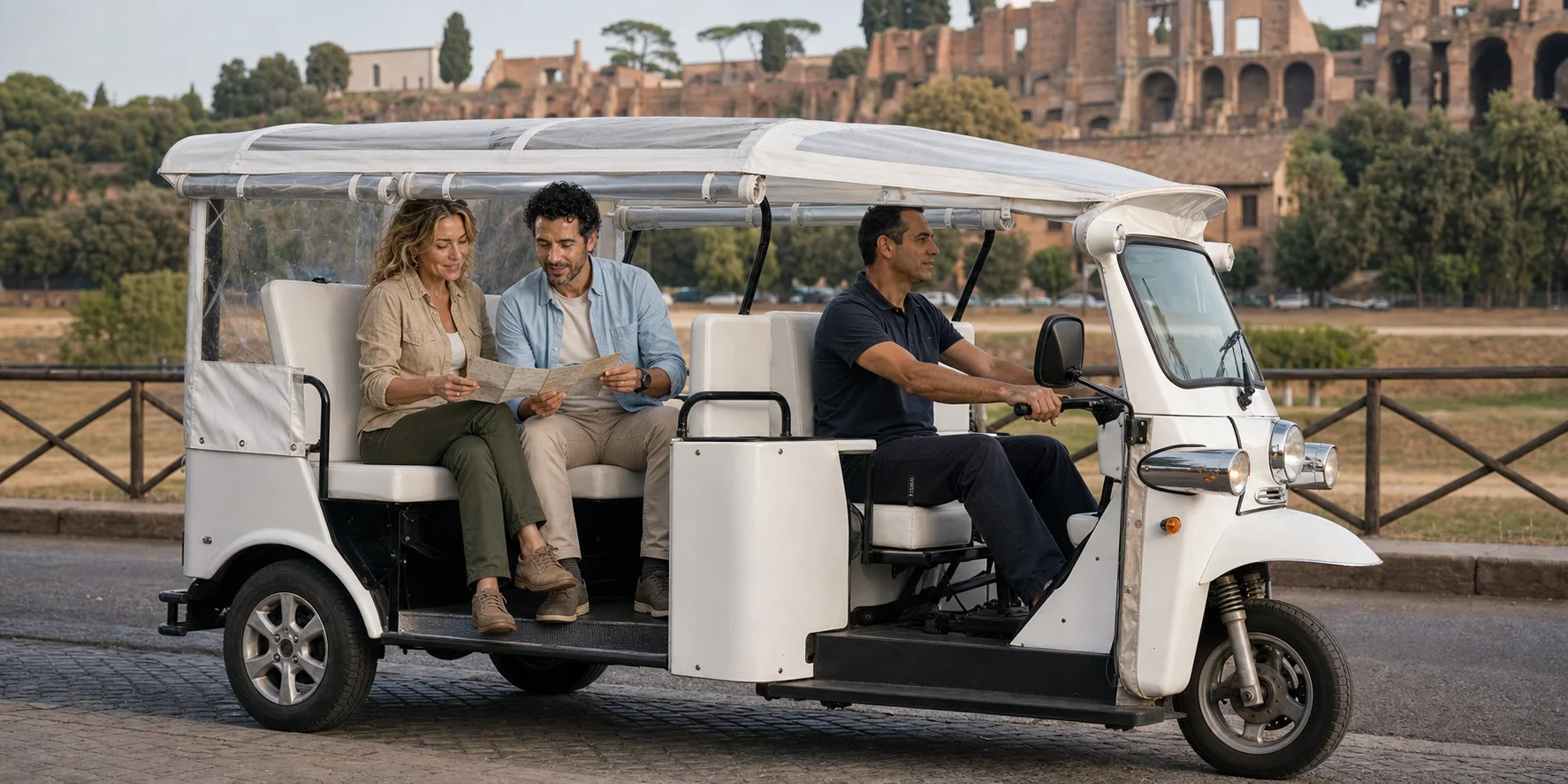
The compact three-wheeled format puts boarding and exposure in plain sight. An open passenger bay, a canopy and seats facing different directions make the experience unlike an enclosed car. Before choosing it, establish the boarding height, seating and restraints of the actual vehicle, how its weather panels work, and whether it can accommodate your mobility aid, luggage or children. A vehicle-format illustration helps locate those questions; the operator's specification must answer them.
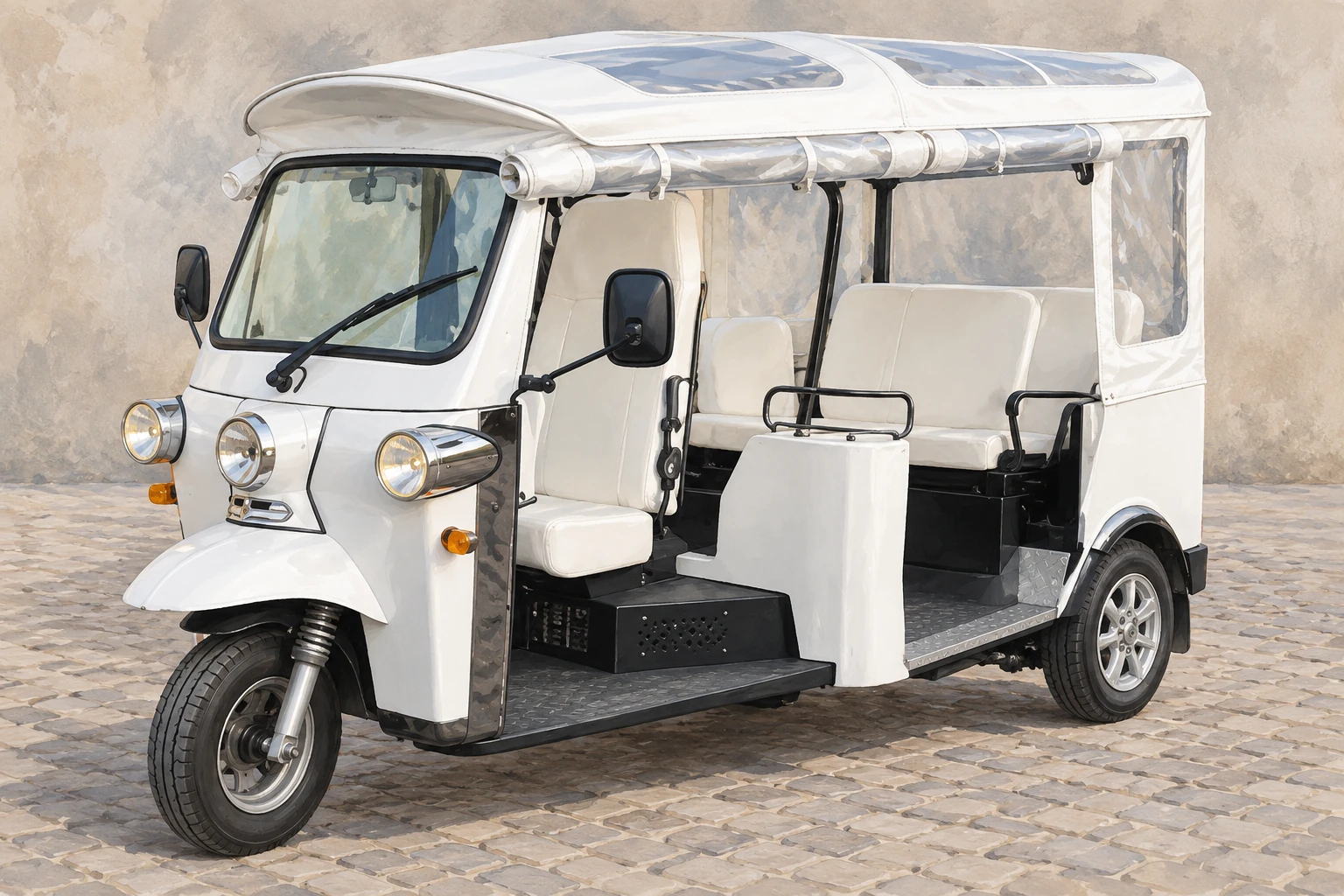
Compared with a coach, a compact vehicle can use a smaller footprint and keep passengers closer to the street. Compared with walking, it can link distant areas with less continuous exertion. Compared with an enclosed car, it may improve lateral visibility and conversation, while exposing passengers more directly to heat, cold, rain, exhaust from surrounding traffic, noise and uneven road surfaces. Compared with public transport, it offers a private narrative and fewer navigation decisions but serves fewer people per vehicle.
“Electric” supports a specific claim: the vehicle has no tailpipe exhaust while operating on battery power. It does not support “zero impact.” Electricity generation, battery manufacture, tyre and brake wear, vehicle production and street space remain part of the environmental account. Nor does the adjective prove quietness at every seat; drivetrain noise may be low, but traffic, cobbles, horns, crowds and commentary do not disappear.
The most credible sustainability argument is therefore modest. A small electric format can be a lower-tailpipe-emission alternative to a comparable combustion-powered private sightseeing vehicle. It is not automatically better per passenger than a well-used bus, tram, metro or walk. Its strongest case is access to a compact overview for a small party that values reduced walking and can use the vehicle safely.
10 · Rome street-scale field guide
Electric is not a pass through the ZTL
Rome's historic centre uses limited-traffic zones, or ZTLs, with electronic access controls and schedules. Vehicle category, authorisations and zone rules determine entry. Under Roma Mobilità's rule effective 1 July 2026, electric cars, vans and equivalent vehicles require permits, with rules and exemptions that vary by legal category. Taxis and authorised NCC hire vehicles remain exempt from the new permit, as do motorcycles, mopeds and quadricycles for the central ZTL; other restrictions still apply. An “electric tuk tuk” label establishes neither the vehicle's legal classification nor its access rights. Expect the operator to match the actual vehicle to streets it may lawfully use.
The daytime historic-centre ZTL has been a 30 km/h zone since 15 January 2026. The change reflects a street environment with high pedestrian density and complex interactions. Thirty kilometres per hour is a maximum, not a sightseeing target. Crowds, crossings, deliveries, narrow geometry and surface condition often demand much less.

Temporary works, ceremonies, demonstrations, institutional security, large events and emergency controls can redirect movement. So can an ordinary queue spilling into a pedestrian approach. These conditions are not rare exceptions to a perfect itinerary; they are part of operating in a protected, inhabited capital. A flexible route is legitimate if the operator communicates the change and preserves the interpretive purpose. Flexibility is not permission to advertise a specific stop that cannot normally be delivered.
Before booking, ask for the difference among pass, pause and stop. Passing means a sightline from the moving vehicle. Pausing may mean a brief legal position without disembarking. Stopping means enough time and a safe place to leave the vehicle. Those verbs prevent disappointment more effectively than a long list of monuments.
11 · Rome street-scale field guide
Accessibility begins before the first landmark
Reduced walking is not the same as step-free access. The ability to board a compact vehicle is a separate requirement. A step, narrow opening, low roof, sideways bench, need to transfer from a wheelchair, lack of wheelchair storage, seat-belt geometry, road vibration or absence of a nearby accessible toilet may make the same format unsuitable for someone else.
Accessibility should be confirmed as a chain:
- the route from accommodation or transit to the meeting point;
- kerbs, paving, gradients and crossings at that point;
- boarding height, handholds, seat orientation and transfer support;
- the exact vehicle's restraints and weather protection;
- whether a mobility aid can travel securely;
- expected disembarkations and walking distance at each proposed stop;
- accessible toilets and recovery time;
- the independent access route for any monument entered later.
Rome's official accessible-tourism resources are place-specific for a reason. Even public transport requires station-level checking. ATAC's accessibility information describes accessible equipment across much of its fleet and network, but individual stations have limitations; Repubblica station, for example, lacks lifts or stairlifts to its platforms. If your independent journey passes through that area, plan a suitable approach rather than assuming that a nearby metro stop makes a meeting place accessible.
The same care applies to children. Confirm the operator's minimum age, restraint system and vehicle classification for the actual departure. A private bench is not equivalent to a family car seat, and a general family-friendly description does not establish child eligibility.
12 · Rome street-scale field guide
Driver, driver-guide and tourist guide are not synonyms
A skilled driver can manage traffic, operate the vehicle safely and provide practical orientation. A host or driver-guide may add city commentary. Tourist guiding is a regulated profession under Italy's current framework, with qualifications checked through the Ministry of Tourism's national system. These roles can overlap in one qualified person, but they should not be collapsed by marketing language.
The distinction matters most where interpretation becomes specialised or an interior visit is implied. Pointing out the Colosseum exterior from a road is not the same service as guiding an archaeological admission. Describing the Pantheon from the piazza is not the same as interpreting its interior during a worship-sensitive visit. A private route does not automatically include a licensed guide merely because the driver speaks English and tells stories.
Ask the operator three direct questions:
- Who drives, and who provides commentary?
- Is that person a qualified tourist guide, and can the credential be verified if the service is sold as guided interpretation?
- Are any interiors included, or is every monument viewed from public space?
A good answer may still be “professional driver with general city commentary; no entries.” That can be exactly the right product for an orientation. Precision protects both the traveller and the professionals whose qualifications should not be implied without evidence.
13 · Rome street-scale field guide
Heat, rain and the myth of the effortless seat
Rome's heat and heavy walking deserve a place in the day's plan. A covered small vehicle addresses some exertion, but heat exposure also depends on temperature, humidity, sun, time of day, health, hydration and the ability to recover. Rome is included in the Italian Ministry of Health's heat-bulletin system during the warm season. Check the current bulletin shortly before travel rather than relying on a general statement that mornings or evenings are always comfortable.
A roof may provide partial shade; open sides still admit hot air and low sun. Clear rain panels can reduce airflow. Seats can remain exposed during disembarkation. Cobbled streets transmit vibration, and a passenger who remains seated through an overview may still need to walk across uneven paving to reach a meeting point, viewpoint, fountain or toilet. The phrase “save your steps” is useful only when the remaining steps are described.
Rain creates the opposite trade-off. A transparent enclosure can keep water out while reducing unobstructed photography and ventilation. Heavy weather can change visibility and street safety. Ask what protection the assigned vehicle provides and what happens if conditions make the booked format unsafe or poor value. A shelter, church visit or substituted route should be agreed rather than assumed; use the written terms for cancellation and weather arrangements.
For any season, carry less than you think you need. Confirm luggage limits because a compact vehicle may have little secure storage. Keep water accessible, protect hearing or medical devices from weather, and bring a layer that works while seated. Most importantly, disclose relevant transfer and heat limitations before the departure day, when changing a vehicle or meeting arrangement may still be possible.
14 · Rome street-scale field guide
A practical decision guide
Choose a private electric tuk-tuk overview when your party wants a shared first map, values street-level visibility, prefers less continuous walking and accepts that most monuments remain exterior views. Confirm the permitted participant count, exact vehicle, meeting point, commentary role, boarding, restraints, weather plan and pass/pause/stop pattern.
Choose walking when architectural detail, spontaneous detours, churches, fountains and the social life of small streets are the main subject. Walking is slower and physically demanding, but it allows the city to interrupt the plan. It is also the best follow-up to a vehicle overview because you can return to the one relationship that remained unresolved.
Choose bus, tram or metro when efficient transport between districts matters more than continuous commentary. Public transport is usually more economical and can carry more people with less vehicle space per passenger. Accessibility varies by vehicle, stop and station, so consult ATAC's live information rather than assume that the network or a single line is uniformly step-free.
Choose an enclosed private car when climate control, reduced exposure or more conventional seating is a higher priority than open lateral views. Road-access and stopping restrictions still apply; enclosure does not solve the ZTL.
Choose a licensed private guide on foot when interpretation is the core purchase. This can be paired with taxis or public transport and may be more effective than asking one driver to combine traffic management, parking, storytelling and specialist history.
Choose separate ticketed visits when the Colosseum archaeology or Pantheon interior is the main reason for the day. A surface route is an orientation, not priority access. Trevi's managed basin area is another independent threshold even though the square remains publicly visible.
15 · Rome street-scale field guide
Questions to resolve before choosing a vehicle
A responsible booking surface or operator should state the commercial terms that an evergreen city guide cannot: availability, participant rules, the meeting point, cancellation, the assigned vehicle and the planned balance between passing, pausing and stopping. If those details are absent or contradictory, choose a different format rather than treating a generic landmark list as a route.
Before payment, verify:
- the exact meeting point and its accessible approach;
- whether the assigned vehicle matches your boarding, restraint and weather needs;
- who gives commentary and whether licensed guide credentials are relevant to the service sold;
- which places are pass, pause or stop examples on your date;
- the realistic walking and standing total;
- whether any admission is included—assume none unless written clearly;
- the live cancellation and weather policy;
- child eligibility rather than a generic family claim;
- the operator's ability to use the planned ZTL streets lawfully.
Immediately before travel, recheck Roma Mobilità's ZTL information, the Ministry of Health heat bulletins, the official Pantheon page and Trevi's official visitor information. Mutable facts are not footnotes here. They determine whether the route described can operate as expected.
16 · Rome street-scale field guide
What to do after the overview
The success of a surface route should be measured by the quality of the next decision, not the number of landmarks photographed. At the end, choose one of these continuations:
Return to the ancient valley. If the Circus–Palatine relationship was the revelation, walk part of the Circus floor and then study the hill from a fixed position. For full archaeological depth, reserve the Colosseum–Forum–Palatine complex separately and use the connected ExcursionPass archaeological feature as preparation.
Leave the walls. If roads and mobility became the question, follow the Via Appia, roadside tombs and catacomb-access field guide. It tests the same vehicle promise against a different landscape: longer distances, surviving basalt, protected road space and an underground handoff whose stairs a surface cart cannot solve.
Enter the Pantheon. The portico is the setup; the rotunda is the answer. Check the official timed ticket, identity and worship conditions, then give the interior enough stillness for the dome, coffers and oculus to become a structure rather than a fact recited from outside.
Follow the water. Walk from the Pantheon fountain toward Trevi and notice how public water changes from useful civic presence to monumental theatre. Add Piazza Navona only if time allows a proper circuit rather than another pin.
Read one ordinary street. Leave the famous sequence and examine paving, building junctions, reused stone, doorways, drains, shrines and changes of level. Rome's layers are not confined to monuments. The overview has worked when an unnamed corner becomes evidence.
17 · Rome street-scale field guide
Make the overview answer your questions
Before departure, tell the person providing commentary what you have already seen and what still puzzles you. A group that has visited the Colosseum may benefit more from the relationship between the Circus and Palatine than another exterior photograph. Someone fascinated by architecture may want the Pantheon's portico–rotunda contrast explained before returning inside. For a party managing fatigue, a few useful pauses may matter more than the longest possible landmark list.
Private attention has value when it changes the explanation and allocation of time. It does not remove the distance between places, traffic, restrictions or the practical needs of other passengers. Agree one priority and one optional continuation, then give the route room to work. A short conversation about an overlooked valley can be more useful than adding another distant viewpoint at the cost of every pause.
At each place, use three questions: what was the ground used for, what survives, and what did a later generation change? At the Circus, the answers involve valley, spectacle and reuse. At the Pantheon, they involve imperial construction and continuous worship. At Trevi, they involve water supply, papal display and the management of a crowded square. These are portable questions; they work even when the legal route changes.
Finish by identifying the one place that needs a return on foot or an independent admission. That decision gives the overview a useful endpoint. You leave with a relationship to investigate rather than a claim to have completed Rome.
18 · Rome street-scale field guide
Listen: a compact Rome travel question
The 22-minute ExcursionPass podcast episode explores a familiar Rome travel question: how to connect crowded icons while managing walking, exposure and the desire for a private route. Listen alongside this guide's map of valleys, streets, water and the places that deserve a slower return.
19 · Rome street-scale field guide
Use the vehicle format to build a map
The format is strongest when the group agrees on one purpose: understand how Rome changes from ancient valley to dense street, from exterior threshold to interior, and from infrastructure to public theatre. Tell the operator which relationship matters most, but do not confuse a request with a guarantee. A lawful route must respond to the city that exists on the day.
20 · Rome street-scale field guide
Rome becomes clearer at the edges
The most revealing moments of a surface route are not necessarily the hero views. They are the edges: where the Colosseum stops being an isolated icon and returns to a valley; where Circus Maximus reads as engineered emptiness; where the Pantheon's temple front gives way to a rotunda; where a stadium survives in a piazza boundary; where aqueduct water becomes sculpture; where a pedestrian zone tells a vehicle it can go no farther.
An electric tuk tuk can hold those edges close enough to compare. It can reduce some physical load and make the topography arrive as a sequence. But the city becomes knowledge only when the traveller understands the format's limits. Rome still asks for a step onto stone, a pause in a square, a separate ticket, a glance upward from inside and sometimes the decision to come back tomorrow.