_and_the_Vesuvio.jpg)
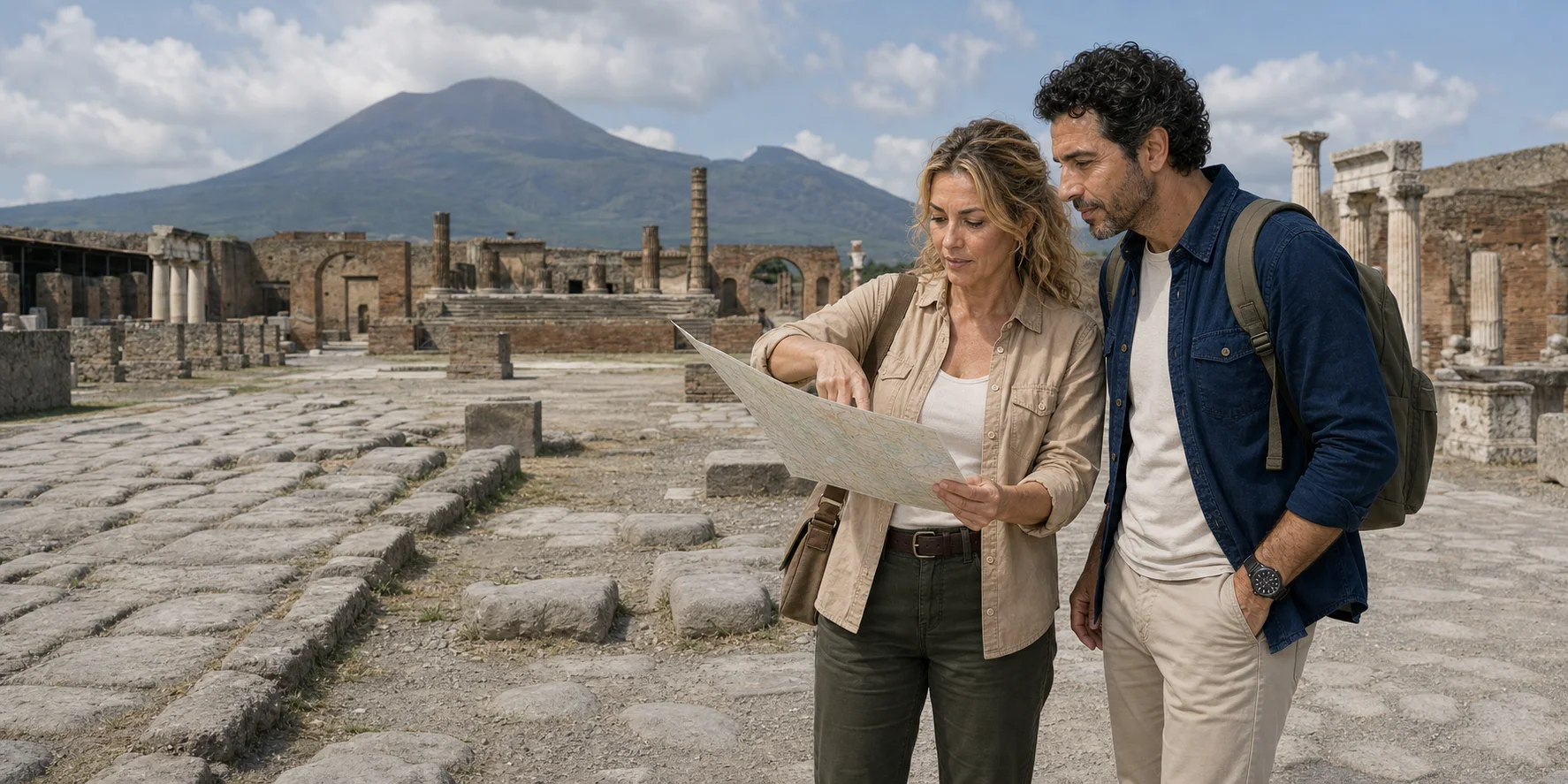
Pompeii is often sold as the city where time stopped. The ground tells a more demanding story: a settlement repeatedly remade before 79 CE, a disaster that unfolded in phases, a burial that preserved selectively, and an archaeological site still altered by excavation, weather, conservation and millions of modern footsteps. A day trip works when it gives each layer enough time to speak.
01 · Read the site
Pompeii was interrupted, not frozen
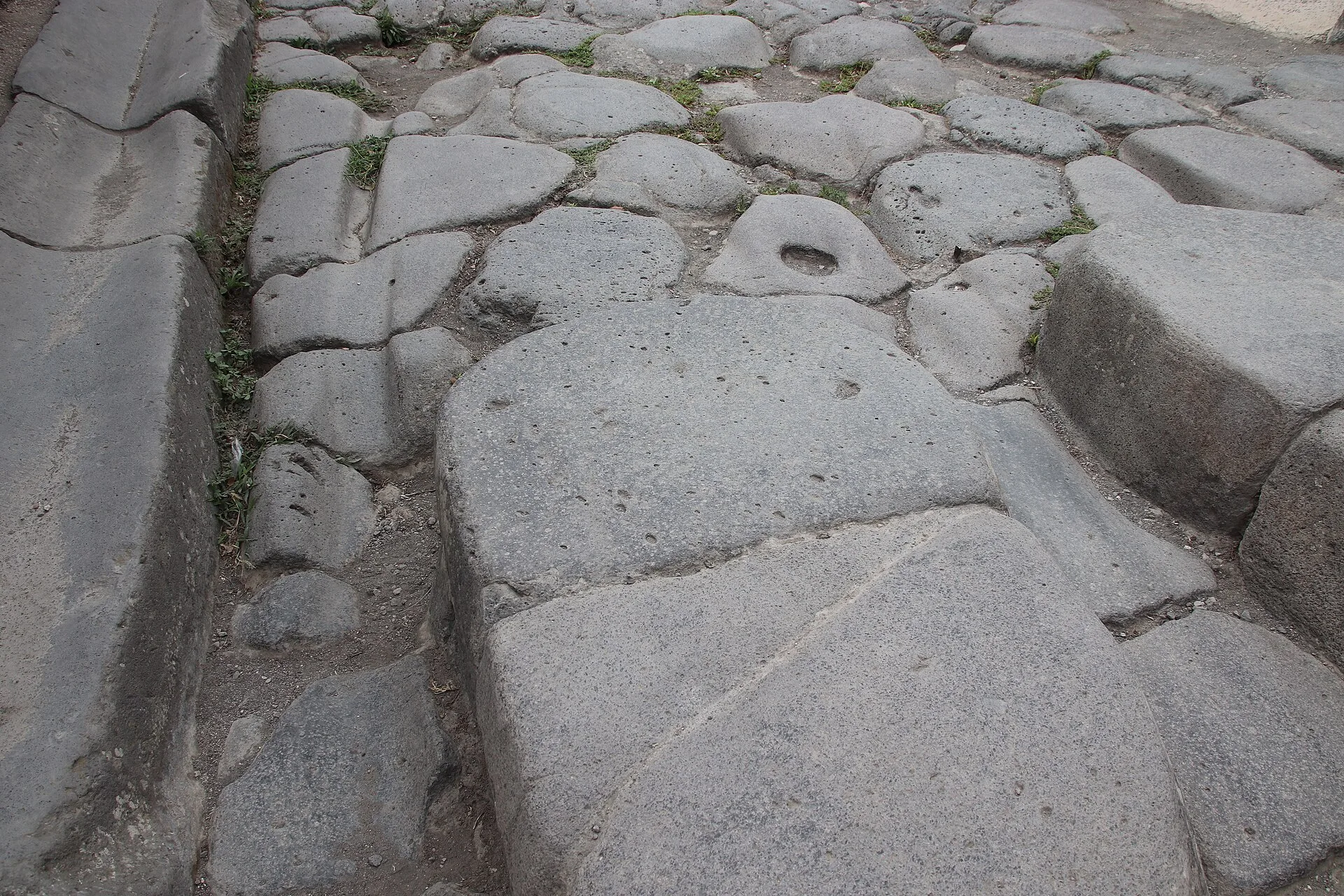
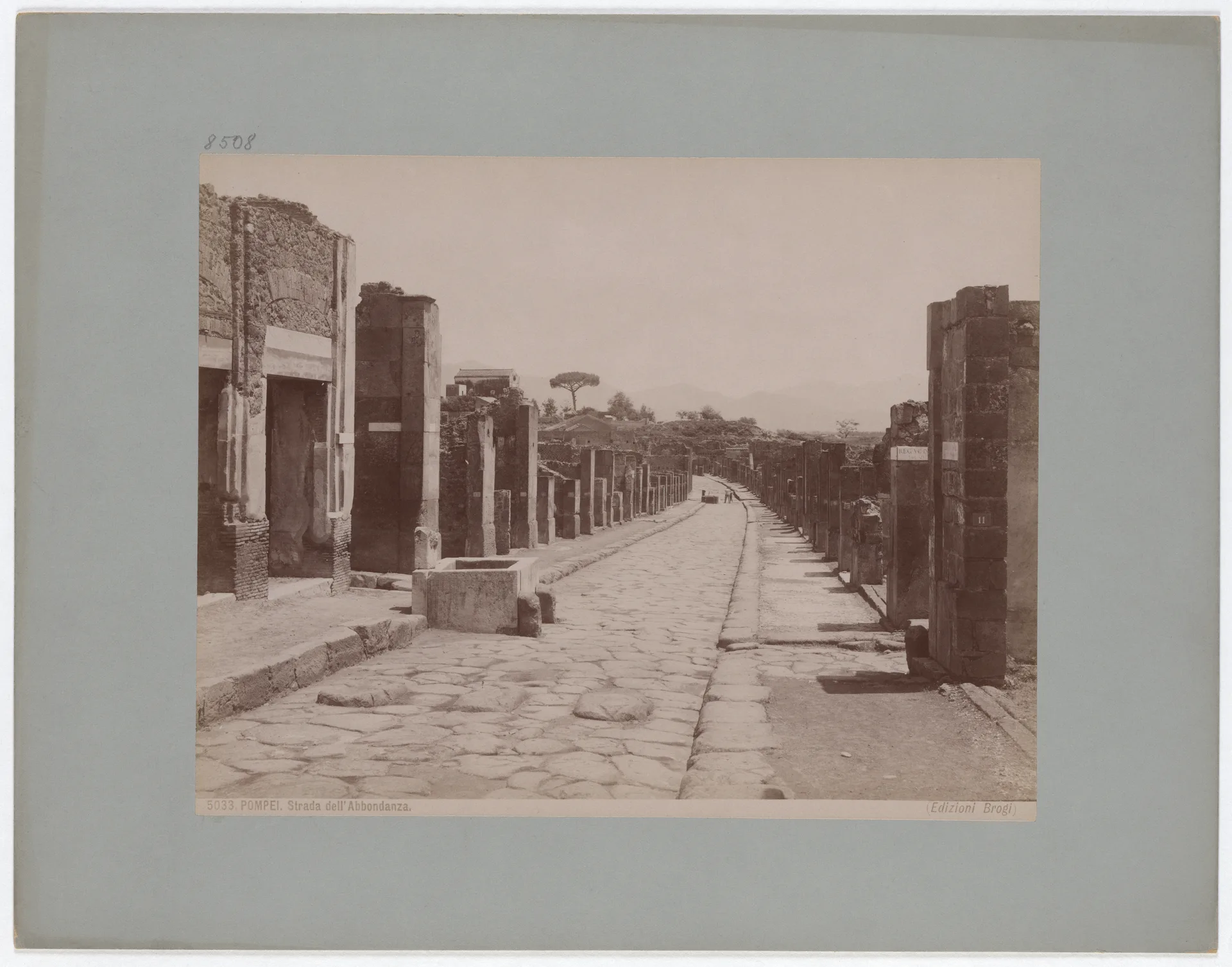
The paving is the first correction. Pompeii's streets are not neat museum aisles between complete houses. Their dark volcanic blocks swell and dip. Wheels cut parallel grooves. High kerbs contain a carriageway that also received rain, dirt and some waste. Raised stones give pedestrians places to cross without turning every street into a permanent river of sewage. Doorways open at different levels because ancient surfaces, eruption deposits, excavation and modern access routes have never formed one simple plane.
The city was changing before the eruption. Buildings had been enlarged, subdivided, redecorated, repaired after earthquakes, converted to workshops or given new shop fronts. A wall painting might be decades older than the room around it. A blocked doorway can preserve an argument between one building phase and the next. Construction materials set into the same elevation may belong to different centuries. In 79 CE, some properties were polished displays of wealth; others were work sites with unfinished plaster, stored lime or damaged rooms.
That is why “frozen in time” misleads twice. It suggests a single perfect moment in the ancient city, and it hides everything people have done to Pompeii since. Organic bodies decayed in the eruption deposits, leaving voids that were filled only in the nineteenth and twentieth centuries. Walls were excavated, reconstructed, roofed, stripped of objects or paintings, bombed, restored and reopened. Soil, plants, rain and sunlight began acting on fabric that burial had protected. A visit is not to untouched 79 CE. It is to a layered archaeological argument.
The useful question is therefore not “What did Romans do here?” in the abstract. It is “What evidence supports this interpretation, which phase does it belong to, and what might excavation have removed or obscured?” A doorway, fountain, counter or cast can answer part of that question. None can speak alone.
02 · Read the site
Before Rome, a crossroads on a volcanic ridge
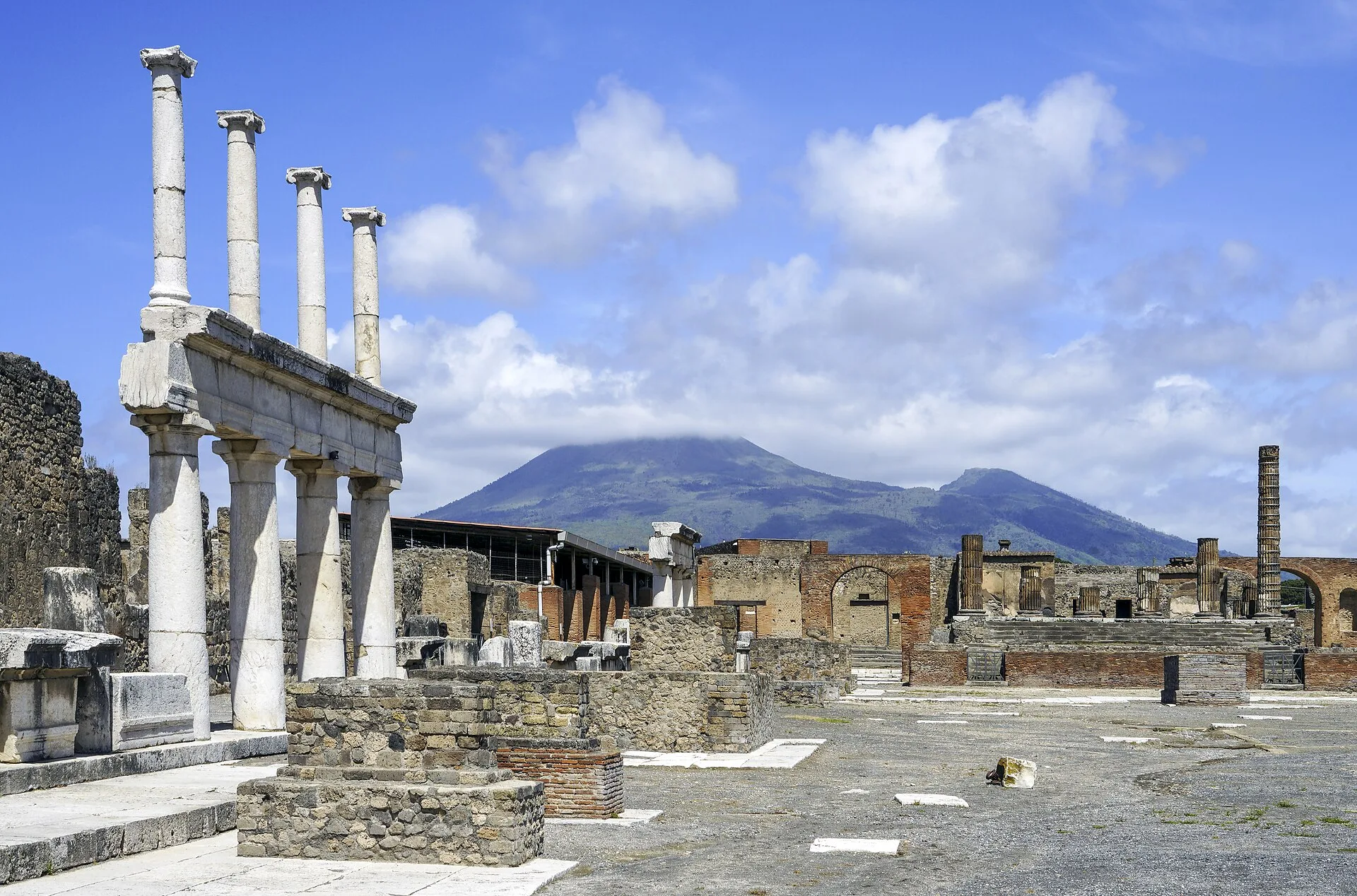
Pompeii occupied a raised lava spur above the Sarno plain, close enough to the coast and river routes to trade across Campania. Its beginnings are less tidy than a label such as “Roman city” implies. Archaeology tracks settlement and sacred activity back into the first millennium BCE, with Oscan-speaking communities and strong Greek, Etruscan and Samnite connections shaping the town over time. The masonry, inscriptions, cult places and street alignments record contact and competition rather than a single founding people.
By the Samnite period, substantial houses and public buildings expressed local power. Rome's expansion into Campania did not erase that world overnight. After Pompeii joined the Italian allies' revolt in the Social War and was besieged, it became a Roman colony in 80 BCE. Veterans arrived, Latin became the dominant public language, and institutions were recast within Roman rule. Older sanctuaries, families, property lines and building techniques persisted inside the colonial city.
The result by the first century CE was neither a miniature Rome nor an isolated provincial relic. Pompeii was a regional town connected to farms, vineyards, ports, roads and neighbouring communities. Wine, oil, grain, wool, pottery, fish products, animals, timber and people moved through its gates. Elite patrons used public buildings and inscriptions to advertise generosity. Shopkeepers and craftspeople worked at the street edge. The dead were placed in monuments outside the gates, where a traveller approached the city through lines of memory and status.
This longer chronology changes a walk. The Forum is not simply “where Romans met.” It accumulated civic, religious and commercial functions as the town's political world changed. The Temple of Apollo preserves an old sacred presence beside later colonial rebuilding. The city wall can be both a defence and, after Roman control made it less necessary, a structure absorbed by houses. A guide who begins only with the eruption turns every earlier century into scenery for the final day.
03 · Read the site
A town of legal inequality and complicated lives
Pompeii's most visible names tend to belong to men who held office, paid for buildings or painted electoral notices. That does not make them the whole population. Women managed property and businesses within legal constraints, sponsored public architecture, appeared in tomb inscriptions and were represented in domestic art. Eumachia, a public priestess and patron associated with a major building on the Forum, is prominent because stone preserved her name. Julia Felix is connected with a large property advertised for rent after the earthquake. Naevoleia Tyche used her tomb monument to project family, status and commercial success. Each is evidence of agency, not proof that gender inequality disappeared.
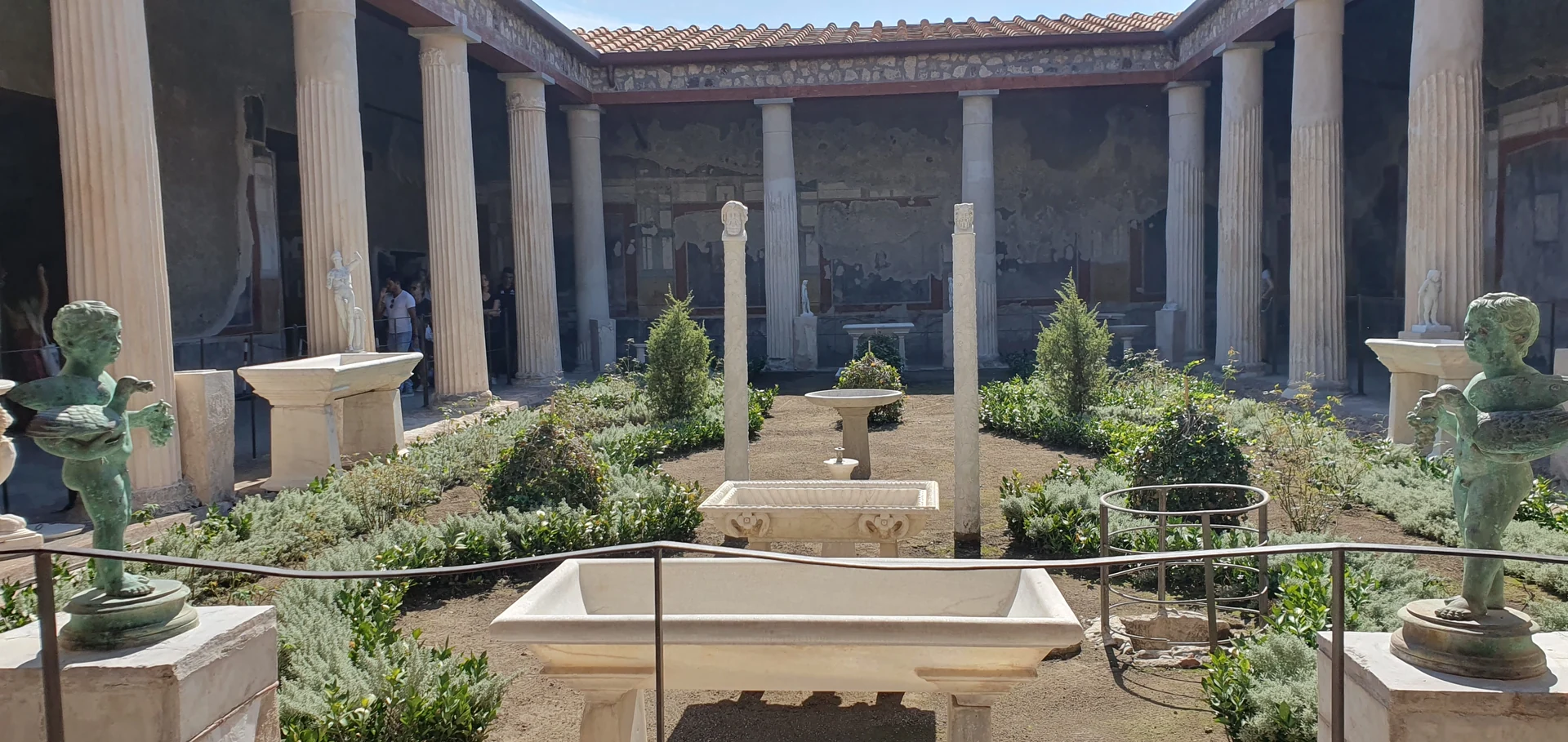
Freedom itself had degrees. Formerly enslaved people could become freedwomen and freedmen, build businesses, create households and accumulate wealth while retaining obligations to former owners and facing political limits. The Vettii brothers, generally identified as freedmen, turned their house into a spectacular performance of arrival. Their paintings, garden and reception rooms are not a neutral sample of domestic life; they are one ambitious household's architecture of display.
Enslaved people remain harder to see because law treated them as property and elite texts rarely centred their voices. They cooked, carried water, cared for children, kept accounts, worked shops, tended gardens and fields, cleaned baths, produced cloth and laboured in bakeries. A service corridor, small sleeping space or chain found in a work context may make coercion visible, but room function and personal status are not always certain. Calling every small room “slave quarters” simply replaces silence with confidence the evidence cannot support.
Children also inhabited work, worship, play and danger. Migrants and travellers passed through a trading town, while soldiers, rural workers and visitors connected it to a wider Mediterranean. Bioarchaeology and isotope research can reveal origins and diet at a population level; graffiti and electoral notices reveal literacy, humour, desire and faction unevenly. No single house represents “the Roman family.”
A humane interpretation keeps returning to this imbalance. The grand atrium was designed to control approach and attention. The person who scrubbed its floor may have entered through another route. The decorated dining room reveals taste and performance. It does not show the full chain of people who produced, transported, cooked and served the meal.
.jpg)
04 · Read the site
Streets were infrastructure, not a punchline about sewage
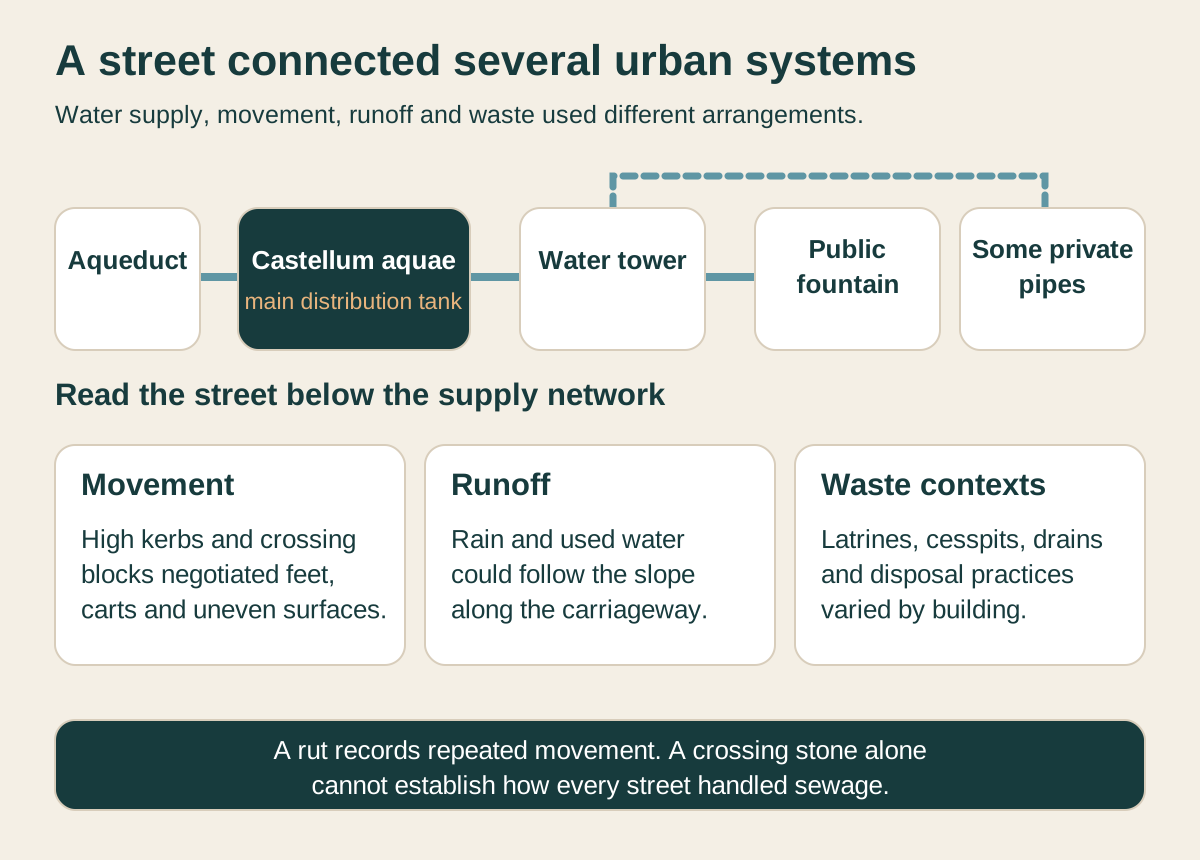
The ruts in Pompeii's paving are vivid, but they are not speedometer readings or proof of a universal one-way system. Repeated traffic wore stone. The spacing of crossing blocks allowed some wheeled vehicles to pass between them. Kerbs separated pedestrians from the carriageway, and building entrances negotiated steep local changes. Scholars use rut patterns, street widths, barriers and wear to reconstruct movement, yet traffic rules probably varied by place and circumstance.
Water reached the city through an aqueduct and a distribution system that used the high point near the Vesuvian Gate, secondary towers, lead pipes and public fountains. Some houses and baths had private connections, while cisterns and roof collection remained important. A fountain was not just picturesque street furniture. It reduced the distance many residents had to carry water and created a social point in the neighbourhood. The stone around its basin records hands, containers and long use.
Waste was more fragmented. Some latrines connected to cesspits or drainage arrangements; water from baths and houses could move into streets; rain washed surfaces downhill; and some rubbish was reused, dumped or removed. Pompeii did not possess a single modern sewer network, but neither was every road continuously flowing with human waste. The dramatic shorthand—“Romans used the street as an open sewer, so they invented stepping stones”—compresses rainfall, topography, traffic, waste and pedestrian movement into one joke.
Public fountains, baths and latrines also expose inequality. Access to water did not mean equal labour. Someone carried it. Bath heating required fuel and workers. Private plumbing was a privilege and could be interrupted. The hypocaust beneath a heated room circulated hot gases through a raised floor and wall cavities; it was a built heating system with ancient precedents, not the sudden invention of modern radiant heating.
What to read in the Stabian Baths
The Stabian Baths sit at the meeting of Via Stabiana and Via dell'Abbondanza, so a stop there can connect the street's water system with the use of bodies inside a public building. The changing room, or apodyterium, organised arrival and clothing; the tepidarium was a warm room; the caldarium supplied hotter bathing; and the frigidarium offered cold water. These names explain functions, not a compulsory sequence followed by every ancient visitor. Read the relationship between rooms, pools and the courtyard before concentrating on ornament.
Excavation research places the construction of the baths in the second century BCE and distinguishes successive changes, including a sweat bath, cold-bathing facilities and aqueduct supply, then a western wing with a swimming pool and ornamental water features. The building's history is therefore a history of altered expectations and resources. Its final form should not be projected unchanged into the earliest phase, and the impressive heating system should not be detached from water supply, fuel, cleaning and repair.
Provision was also unequal. In the final arrangement, the men's section included a courtyard for exercise, a swimming pool and a wider range of rooms; the women's section was smaller and offered fewer facilities. Research published in 2024 identified two earlier circular sweat rooms beneath the courtyard and interpreted them in relation to male privilege. They were reburied after investigation. Standing on a courtyard thus does not mean that all the evidence is visible: archaeology can produce knowledge and deliberately return fabric to protective cover.
The useful question is who could use each space, with what comfort, and whose work kept it running. A decorated ceiling records investment in the bather's experience. A furnace and service area point toward the repeated labour that made that comfort possible. Bathing brings the article's themes together: technological change, gender, public provision, maintenance and the difference between what survives and what is displayed.
.jpg)

05 · Read the site
Food reveals work before it reveals a menu
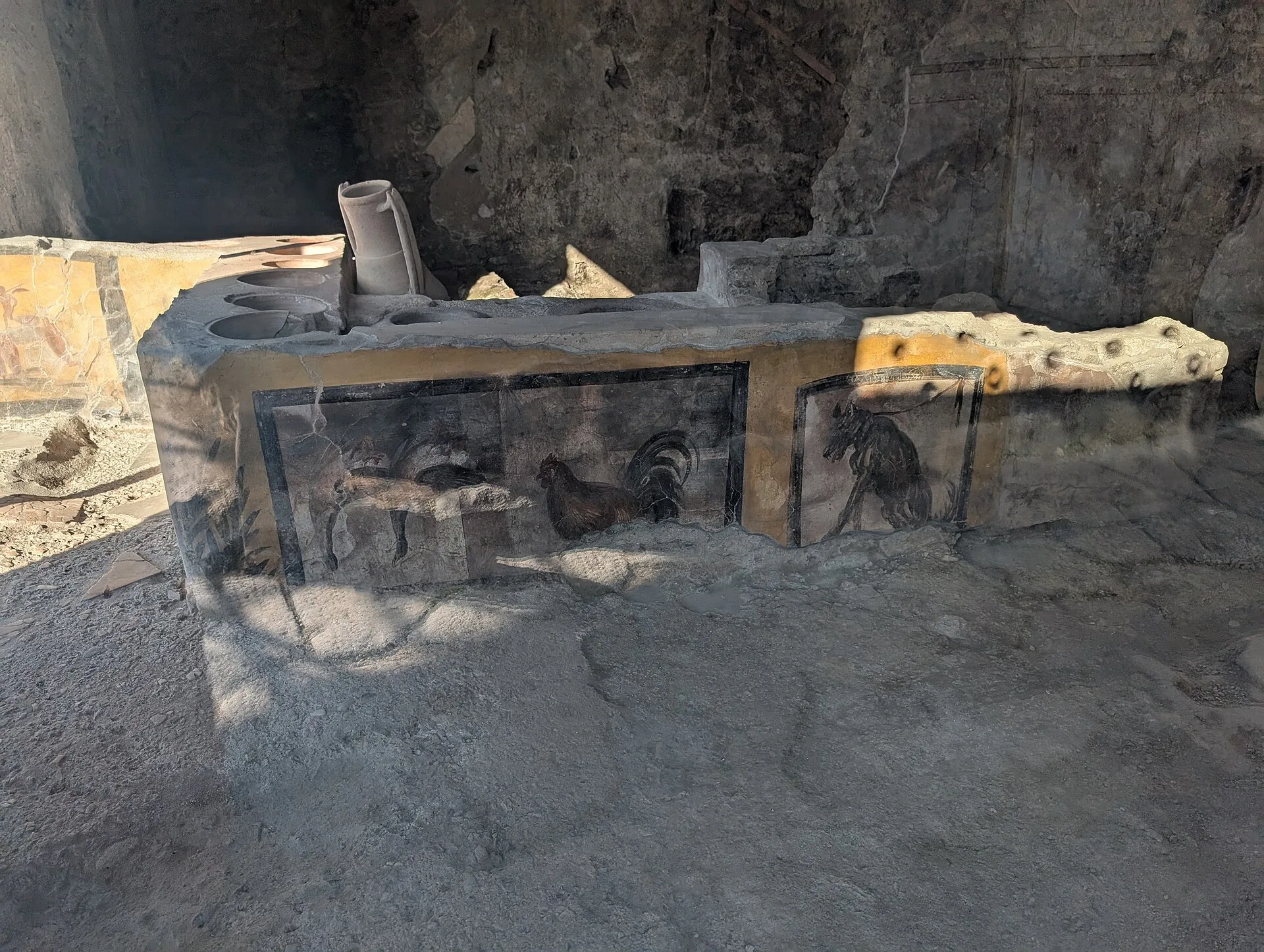
Pompeii's counters with large inset jars are conventionally called thermopolia. Roughly eighty have been identified across the city, although their layouts and services differed. They sold food and drink to people whose homes might lack elaborate cooking facilities, to workers moving through the street and to customers seeking convenience. “Ancient fast food” is a useful first comparison only if it is not mistaken for the conclusion.
The counters were not Roman drive-throughs. Customers approached on foot. The jars may have held dry goods or supported serving vessels as well as liquids; storing every food directly in deep fixed containers would have made cleaning difficult. Painted images can advertise abundance or identity without functioning as literal menus. Animal and plant remains recovered from drains, vessels and deposits provide firmer evidence, but a residue from one context does not define every meal sold in the city.
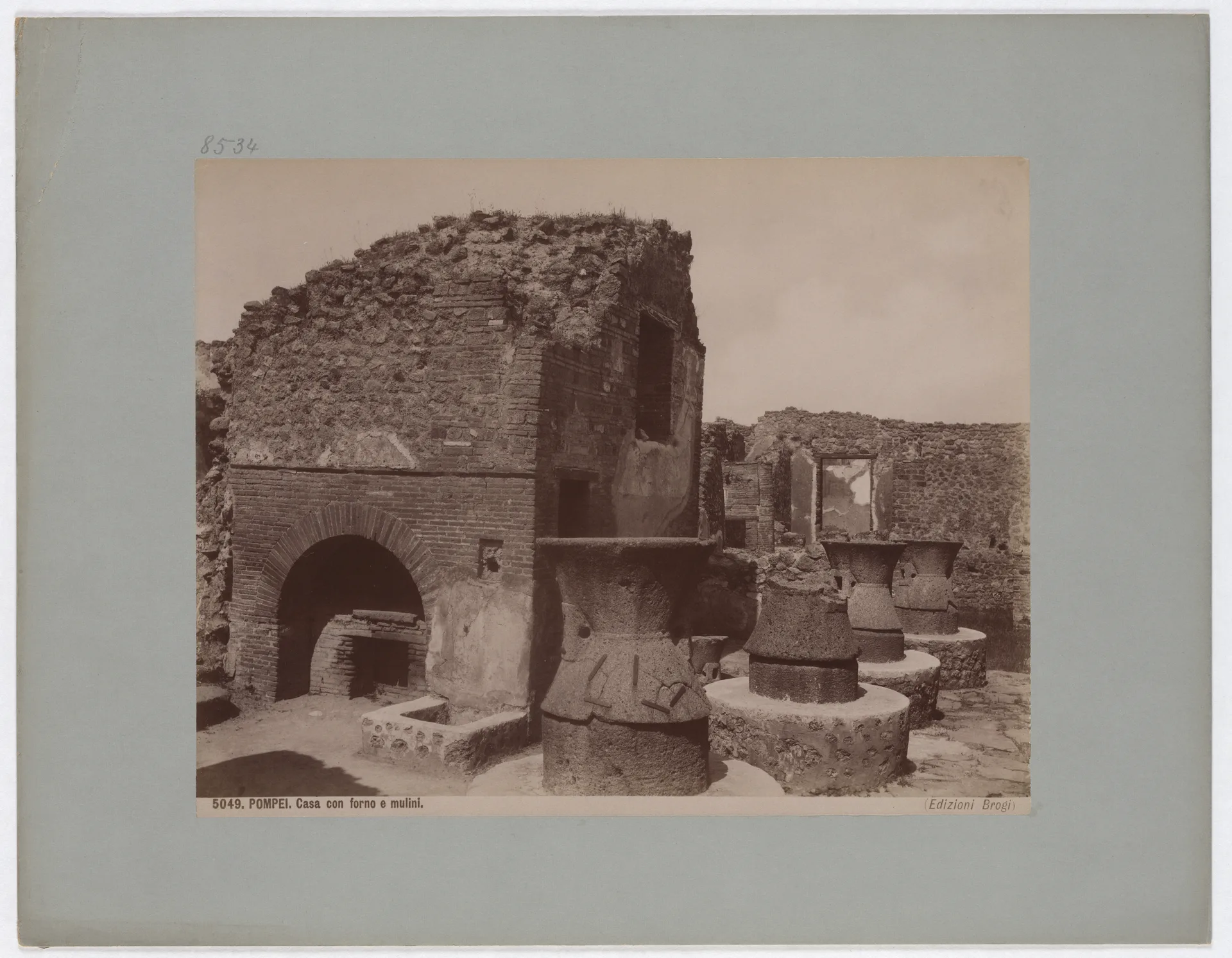
Bakeries make the labour system harder to ignore. Hourglass-shaped lava millstones turned grain into flour. Ovens, work surfaces, storage and animal movement occupied dense premises. Some mills were driven by donkeys or mules; people performed the loading, sifting, kneading, firing, carrying and selling. Enslaved labour was part of this economy. A beautifully preserved oven cannot be interpreted only as a precursor to an artisan bakery.
Markets and street shops were linked to farms and transport beyond the walls. The Macellum beside the Forum is often presented as a lunch market, but its functions and the timing of activity cannot be reconstructed as a single frozen meal. Fish bones, seeds, amphorae, carbonised foods and graffiti open different windows. Together they show supply networks, taste, preservation and status—not a complete menu for a particular weekday.
.jpg)
.png)
06 · Read the site
The final generation lived through repair
A major earthquake struck the region in 62 or 63 CE. Ancient writers record damage in Campania, and Pompeii's buildings reveal repair, rebuilding and unfinished work. Later tremors compounded the problem. By 79, the city was not a fully restored monument awaiting destruction. It was a place where owners, tenants, craftspeople, officials and labourers had made different decisions about what to repair, replace, abandon or redecorate.
That uneven recovery helps explain building evidence. Masonry patches can strengthen a wall. Reused blocks can be pragmatic rather than careless. A room stripped of decoration may have been awaiting new plaster. A business could operate beside a construction site. Public rebuilding provided opportunities for patrons to attach their names to restoration, while households with fewer resources adapted more modestly.
The earthquake also changes how the eruption is narrated. Residents had experienced seismic activity before. Some tremors were part of ordinary regional life; others may have intensified before the eruption. It is tempting to turn every crack or repair into a warning ignored by complacent inhabitants. That judges people with knowledge they did not possess. Modern volcanology can connect earthquakes, magma movement and eruption processes in ways a first-century household could not.
At the same time, prior damage affected vulnerability. A weakened roof accumulated pumice differently from a sound one. Blocked routes, stored materials and repair trenches could influence escape. The disaster met a real built environment, not a model city. Archaeologists therefore read the final deposits together with the condition of walls and roofs beneath them.
07 · Read the site
The eruption changed character over many hours
Pliny the Younger, observing from across the Bay of Naples, later compared the rising cloud to a pine tree: a tall trunk spreading into branches. His letters are indispensable eyewitness sources, but they describe what he saw at a distance and what others later told him. They do not provide a minute-by-minute account for every street in Pompeii.
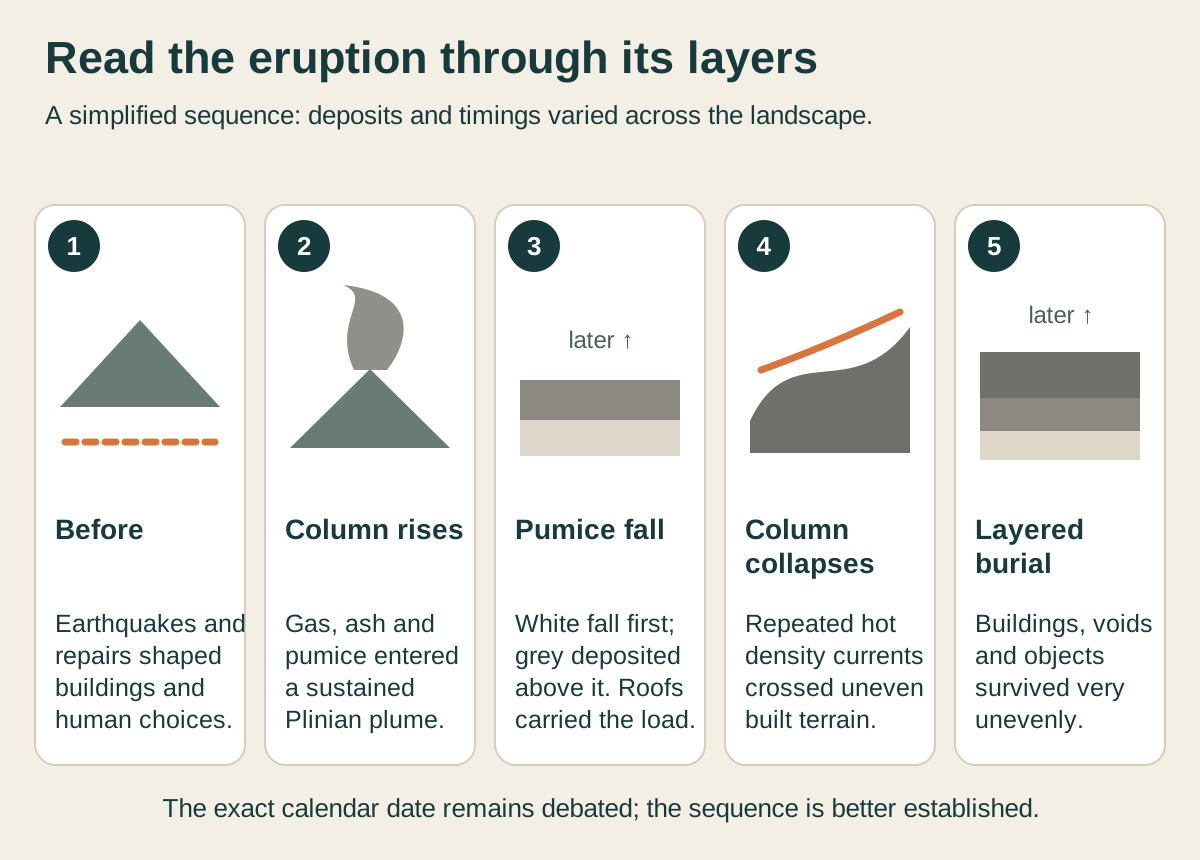
Volcanological research reconstructs a sustained explosive column that carried gas, ash and pumice high above Vesuvius. Wind directed much of the falling material toward Pompeii. White pumice was followed by greyer material as the eruption tapped changing magma. Accumulating lapilli made movement difficult, obscured streets and loaded roofs until some collapsed. Darkness, tremors and falling fragments would have altered decisions hour by hour.
As the column became unstable, parts collapsed and generated pyroclastic density currents: ground-hugging mixtures of hot gas, ash and particles. Repeated currents crossed the landscape rather than one uniform “wall.” Topography and the urban fabric affected how they moved. Pompeii had already received a deep pumice fall before later currents entered and filled remaining spaces. Causes of death varied with location and phase; collapse, impact, burial, heat and inhalation cannot be reduced to one cinematic mechanism.
The exact calendar date is still debated. The earliest surviving manuscripts of Pliny's letter transmit 24 August. Archaeological evidence including autumnal produce, clothing, a coin and a fragile charcoal inscription dated 17 October has supported a later date. A 2024 Pompeii Archaeological Park review of the manuscript problem warns that the frequently repeated 24 October is not itself securely transmitted. The honest label is “79 CE,” followed by an explanation of the open debate.
Likewise, the city was not buried by “six inches of ash an hour” everywhere, nor did everyone die instantly. Deposit thickness and timing varied. Some people left early. Some sheltered. Some returned or moved during lulls. Some were trapped by collapse. The archaeology records different decisions without allowing us to hear the conversations behind them.

08 · Read the site
Escape, shelter and return were decisions under uncertainty
Disaster stories often divide ancient residents into those wise enough to flee and those foolish enough to remain. The evidence does not support that moral sorting. Leaving required a route, physical ability, information, confidence and somewhere to go. Children, older people, disabled people, enslaved workers and anyone responsible for others faced different constraints. Falling pumice made streets and roofs dangerous; darkness and earthquakes made direction harder; possessions could be essential to survival after evacuation, not merely evidence of greed.
Some victims were found with keys, money, jewellery, tools or containers. These assemblages can suggest preparation or identity, but they do not reveal the exact motive. A key could mean hope of return. Coins could be ordinary travel resources. A valuable worn on the body might be normal. Archaeology should resist turning objects into final dialogue.
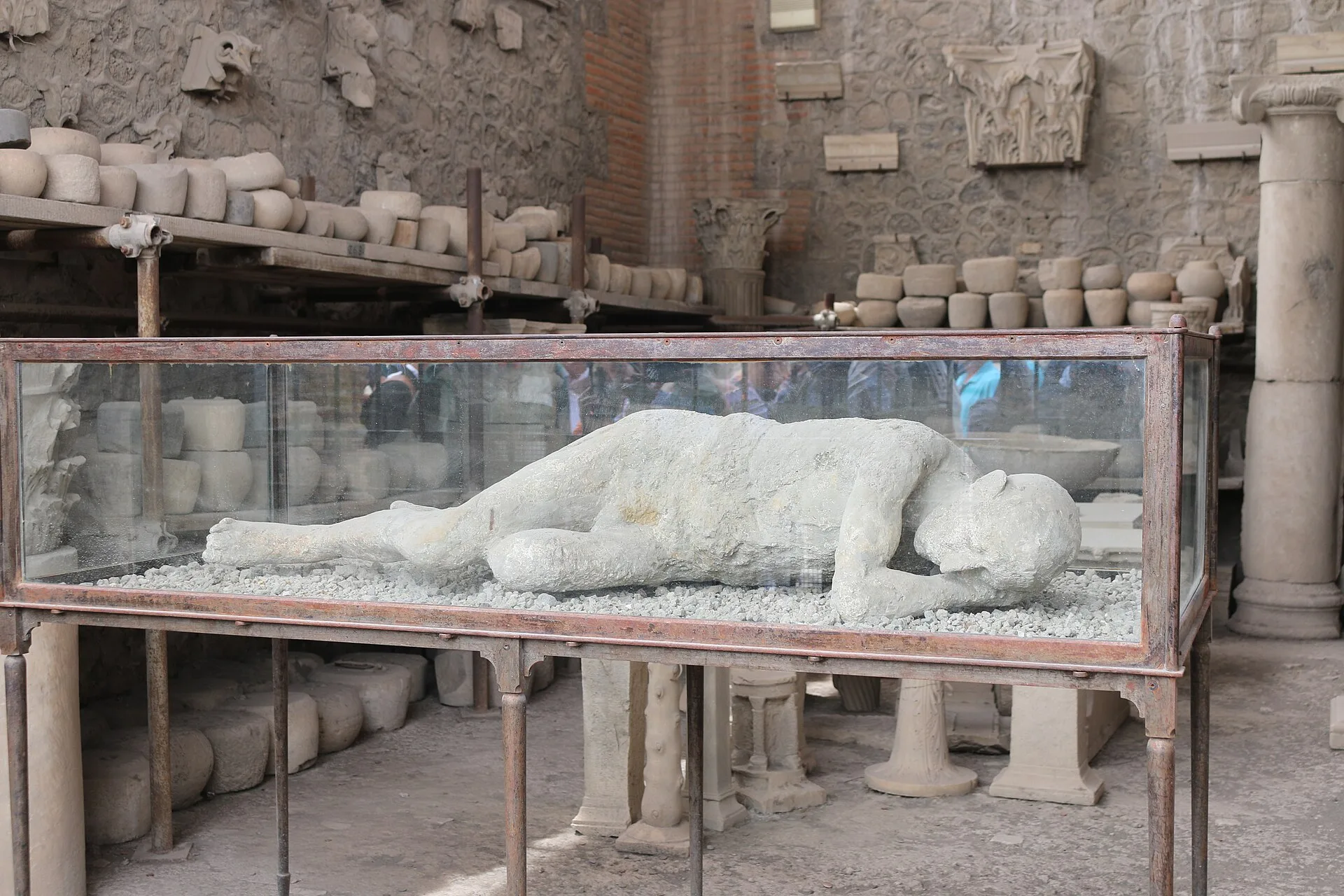
Nor does a body position reliably record emotion. A cast can preserve the outer space around clothing and limbs at a late stage of burial; it is not a photograph of a face at the instant of death. Movement of deposits, decomposition, later damage and the casting process intervene. Labels such as “the praying man” or “the mother protecting her child” can harden an affecting pose into an invented biography.
The strongest account remains both personal and restrained. People made choices as conditions deteriorated. Some choices worked for a time and then failed. Others succeeded, which is why the dead are not the whole population. Survivors carried knowledge, grief and claims into the post-eruption landscape, even though their stories are less visually present than the casts.
09 · Read the site
The casts are evidence, remains and an ethical encounter
When organic tissue decomposed inside compacted ash, it could leave a cavity around bones, clothing and objects. In 1863, Giuseppe Fiorelli's team systematically poured plaster into some of these voids. Once the surrounding deposit was removed, the cast preserved the negative space as a positive form. The technique recovered details that ordinary excavation would have destroyed, but it also created a new object combining modern material, ancient bones and the final burial context.
Just over one hundred human casts have been made, while remains of more than a thousand victims have been found across Pompeii. Plaster was not the only medium: later work experimented with cement and transparent resin, and casts of doors, furniture, roots and other organic materials expanded the method beyond bodies. Modern teams use radiography, CT, laser scanning, photogrammetry and 3D printing to examine or reproduce casts with less handling.
Science can correct confident visual stories. A 2024 Current Biology ancient-DNA study found that some widely repeated relationships and sex identifications assigned from pose or appearance did not match genetic evidence. The lesson is larger than the sample: a composition that looks like a family tableau may be a product of assumption, excavation history or display.
Display creates obligations. These are not props for disaster tourism. Photography should follow the park's rules, avoid comic poses or intrusive close-ups, and never use a cast as a backdrop for self-performance. Children may need preparation before entering a display. Adults are allowed to decide that viewing human remains is not part of their visit.
A respectful guide explains the method before narrating emotion, distinguishes bones from cast surface, and acknowledges uncertainty. The casts deserve attention because they reconnect urban systems and volcanic processes to individual bodies. Dignity begins where invented intimacy stops.

10 · Read the site
Burial did not erase the city from human activity
The eruption transformed the coastline and buried settlements unevenly, but the zone did not become an untouched secret. Survivors and others returned to recover materials and possessions where access was possible. Ancient tunnels and breaches show organised salvage as well as looting. Upper walls remained visible in places. The name and memory of Pompeii survived in texts and local geography even as the urban plan disappeared beneath new ground.
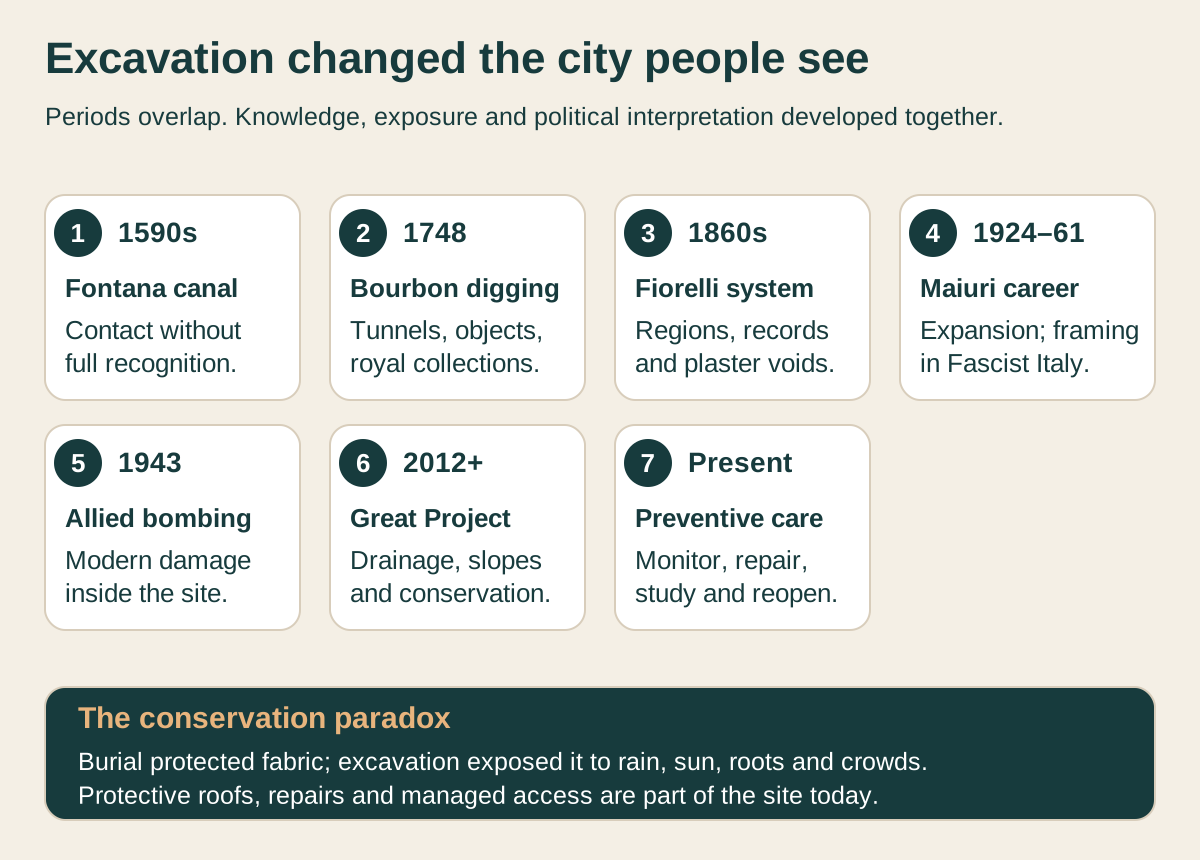
In the late sixteenth century, engineer Domenico Fontana drove a water channel through buried structures while building the Sarno canal. His workers encountered walls, objects and inscriptions. This was contact, not the single cinematic “rediscovery” of a lost city. The works did not become a systematic excavation, and some evidence was cut or passed through.
Bourbon-sponsored exploration began at Herculaneum in 1738 and at Pompeii in 1748. Early excavators tunnelled in search of sculpture, paintings and valuable objects for royal collections. Context could be poorly recorded; paintings were cut from walls; routes were backfilled or kept secret. Yet methods changed over the century as the street plan emerged and visitors arrived. Pompeii became a laboratory for archaeology, art history, architecture and tourism before those disciplines had modern boundaries.
Every phase produced knowledge and loss. Removing an object could save it from exposure while severing it from its room. Clearing soil could reveal a façade and eliminate later deposits. Rebuilding a wall could stabilise it and make an uncertain ancient form appear complete. The history after 79 is not an appendix. It determines what a visitor can see.
11 · Read the site
Excavation methods carried politics
Fiorelli, director from 1863, helped move work toward systematic top-down excavation and fuller recording. He divided the city into numbered regions, blocks and doorways—the regio, insula, doorway addresses still used today—and opened access to paying visitors. His plaster method made voids legible. These innovations did not make nineteenth-century archaeology neutral, but they improved the relationship between finds and place.
Amedeo Maiuri directed Pompeii from 1924 to 1961. His long tenure exposed large areas, including houses south of Via dell'Abbondanza and the Villa of the Mysteries, and developed the site for mass visitation. Speed and broad clearance created the Pompeii many visitors recognise. They also exposed fragile fabric at enormous scale, encouraged reconstruction and sometimes privileged persuasive historical narratives over later caution.
Maiuri's work operated through Fascist rule, when ancient Rome was mobilised to legitimise the modern state. Excavation, road building, spectacle and official visits could present Pompeii as evidence of revived imperial greatness. That context does not erase every scholarly observation or conservation effort; it requires visitors to ask why particular areas were cleared, framed and connected when they were.
Modern war then entered the ancient site. Allied bombing in 1943 damaged buildings, decorations and stored casts. Some bombs may have targeted nearby transport and military infrastructure; their impact inside Pompeii was real. Pre-war photographs by researchers such as Tatiana Warscher became essential evidence for lost façades and paintings. Post-war restoration added another layer of intervention.
.png)

12 · Read the site
Conservation is the present tense of Pompeii
Excavation ends one protective condition and creates a maintenance obligation. Rain enters wall tops. Sun and temperature changes affect pigments and mortar. Salts move through porous material. Roots widen cracks. Earlier iron cramps corrode. Protective roofs change drainage and airflow. Visitors concentrate wear on thresholds and paving. The archaeological site is therefore a working landscape of monitoring, scaffolding, drainage, documentation, repair and selective closure.
A crisis became especially visible after collapses including the Schola Armaturarum in 2010. The Italian state and European Union backed the Great Pompeii Project, an investment of about €105 million focused on stabilising excavation fronts, improving drainage, conserving structures, documenting conditions and strengthening management. Its achievement is not a once-and-finished restoration. It created systems for continuing care and enabled research where safety work exposed new deposits.
Recent discoveries in Regio V and Regio IX are often reported as treasure reveals: painted rooms, a food counter, bodies, inscriptions, construction scenes. Their deeper value comes from context and interdisciplinary method. Archaeologists work alongside volcanologists, architects, engineers, conservators, archaeobotanists, anthropologists and digital specialists. Soil layers, repair sequences, seeds and tool marks can matter as much as a vivid fresco.
This is why a closure is not necessarily a failure or a reason to force an alternative entrance. The park's open-buildings list changes as conservation proceeds, so a sound route is built around questions and nearby alternatives rather than a promise that one named interior will always be available.
A good visit treats scaffolding as evidence of care and route changes as part of the site's life. “What are they conserving, and why?” may yield more insight than rushing to replace one closed highlight with another famous room.
13 · Plan the visit
Build a route from questions, not a checklist
Pompeii is too large and too changeable for a reliable two-hour list of guaranteed interiors. A focused route can still be coherent. Begin with orientation: locate Vesuvius, the old coastline, the city gates and the slope. Then let the street do analytical work. Read paving, kerbs, wheel wear, crossings, fountains and shop thresholds before entering a prestige house. The city will stop looking like a collection of villas.
A civic sequence around the Forum can connect government, cult, market activity, commemoration and patronage. A domestic sequence should contrast, not merely accumulate luxury: an atrium house, a shop-house relationship, a garden or service space, and evidence of repair. A work sequence can connect bakery, fullery, food counter or workshop to water, animals, enslaved labour and supply from the countryside. Baths add fuel, water, heating, bodily practice and maintenance.
The eruption sequence should be read in deposits and building damage rather than saved for the casts alone. Ask where pumice accumulated, why some roofs failed, how later currents entered, and which excavation cuts reveal layers. The casts belong after this physical explanation. Otherwise human remains become a dramatic shortcut around the disaster's complexity.
End with excavation and conservation. Look for modern roofs, repaired wall tops, drainage channels, supports, faded labels and boundaries between cleared and unexcavated ground. The final insight is that Pompeii has no finished state.
The park publishes a current official map and excavation guide. Use them to choose two or three priorities plus substitutes in the same area. Do not cross the entire site repeatedly to collect famous names. Distance consumes interpretation, and summer heat makes repeated crossings tiring.
A coherent sequence through the western city
For an arrival through the western entrances, use the Forum as the anchor and keep the exit in mind. Its north–south axis brings the Temple of Jupiter and Vesuvius into the same view. Along the edges, changes of building type matter more than the number of columns. The Basilica served business and the administration of justice; it was not a Christian church. At the Macellum, a courtyard, shops and a central circular structure connect the market with food processing, while a raised cult space shows that commerce and imperial religion occupied the same complex. These are contrasting civic functions within a short walk.
At Eumachia's building on the eastern side, attach a person to the architecture. Its dedication identifies her as a public priestess and names her son Marcus Numistrius Fronto alongside her patronage. Fullers honoured her with a statue; the figure displayed on site is a copy. The surviving inscription ties a woman's expenditure to family standing and imperial values. It gives a firmer starting point than imagining a conversation in the square, while leaving the building's full range of activities open to interpretation. The park's account of Eumachia and her building records both the dedication and the statue.
Continue east along Via dell'Abbondanza toward its junction with Via Stabiana. A fountain, crossing or shop threshold makes a useful pause on the way to the Stabian Baths: the sequence moves from civic prestige through street infrastructure to public bodily care. Add one accessible domestic or working interior in this area rather than rushing north to a famous house and then back again. If the Vettii house is a priority, give its northern position room in the plan and shorten something else. The pleasure of a peristyle disappears when it is treated as a photograph to collect between hurried crossings.
An Esedra-based loop can instead start or finish around the theatre area, then connect Via Stabiana, the baths and Forum. The park's suggested itineraries distinguish routes of different lengths and entrances. Use them as spatial examples alongside the live open-buildings list. Set the departure point, a place to rest and a latest turn-back time before adding another monument. This sequence supplies an intelligible visit even when a particular interior is unavailable; it does not assume that everyone can or should cover the same ground.
14 · Plan the visit
A licensed guide is not automatically an archaeologist
Italy has a national framework for tourist guiding and a Ministry of Tourism register of authorised guides. Ask who will lead the visit and how their professional qualification can be checked. Licensing establishes a legal role and a knowledge threshold; it does not mean every guide has an archaeology degree or active excavation experience. Conversely, an archaeologist's credential does not automatically make that person an effective guide for a mixed group. Ask precise questions: who leads, in which language, for how long, what is the group size, and how does the route adapt to closures and mobility?
A strong guide can make stratigraphy, water systems, social inequality and conservation visible while managing a large site efficiently. The trade-off is pace and selection. A two-hour group route cannot cover every house, and the group may move when an individual wants to linger. Headsets help larger groups hear but do not repair a generic script.
The park's authorised audio guide offers consistency and independence. It works best when paired with the official map and a preselected route. It cannot answer a question, see that a doorway has closed or judge when the group is exhausted. Check which device and headphones the authorised service supplies or requires. Keep enough awareness of uneven paving and staff directions while listening; an audio track cannot choose a safe place to stop for you.
Independent visiting offers maximum control and the greatest planning burden. Primary interpretation from the park is preferable to a viral list of “secrets.” A reader can compare evidence on site, slow down for one neighbourhood and skip human remains. The risk is spending the first hour navigating or relying on obsolete opening claims.
The choice is not “expert guide or clueless wandering.” It is a fit problem. First-time visitors with limited hours often benefit from a guide who teaches how to read the city. Returning visitors may gain more from a thematic independent route. Families, disabled visitors and people who need frequent rests should value pacing and route flexibility as highly as credentials.
15 · Plan the visit
Accessibility is a route, not a yes-or-no label
Ancient paving, high kerbs, crossing stones, slopes and narrow thresholds create real barriers. It is inaccurate to declare the entire site inaccessible; it is equally inaccurate to market one improved route as universal access. The park's Pompeii for All itinerary extends for about 3.5 kilometres from Piazza Anfiteatro toward the Sanctuary of Venus and improves access to a substantial sequence. The park explicitly notes inclines that may exceed eight percent, abrupt changes in level, uneven surfaces and narrow sections.
A wheelchair user, someone with a cane, a person who cannot stand long, a blind visitor and a family with a pushchair do not have the same route requirements. Equipment dimensions, assistance, surface tolerance, accessible toilets, transfer points, heat and the return journey all matter. Contact the park and tour operator with functional questions rather than asking only whether a tour is “accessible.”
- Which entrance and exact path will the group use?
- Are there steps, crossing stones, steep gradients or narrow thresholds?
- Can the route shorten without separating a participant from the group?
- Where are accessible toilets, water points, shade and staffed assistance?
- Does the rail transfer require lifts, long platform changes or boarding gaps?
- Can a mobility aid be carried on every transport segment?
Sensory and cognitive access also deserve planning. The site can be bright, hot, crowded and visually complex. Quiet pauses, a simple route preview, captions or transcripts, and explicit preparation for human remains can transform a visit. Service animals and support arrangements should be confirmed under current rules.
Choose the journey around the route you can comfortably use. A Naples departure, an adapted private transfer or a shorter independent visit may remove a difficult connection or make rests easier to arrange. Confirm those details before buying, including who will assist and how you will return if you need to leave the group early.
16 · Plan the visit
From Rome, the transfer is the tour's most fragile structure
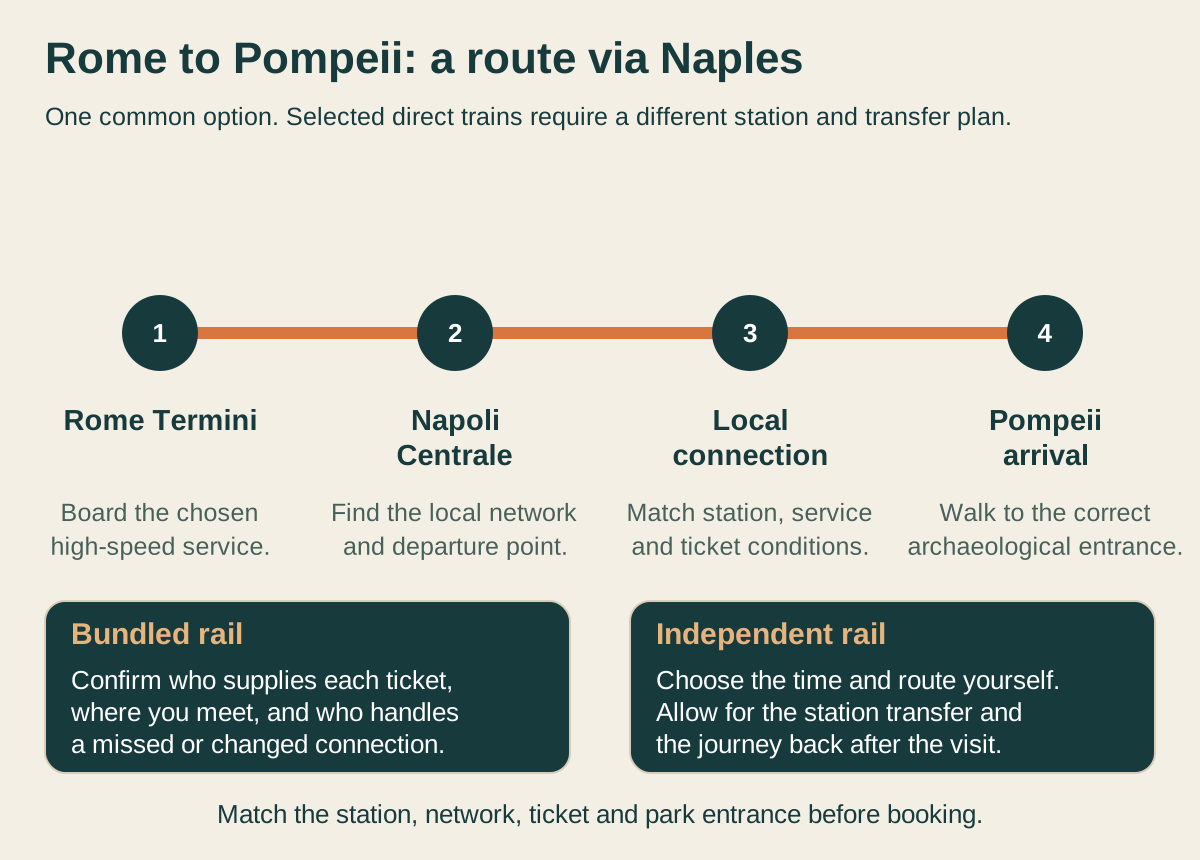
High-speed rail makes Pompeii plausible as a Rome day trip. The usual journey involves a connection; selected direct services need a different plan. The common chain runs from Roma Termini to Napoli Centrale, through a transfer to a local service, then from a Pompeii-area station to the correct park entrance or meeting point. Napoli Piazza Garibaldi is integrated below Napoli Centrale, but finding the route, validating or presenting the right ticket and reaching the platform still takes time.
There are several independent rail patterns. Trenitalia describes high-speed services to Naples with onward regional connections, selected-date direct Frecciarossa journeys, and Frecce plus PompeiLink combinations. Circumvesuviana services operated by EAV use a different network and station pattern. A product may bundle one specific chain. Match the stations and included tickets to the journey you choose.
Station names matter. Pompei, Pompei Scavi–Villa dei Misteri and a PompeiLink bus stop are not interchangeable labels. The closest entrance depends on the service, route and meeting arrangement. A passenger who follows “Pompeii” on a map can arrive at a workable station and still miss a commercial guide.
Digital tickets can have activation or check-in rules that differ by train type and seller. Screenshots, battery level, identification and the lead passenger's booking record should be ready. Platform information can change. Keep the journey's assistance contact accessible and save ticket files where you can find them without a reliable mobile connection.
Allow recovery margin. A same-day itinerary compresses rail, transfer, entry, interpretation and return into one chain. Travel time is not time inside Pompeii. A delayed inbound train can consume the visit; a late return can affect dinner, theatre or onward transport. The strongest day plan leaves the evening flexible.

17 · Plan the visit
Judge a bundled day by the chain it actually closes
A bundled rail day can reduce separate purchases and give the visit a guided core. That convenience is meaningful only when the booking defines every handoff: the Rome departure point, the Naples connection, the Pompeii arrival station, the park entrance, the person responsible for admission, the guided duration and the return obligation.
Read “included rail” as a sequence, not a magic transfer. Confirm whether the local leg is a regional train, a train-and-bus connection or an escorted transfer, and whether a missed connection is protected. Ask how tickets are delivered and activated, which name must match identification, and who can help while the journey is in progress.
The guide will cover a focused portion of the city rather than every house. Before choosing this format, establish whether independent time is possible, which exit leads back to the booked transport and whether leaving the group changes the return arrangement. Pompeii admission ordinarily does not permit exit and re-entry on the same ticket.
The park's current system uses personal tickets and a daily admission limit, while routes and open interiors can change for conservation. A commercial booking should explain how its admission is handled without asking the traveller to buy a duplicate ticket. Live inventory, price, departure time, age tiers and cancellation belong to the checkout chosen for the actual date.
18 · Plan the visit
Compare formats by the time and responsibility they transfer
Bundled rail from Rome is attractive when one purchase and a guided core matter more than flexibility. It concentrates responsibility but still requires punctual self-navigation at the Rome meeting point and through stations. Read the missed-connection policy and identify who assists if the high-speed leg is late.
Independent rail from Rome lets a traveller choose earlier outbound and later return trains, select the preferred entrance and spend longer inside. The cost is responsibility for every ticket, activation, transfer and disruption. It suits confident rail users who want a full archaeological day rather than a compact guided visit.
Staying in Naples shortens the transport chain and makes an early arrival easier. It also gives the Bay of Naples, the National Archaeological Museum and Herculaneum space in the itinerary. For readers whose main interest is the Vesuvian landscape, moving one or two nights from Rome may create more value than optimising a single long day.
Coach tours reduce station navigation and can add Mount Vesuvius or another stop. Road traffic, larger groups and fixed retail or meal stops may consume the gained simplicity. “Air-conditioned coach” is not proof of more site time.
Private car or driver can support a family, mobility equipment or a tailored schedule. It costs more, and the vehicle does not remove walking inside the park. Confirm the precise drop-off, waiting arrangement, luggage security and whether the driver is also a licensed guide; those are different roles.
An overnight near Pompeii offers the best chance to arrive early, rest, revisit the region and avoid building the whole experience around a return train. It is not necessary for every first visit. It is often the better choice for deep archaeology, access needs, photography or summer pacing.
19 · Plan the visit
Heat, stone and bags shape the archaeological day
Pompeii offers limited shade across long exposed stretches. In summer, heat load is not a minor comfort issue. Start hydrated, carry a refillable bottle within current rules, wear a breathable hat and use sun protection. Closed shoes with stable grip are more useful than fashionable sandals on polished, broken and sloping stone. Anyone with heat-sensitive medication or a medical condition should plan with professional advice and a conservative route.
Water fountains may be available, but a broken or crowded point should not become the day's only plan. Food services and opening arrangements can change. A compact snack may be permitted under current regulations, yet eating rules inside archaeological areas should be respected. Do not sit on ancient walls or use a fountain basin as a picnic surface.
The park's visitor regulations currently limit bags to 30 × 30 × 15 centimetres and prohibit bringing larger luggage into the excavations. Do not arrive from a hotel checkout assuming a suitcase will fit somewhere at the entrance. Confirm any staffed storage separately and preserve rail recovery time.
Nominative tickets mean identification matters. Larger guided groups may be required to use audio systems. Drones, tripods, professional shoots and commercial reproduction involve separate rules. Ordinary photography should not obstruct a doorway or ignore barriers. Follow posted rules and staff directions when choosing where to stop.
Plan the return before becoming tired. Save the exit, station and train details offline. Note that the archaeological park generally does not allow ordinary exit and re-entry on the same admission. If staying after a guided tour, confirm that decision with the leader before the group departs and know which entrance remains practical for the booked train.
20 · Plan the visit
Five checks before setting out
- Confirm the transport chain. Record the Rome meeting point, both Naples station levels or transfers, the Pompeii arrival station, entrance and return obligation.
- Confirm the interpretive format. Ask for guide language, credentials, group size, headset use, guided duration and whether independent time is genuinely possible.
- Confirm the route, not a list of famous houses. Check the park's open-buildings page on the day and accept conservation-driven substitutions.
- Confirm access function by function. Discuss gradients, steps, surfaces, toilets, shade, transport boarding and how the group handles a shortened route.
- Confirm the booked terms. Recheck live availability, age tiers, cancellation, inclusions and the responsible contact at checkout.
A successful Pompeii visit does not depend on seeing every promised icon. It depends on understanding why the city changed before 79, how the eruption changed through time, what excavation created, and why conservation sometimes asks a visitor to stop. The route becomes memorable when a street rut, a repair seam, a fountain or a protective roof can carry as much meaning as the famous casts.
Listen · Original field notes
Listen to the journey
The podcast follows the practical anxieties of making Pompeii a rail day trip from Rome: train platforms, the Naples transfer, guided versus audio interpretation, site scale, heat, uneven ground, food counters, baths and the emotional force of the casts.