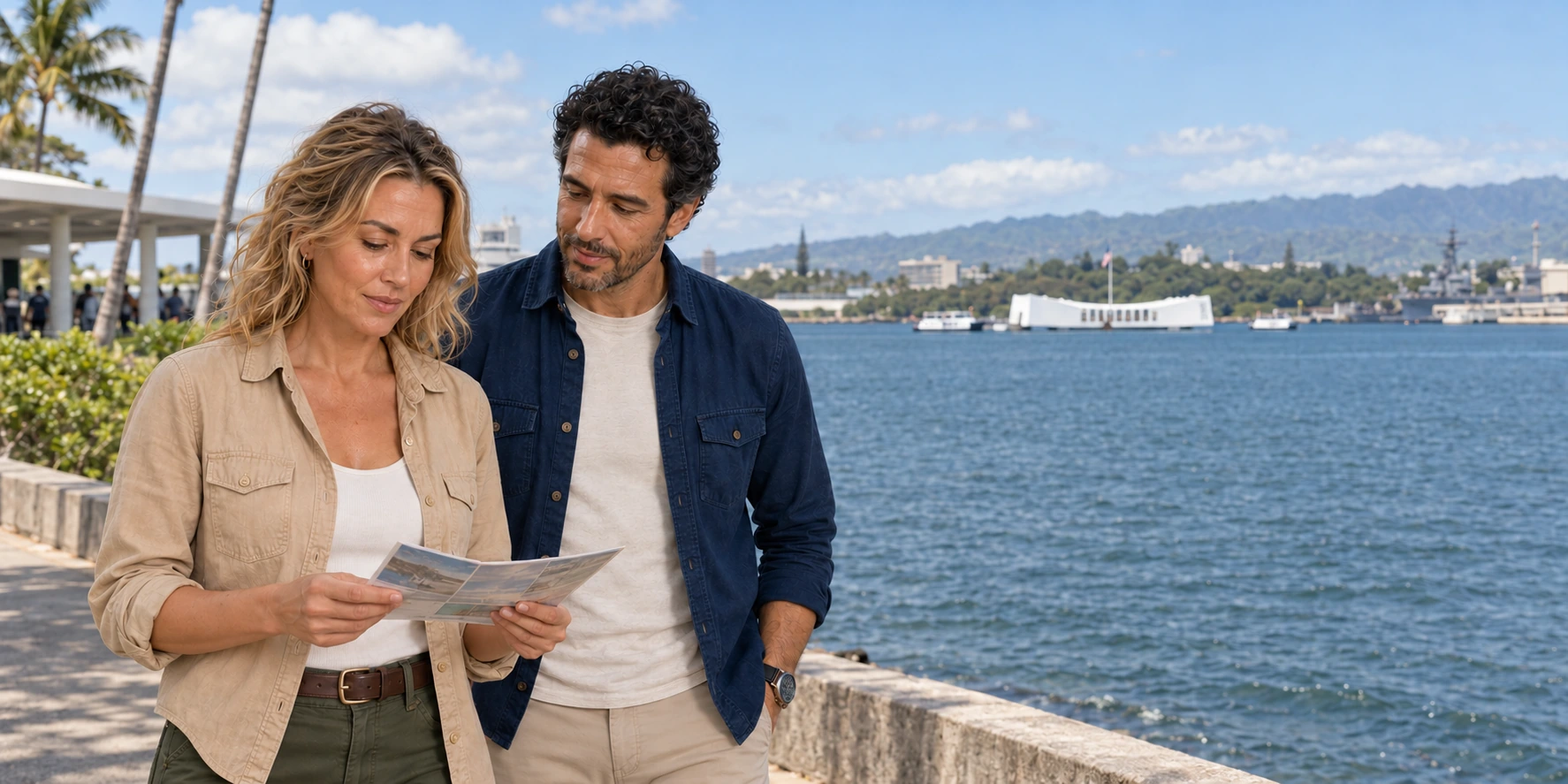
A route from Puʻuloa’s memorial waterfront through Puowaina/Punchbowl to Honolulu’s royal and civic core crosses several systems of memory. A longer day can add a submarine, a battleship and an aviation museum, but understanding what the sequence shows—and what a drive-by can hide—still requires beginning before the naval base, keeping civilians beside service members, and refusing to treat Hawaiian history as an epilogue.
01 · Honolulu memory
One road, several ways of remembering
The useful question on a Honolulu memorial route is not how many landmarks fit into one day. It is what happens to history as the setting changes—and whether the pace leaves enough attention for that change to register.
At Pearl Harbor, federal interpretation, a working naval base and a war grave place the attack of 7 December 1941 at the centre. At the National Memorial Cemetery of the Pacific, loss is ordered across terraces and courts that extend beyond the Second World War to later wars. Downtown, ʻIolani Palace, Aliʻiōlani Hale, the Kamehameha statue, Kawaiahaʻo Church and the State Capitol compress the Hawaiian Kingdom, Christian mission, constitutional government, overthrow, annexation, territory and statehood into a few walkable blocks.
A narrated vehicle can connect those places efficiently. It cannot make every stop an interior visit. The shorter recorded route treats Pearl Harbor as self-guided and much of Puowaina and downtown as orientation from a vehicle. The later full-day recording adds the USS Bowfin, Battleship Missouri and Pearl Harbor Aviation Museum before returning to the same compressed civic district. That distinction is essential. A route can orient; it cannot substitute for entering the palace, reading a memorial gallery slowly or allowing a cemetery to become more than scenery.
Names matter because they reveal which history is being centred. The federal site is Pearl Harbor National Memorial, not the former Second World War Valor in the Pacific National Monument. The royal residence is ʻIolani Palace, the church is Kawaiahaʻo, and the crater is commonly called Puowaina as well as Punchbowl. A careful visit keeps those names distinct from the language of product itineraries and military shorthand.

02 · Honolulu memory
Before Pearl Harbor: Puʻuloa was a lived estuary
Beginning the story in 1941 makes the harbour appear to have been waiting for a navy. It was not. The estuary had Hawaiian names and uses long before the dredged channel, dry docks and Battleship Row.
The National Park Service identifies Wai Momi, “waters of pearl,” and Puʻuloa among the older names associated with Pearl Harbor. Its shores and wetlands supported fishponds, fishing, shellfish gathering, cultivation and settlement. Ford Island was known as Mokuʻumeʻume. Public Hawaiian traditions associate the waters with the protective shark figure Kaʻahupāhau; that tradition should be acknowledged as a living cultural account, not turned into a decorative legend for visitors.
This was an engineered food landscape as well as a natural estuary. Hawaiian loko iʻa used walls, channels, gates, brackish water and close ecological knowledge to manage fish. Calling the harbour “pristine” can obscure that human intelligence. Calling it merely “strategic” erases the people for whom water, land and food production were already joined.
The transformation into a naval harbour was political and physical. The 1887 extension of the Reciprocity Treaty granted the United States exclusive rights to enter Pearl Harbor and establish a coaling and repair station. That agreement came during King Kalākaua’s reign and the same year he was forced to sign the so-called Bayonet Constitution under pressure from armed political opponents. After the United States annexed Hawaiʻi in 1898, naval development accelerated. Beginning in the early twentieth century, dredging cut through reef and sediment to admit large ships; land was acquired, including through condemnation; wetlands, fishponds and shorelines were altered. The present base is not simply a favourable natural harbour. It is a remade Hawaiian place.
That earlier layer does not reduce the reality of 1941. It changes the ground on which the attack is remembered.
03 · Honolulu memory
The attack was short; its consequences were not
On Sunday morning, 7 December 1941, Japanese carrier aircraft approached Oʻahu in two waves. Radar operators detected the incoming formation, but the warning did not produce an effective defence. Beginning shortly before 8 a.m., aircraft struck the fleet at Pearl Harbor and military airfields around the island. Torpedoes hit ships along Battleship Row. Bombs penetrated decks. Aircraft on the ground were destroyed or disabled. Within roughly two hours, the United States Pacific Fleet had suffered catastrophic damage and thousands of military personnel and civilians were dead or wounded.
The USS Arizona became the attack’s most concentrated site of loss. A bomb reached the forward magazines; the explosion destroyed the forward part of the ship. The explosion and fire killed 1,177 of its officers and crew. The hull remains where it sank, with many of the dead still within it.
The National Park Service’s account of the people affected records 2,390 deaths on Oʻahu: 2,341 service members and 49 civilians. A harbour memorial can concentrate attention on a ship, but the losses reached well beyond the fleet. The number is a frame around individual lives, rather than the whole meaning of the event.
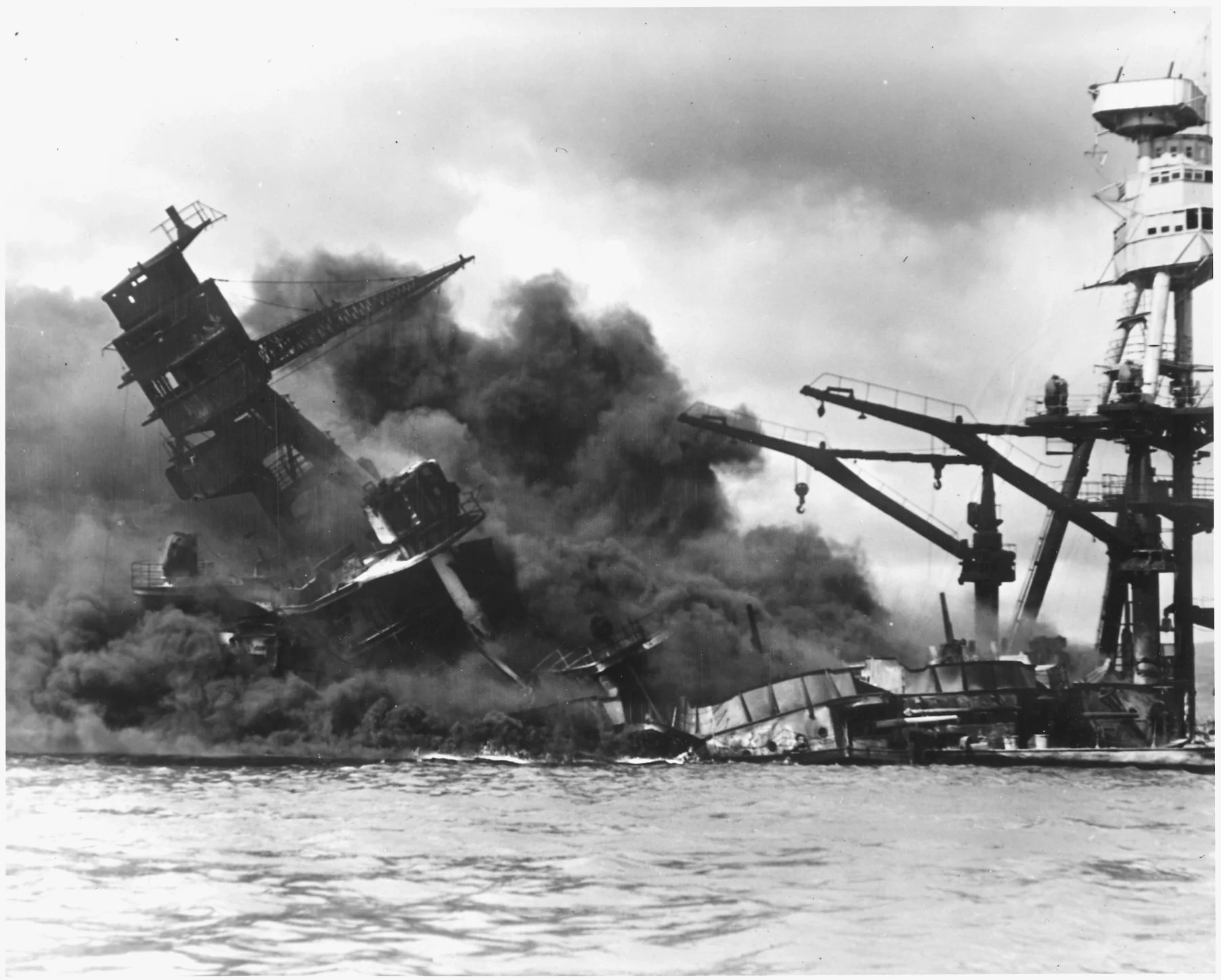
The attack did not occur only on ships. Japanese aircraft struck airfields and other military targets around Oʻahu. Exploding American antiaircraft shells and falling fragments also killed civilians in Honolulu. The National Park Service records 49 civilian deaths and 35 wounded; some were hit by direct attack, others by friendly fire. That fact complicates any clean division between battlefield and city. People were killed in homes, streets, workplaces and vehicles while trying to understand what was happening.
The next day the United States declared war on Japan. Germany and Italy declared war on the United States days later. For the continental United States, Pearl Harbor became the threshold into the Second World War. For Hawaiʻi, it was also the beginning of years under military rule.
04 · Honolulu memory
Why this harbour was targeted
“Surprise attack” describes the defenders’ immediate experience, not a world without warning or context. Japan had invaded Manchuria in 1931, launched full-scale war in China in 1937 and occupied northern French Indochina in 1940. The United States opposed that expansion through diplomatic and economic pressure, including restrictions that cut Japan off from resources vital to its military. Negotiations continued while Japanese planners prepared attacks across the Pacific and Southeast Asia.
Pearl Harbor held much of the U.S. Pacific Fleet. Japanese planners aimed to disable that fleet long enough to secure an expanded defensive perimeter and seize resource-rich territory, including the oil of the Dutch East Indies. The strike was coordinated with operations against the Philippines, Malaya, Hong Kong, Guam and other targets. Hawaiʻi was therefore not an isolated stage on which two nations suddenly met. It was one point in a violent imperial contest spanning Asia and the Pacific.
Context is not exculpation. Japan’s attack occurred before its declaration of war reached Washington and killed military personnel and civilians. Nor does American victimhood at Pearl Harbor erase U.S. colonial power in Hawaiʻi or racial exclusion at home. A mature memorial history can hold aggression, strategy and different forms of empire in the same account without pretending they are identical.
This wider map also corrects the tendency to treat the attack as a self-contained American prologue. Millions of people in China had already endured years of Japanese warfare. The Pacific War that followed would bring mass civilian death, forced labour, atrocities, firebombing and atomic bombs. The Arizona is one grave in a conflict of far greater geographic scale. Its specificity matters precisely because it offers a place from which to face that scale, not because it contains all of it.
05 · Honolulu memory
Courage existed inside unequal institutions
Memorial narratives often need exemplary figures. The danger is allowing heroism to smooth away the conditions in which it occurred.
Doris “Dorie” Miller, a mess attendant aboard the USS West Virginia, helped move his mortally wounded captain and then operated an antiaircraft gun despite having no formal training on the weapon. The Navy later credited his conduct and Admiral Chester Nimitz presented him with the Navy Cross in 1942. Miller was the first Black American to receive that decoration. He died in 1943 when the escort carrier USS Liscome Bay was torpedoed.
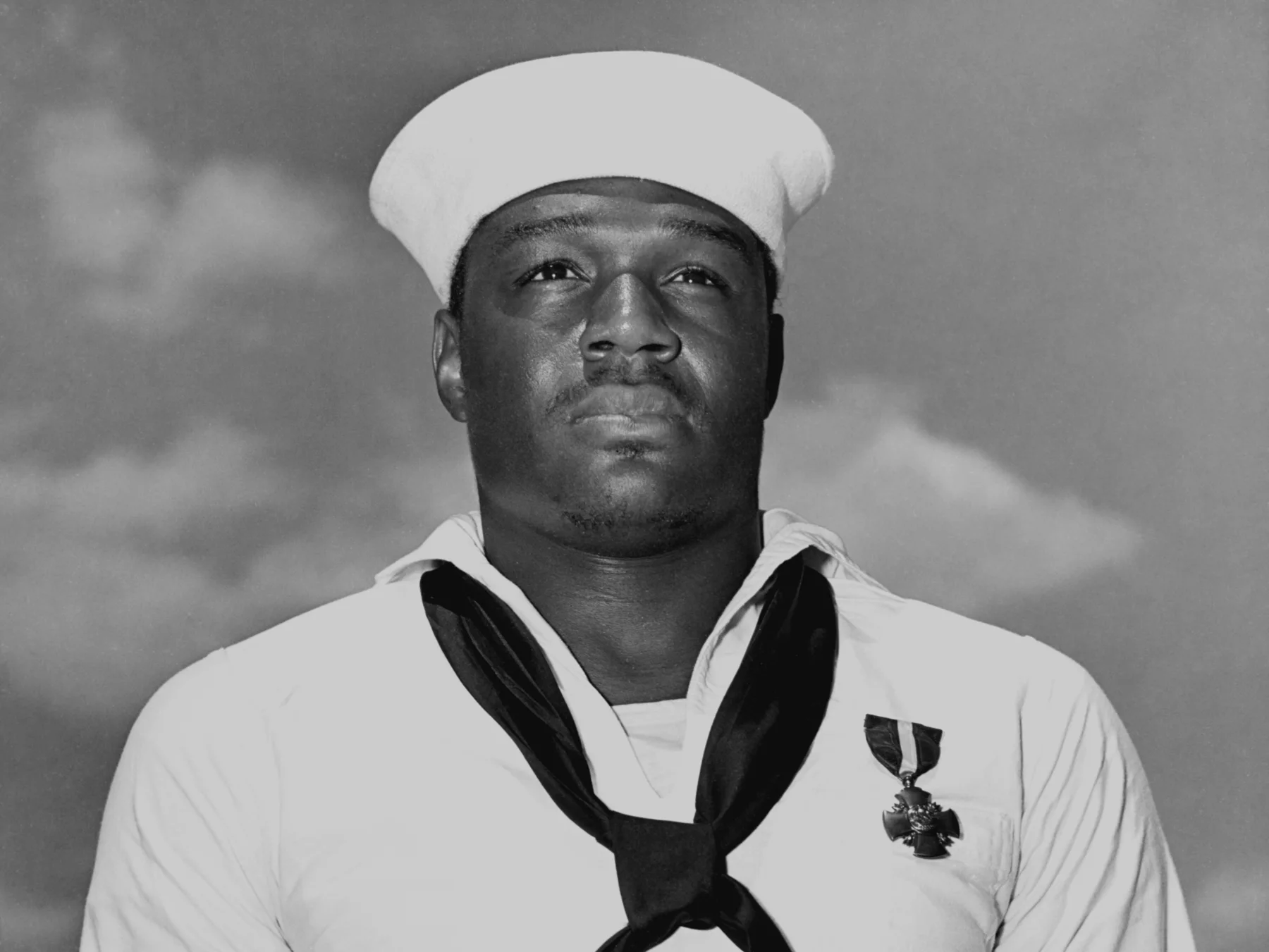
Miller’s story should not be compressed into “he shot down several planes.” Naval historians caution that exact claims about aircraft he may have hit cannot be confirmed. What is documented is already substantial: he acted under fire, assisted casualties and took up a weapon in a Navy that generally confined Black sailors to service roles. His Navy Cross recognised an individual while exposing an institution that had denied men like him equal opportunity.
Other lives widen the frame. Sailor Joseph “Joe” George aboard the USS Vestal threw a line to six men trapped high on the burning Arizona, despite orders to sever the connection between the ships. They crossed hand over hand above burning water. Recognition came much later: the Navy presented a posthumous Bronze Star with a valor device to his daughter in 2017. The NPS account preserves the survivors’ testimony, making this a documented rescue rather than an interchangeable story of bravery. Navy nurses treated casualties amid smoke, wreckage and overloaded facilities. Eleven-year-old Jimmy Lee watched the attack unfold from his family’s farm area and later gave the National Park Service a child’s account of confusion, aircraft and explosions. None of these perspectives is the whole event. Together they resist the idea that only admirals and ships make history.
06 · Honolulu memory
Salvage created the landscape visitors see
The familiar memorial view can make it seem that the harbour settled immediately into its present arrangement. For months and years after the attack, Pearl Harbor was a salvage and repair site. Divers entered dark, oil-filled compartments. Crews cut steel, pumped ships, removed ammunition, recovered remains and returned damaged vessels to service. The work involved extreme physical risk and difficult decisions about where rescue had ended and recovery began.
Several battleships damaged on 7 December were repaired and fought later in the war. The capsized USS Oklahoma was righted in a vast engineering operation but proved too badly damaged to return to service. It sank under tow to the mainland in 1947. The Arizona and the target ship USS Utah remained in the harbour. Arizona’s surviving superstructure and guns were removed, changing the outline visible above the water; the submerged hull became both source material and grave.
This salvage history matters for two reasons. First, the wreck beneath the memorial is not a perfectly untouched instant of 8:10 a.m. It is the product of explosion, fire, sinking, recovery, dismantling, corrosion and preservation decisions. Archaeologists interpret change as well as impact. Second, the labour behind recovery is easy to miss because repair succeeded. A ship returned to war can disappear into an operational history; a ship left in place becomes a memorial. Both outcomes were made by people working in the same contaminated water.
The memorial landscape therefore contains a paradox. It asks visitors to encounter an event that can never be recovered intact, at a site whose post-attack transformation is itself historical evidence.
07 · Honolulu memory
The memorial is a building, a wreck and a living conservation problem
The Navy boat ride to the USS Arizona Memorial is short, but the transition is exacting. Visitors move from an interpretive complex to an active naval harbour, then onto a structure spanning a wreck whose dead remain below. It is not a museum with an object safely behind glass.
Architect Alfred Preis designed the white memorial as a long form that sags in the middle and rises at both ends. He described the depressed centre as defeat and the raised ends as renewed strength. The building, completed in 1961 and dedicated in 1962, contains an entry, a central assembly space open to sky and water, and a shrine room bearing the names of those killed aboard Arizona. Openings admit air and changing light. The building does not imitate a battleship; it creates distance and contact at once.
Preis’s biography adds a documented and unsettling layer. An Austrian Jewish refugee from Nazism, he came to Hawaiʻi in 1939. After the Pearl Harbor attack, U.S. authorities detained him as an “enemy alien.” Members of his family were later killed by the Nazis. The designer of the most recognisable American memorial at Pearl Harbor had himself experienced suspicion and confinement by the nation whose losses he was asked to commemorate.
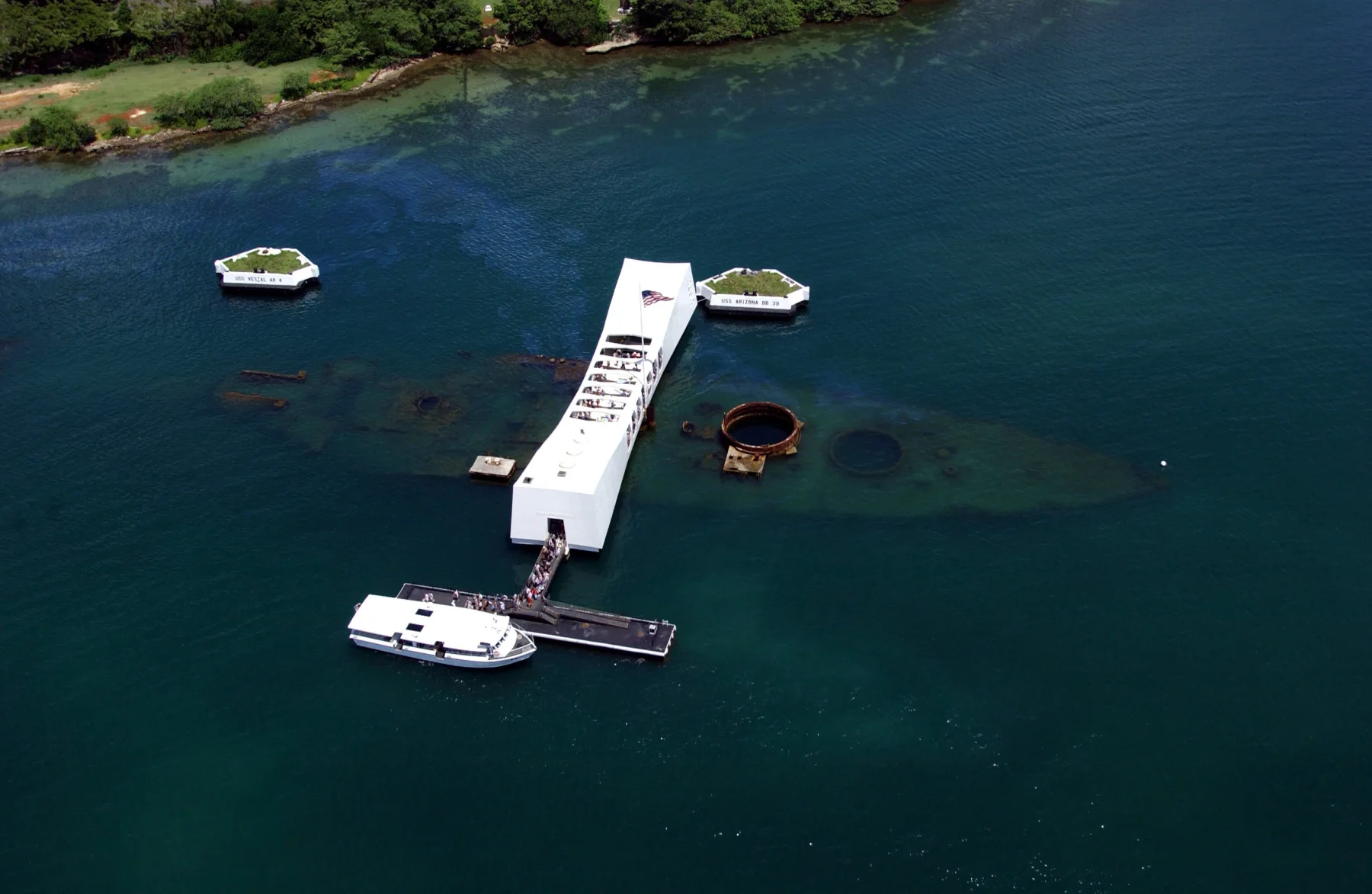
From above, the wreck’s scale becomes legible. The memorial crosses the hull near the middle. Rusted structures remain visible through the water; a circular gun-turret barbette rises above it. Oil still escapes in small amounts from the ship. The popular phrase “black tears” gives that oil an emotional meaning, but it should not replace material truth. The wreck is corroding steel containing fuel, archaeological evidence and human remains in a tidal marine environment.
National Park Service and Navy researchers monitor corrosion, oil release, structural change and water conditions. Estimates of remaining fuel are necessarily uncertain. Immediate removal could damage the wreck and disturb a grave; doing nothing also carries environmental risk as metal deteriorates. Preservation is therefore active engineering and ethical judgement, not a frozen state.
The water also determines what investigators can know. Sediment, runoff and harbour traffic reduce visibility outside the hull; inside, confined spaces and entanglement make entry hazardous. In the NPS underwater research account, earlier remotely operated vehicle investigations found low-oxygen conditions that slowed deterioration. A robot’s tether could snag before researchers reached the spaces they wanted to inspect. The contrast matters: the ship is not corroding uniformly, and seeing one exposed surface cannot reveal the condition of every fuel compartment. The conservation problem joins chemistry, access and the obligation to disturb a grave as little as possible.

The most respectful way to see the oil is not as a promised spectacle. Wind, water and maintenance conditions change what is visible. The reason to look into the water is to understand that the memorial depends on a vulnerable physical site.
08 · Honolulu memory
A full Pearl Harbor day is four institutions, not one attraction
The later full-day route changes the practical question. Instead of pairing the Arizona waterfront with Honolulu’s civic core, it attempts to place four separately operated historic sites into one continuous day: Pearl Harbor National Memorial, the Pacific Fleet Submarine Museum and USS Bowfin, the Battleship Missouri Memorial, and Pearl Harbor Aviation Museum. They share a landscape and a consortium name, but they do not share one admission, one interpretive authority or one access system.
That distinction prevents a common planning mistake. The National Park Service controls the visitor centre grounds and facilitates the Navy boat program to the USS Arizona Memorial. The Bowfin museum sits beside the visitor centre and is reached on foot. The Missouri and aviation museum are on Ford Island, an active military installation; visitors without base access use the authorised shuttle. A ticket to one institution does not silently become a reservation for another, and a commercial itinerary cannot turn a Navy operation into a guaranteed departure.

The USS Bowfin makes the material conditions of submarine war immediate. A visitor crosses high thresholds between watertight compartments, moves through narrow passages and sees torpedo spaces, bunks, machinery and control stations compressed into a pressure hull. Those barriers are not theatrical obstacles added by a museum. Compartments and closable hatches were part of a submarine’s survival system: damage in one section had to be isolated before flooding destroyed the boat.
Bowfin completed nine war patrols in the Pacific. Interpreting the boat well means holding engineering achievement beside what submarines did: attack shipping, enforce blockade, gather intelligence and expose crews to depth charges, machinery failure, heat, exhaustion and confinement. The preserved boat can show scale and systems, but it should not turn combat into an escape-room challenge. Its physical route is steep and constricted; the submarine itself is not wheelchair accessible, although the museum galleries provide an accessible alternative and a virtual tour for people who cannot board.
Across the harbour, the USS Missouri occupies a different place in the war’s chronology. Commissioned in 1944, the Iowa-class battleship joined the Pacific campaign and hosted the formal Japanese surrender on 2 September 1945. The surrender deck is powerful because a specific legal and ceremonial act happened there. It is not a simple place where violence ended everywhere at once. Fighting and captivity had left devastated societies across Asia and the Pacific, demobilisation took time, colonial conflicts continued, and the political order created after 1945 carried new tensions.
Missouri’s later service also resists the neat “war began here, war ended here” slogan. The ship served during the Korean War, returned to active service in the 1980s and fired weapons during the 1991 Gulf War before final decommissioning. A guided route that focuses only on the surrender risks making the enormous vessel into one ceremonial platform. Its propulsion, armour, magazines, gunnery, command spaces and the labour of thousands belong to the story too.
The accessible route on Missouri is necessarily selective. Ramps and an elevator connect the main and surrender decks, while steep ladders, low overheads and narrow interiors limit other spaces. The official accessibility guidance says the wardroom is the only interior room accessible by wheelchair. “Accessible battleship” therefore means access to important highlights, not identical access to every compartment. The shuttle transfer, mobility-device arrangements and the ship route need to be understood as one chain before a traveller commits to the day. The Missouri’s published accessibility guidance asks users of powered wheelchairs to transfer to a manual chair for its shuttle, with staff storing the powered chair during transport. Someone who cannot make that transfer needs a specific arrangement from the institution; the presence of a lift alone does not resolve it.
The Pearl Harbor Aviation Museum restores the aerial scale that a waterfront visit can flatten. Its Ford Island hangars and aircraft place the 1941 attack inside a longer history of reconnaissance, air defence, carrier warfare and industrial production. The buildings are evidence as well as containers for exhibits.
Hangar 37 concentrates on the attack and the early Pacific War. Aircraft, maps and recovered material help distinguish an aerial assault from the view a sailor had at water level. A machine displayed safely on a floor reveals wingspan, construction and crew positions; it cannot reproduce an aircraft moving over the harbour. Comparing those two perspectives makes the exhibits more useful than simply recognising a familiar type. The collection includes aircraft associated with both Japanese and American forces, allowing technical comparison without reducing the conflict to one national viewpoint.
The museum’s documented history of Hangar 79 explains another part of air power. Completed in 1941, it was a maintenance and engine-repair facility organised like a factory floor. Aircraft entered from the harbour side and progressed through workstations; overhead cranes assisted assembly and repair. Electrical equipment, radios, batteries, parachutes and ordnance each needed specialised labour. A warplane depended on this less spectacular world of inspection and maintenance as much as on its pilot.
The museum retains bullet-damaged windows as evidence of the attack. Its account also records American defensive fire across Ford Island when returning carrier aircraft attempted to land that evening. The damaged hangar therefore complicates a tidy division between attackers above and defenders below. Look at the building fabric as well as the aircraft: a surviving workshop can reveal improvisation, fear and the work needed to keep an airfield operating.
The Ford Island Control Tower offers a broader reading of the harbour, but the tower’s access requirements include an elevator followed by two flights of steep stairs. Its optional viewpoint is not step-free. A traveller can still engage with the aircraft and hangars without climbing the tower; choosing that route is a change of perspective, not the loss of the whole museum.
The four sites thus ask different kinds of attention. Arizona is a war grave, architectural memorial and submerged archaeological site. Bowfin is a confined machine interpreted through crew life and undersea warfare. Missouri is a battleship whose surrender deck sits inside a much longer service history. The aviation museum explains air power through aircraft, hangars and the geography of Ford Island. Counting all four as boxes understates them; treating them as one undifferentiated “Pearl Harbor museum” misrepresents who operates them and what each can establish.
09 · Honolulu memory
What happened after the sirens matters here
Within hours of the attack, Hawaiʻi was placed under martial law. Military authorities assumed broad control over courts, movement, work, communications and civilian life. Blackouts, censorship, curfews, identification requirements and military tribunals became part of daily experience. Martial law continued until October 1944—far longer than the immediate emergency.
People of Japanese ancestry faced suspicion, searches, arrests and detention. Hawaiʻi did not experience the same mass removal imposed on the continental West Coast, in part because Japanese Americans formed such a large share of the islands’ population and labour force. That difference did not make the policy benign. Roughly 2,000 people from Hawaiʻi were incarcerated in the islands or transferred to mainland camps, and about a third were U.S. citizens. Community leaders, Buddhist priests, language teachers, journalists and others were targeted, often without normal due process.
The Honouliuli National Historic Site west of Honolulu preserves one of the places where civilians and prisoners of war were confined. It is not on this half-day route, but its history belongs to an honest account of the attack’s aftermath. Pearl Harbor memory cannot stop at American entry into war and victory. It also has to ask what emergency power did to people who had committed no crime.
10 · Honolulu memory
The harbour remains military—and the environmental story is current
Pearl Harbor is simultaneously a memorial landscape and an active joint military base. Security rules, boat operations and access limits are not theatre. Naval traffic can interrupt the Arizona program. Visitors see only selected parts of a much larger defence complex.
That continuing military presence is part of modern Oʻahu’s economy and security, but it also creates land and water disputes. The Red Hill Bulk Fuel Storage Facility, built in the hills above the harbour during the Second World War, leaked petroleum into the Navy’s drinking-water system in 2021. Thousands of people reported fuel odour or taste and health symptoms. The crisis intensified concern about the aquifer shared across southern Oʻahu and about military stewardship of Hawaiian land and water.
The tanks have been defuelled and the facility is in closure and remediation under federal and state oversight, but closure is not the same as the end of risk. Monitoring, cleanup, accountability and decisions about infrastructure continue. Native Hawaiian organisations, including the Office of Hawaiian Affairs, argue that military land decisions must include Native Hawaiian rights and responsibility to ʻāina and wai—land and water.
This current debate belongs in the route because it prevents a false division between “history” at the waterfront and “the present” elsewhere. The same harbour can hold a sacred Indigenous landscape, a national war memorial, an active base and a contamination controversy. Responsible interpretation keeps all four visible.
11 · Honolulu memory
Puowaina / Punchbowl changes the scale of loss
The drive back toward Honolulu climbs into a tuff cone commonly called Punchbowl. The Hawaiian place name is often written Puowaina or Pūowaina. Translations and stories about the name vary, including confident claims about human sacrifice. Public authorities themselves are inconsistent. The responsible approach is to use the Hawaiian name, acknowledge that its etymology is debated and avoid presenting a sensational translation as settled fact.
The crater is geological before it is monumental: an extinct volcanic tuff cone formed by explosive interaction between magma and water. Its enclosed form later made it a dramatic site for the National Memorial Cemetery of the Pacific, established in 1948. Burials began in 1949.
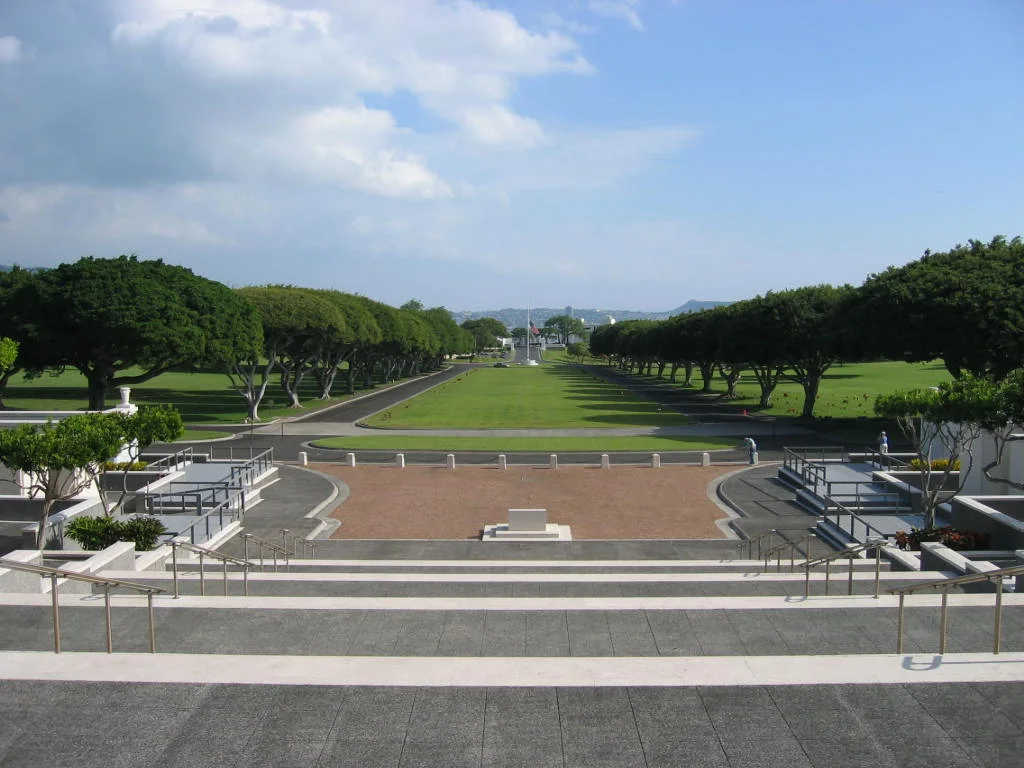
Punchbowl is not a cemetery only for Pearl Harbor or even only for the Second World War. Its graves and memorial courts include people connected to the Second World War, Korea and Vietnam, and the Courts of the Missing record names of people whose bodies were not recovered or identified. Moving through it by vehicle offers scale and topography but little biography. A drive-through should be described honestly as orientation.
The relationship to Pearl Harbor is also forensic. After the attack, unidentified remains from the USS Oklahoma were buried in cemeteries and later transferred to Punchbowl. From 2015, a Defense Department project exhumed grouped unknowns and used dental records, anthropology and DNA to identify hundreds of service members. A national cemetery is therefore not only a final arrangement. It can be a site where scientific work, family memory and institutional promises change what a name means decades later.
12 · Honolulu memory
Downtown reveals a nation that existed before statehood
The route’s most important correction happens when it leaves the cemetery and enters Honolulu’s government district. If the narration jumps directly from Pearl Harbor to the fiftieth U.S. state, it erases the internationally recognised Hawaiian Kingdom that built these institutions.
Kamehameha I brought the major Hawaiian Islands under a single government by the early nineteenth century, using warfare, alliance and political consolidation. His successors developed written law, constitutional government, diplomacy, education and institutions while confronting epidemics, missionary influence, foreign commercial power and pressure over land. The kingdom was not an untouched ancient society preserved against modernity. It was a sovereign state adapting rapidly and unequally to a changing Pacific world.
The gold-coloured Kamehameha I statue in front of Aliʻiōlani Hale is a replica with its own travelling story. The kingdom commissioned the original in Europe; the ship carrying it sank near the Falkland Islands. A replacement reached Honolulu and was installed in 1883. The recovered original was later placed at Kapaʻau on Hawaiʻi Island. The statue’s Roman and European conventions do not make it a transparent portrait of the king. It is a nineteenth-century public image of sovereignty, commissioned by a Hawaiian government and interpreted through foreign sculptural language.
Behind it, Aliʻiōlani Hale was completed in 1874. Plans first conceived for a palace became government offices when Kamehameha V decided the growing kingdom needed administrative space. The legislature and Supreme Court met there. It later witnessed the proclamation of the 1893 provisional government after the overthrow. Today it remains home to Hawaiʻi’s Supreme Court and the Judiciary History Center. A single façade joins kingdom government, regime change and the present judiciary.
13 · Honolulu memory
ʻIolani Palace is not just an attractive exterior
Across King Street, ʻIolani Palace makes the kingdom’s political and technological ambition visible. Completed in 1882 for King Kalākaua and Queen Kapiʻolani, it served as the official royal residence. Its architecture combines forms familiar from European palaces and public buildings with a design developed for Hawaiʻi. Inside were spaces for diplomacy, ceremony, governance and domestic life.
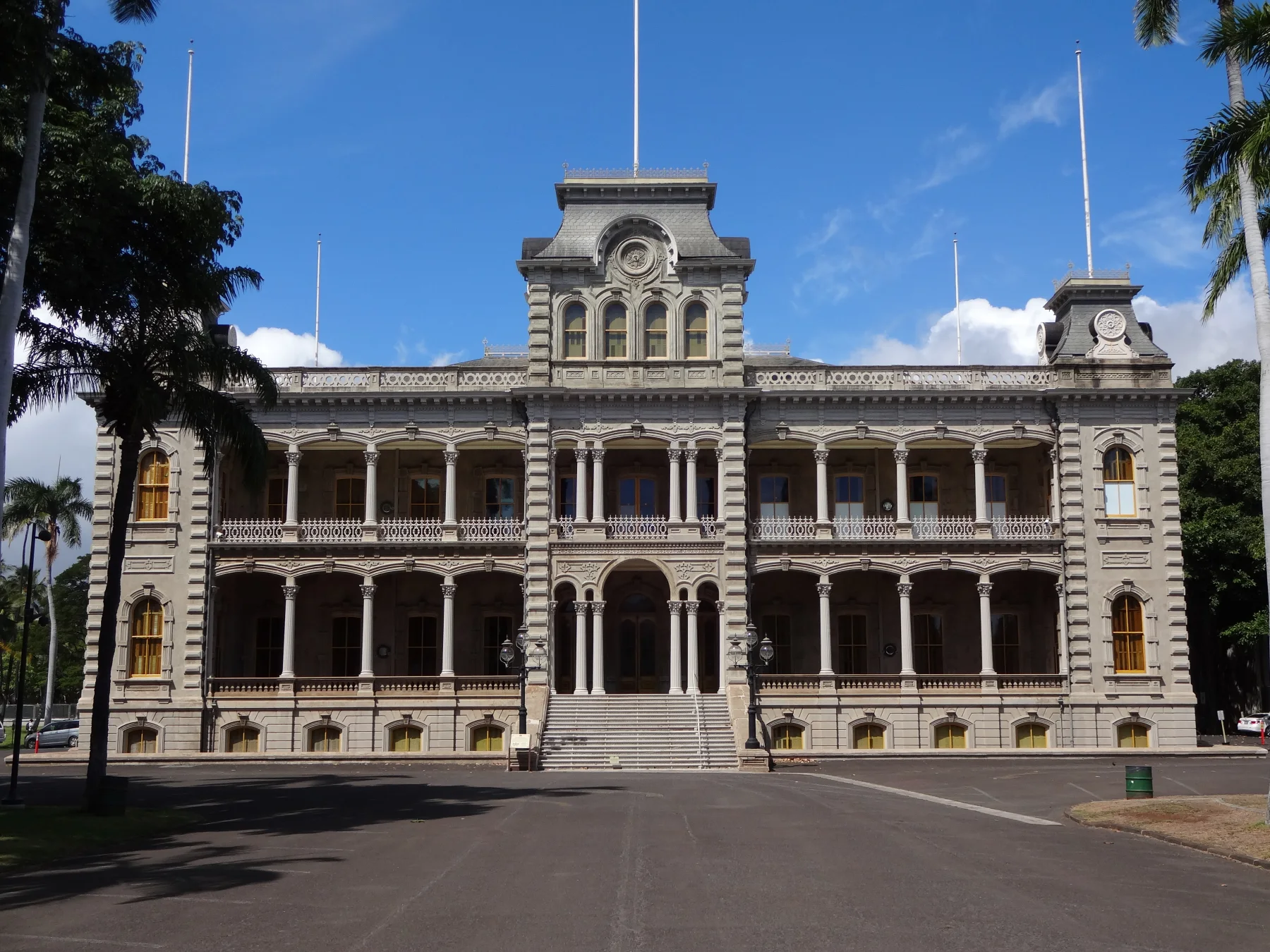

Kalākaua’s reign is often remembered for cultural revival, music, travel and modern technologies. It was also constrained by a political movement dominated by white businessmen and the armed Honolulu Rifles. In 1887 they forced him to accept the Bayonet Constitution, which reduced royal power and changed voting qualifications in ways that empowered wealthy residents and disenfranchised many Native Hawaiians and Asian residents.
After Kalākaua’s death, his sister Liliʻuokalani became queen. Her attempt to promulgate a new constitution in 1893 was used by annexationists as a pretext for overthrow. U.S. Minister John L. Stevens ordered U.S. troops ashore; a provisional government displaced the queen. President Grover Cleveland later called the overthrow wrong, but restoration did not follow. The Republic of Hawaiʻi was proclaimed in 1894, and the United States annexed the islands in 1898 without a Native Hawaiian referendum consenting to the loss of sovereignty.
In 1993, the U.S. Apology Resolution formally acknowledged the participation of U.S. agents and citizens in the overthrow and stated that the Native Hawaiian people never directly relinquished their claims to inherent sovereignty through a plebiscite or referendum. That law did not restore the kingdom or resolve land and sovereignty claims. It did establish that describing 1893 as a simple transition to American government is factually inadequate.
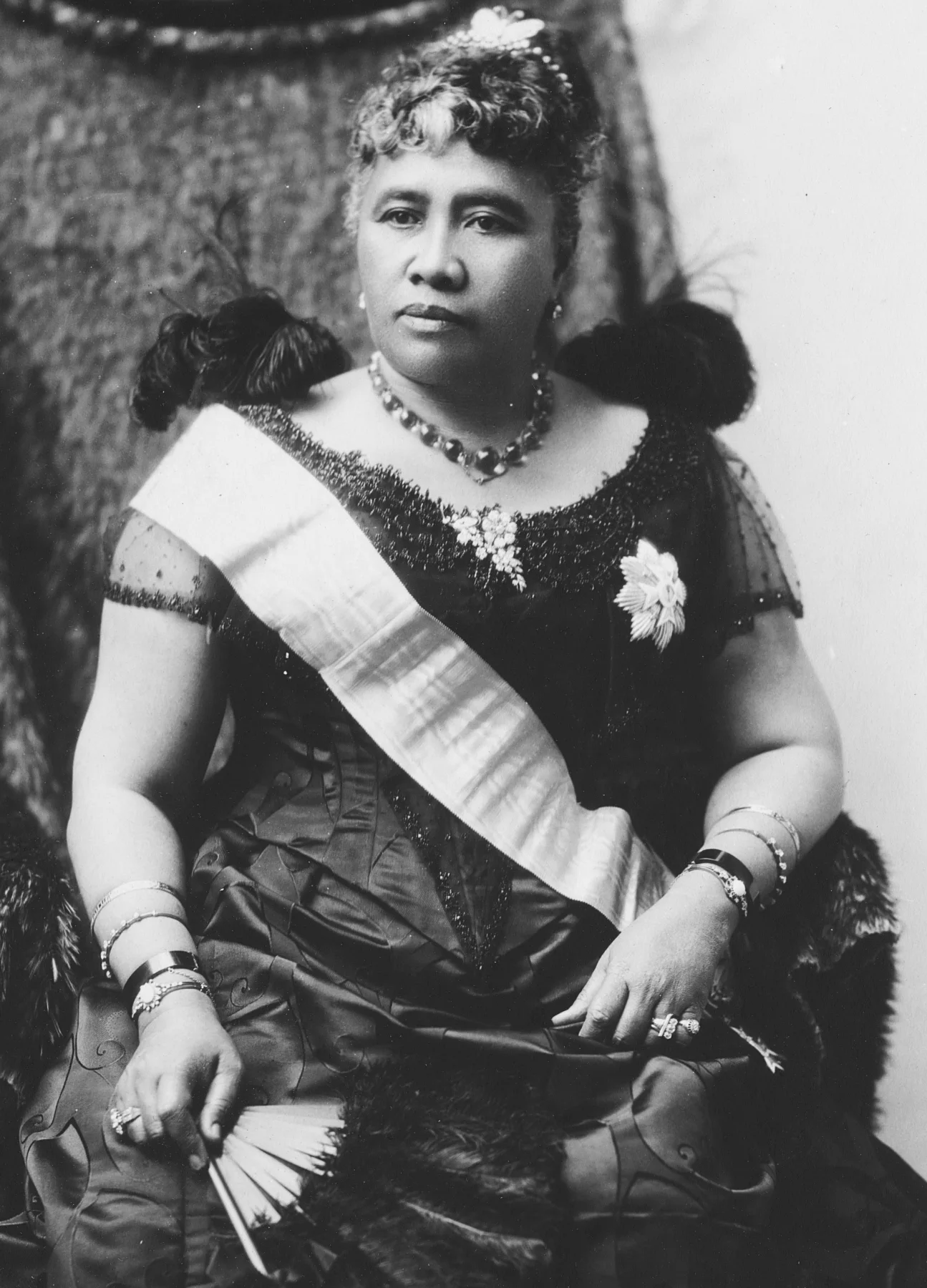
In 1895, after a failed royalist counter-revolution, Liliʻuokalani was arrested, tried by a military commission and confined in an upstairs room of her former palace. She composed and translated while imprisoned. The palace was then used as the capitol by successive Republic, Territorial and State governments until 1969. Restoration later recovered a royal interior that political change had stripped and repurposed.
A tour that only sees the palace from the statue area cannot communicate those rooms. The exterior provides orientation. A separate, reserved palace visit is the way to understand court life, governance, imprisonment, objects dispersed after overthrow and the labour of restoration.
14 · Honolulu memory
Kawaiahaʻo Church makes conversion and construction visible
Kawaiahaʻo Church, completed in 1842, is frequently called Hawaiʻi’s “Westminster Abbey” because of its association with aliʻi and major public events. The comparison can help a foreign visitor grasp institutional importance, but it can also make a Hawaiian place intelligible only through Britain. The Hawaiian name and local history should come first.
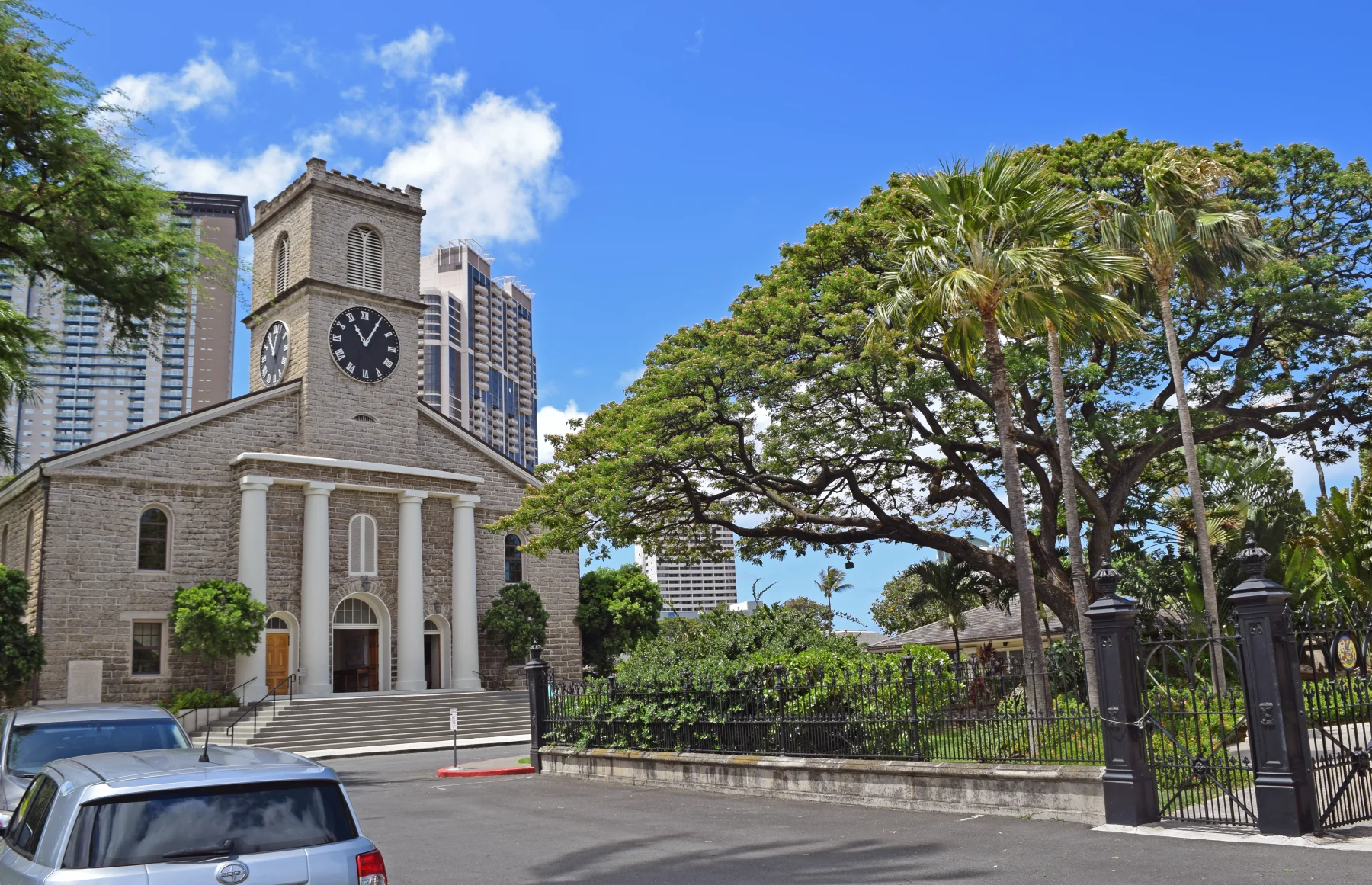

The name refers to the waters associated with the chiefess Haʻo. The present church’s walls were built from roughly 14,000 blocks cut from coral reef. That number demonstrates extraordinary planning and labour; it also records an extraction from a living marine environment. Congregants and workers quarried, transported and dressed heavy blocks without modern machinery.
The church became a centre of Protestant worship, Hawaiian-language literacy, royal ceremony and political life. Missionaries participated in profound transformations: the creation of a written Hawaiian-language print culture and expanded literacy existed alongside religious suppression, changes in law and landholding, and the disruption of cultural practice. Neither a simple story of benevolent education nor a simple story of foreign control is sufficient. The building belongs to an active Native Hawaiian congregation that has negotiated those inheritances for generations.
Because the connected route describes Kawaiahaʻo as a drive-by, visitors should not assume entry, a service or access to the grounds. If returning independently, check the church’s official information, dress and behave for a place of worship, and do not treat a service as a performance.
15 · Honolulu memory
The State Capitol is a modern argument in concrete
The Hawaiʻi State Capitol, completed in 1969, deliberately refuses the dome-and-staircase formula of many U.S. capitols. Its open central court, broad roof, perimeter columns and reflecting pools were designed to evoke island geography: sea, volcanoes, sky and the eight principal islands. Legislative chambers occupy forms often read as volcanic cones. The building attempts to make a tropical, Pacific state visible through modern architecture.
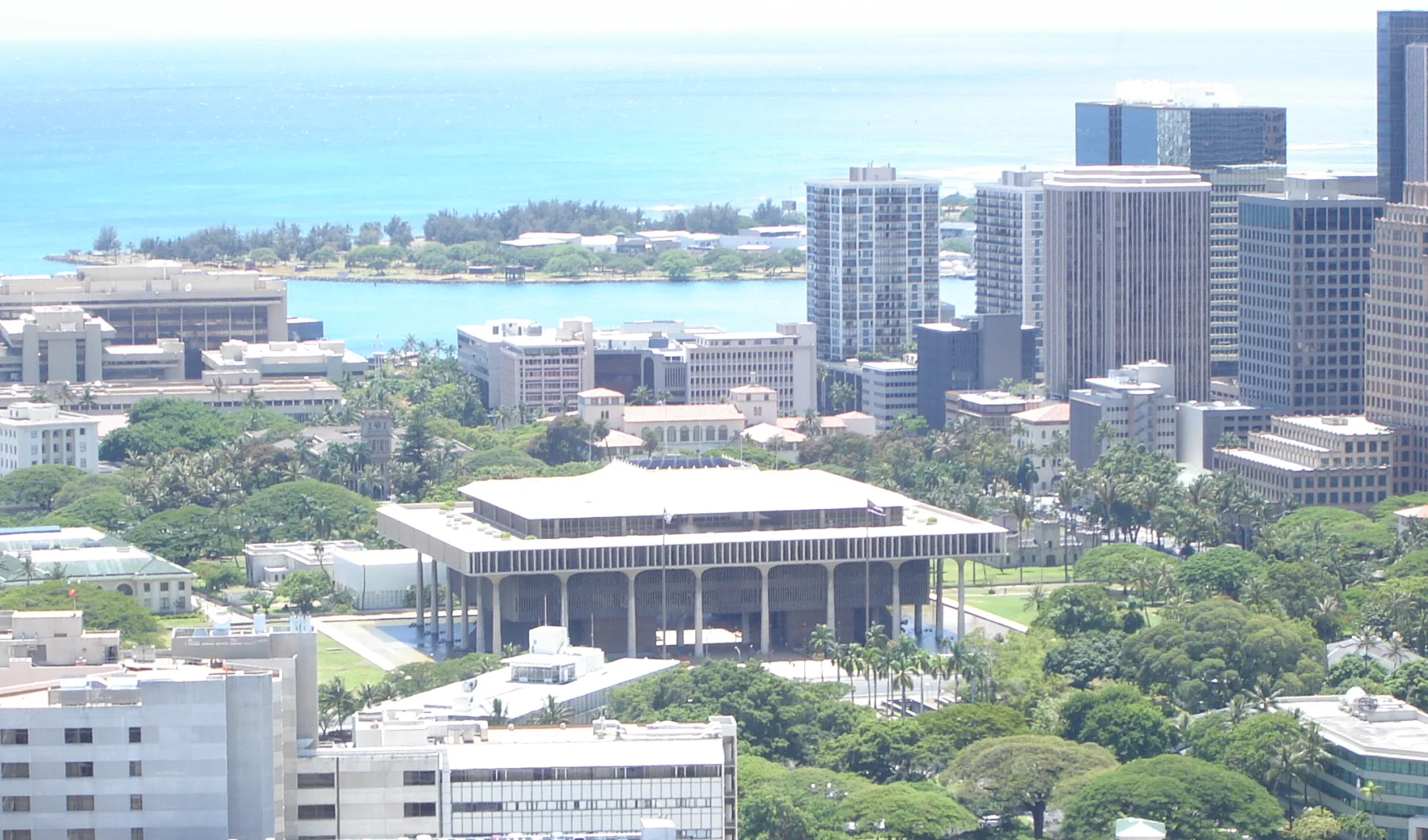
Symbolism does not remove engineering. The vast reflecting pools have leaked and required repairs; salt, water, heat and an open public plan create maintenance and security problems. The Capitol is a working building, not only an architectural metaphor.
Its location beside ʻIolani Palace and Aliʻiōlani Hale is politically charged. Statehood followed a 1959 vote in which eligible Hawaiʻi residents chose admission to the union, but the ballot did not offer independence or restoration of the kingdom. The state’s legitimacy and benefits, the overthrow’s unresolved consequences, federal recognition debates, land trusts and Native Hawaiian sovereignty claims occupy the same district. A responsible route does not demand that a visitor solve those debates in one afternoon. It makes them impossible to miss.
16 · Honolulu memory
What the sequence teaches
Pearl Harbor’s memorial language tends toward sacrifice, service and national entry into war. Punchbowl arranges service and loss across multiple conflicts. The royal and civic district shifts the subject from war to sovereignty, law, conversion, government and contested political succession.
Those frames do not cancel one another. Native Hawaiians served and died in the U.S. armed forces. Japanese Americans from Hawaiʻi fought in highly decorated segregated units while their families lived under suspicion. The Hawaiian Kingdom used global law and architecture while resisting foreign domination. The state government operates democratic institutions on lands and inside histories shaped by overthrow. A person can honour the Arizona dead and question military stewardship of water. A national cemetery can be moving without making every war politically identical.
The route becomes ethically useful when it allows these truths to remain in tension. Memory is not improved by adding one token sentence about Hawaiians to a military narrative. It changes when Hawaiian place, political history and contemporary voices organise the whole journey.
17 · Honolulu memory
A guide should show the seams
On a compressed route, the guide’s most valuable skill is not reciting the largest number or producing tears on schedule. It is naming the source of a claim and showing where interpretation changes.
At Puʻuloa, that means distinguishing Hawaiian place history from naval institutional history; at the Arizona, separating what the wreck physically shows from what later commemorative language asks it to mean. At Puowaina, it means resisting a sensational place-name translation and explaining that the cemetery extends across conflicts. Downtown, it means using the words kingdom, overthrow and annexation, not sliding from “monarchy” to “statehood” as though there were no coercive break.
Good narration also admits the limits of the window. A palace exterior cannot prove how Liliʻuokalani experienced confinement. A row of headstones cannot reveal one family’s grief. A church wall cannot settle the effects of missionisation. A guide can point to the next source: an interior tour, a name in a database, a Hawaiian-language archive, a legal document or an Indigenous institution.
This is why a named guide’s online review score is a weak editorial foundation. Reviews can report courtesy or timing, but they do not validate a casualty total, a Hawaiian translation or a political claim. Authority comes from transparent evidence, careful attribution and the willingness to say when a story is debated.
18 · Honolulu memory
How to visit Pearl Harbor without letting logistics take over
The Pearl Harbor Visitor Center grounds are free and do not require a general admission reservation. The Navy-operated boat program to the USS Arizona Memorial is also free, but timed reservations are strongly recommended through the official National Park Service program page and Recreation.gov; the reservation system charges a small non-refundable transaction fee. Limited standby access may exist, but it is not a dependable substitute for a reservation.
Security is strict. The National Park Service currently allows small items and certain clear bags within stated limits, while containers that can conceal prohibited items must be stored elsewhere or in the paid facility near the entrance. Medical supplies are handled as an exception subject to screening. Check the official safety and bag guidance immediately before travel rather than relying on an old blanket “no bags” rule.
The visitor complex, Navy vessels and Arizona Memorial are wheelchair accessible, according to the park’s current accessibility guide, although distances between facilities can still be tiring and wheelchairs are not loaned for ordinary use. The Navy boat and memorial program may be suspended for weather, safety, maintenance or military operations. Strollers have restrictions on the boat and memorial. There is no restroom after departure for the Arizona program. Children, including infants, count in a reservation. These are practical constraints, not footnotes.
The park film can be watched separately; it is no longer a compulsory pre-boat screening. Current NPS guidance also says ordinary public Arizona reservations cannot be booked or resold by tour companies. A commercial day can coordinate transport and interpretation, but travellers should never assume that “skip the line” overrides Recreation.gov, Navy capacity or a safety cancellation.
Allow emotional space as well as clock time. Read the exhibits before the boat if possible. Do not make oil sightings or a particular photograph the measure of whether the visit “worked.” Phones should be silent; voices should be low; railings and openings are not locations for celebratory poses. The memorial asks for presence, not performance.
19 · Honolulu memory
The full-day choice is a question of pace
An organised full day offers a real convenience: one transport chain can connect the visitor centre, Ford Island sites and Honolulu without asking a traveller to solve every transfer. That convenience does not create more time inside the day. Security screening, a fixed Arizona departure, Ford Island shuttles, meals, toilet stops and the simple act of regrouping all consume the same finite hours as the museums.
The correct comparison is therefore not “all the important sites” versus “missing history.” It is range versus control. A fast route can reveal the material difference between a submerged wreck, a submarine, a battleship and an airfield in one sweep. It can also leave a visitor with little time to read a crew list, trace one aircraft’s provenance, sit after the Arizona program or understand why downtown Honolulu changes the story. A breakdown or missed transfer is not the only threat to the day; an itinerary can run exactly as designed and still be too dense for a particular traveller.
Food belongs to that pacing calculation without becoming part of the memorial’s meaning. The historic sites have separate cafés and food counters, but opening, menus and queues change. Plan food and rest because a long day requires energy; a named lunch is not an interpretive attraction. Carry water within the current security rules, protect time for rest, and do not let a prepaid meal force you past a section that matters more.
Mobility must be assessed end to end. The NPS visitor centre and Arizona program, the Bowfin museum campus, the submarine interior, the Ford Island shuttle, Missouri decks, aviation hangars and any optional control-tower visit are different access environments. A site may be broadly accessible while a preserved vessel or tower remains partly inaccessible. Ask about the exact vehicle and transfers, then compare those answers with each institution’s own guidance. No general “wheelchair accessible” label can replace that chain.
20 · Honolulu memory
Guided route or independent day?
Choose a guided half-day route when transport from Waikīkī, narrated transitions and a first orientation to the civic district matter more than entering each downtown site. Confirm the live pickup zone, duration, accessibility, baggage rules and inclusions before purchase. The guide’s narration normally occurs in the vehicle; Pearl Harbor itself remains under National Park Service and Navy control.
Choose a guided full-day route when avoiding multiple transport decisions matters more than controlling time at each museum. Obtain a written list of admissions, identify who holds the Arizona reservation, ask how the Ford Island shuttle is handled and learn what happens if a Navy program or museum connection changes. Treat any downtown circuit at the end as orientation unless interior time is stated clearly.
Choose an independent Pearl Harbor visit when you want to move slowly through the visitor exhibits, manage a specific Arizona reservation directly or add other separately operated Pearl Harbor sites. Arrange transport and storage before arrival. Do not assume that every museum or historic ship at Pearl Harbor is included in the free NPS grounds.
Choose a separate downtown day when Hawaiian Kingdom history is a central interest. Reserve an ʻIolani Palace tour, check the Judiciary History Center’s current access, walk the Capitol District and approach Kawaiahaʻo according to its active-congregation schedule. The distance is compact; the subject is not.
For many travellers, the best design is two-stage: devote one day to the harbour sites at a humane pace and a separate period to the palace and civic district. Efficiency is valuable, but comprehension often requires a second door.
21 · Honolulu memory
A field checklist for the actual day
Before booking:
- Check the National Park Service alert, Arizona reservation and security pages directly.
- For a guided day, obtain the exact current admissions, reservation responsibility, transport sequence and mobility arrangements in writing.
- For an independent full day, map the walking link to Bowfin and the Ford Island shuttle separately from the Arizona boat program.
- Decide whether a pass-through at Punchbowl and exterior orientation downtown meet your priorities.
- Disclose mobility needs before booking and verify the specific vehicle, walking distance and transfer requirements.
- If the palace matters, reserve it separately rather than assuming entry.
On the route:
- Learn and use the names Puʻuloa, Puowaina, ʻIolani and Kawaiahaʻo.
- Ask what is known from primary records, what is interpretation and what remains debated.
- Keep the 1887 harbour concession, 1893 overthrow, 1898 annexation, 1941 attack and 1959 statehood in chronological order.
- Notice when the narrator’s frame changes from Hawaiian place to U.S. military history, and from national memorial to state government.
- Treat cemeteries, memorials, active worship and royal sites according to their present purpose, not as interchangeable photo stops.
Afterward:
- Follow one person rather than one more statistic: Doris Miller, Joe George, Alfred Preis, Jimmy Lee or Queen Liliʻuokalani.
- Revisit an interior that the vehicle could only pass: the palace is the most consequential omission.
- Read a Native Hawaiian source on land, water or sovereignty so that federal and military interpretation is not the only authority retained.
22 · Honolulu memory
Two recorded routes expose the same trade-off
The shorter recording follows Pearl Harbor, the ordered crater cemetery and the royal-government district. The later full-day recording adds Bowfin, Missouri and aviation before reaching the same drive-by downtown. Together they make the central choice unusually clear: a route gains force through contrast, but each additional institution reduces control over pace.
Both recordings are strongest when they distinguish orientation from depth and ask what convenience costs. The four-site route adds submarine interiors, the surrender deck and the surviving airfield to the memorial’s architecture and submerged wreck. That range has real value when the traveller wants a first understanding of how sea and air war connected. It also makes walking, shuttle transfers and concentration part of the itinerary. Someone who wants to follow a particular person, read exhibits closely or spend time in the palace will need to give those interests their own space.
The recordings do, however, identify useful reader questions. Do you want one day’s geographic sweep or time with individual stories? Can every traveller manage the Bowfin’s hatches and the Missouri’s partial access? Who controls the Arizona reservation? Is downtown an interior visit or scenery through glass? Answering those questions produces a better day than choosing by the number of stops alone.
23 · Honolulu memory
Listen to the field notes
The Travel Podcast by ExcursionPass episode 2961244 supplies the shorter memorial-to-civic route. Episode 3003533, “A Day at Pearl Harbor”, tests the denser full-day sequence through Bowfin, Missouri and the aviation museum. Listen for the difference between range and depth, then verify reservations and access with the institutions that control them.
24 · Honolulu memory
Continue the journey
For another investigation of how national institutions construct public memory, continue with Washington’s Civic Triangle: Who Builds the Nation’s Memory?. For a Pacific story in which Indigenous Country must remain the organising layer rather than the opening acknowledgement, read Yidinji Country from Gimuy to the Tablelands.
Pearl Harbor deserves time and silence. Honolulu deserves to be understood as more than the city you return to afterward.