On Queensland’s Atherton Tablelands, an immense strangler fig and a volcanic lake are often presented as two beautiful stops. They become a different journey when read as Country: a living field of kinship, law, memory, technology and responsibility in which rainforest ecology and Yidinji knowledge are not competing explanations. The most important choice is not where to point a camera, but whose authority teaches the place.
At Cathedral Fig Tree, the first useful act is to stop calling the forest a backdrop.
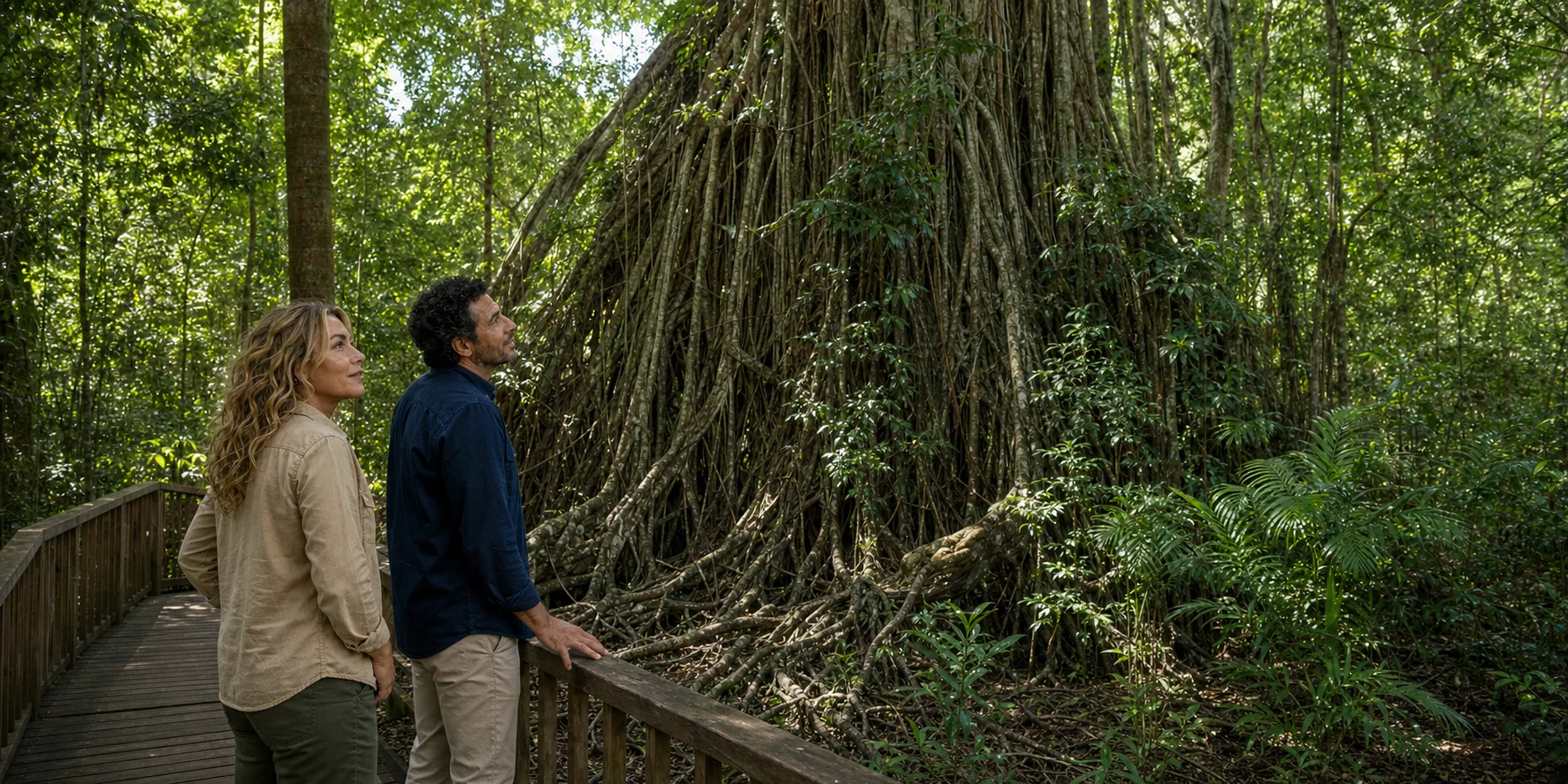
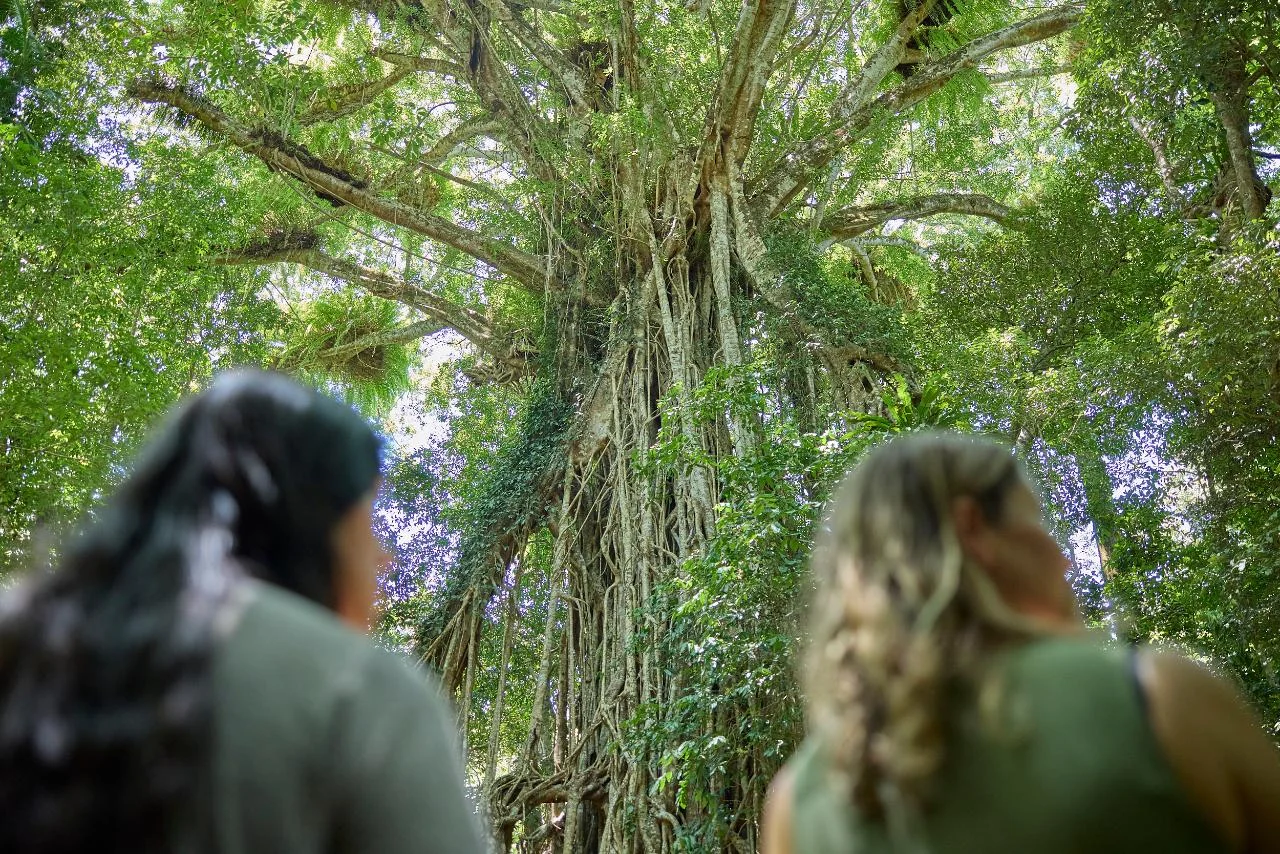
The public boardwalk arrives beneath a crown that Queensland Parks describes as nearly 50 metres high. A lattice of roots rises around the space once occupied by a host tree. Vines, ferns and epiphytes occupy ledges in that living architecture. The popular name—“cathedral”—borrows a European building type to communicate scale, but the tree was not waiting to become a metaphor. It is an organism within an old, crowded and continuously changing rainforest. It is also on Country, where a plant can be habitat, relation, material, teacher and evidence of care.
That difference is the subject of this story.
A conventional scenic route might join two coordinates: the fig in Danbulla National Park and Lake Barrine in Crater Lakes National Park. The first supplies vertical awe; the second opens a blue surface inside forest. A cultural route asks more demanding questions. Who can speak for this place? Which Yidinji people are connected to which part of the Tablelands? How did rainforest families make food from plants that can poison an untrained person? What survived logging, clearing, missions, removals and the legal fiction that the land belonged to no one? Why is a volcanic explanation of Lake Barrine not a replacement for Indigenous knowledge? What should a visitor do when a story, face or object may not be theirs to photograph and redistribute?
The journey has two principal rainforest stops: Cathedral Fig Tree, followed by Lake Barrine and its twin kauris. A longer rainforest-to-bush journey can continue through Hasties Swamp and Watsonville into Mbabaram Country. That broader circuit makes room for other ecological settings and cultural teaching; it should be chosen deliberately rather than squeezed into a visit to the fig and lake. A coffee beside the water is another choice, not the reason to hurry the forest.
Cultural tourism depends on consent, place and the people present. A practice appropriate on one family’s Country, under one guide’s authority, cannot simply be transferred to another stop. The short route offers enough to occupy serious attention: the fig’s living structure, the lake’s volcanic basin, the long history of rainforest knowledge and the contemporary people who have authority to share it.
Listen while you read
Listen to the rainforest journey
The Yidinji Explorer episode follows a cultural journey from rainforest to open country. Listen alongside the fig, lake, tools and fire sections below; the longer route through Hasties Swamp and Mbabaram Country has its own places and permissions. Read the transcript.
01 · Yidinji Country
A route between ecosystems, not an outline of Country

The Atherton Tablelands sit above the tropical coast west and south-west of Cairns. Reaching them commonly involves climbing the forested escarpment by a winding highway, then moving through a plateau whose pastures, farms, towns, crater lakes and remnant rainforest record very different land histories. The visual transition is quick enough to tempt a simple story: coast below, cool highlands above, wilderness alternating with cultivation.
The real geography is more intricate. “Atherton Tablelands” is a visitor-region name spread across many Traditional Owner groups and ecosystems. “Yidinji” identifies related peoples and language traditions, not one undifferentiated corporation or a border that can be drawn from a tourism map. Around Lake Barrine and Yungaburra, Dulgubarra-Yidinji and Tableland Yidinji names matter. Elsewhere, other Yidinji groups and neighbouring peoples hold their own Country and authority. Rainforest To Bush Cultural Experiences describes family lineage connecting Yidinji rainforest and Mbabaram savannah homelands. Those relationships explain the operator’s rainforest-to-bush range; they do not make every stop interchangeable.
The map above gives physical orientation. It cannot substitute for a custodian’s account of Country. The 2012 Tableland Yidinyji native-title determination concerns defined lands and waters around the upper Barron River and Lake Tinaroo; the present prescribed body corporate uses Tableland Yidinji in its name. A court boundary and a tourism-region name answer different questions from cultural connection. Learn the name offered for the particular Country you are entering and listen for the clan or family relationship when a custodian chooses to explain it.
The two story stops demonstrate this discipline. Queensland Parks’ Lake Barrine page publishes a welcome from the Tablelands Yidinji Traditional Owners. State Library of Queensland’s oral history with Dulgubarra-Yidinji Elder Uncle Laurie Padmore places Lake Barrine within Dulgubarra-Yidinji traditional area and explains Dulgubarra as rainforest-belonging Yidinji. Cathedral Fig Tree lies in the Danbulla landscape farther north. A Yidinji-led operator can explain its own authorised connection. The correct response is to retain those layers, not smooth them into a single convenient label.
02 · Yidinji Country
Country is a relationship, not a synonym for landscape
In everyday English, “country” can mean nation or rural land. In Aboriginal English, Country carries a much denser field of meaning: land and waters, plants and animals, ancestors and living kin, law, language, stories, places, obligations and reciprocal care. Reconciliation Australia describes it as a relationship in which people belong to Country as much as Country may be spoken of as belonging to people.
That grammar changes tourism.
If a rainforest is scenery, a traveller can arrive, extract an image and leave. If it is Country, arrival creates a social position. The visitor is a guest. A Welcome to Country is therefore not a generic performance or a polished version of an Acknowledgement. AIATSIS and Reconciliation Australia are explicit: only Traditional Owners, or people authorised by them, can welcome others to that Country. A visitor, business or institution may acknowledge Country, but cannot confer permission on itself.
A First Nations-led tour matters because the guide’s authority does not come only from a memorised natural-history script. It comes from family, community, place and permission. That does not mean one guide speaks for every Yidinji person or reveals everything they know. Cultural authority includes the right not to disclose. It can distinguish a public story from restricted knowledge, a demonstration from a sacred object, and a photographable moment from one that should remain within the encounter.
The distinction also protects against a familiar kind of romanticism. Living Country is not an untouched past. Tablelands families use vehicles, booking systems, mobile phones, park infrastructure and contemporary businesses. Native-title corporations administer legal responsibilities. Rangers and agencies negotiate management. Families reconnect after forced absence. Guides decide how to translate concepts for visitors whose categories do not match their own. Continuity is not proved by pretending modernity never happened; it is visible in the ability to carry law, kinship and care through change.
For the traveller, “respect Country” must become more than a closing slogan. It means staying on a boardwalk that protects roots. It means not handling or photographing an object until invited. It means refusing to geotag a sensitive site. It means accepting that a story may be offered in one form but not reproduced as content. It means paying attention to who owns and operates the experience, because economic participation is one material part of cultural continuity.
03 · Yidinji Country
The Wet Tropics is natural heritage and a cultural homeland
The Wet Tropics of Queensland entered the World Heritage List in 1988 for natural values: an exceptional record of evolutionary history, continuing ecological processes, biological diversity and beauty. The forest contains lineages connected to the ancient Gondwanan flora and an extraordinary concentration of endemic species. Those facts matter. They also helped create a management story in which rainforest could be celebrated as “nature” while its human history remained less visible.
Australian national heritage recognition in 2012 addressed part of that separation. The federal record identifies Rainforest Aboriginal peoples’ permanent occupation of the rainforest environment for at least 5,000 years and recognises a distinctive technical and cultural response to plants, terrain and climate. Eighteen Rainforest Aboriginal tribal groups are associated with the World Heritage Area. A Regional Agreement provides a framework for cooperative management and participation, though an agreement does not automatically dissolve every dispute about authority, resources or decision-making.
The rainforest demanded specialised knowledge. Some of its most calorie-rich seeds and nuts contain toxins dangerous to an untrained eater. The national heritage citation records complex treatment of at least fourteen toxic plant species through combinations of cracking, grinding, leaching, roasting, fermenting and careful water management. It also records distinctive technologies: bicornual baskets woven from lawyer vine, large grinding surfaces and hammerstones, waisted stone axes and practices adapted to dense, wet country.
These are not quaint survival tricks. They are systems of observation, experimentation, teaching and quality control. A toxic seed becomes food only if someone knows its season, how to recognise the species, which steps make it safe, how long those steps take and how to pass the method on. A basket is not merely decoration when its fibres, form and strength solve the problem of carrying prepared food, tools or children through steep forest. A pathway is not empty space when generations know which ridge, creek and seasonal resource it connects.
The regional heritage record must still be used carefully. It establishes the sophistication and breadth of Rainforest Aboriginal traditions; it does not mean every named technique belongs identically to every group, or that a visitor may reproduce a process without permission. A Yidinji guide provides the missing local relationship: which plant, object or practice can be discussed here, by this family, in this public setting.
That is the difference between information and knowledge in context. A label can name a species. A scientific paper can explain its chemistry. An Indigenous custodian may connect the plant to season, place, story, use, responsibility and the limits of what should be shared. Those forms can support one another without becoming interchangeable.
04 · Yidinji Country
Cathedral Fig Tree: a forest built in the air
The official walk to Cathedral Fig Tree is brief: 300 metres return, grade 2, with about ten minutes suggested walking time. Those numbers describe distance, not intellectual size. Queensland Parks asks visitors to remain on the boardwalk because repeated footfall compacts soil and damages the shallow roots that support the giant above.
The fig begins far from the ground. A bird or fruit bat deposits a seed in the fork of another tree. Moisture and organic debris let it germinate as an epiphyte—a plant using the host for position rather than initially drawing nutrients from its tissues. Roots descend through open air. When they reach soil, they gain access to more water and nutrients, thicken and branch. Other roots join them. The fig expands toward canopy light while its lattice encloses the host. Competition for light, water and space can weaken the original tree; if it dies and decays, the fig’s joined roots can remain as a hollow column.

The result is neither a conventional trunk nor a frozen monument. New roots still descend. Existing ones fuse. Storms remove limbs. Epiphytes gather in pockets. Animals feed on figs and distribute the next generation of seeds. Cavities create shelter. A tree can be an individual and an infrastructure for other lives.
The popular age estimate—about 500 years—should be treated as an informed public interpretation, not a birth certificate. Strangler figs do not offer a simple sequence of annual rings through one intact trunk. The crown’s comparison to two Olympic swimming pools and the height near 50 metres communicate scale, but they should not become a reason to step off the boardwalk in search of a better angle.
A guide can make the stop larger without claiming that every fact is secret. Natural history explains seed dispersal and root growth. Cultural interpretation may identify plants as food, medicine, material or seasonal sign, but the authority to make those connections locally rests with the people sharing them. A visitor should notice not only what is disclosed but how: which leaf is handled, which name is used, what is connected to family teaching, and where the explanation stops.
The word “cathedral” can then be useful if kept in its place. It describes how visitors respond to height, filtered light and a column-like enclosure. It does not make the forest sacred because Europeans recognise a church. Country already carries its own law and meaning. The ethical move is not to ban metaphor, but to prevent metaphor from overwriting the place it tries to praise.
05 · Yidinji Country
The guide changes the centre of the picture
Indigenous cultural tourism is often marketed with the language of access: hidden stories, ancient secrets, authentic encounters. Each phrase can be useful and each can become extractive. “Access” sounds as though the visitor acquires something. “Secret” turns restricted knowledge into a sales hook. “Ancient” can trap living people in a timeless past. “Authentic” becomes meaningful only when it refers to authority, consent and control rather than a traveller’s expectation of costume or spectacle.
Rainforest To Bush Cultural Experiences identifies itself as an Indigenous family-owned operator. Its public account connects Yidinji rainforest and Mbabaram savannah lineage. That ownership matters because the business can choose the route, the public teaching and the limits. Revenue supports a First Nations enterprise rather than merely adding Indigenous content to someone else’s tour.
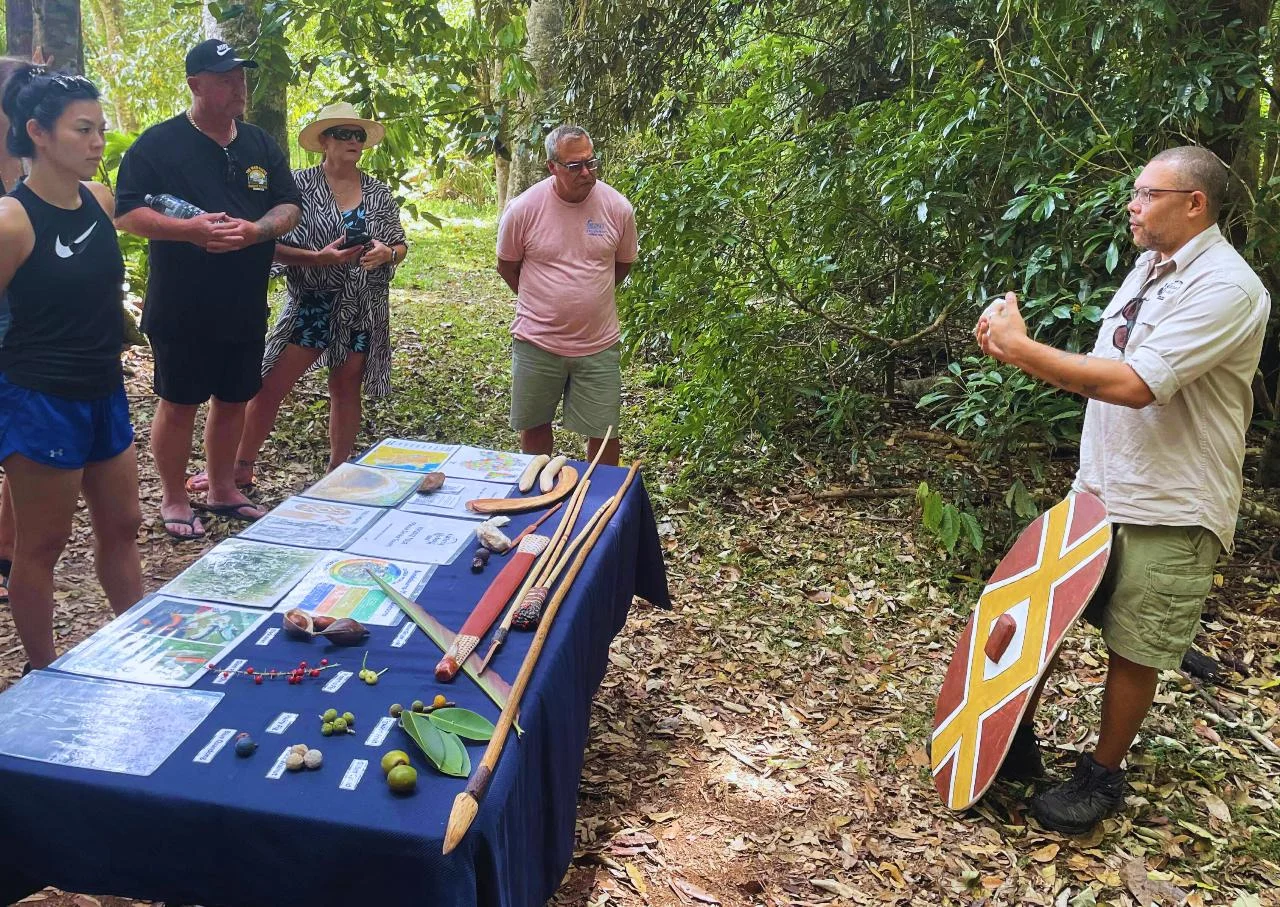
A guide’s authority includes distinguishing family teaching from park science and choosing what can be told in a particular place. It also includes declining a question. Cultural survival becomes visible through ordinary contemporary work: driving a vehicle, managing a group, interpreting an object and caring for a site. Listen for the relationship between the speaker and the knowledge rather than expecting one person to stand for an entire people.
Photography tests whether the visitor has understood. An image displayed publicly does not create permission to record every future guide, participant or object. Tourism Australia’s cultural-reference guidance asks photographers and publishers to seek permission before recording people, cultural objects and stories, to respect secret or sacred restrictions and to consider protocols relating to images of people who have died. Indigenous Cultural and Intellectual Property extends beyond ordinary copyright: owning a photograph does not automatically mean owning the cultural knowledge it contains.
The practical habit is simple. Ask before raising the camera. Ask again before publishing or tagging. If a guide says a demonstration may be photographed but a story may not be recorded, treat those as different permissions. Do not pressure a person to repeat a phrase for video. Do not assume that a child visible in a group can be used in promotional content. And do not interpret a refusal as poor hospitality. A boundary is evidence of cultural governance.
06 · Yidinji Country
The forest carries a history of clearing—and survival

The Atherton Tablelands tourism image depends on contrast: rainforest remnants beside open dairy country, volcanic lakes near neat towns, wet green edges against cultivated red soil. That mosaic did not simply appear. European settlement brought logging, sawmilling, selection, farming and a determined effort to convert forest into economically legible land.
At Malanda, the State Library’s local history places the first European settlement in 1907 and the arrival of the railway in 1910. Dairy farmers came from the Northern Rivers of New South Wales, cleared forest and built a district whose first agricultural show followed in 1916. Sawmills, rail connections, factories and shows made timber and milk into a regional economy. These histories record work and hardship, but the cleared blocks were not previously empty land.
For Aboriginal families, the same transformation meant loss of access, surveillance, removals and the interruption of routes connecting food, ceremony, kin and teaching. Forest clearing did more than reduce habitat. It could remove a named tree, expose a camp, block a path, alter water, disperse animals and make a seasonal practice harder to sustain. Administrative categories and mission systems tried to separate people from Country and from one another.
Uncle Laurie Padmore’s 2022 oral history gives that period a family scale. He remembers his grandfather Jack Stewart growing vegetables and taking them by horse and dray to Kulara. Children helped water the garden with milk tins whose bottoms had been pierced. The account is one of enterprise and ordinary family labour, carried out under a system that monitored Aboriginal people’s movement and employment. Padmore also recalls annual scrutiny of exemption documents and relatives being sent to Yarrabah. These are his recollections of family experience, not anonymous atmosphere added to a scenic drive. They place a working grandfather, a garden and children’s hands inside a regional history too often told only through settler achievement.
Yet “disruption” must not become a polite substitute for erasure, and “survival” must not imply that culture persisted unchanged and without cost. The legal history provides one public measure of continuity. The 2012 Tableland Yidinyji consent determination recognises non-exclusive rights within its defined area to access and camp; hunt, fish and gather; use natural water; light fires; conduct ceremonies; teach; and maintain places of importance. Tableland Yidinji Aboriginal Corporation RNTBC now acts as agent for the recognised rights and interests.
Native title does not return a landscape to a pre-colonial condition. Recognised rights coexist with other tenures, national parks, farms, roads, towns and statutory rules. A consent determination is both achievement and compromise. It converts some continuing law and relationship into terms Australian courts can recognise while leaving much cultural meaning outside the judgment.
The public visitor should resist two opposite conclusions. One is that a protected forest has repaired everything. National parks conserved essential habitat, but protection systems historically excluded or marginalised Traditional Owners and sometimes restricted customary practice. The other is that visible farms prove Aboriginal connection was broken. Connection can survive dispossession, be practised through altered access, and be renewed by descendants returning with Elders, family histories and legal recognition.
Contemporary Dulgubarra-Yidinji families speak publicly about reconnecting with Tablelands Country after generations of separation. That return is not a tourist reenactment. It is family work: finding places, hearing names, grieving absence, meeting relatives and deciding what to carry forward. A cultural tour exists inside this present tense.
07 · Yidinji Country
Lake Barrine is not an empty blue circle
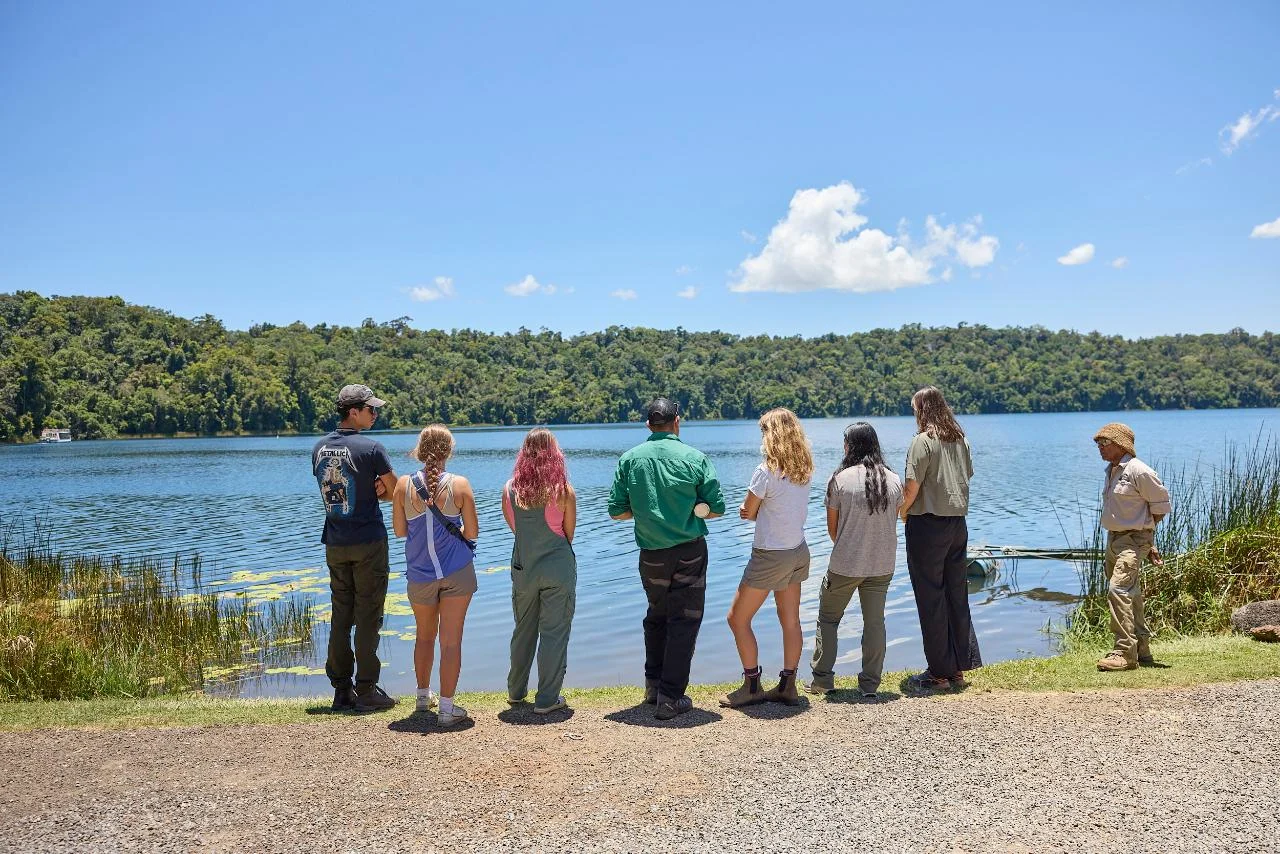
Lake Barrine can look self-contained: a near-circular body of water surrounded by rainforest, its far shore making a continuous green rim. The shape encourages the eye to read it as an object. Country restores the relationships beyond the frame.
Queensland Parks identifies Tablelands Yidinji as the Traditional Owners of Lake Barrine and publishes their welcome to visitors. Uncle Laurie Padmore’s State Library oral history adds clan specificity. He identifies the lake within Dulgubarra-Yidinji traditional area and describes Dulgubarra as rainforest-belonging Yidinji. That account prevents the landscape from becoming a generic “Aboriginal place.” It also shows why language matters: a clan name can carry ecological and social relationship in a way the English park title does not.
The lake sits within Crater Lakes National Park, which comprises separate Lake Barrine and Lake Eacham sections. Rainforest reaches close to the water, while reeds and sheltered margins provide different habitats from the tall canopy behind them. Ducks, herons and other waterbirds use the shore; forest birds occupy the surrounding vegetation. Watching these edges is more revealing than treating the lake as one uniform blue surface. Picnic facilities serve the day-use area. The privately operated teahouse offers a separate stop for food or drink, and a boat cruise is a separate choice rather than an automatic part of a guided forest visit.
Water deserves caution as well as contemplation. Queensland Parks describes both crater lakes as deep, open water. A calm surface can obscure steep underwater slopes, cool depths and changing conditions. Stinging trees grow beside tracks, and roots, stones or loose gravel can make even short paths uneven. The correct practical response is not alarm, but attention to formed tracks, signs and current guidance.
Lake Barrine’s most revealing movement may be the one too slow to see. Material settles on the lake floor in layers, preserving evidence of the catchment and its changing climate. In a 2022 study led by Ting Li, a 7.2-metre sediment core supported a reconstruction spanning about 18,000 years. Twenty-two radiocarbon dates anchored the chronology. Researchers combined chemical and organic measurements to infer rainfall and vegetation change. This is an environmental archive assembled through sampling and comparison, not a direct photograph of the past.
The study identifies a shift toward wetter conditions and the development of closed forest in the catchment during the Holocene. That matters at the viewpoint: the green rim is a history of change, not proof that the landscape has always looked exactly as it does today. The sediment record and a family’s relationship with the lake offer different kinds of continuity. Neither removes the need to understand the other.
08 · Yidinji Country
A maar, a memory and the danger of easy confirmation

Geologists classify Lake Barrine as a maar: a broad, relatively low-rimmed volcanic crater created when rising magma encountered groundwater. Rapid conversion of water to steam generated explosive pressure, excavating a basin that later filled with water. Queensland Parks gives a general depth of about 65 metres for the crater lakes; the 2022 sediment study also describes Lake Barrine as 65 metres deep. The diagram separates the eruption process from the present lake so that today’s water is not mistaken for an active eruption.
The eruption occurred in the late Pleistocene, and the lake’s long sediment record makes it important to studies of tropical environmental change. Those statements belong to a scientific method: physical sampling, stratigraphy, dating, comparison and revision.
Aboriginal oral traditions recorded around the Atherton Tablelands have also been studied in relation to volcanic events. A 2024 Quaternary Research paper discusses an account given in 1940 by Emily Russell, a Ngadjon woman, concerning the formation of Lake Eacham and Lake Barrine. Its named provenance matters: an account recorded from one speaker is not a generic story belonging equally to every visitor-region group. Researchers ask whether such traditions can preserve memories of distant eruptions, but resemblance cannot by itself establish the exact age or unchanged transmission of a particular account.
It creates several problems. A story may have law, ethics, genealogy and place-specific meaning that cannot be reduced to a geological observation. Written versions were often recorded by outsiders, translated across languages and separated from the conditions in which they could properly be told. Dates for eruptions and for the transmission of a particular account carry uncertainty. Different communities may hold different traditions. Declaring that science has “validated” a story grants science the final authority and treats Indigenous knowledge as impressive only when it resembles a modern dataset.
A better relationship is parallel and conversational. Geology can explain how a maar forms and test the age of deposits. A named Indigenous tradition can carry a people’s relationship to that transformation, but its custodians decide its meaning and circulation. Correspondence between the two may expand the history humans are willing to consider without collapsing one system into the other.
For a visitor at Lake Barrine, this caution is productive. Look at the enclosing rim and understand the explosive process. Look at the same water as Country and accept that physical explanation has not exhausted the place. Intellectual humility is not vagueness; it is accurate accounting of who knows what, by which method, and with what authority.
09 · Yidinji Country
The twin kauris measure another kind of time
A short sealed path near Lake Barrine leads to two bull kauris. Queensland Parks identifies the species as Agathis microstachya, an Atherton Tablelands endemic. Each rises to about 45 metres; the trunks exceed six metres in girth and are believed to be more than a thousand years old. The return walk is approximately 160 metres, grade 1 and accessible to wheelchairs with assistance.
Kauris carry deep botanical history. Their family belongs to an ancient conifer lineage with a fossil record extending into the age of Gondwana. That does not mean an individual tree is a dinosaur survivor, a phrase that compresses evolution into advertising. It means the living species participates in a lineage whose forms and distributions help scientists reconstruct changing continents and climates.
At human scale, girth becomes the first fact. A bull kauri does not build the open root lattice of a strangler fig. Its column is comparatively continuous and massive. The contrast allows the route to show two strategies for occupying the canopy: one begins as a seed lodged in another tree and sends roots downward; the other builds a trunk over centuries from the ground up.
Both depend on more than individual longevity. Reproduction, soil, moisture and space for young trees matter as much as the survival of an old crown. Cyclones create openings. Fire frequency and intensity change forest edges. Fragmentation alters the movement of animals and the humidity within small forest patches. A thousand-year-old trunk can survive many storms and still depend on decisions made beyond its visible crown.
This is where World Heritage language becomes practical. Protecting “evolutionary history” is not preserving a static museum of old species. It is maintaining the ecological processes through which forests regenerate, migrate and adapt. Traditional Owner knowledge and participation are not an interpretive supplement after the ecological work is complete. They are part of how a living cultural landscape can be cared for.
10 · Yidinji Country
Tools are condensed knowledge
A spear, shield, basket, grinding stone or throwing implement can be photographed as an isolated object. The image usually conceals the knowledge that makes it work.
Consider a spear-thrower, often called a woomera in broad Australian English. It acts as a lever that lengthens the thrower’s arm, increasing the speed and range of a spear. That mechanical explanation is real but incomplete. A working tool also depends on selecting and seasoning material, shaping a straight shaft, balancing weight, matching spear and thrower, maintaining surfaces, reading distance and wind, and practising under instruction. Names, forms and uses vary across language groups. “Woomera” should not be treated as the one universal Indigenous term.
Supervised handling can turn this explanation into a bodily lesson: the weight, grip and relationship between thrower and shaft become apparent in the hand. It belongs only in a place and session where the guide has chosen to teach it. Do not turn a demonstration into an expectation at every rainforest stop, and never practise independently around other visitors.
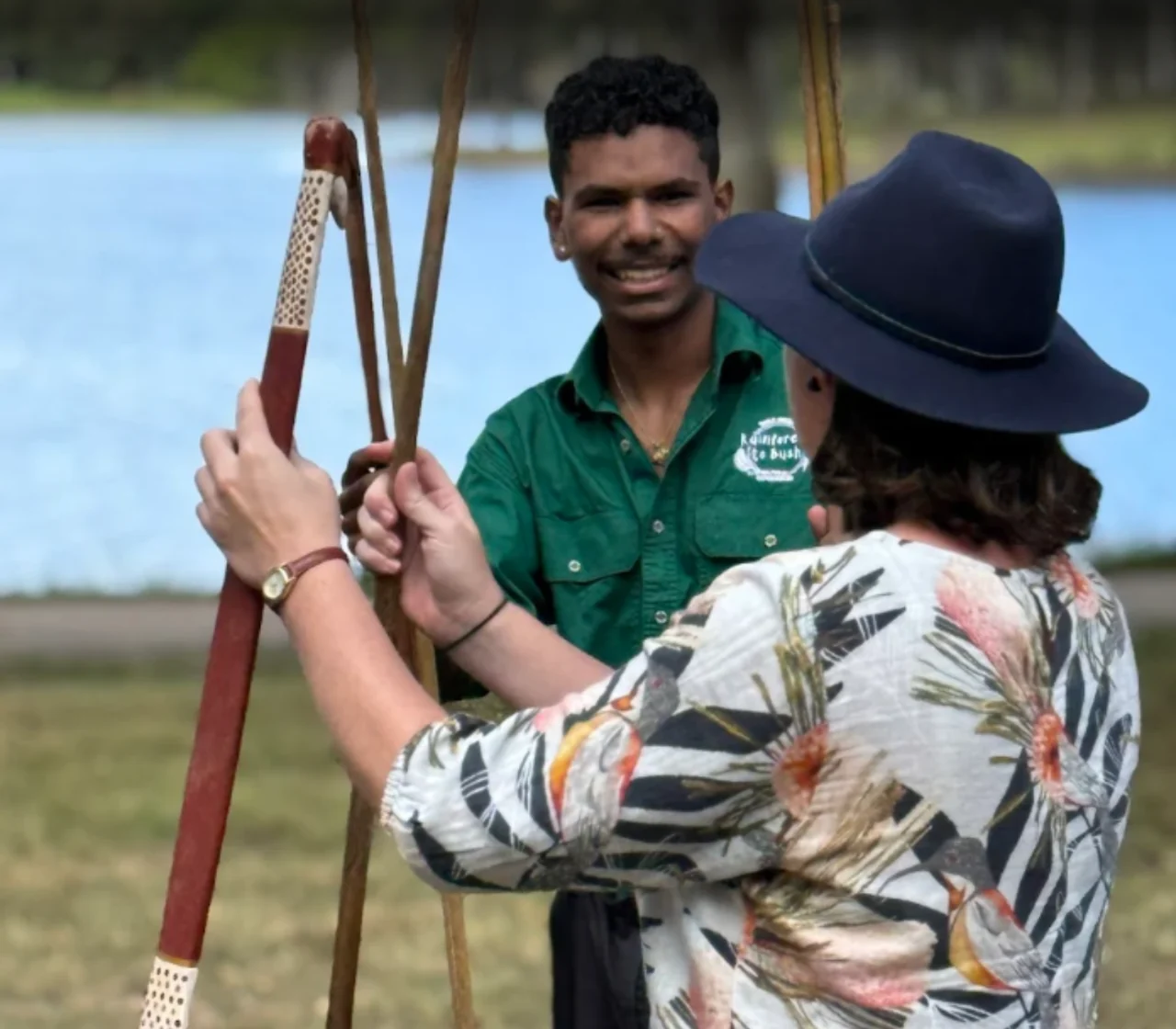
The same principle applies to rainforest foods. A display can make seeds, leaves and fruit visible, but safe processing requires expertise developed across generations. The intellectual achievement lies in classification, detoxification, timing, grinding and leaching. An abbreviated explanation is not a recipe. Do not taste an unfamiliar rainforest plant or try to reproduce a treatment after a short demonstration.
Material knowledge also reveals exchange between rainforest and open country. Dense forest, wet sclerophyll margins and savannah offer different fibres, woods, resins, foods and movement problems. Rainforest To Bush’s family account connects Yidinji rainforest and Mbabaram savannah relationships. A cultural tool can therefore carry evidence of travel, trade, marriage and teaching across ecological zones. The object is not an emblem of an isolated tribe; it participates in a social landscape.
Hands-on activity is most meaningful when the visitor follows the guide’s frame. The aim is not to perform Indigeneity for a photograph or prove skill after a few attempts. It is to feel how balance, leverage and instruction turn material into technology—and to recognise how much remains beyond a short demonstration.
11 · Yidinji Country
Fire is knowledge, not a generic attraction
Few topics are more vulnerable to oversimplification than cultural burning. Public discussion often swings between two slogans: Aboriginal people always burned the land, or rainforest should never burn. Neither is sufficient.
Fire practice is specific to Country, season, fuel, weather, purpose and authority. Low-intensity burning may protect particular resources, maintain travel routes, produce fresh growth, shape habitat, reduce dangerous fuel or fulfil cultural obligations. Wet rainforest interiors behave differently from eucalypt forest, grassland and savannah. Some communities use fire in carefully selected rainforest margins or associated ecosystems; other areas should remain unburnt. A technique appropriate on Mbabaram savannah cannot be transferred automatically to a wet Yidinji rainforest stop.
The Commonwealth heritage record recognises distinctive Rainforest Aboriginal uses of fire as part of a technical response to the Wet Tropics environment. Native-title rights can include lighting fires subject to law and the terms of the determination. Contemporary cultural-burning programmes bring Traditional Owner knowledge into dialogue with land agencies and fire science. That does not make fire a demonstration available on demand.
The rainforest-to-bush sequence discussed in the podcast places cultural burning in Mbabaram Country, on a longer journey beyond the fig and lake. It is a different ecological and cultural setting. A guide may explain fire without lighting one; the teaching lies as much in deciding where, when and whether to burn as in watching flame.
For the reader, the larger lesson is methodological. Cultural practice cannot be separated from the decision-making system around it. The visible flame is the smallest part. Reading moisture, wind, plant response, animal refuge, neighbouring land and the right time to stop is the knowledge.
12 · Yidinji Country
Choosing time and transport
A visit centred on Cathedral Fig Tree and Lake Barrine works best when it leaves room for conversation. The public fig walk is short; the lake and kauris are close to the day-use area. Short paths do not make the subject small. Allow the guide’s explanation to determine the rhythm rather than trying to collect attractions at the speed of a photograph.
Rainforest To Bush Cultural Experiences offers a pickup approach and a private tag-along approach to these principal stops. Pickup places navigation in the operator’s hands. Tag-along lets visitors travel in their own vehicle and can fit an onward Tablelands journey. Confirm the actual departure arrangements, seats and vehicle suitability with the operator; a format name alone does not settle those details.
For a family or small group, a private conversation can accommodate different interests: a child’s question about roots, a naturalist’s question about regeneration, or a visitor’s question about who speaks for Country. Discuss mobility and communication needs before choosing the route. A private guide cannot remove steps, change park rules or make every path accessible.
Travellers who want Hasties Swamp, Watsonville and Mbabaram Country should allow for a broader rainforest-to-bush itinerary. Those places extend the story into wetlands, settlement history and savannah relationships. Lunch, food teaching, spear practice and cultural burning depend on the particular experience and its custodians. Choose that journey for its own sequence instead of assuming it is bundled into the fig-and-lake visit.
Lake Barrine also offers a practical fork. The 160-metre Twin Kauris return walk is a short forest visit; the five-kilometre lake circuit is a separate commitment. Coffee or a cruise adds another use of time. Decide which matters to your group before adding it to the day, and keep enough time to return without rushing on unfamiliar roads.
The pickup choice suits travellers who prefer to listen between stops and leave road-finding to someone else. Tag-along suits drivers comfortable with winding Tablelands roads and coordination between vehicles. Neither choice grants exclusive use of the national parks or possession of restricted knowledge. Their value is the space they create for an accountable relationship with the guide.
13 · Yidinji Country
A visitor protocol for living Country
Respect becomes credible when it changes behaviour. The following choices matter more than a perfect pronunciation delivered without attention.
Before the drive
Confirm the route and departure arrangements with the operator. Describe mobility, seating, child-restraint or communication needs before booking, and ask how vehicle transfers and each path will work. Keep the agreed meeting details available offline because mobile coverage can vary. Check Queensland Parks alerts and road conditions close to travel.
Cathedral Fig Tree is reached from Danbulla Road. Queensland Parks describes the road through the park and state forest as suitable for conventional vehicles, but much of it is unsealed, narrow and winding, with rough surfaces and other traffic. Conventional-vehicle access does not mean an easy urban road. A tag-along driver should follow the operator’s vehicle advice and current park directions.
At Cathedral Fig Tree
Remain on the boardwalk. The official route is 300 metres return and grade 2. It has no wheelchair-accessible facilities. A short distance does not mean barrier-free: boardwalk approaches, gradients, weather and vehicle transfers can all affect access. Ask the operator for an honest assessment rather than relying on the word “easy.”
Do not touch or climb the roots. Do not step around a barrier for a full-body photograph. Keep voices low enough to hear birds and the guide. If another group is present, let interpretation and photography share the limited space.
At Lake Barrine
The day-use access road is sealed and suitable for conventional vehicles. Picnic tables and toilets are available; the teahouse has ramps and wheelchair-accessible toilets. The Twin Kauris path is sealed, 160 metres return and accessible to wheelchairs with assistance. Those facilities do not make every lakeside path or surface accessible.
Remain on formed tracks. Learn to recognise the broad leaves of the stinging tree from official signs, but do not approach one for a photograph. Treat the lake as deep open water. Do not feed wildlife. Take rubbish away where bins are not provided.
With people, stories and objects
Ask before photographing the guide, other guests, a demonstration or a cultural object. Ask whether audio or video recording is acceptable; still-photo consent is not automatic recording consent. Ask before sharing a story in a public post. A guide may allow a photograph but not the reproduction of a name or explanation attached to it.
Use the names people give for themselves. If unsure about pronunciation, ask once and listen. Avoid shortening a clan name into a generic label. Do not request a Welcome to Country as if it were an entertainment inclusion. Receive a welcome when it is offered by someone authorised to give it.
Do not collect seeds, bark, stones or “souvenirs.” National-park rules and cultural protocol point in the same direction: leave material relationships intact. A purchased object from an identified First Nations maker is different from taking material from Country.
After the tour
Credit the operator and, where invited, the guide. Do not geotag a place the guide identified as sensitive. Do not post photographs of children without explicit guardian and operator permission.
The best aftercare is intellectual. Correct the story when someone calls the visit “untouched wilderness.” Explain that Country is living and governed. Distinguish the short route from the longer itinerary. Recommend the experience for the quality of relationship, not for access to “secrets.”
14 · Yidinji Country
Conservation without custodianship is incomplete
The Wet Tropics conservation achievement is immense. World Heritage listing strengthened protection against large-scale clearing and helped secure habitat whose evolutionary record has global significance. National parks protect Cathedral Fig Tree, Lake Barrine’s rainforest and the twin kauris. Boardwalks reduce trampling; alerts manage closures; research tracks ecological change.
But a conservation story built only around rare species can repeat the separation this journey is trying to repair. It may treat Indigenous occupation as an earlier chapter, then place modern expertise in government agencies and laboratories. The federal recognition of Indigenous heritage values and the Regional Agreement acknowledge that Rainforest Aboriginal peoples are not stakeholders arriving after the forest was protected. They are peoples of the place, with continuing law, knowledge and aspirations.
Co-management is not a ceremonial panel added to a plan. It asks who sets priorities, who is employed, whose knowledge controls a burn or access decision, how intellectual property is protected, and whether communities have resources to participate. Tourism faces the same test. A brochure can use an Acknowledgement of Country while revenue and narrative authority remain elsewhere. First Nations ownership changes that distribution, though one small business cannot solve every structural inequality.
Visitors influence the system through ordinary purchases and expectations. Choosing an Indigenous-owned operator creates direct economic value. Accepting limits reduces pressure to commodify restricted knowledge. Staying on infrastructure protects ecology. Seeking clear departure information supports an honest encounter. Refusing stereotypes lets guides present contemporary life without performing a tourist’s fantasy.
There is also a conservation benefit in learning to read a place as relationship. The fig stops being one photogenic organism and becomes seed dispersers, host, soil, water, roots and boardwalk. The lake becomes crater, catchment, deep water, sediment, story and Country. The kauri becomes lineage, fungi, storm history and future regeneration. Responsibility grows as the frame widens.
Traveller’s field notes
Carry respect into the practical details
- Choose the route: The fig and lake form a focused rainforest journey. Hasties Swamp, Watsonville and Mbabaram Country require a broader itinerary.
- Confirm the arrangements: Agree pickup or meeting details, vehicle suitability and access needs before departure. Leave room for conversation at both main stops.
- Treat roads honestly: Danbulla Road is open to conventional vehicles under normal conditions but includes unsealed, winding sections. Check park alerts and follow operator advice.
- Protect roots: Cathedral Fig Tree is a 300-metre-return grade 2 boardwalk with no wheelchair-accessible facilities. Never step off for a photograph.
- Use the accessible option precisely: The Twin Kauris route is a 160-metre sealed grade 1 walk, accessible to wheelchairs with assistance. That claim does not extend to every track.
- Respect deep water and stinging plants: Stay on formed paths, follow signs, carry water and do not treat Lake Barrine’s calm surface as a safety guarantee.
- Ask before recording: Permission to attend is not permission to photograph, film, record or republish cultural knowledge.
- Keep names specific: Yidinji, Tableland Yidinji, Dulgubarra-Yidinji and Mbabaram relationships should not be flattened into one interchangeable label.
- Do not demand performance: A Welcome, burn, spear practice or bush-food demonstration proceeds only under the relevant authority and conditions.
- Value the relationship: The guide’s value is context, conversation and accountable authority. Restricted knowledge is not a souvenir.
Sources & reporting record
Sources for the journey
The park guides describe paths and facilities; the named oral history, heritage records and research provide the historical and scientific context for this journey.
- Yidinji Explorer episode 2960755 and its complete transcript — listen to the rainforest route and the questions it raises about living culture.
- Rainforest To Bush Cultural Experiences — operator ownership, family lineage and public cultural framework.
- Cathedral Fig Tree, Danbulla safety and park alerts — official access, ecology, boardwalk and mutable conditions.
- Crater Lakes National Park, Lake Barrine day-use area, Twin Kauris and visitor safety — official Traditional Owner welcome, geology, access and practical conditions.
- Wet Tropics of Queensland and the Indigenous national heritage citation — natural and Indigenous heritage values, technologies and cooperative-management context.
- Tableland Yidinji/Yidinyji native-title determination and current Tableland Yidinji prescribed body corporate — the source’s spelling variation, recognised rights and present governance.
- Uncle Laurie Padmore oral history — primary Dulgubarra-Yidinji account of Lake Barrine and rainforest-belonging identity.
- Acknowledgement and Welcome to Country and AIATSIS protocol — authority and visitor relationship.
- Tourism Australia cultural reference guide — visitor photography, respectful terminology and Indigenous Cultural and Intellectual Property.
- The selective geography of volcanism in oral traditions and Lake Barrine sediment research — named records, geological interpretation and environmental history.
- Malanda and Tablelands dairying history — archival context for sawmilling, clearing and agricultural transformation.
The question we carry out