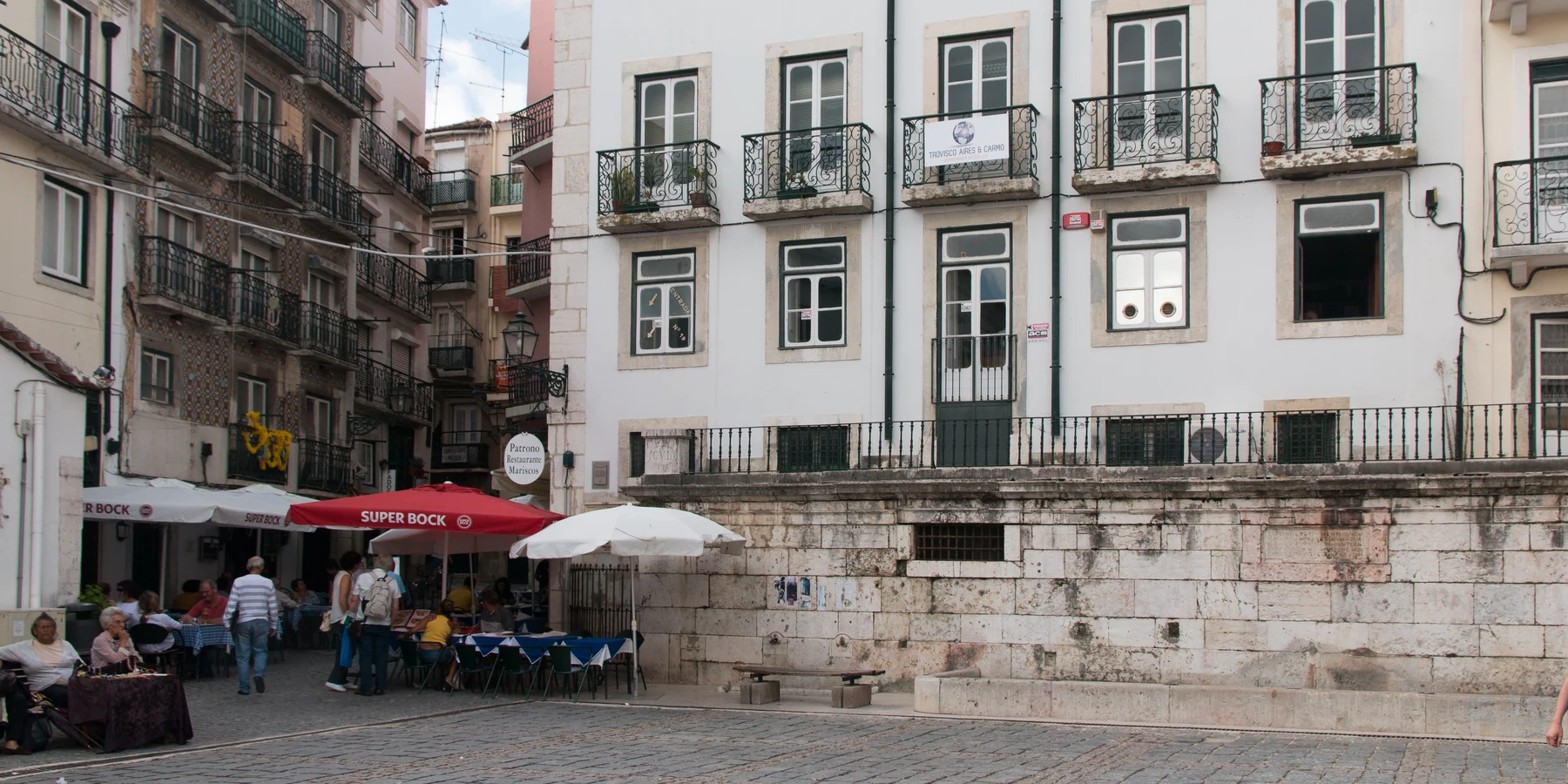

From the fountains of Alfama to the trading streets of the Baixa and the church of São Domingos, a walk through Lisbon reveals more than the machinery of Atlantic slavery. It also reveals African work, religious communities, arguments for freedom and the continuing struggle to decide whose lives belong in the city's public memory.
01 · Lisbon through evidence
Begin with the fountain, then follow the work
Largo do Chafariz de Dentro offers a useful beginning because it brings an ordinary urban necessity into view. A fountain belongs to a history of carrying, queuing, washing and supplying houses. It invites a different question from the one posed by a royal statue: who kept the city working? Across Lisbon's African histories, that question leads to people whose labour was highly visible while their own accounts of their lives were seldom preserved.
The square is in lower Alfama, beside the Museu do Fado. The river lies below the neighbourhood; the streets rise behind it. Start by locating those relationships before taking a turn uphill. The museum's location page identifies the square and nearby transport connections. It is a modern cultural institution and a useful landmark, rather than a museum dedicated to the slave trade. Its subject should not be pressed into supplying an easy, single-origin explanation for every African influence in Lisbon.
There are two fountains to keep separate. Chafariz de Dentro is the starting landmark. Chafariz d'El-Rei, farther west along the lower edge of Alfama, is the fountain associated with a celebrated early modern painting and documentary accounts of African water carriers. Confusing the names turns a promising walk into a false identification before it has properly begun.
The central circuit proposed here moves from this square towards Chafariz d'El-Rei, Campo das Cebolas and Praça do Comércio, then through the Baixa to Rossio and São Domingos. It follows relationships between water, port, commerce, religion and public authority. It is a way to read the city independently; individual guided walks may take different streets or spend their time differently. A western extension through Poço dos Negros and the old Mocambo district, and a separate visit to Belém, broaden the argument without turning one central walk into a forced march.
Use three kinds of evidence together. A present-day place gives orientation. A dated record establishes something that happened there or in its historical vicinity. A painting, memorial or later building shows how people have represented the past. These kinds of evidence sometimes overlap, but they do not become interchangeable. Lisbon's shoreline, streets and institutions changed, most dramatically in 1755. The aim is to understand the connections through those changes.

02 · Lisbon through evidence
An Atlantic history with more than one beginning
Portuguese voyages and raids along the African coast in the fifteenth century opened an expanding Atlantic system of forced movement. Lagos, on the Algarve coast, was an early landing and sale centre; Lisbon became a major capital, port and administrative centre within that developing system. Calling Lisbon the place where slavery itself began would erase ancient, medieval and other histories. Calling it the sole centre of a global trade would erase the many ports, states and commercial networks through which that trade worked.
The distinction does not diminish Portugal's responsibility. Atlantic expansion gave coerced labour new geographical reach, commercial organisation and later plantation scale. It joined capture and sale to ocean shipping, imperial authority and the demand for work across the Americas. UNESCO's Routes of Enslaved Peoples programme places this history within a global field of research and memory. Its wider perspective helps keep a Lisbon walk from mistaking one important vantage point for the whole system.
Africa also cannot be treated as one undifferentiated place of origin. People brought to Lisbon came from different regions, spoke different languages and lived within different political worlds. The labels used by Portuguese officials often identify a trading coast, a port, an imposed category or an owner's concern more clearly than they identify a person's own community. The fact that a record survives is not proof that it describes identity accurately or completely.
This matters when discussing African participation in trading networks. Particular rulers, merchants and intermediaries participated in capture, sale or diplomacy; others resisted, fled or were subjected to those activities. Their positions changed across time and place. Assigning one motive or collective responsibility to an entire continent obscures the people and institutions that actually exercised power. European demand, ships, finance and legal protections remain essential parts of the explanation.
Nor were all Black people in Lisbon enslaved. Enslaved, freed and free people lived in the city, with differences in occupation, resources and social standing. A person might work outside an owner's house without controlling the income or the terms of their labour. Another might have obtained manumission yet still face racial exclusion and insecure employment. Skin colour in a painting cannot supply the legal status that the image leaves unstated.
The route therefore follows two histories at once. One concerns institutions that bought, classified and compelled people. The other concerns people who made households, associations, livelihoods and arguments within and against those institutions. The second history is not an uplifting addition after a difficult first one. It is necessary to understand how the city functioned.
03 · Lisbon through evidence
Chafariz d'El-Rei: the city carried by hand
At Chafariz d'El-Rei, water makes urban labour tangible. Before domestic piped supply became ordinary, water had to move from a shared source to where it was needed. The distance between fountain and household became someone's repeated journey, often with a burden. For a visitor looking up at Alfama, a short steep street can be picturesque. For the person carrying water, the slope was part of the work.
The Contested Legacies archive brings together the fountain's historical imagery and written accounts. João Brandão's description of Lisbon in 1552 includes African women who carried and sold water. His estimates and discussion of earnings show that cash circulated through this labour while owners could appropriate a share. They should be read as one contemporary author's account, rather than a precise census of the city. Earning money did not, by itself, mean a worker was free.
Other tasks connected households to public space: carrying loads, selling food, unloading boats and serving in kitchens. They required strength, skill, routes and social knowledge. The fact that an owner could profit from someone's work does not make that work unskilled, or turn the worker into a passive object. It does identify a fundamental constraint: the labouring person might not be able to choose where to live, whom to serve or when to stop.
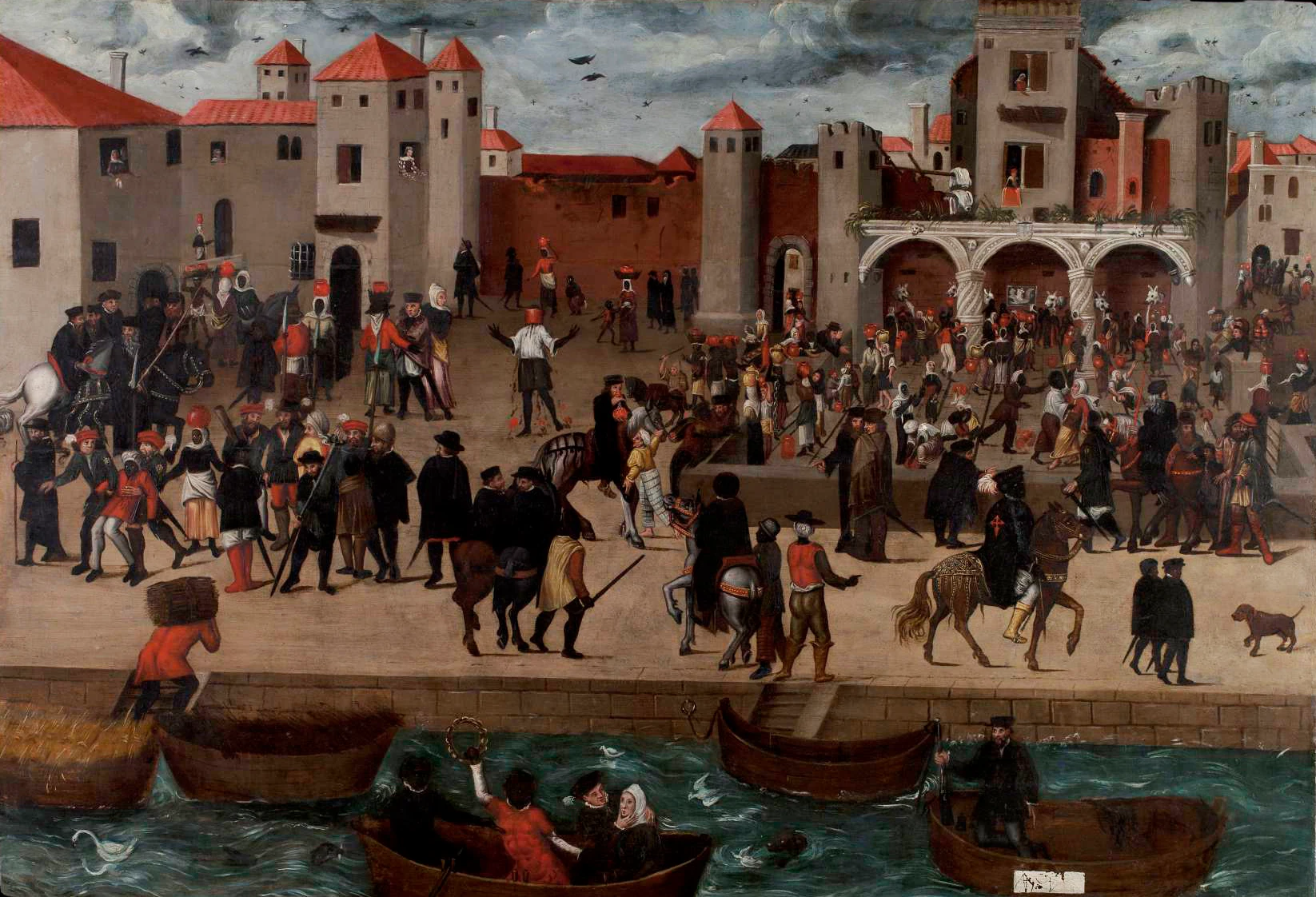
The painting conventionally known as Chafariz d'El-Rei brings African figures into a crowded urban scene. Look across the whole image rather than searching for one person who can stand for everyone. Water vessels, movement, social encounters and differently dressed figures form a busy composition. The picture is valuable precisely because African presence occupies the everyday city, rather than appearing only at the margin of an imperial portrait.
.png)
Art historian Stefan Halikowski Smith's study of the painting examines its genre, dating and interpretations. The image was composed by an artist; it is not a camera recording an unselected instant. A horse, garment or gesture may invite a plausible reading without establishing a name, occupation or legal condition. Even the temptation to identify a prominent figure as a famous Black courtier needs more evidence than visual resemblance.
Bring that restraint back to the fountain. The present architecture anchors the location, but it does not reproduce every detail of the painted scene. The useful continuity is the relationship between water, people and the lower city. A visitor can understand the social importance of a shared water source without pretending that the people in the picture are still waiting just beyond the frame.
04 · Lisbon through evidence
Terreiro do Paço: a port beside the crown
Continue towards Campo das Cebolas and the great river-facing square now called Praça do Comércio. Its earlier name, Terreiro do Paço, points to the royal palace that stood here before the earthquake. That proximity matters. Maritime trade and royal administration were joined physically as well as politically. Ships, cargoes, officials and financial claims met along this shore.
The archive's account of Terreiro do Paço includes the testimony of Jan Taccoen, a visitor in 1514, who described Africans being brought ashore and treated as property. His account provides evidence of a public commercial process, although the precise landing point cannot be fixed confidently onto the present square. It is enough to establish the connection between this historical waterfront and the trade; an invented exact spot would add drama at the expense of accuracy.
State involvement extended beyond watching ships arrive. The Casa dos Escravos, established as an administrative department in 1486, formed part of the crown's management of African commerce. Its name should not be read as a promise of an intact building that can be entered today. What survives most clearly for this walk is an institutional history: officials, records, valuation and the classification of human beings as taxable property.
The 1509 regulations discussed in the digital archive set out procedures for officials to inspect arrivals, record people and assign values. These administrative acts translated a violent transfer into forms that the crown could govern and profit from. A ledger entry could make a person legible to an accountant while obscuring their language, family, previous life and wishes.
This is one reason a grand square cannot explain the history through architecture alone. The institutions that operated around the old palace had powers that extended far beyond what a visitor can see in stone. Customs, licensing and registration linked distant transactions to the capital. The records reveal mechanisms of control, even where the buildings and individual life histories are lost.
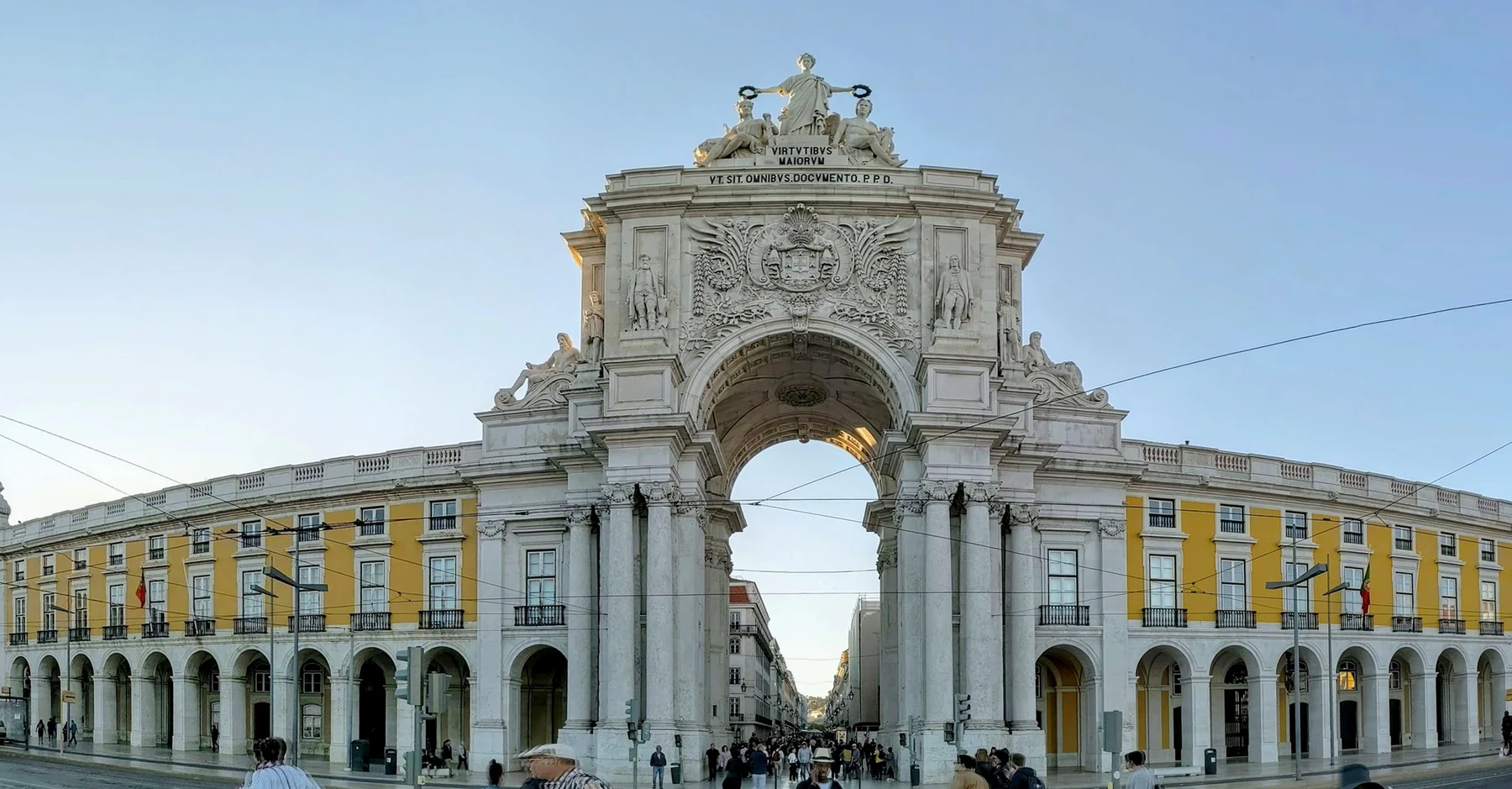

Stand where you can see both the river and the streets leading inland. The arrangement makes a durable geographical point: water brought people and goods towards a place where authority could supervise their movement. It does not establish that every ship or every enslaved person passed through Lisbon. The city's role was substantial without being universal.
05 · Lisbon through evidence
The vanished trading street and the wider Atlantic
Behind the old palace lay Rua Nova dos Mercadores, a major commercial street. Nearby, the Largo do Pelourinho Velho was associated with the sale of enslaved people. The historical account of this area uses João Brandão's 1552 description to place those sales within a broader market world. Furniture, textiles, valuables and people could enter the same commercial vocabulary. The violence lies partly in that ordinary arrangement: the market treated human ownership as a category of business.
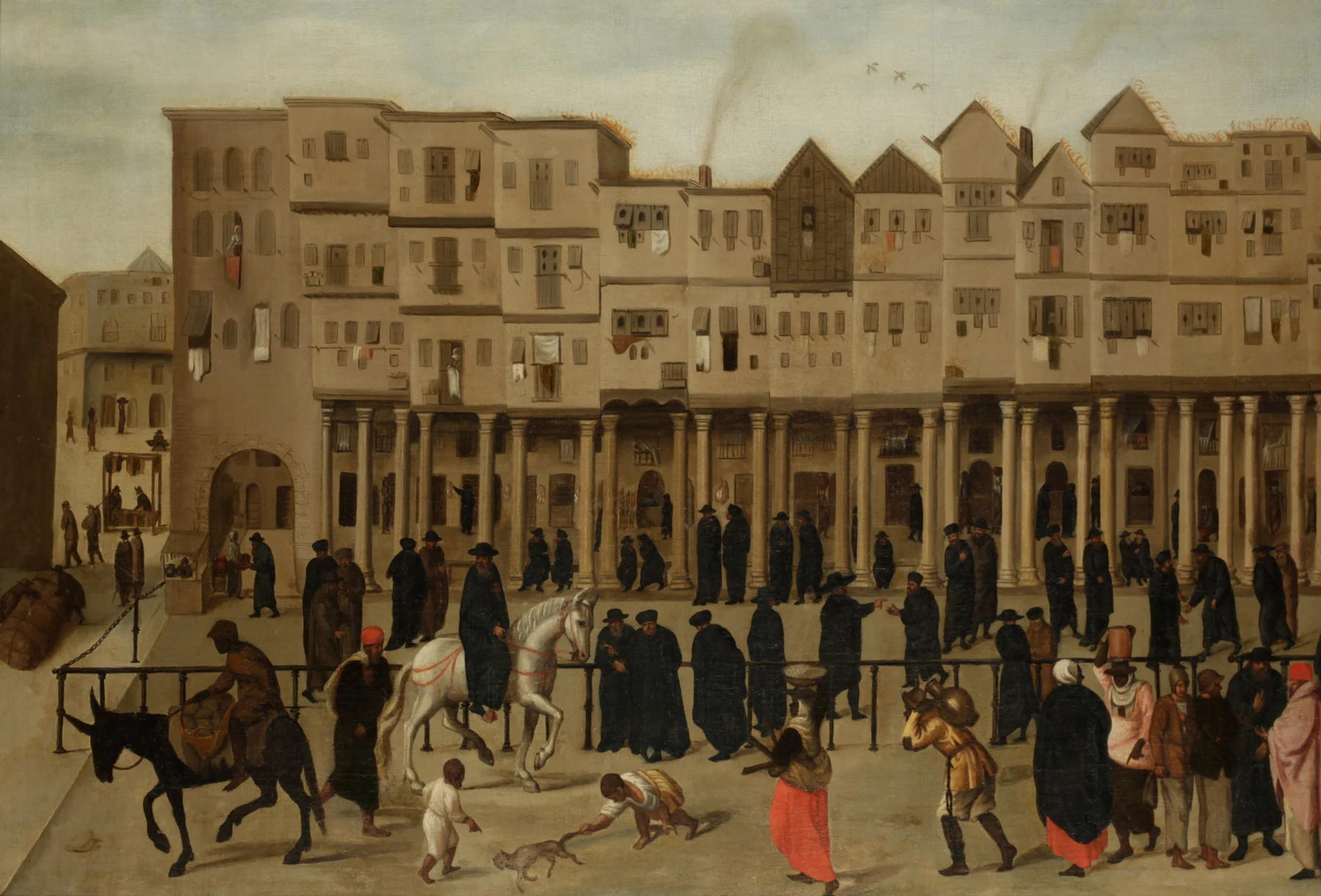
The street was destroyed in 1755. Its surviving painted representation, now associated with Kelmscott Manor, offers a way to imagine the density of the commercial setting without inventing a reconstruction. Look at buildings and people together. Commerce occupied thresholds, arcades and the street itself. A trading quarter needed people to carry, measure, negotiate, supervise and maintain it, as well as merchants who appeared in the accounts.
_-_Society_of_Antiquaries_of_London,_Kelmscott_Manor.png)
The scene also helps resist an overly simple economic explanation. Lisbon participated in trades in spices, textiles, gold and many other goods. Different institutions, taxes and labour arrangements supported the empire. Enslavement was a major part of that system, but describing every palace stone or every city improvement as financed by one identical transaction would substitute a slogan for the work of tracing money, materials and power.
Across the Atlantic, Portuguese and later Brazilian shipping carried enormous numbers of Africans into slavery in the Americas. The SlaveVoyages research overview shows the importance of the southern Atlantic and direct connections between African ports and Brazil. Many voyages did not complete a neat Europe–Africa–America triangle. Lisbon could be involved through administration, finance and commerce without being a physical stop on every passage.
That distinction changes how to look at the Tagus. A port can be powerful through decisions made there, not only through vessels visible from its quays. The history extends towards plantations and towns in Brazil, African coastal trading centres and the regions from which people were forcibly taken. None of those places should become an anonymous backdrop to the story of a European capital.
Voyage databases also demand care. Their numbers combine surviving records with research methods for estimating gaps; a ship's entry is not a complete record of the people aboard it. The project's methodology makes those limitations explicit. Counted movement, unrecorded loss and a person's own biography are different things. The database establishes scale and connections while individual documents may recover fragments of a life.
06 · Lisbon through evidence
Grácia: a person inside an accusatory archive
One such fragment concerns a woman recorded as Grácia. Portuguese documents place her at São Jorge da Mina, the fortress at Elmina in present-day Ghana, working in the royal oven. A record identifies her as a kneader in 1519. Her name before baptism and her original home are unknown. The name preserved by the archive therefore gives access to a person while also showing what the record cannot restore.
Accused of religious offences in 1540, she was sent to Lisbon, where Bishop Diogo Ortiz questioned her in his lodgings in Rua do Saco while she was held in the Aljube prison beside the cathedral. The Inquisition took over in May 1541. The surviving proceedings, Torre do Tombo's Process 11041, distinguish the prosecution's claims from her denial and the defence's allegation that an oven official had fabricated charges to replace her with another worker. On 22 December 1541 she was sentenced to confinement in Santa Clara convent.
Her story should not be retold as proof that the accusation was true. Nor should the defence's explanation become a completely verified account of what everyone intended. The record preserves competing claims made within a coercive legal process. It does show how work, royal ownership, baptism, language and ecclesiastical authority converged on one woman's life.
The journey from Elmina to Lisbon was no ordinary travel between two connected ports. It happened under custody and legal compulsion. The archive's geographical reach is therefore part of its human meaning: institutions could move a worker across an ocean and subject her to judgment far from where she had lived. A city's African history includes these imposed movements as well as the everyday labour visible at its fountains.
The questions raised by her case continue beyond what the file answers. Who chose the name used by the court? Who translated her replies? What counted as acceptable knowledge of a religion into which she had been baptised? What did the employer need the oven to produce? Those questions keep the worker, rather than the prosecutor's categories alone, at the centre of the reading.
It is possible to tell a documented human story without supplying missing dialogue, an imagined expression or a dramatic description of suffering. Grácia's occupation, transfer, denial and sentence carry the account. The limits of knowledge belong with those facts. They do not make the person less real.
07 · Lisbon through evidence
São Domingos: association, faith and arguments for freedom
Cross the lower Baixa towards Rossio, then enter the adjoining Largo de São Domingos. The church gives the walk a different institutional focus. Africans were not present only as people administered by the crown or sold by merchants. They also formed religious associations through which they organised devotion, mutual support and claims to social recognition.
The Brotherhood of Our Lady of the Rosary associated with São Domingos is central to that history. The digital archive's church entry explains the development of a Black confraternity and the eventual separation of Black and white brotherhoods. Institutional division did not remove racial hierarchy. It did create a setting in which African and Afro-descendant people could act collectively, rather than appearing only as individuals negotiating with an owner.
Confraternities linked worship to practical responsibilities such as assistance, funerary observance and efforts to obtain freedom. These concerns belonged together. A dignified burial, help during hardship and a legal or financial route out of bondage all required resources and relationships. A brotherhood could organise contributions and collective representation in ways that an isolated worker could not.
Historian Didier Lahon's research on Black confraternities places their activity within the tensions of slavery, religious belonging and ideas of blood purity. Christian membership did not automatically produce legal freedom or social equality. Baptism could coexist with ownership; participation in a church could coexist with exclusion. The institutions offered possibilities that need to be understood inside those constraints.
For a visitor, the important question is not simply whether the Church supported or opposed slavery as if it were one person making one decision for several centuries. Particular clergy, religious bodies and lay associations acted differently. Churches could participate in systems of domination while Black worshippers used religious organisation to protect one another and contest their position. Keeping those actors distinct makes the contradiction intelligible.
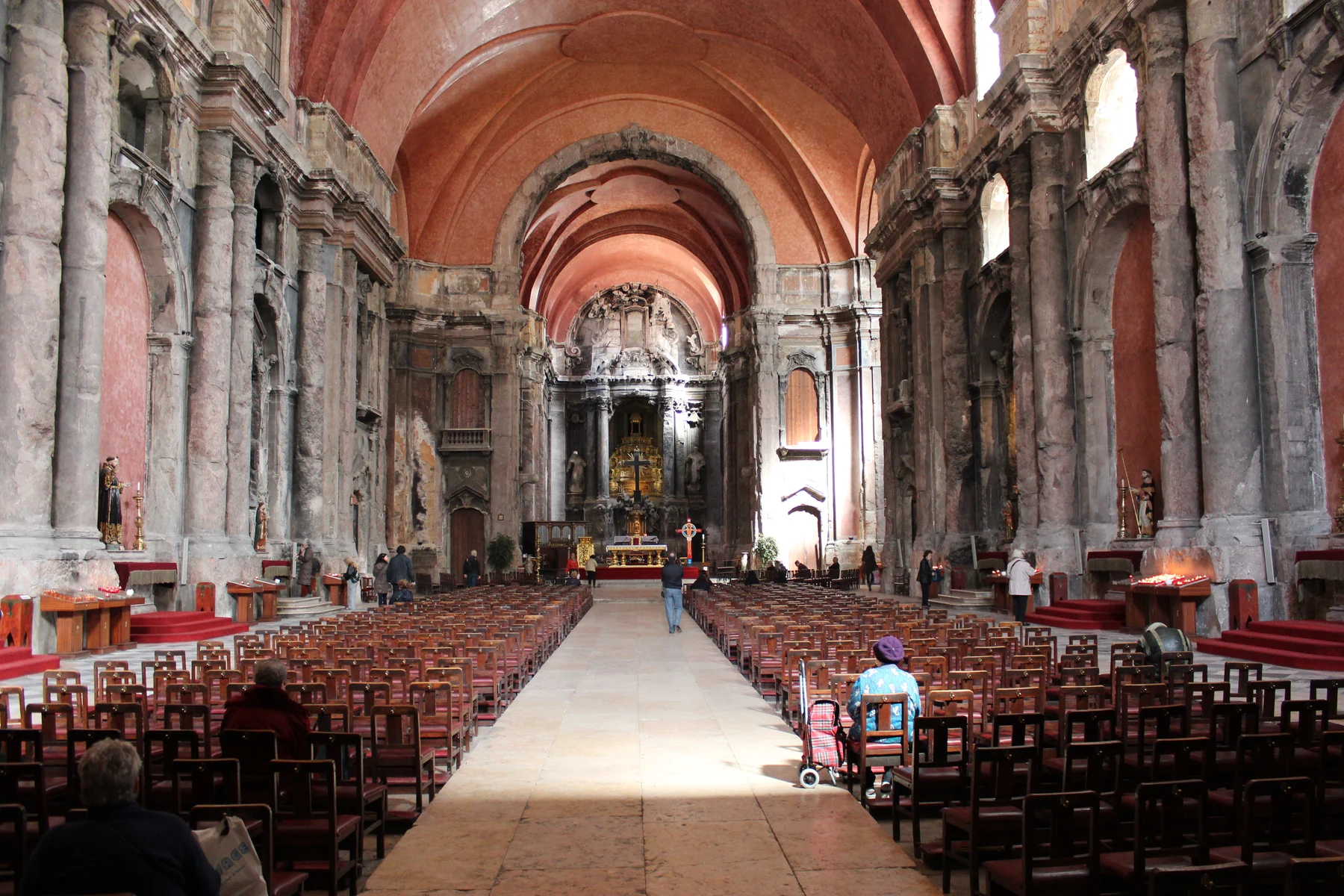

The present interior also asks for chronological discipline. Lisbon's official tourism account describes the transformations caused by rebuilding, the 1755 earthquake and the 1959 fire. The damaged surfaces visitors see belong to those histories, rather than serving as a convenient visual metaphor for every injustice discussed on the walk. Attend to the building on its own terms, and to worshippers as people using a church, not as participants in a visitor's historical scene.
08 · Lisbon through evidence
Rossio and a Black Atlantic challenge to slavery
At the northern edge of Rossio, the site occupied by the national theatre once held the Estaus palace, associated with the Portuguese Inquisition. That historical geography connects the square to public judgment and religious coercion. It does not mean the present theatre is an unchanged courtroom. Here, as at the riverfront, a later building stands within an older institutional landscape.
The walk also needs an account of Africans arguing against slavery, rather than a story in which freedom arrives only when Europeans eventually decide to grant it. Lourenço da Silva Mendonça offers a documented seventeenth-century example. A member of the royal family of Ndongo in present-day Angola, he experienced exile through Brazil and travelled through Portugal and Spain before presenting a case in Rome in 1684.
José Lingna Nafafé's archival study of Mendonça reconstructs a challenge to Atlantic slavery through legal and religious channels. Mendonça drew on networks that connected Black confraternities and other oppressed groups across the Atlantic world. His argument belongs to a history of organised claims about the wrongfulness of human enslavement, well before the eighteenth-century abolitionists who often dominate popular accounts.
It did not bring Atlantic slavery to an immediate end. That limitation is essential: the importance of a political argument cannot be measured only by whether powerful opponents promptly accepted it. Mendonça's work reveals people diagnosing the system and attempting to change it, not simply resisting one owner or surviving one voyage. It also shows that Lisbon belonged to networks of African political thought as well as networks of trafficking.
No surviving central-city doorstep needs to be invented for him. His relevance to the walk is the connection between Portugal, Black associations and a wider campaign. A plaque identifying a particular residence would be a different kind of claim and would require different evidence. The strength of this account comes from the records and the network, not from staging a supposed meeting on a picturesque street.
At Rossio, a traveller has now encountered two very different uses of institutions: authorities classifying and punishing, and people using organised representation to seek rights. That relationship is more revealing than a simple division between a beautiful city and a hidden dark history. Both kinds of activity helped make the city.
09 · Lisbon through evidence
Mouraria, Alfama and the neighbourhood beyond the label
An optional continuation towards Martim Moniz and the lower streets of Mouraria turns attention towards neighbourhood life. Alfama and Mouraria have long histories of different populations, trades and religious practices. They should not be presented as a single preserved African quarter in which every doorway carries the same past.
Mouraria's name belongs to the city's medieval Muslim history. Atlantic African trafficking, free African settlement and later migration are related to Lisbon through different periods and mechanisms. Compressing them all into one category would erase the difference between religious classification, origin, racialisation and legal status. A useful route names those distinctions even when it crosses the same ground.
The broader African Lisbon route published by Turismo de Lisboa extends across several parts of the city. Its geography is a reminder that African presence was not confined to one monument or an isolated enclave. Households, work sites, churches and places of sociability created overlapping urban networks.
The modern neighbourhoods also have their own residents and businesses. A person who looks African to a visitor should not be asked to stand in for an entire history, explain their ancestry or pose as an illustration. Music, food and shop signs may offer opportunities for cultural encounter, but they do not tell a stranger's biography. Ask permission for close photographs, and respect the answer.
If the climb towards the castle or the viewpoints is part of a second outing, our Lisbon Uphill story explains the archaeology, conquest, rebuilding and transport choices of that landscape. It complements this walk where their streets intersect. It does not replace the history of work, slavery and association developed here.
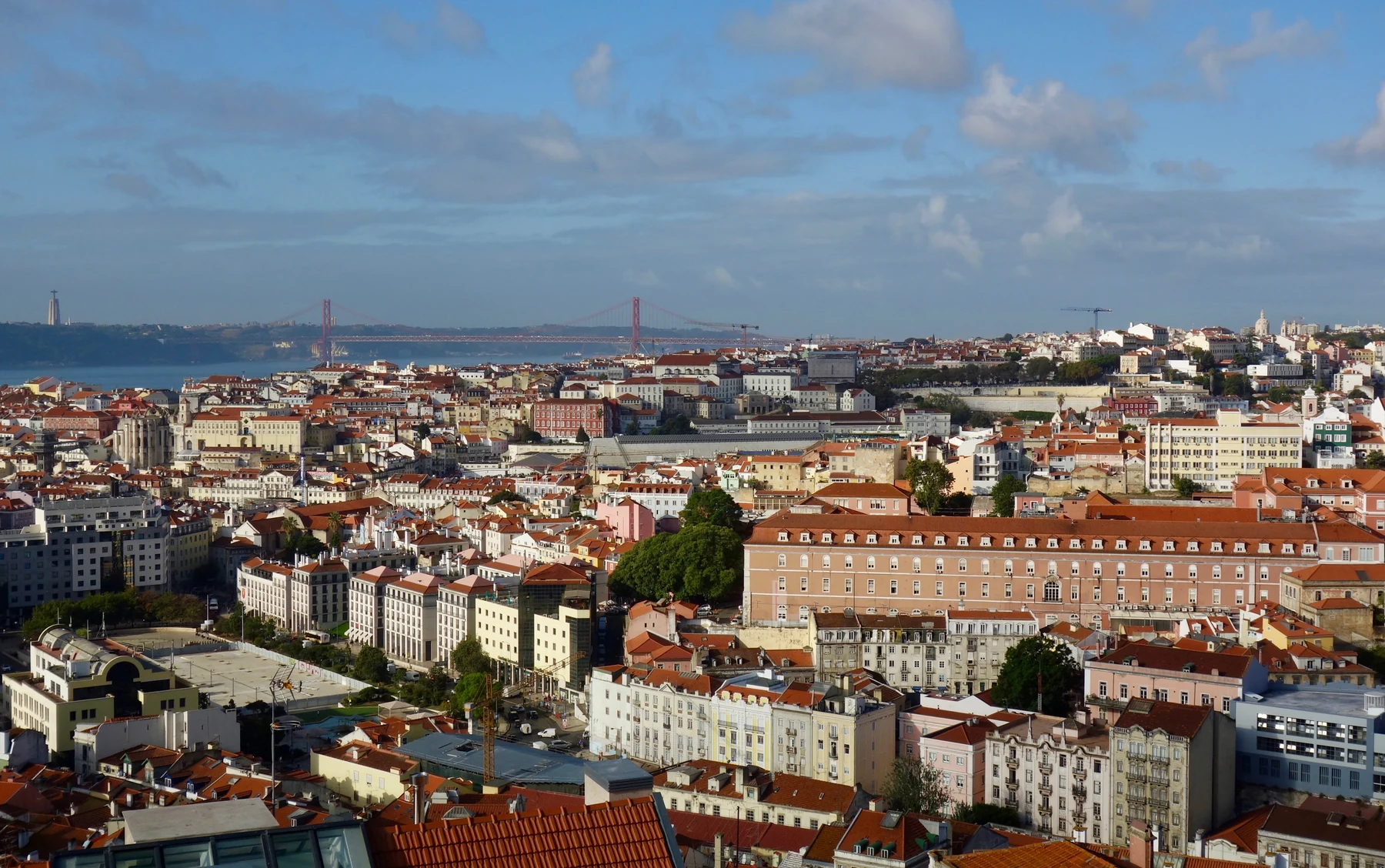
.jpg)
Choose a neighbourhood visit for something concrete: a public cultural programme, a museum, an advertised performance or a meal you want to eat. Buying food after a history walk need not become a scripted act of reconciliation. Supporting a business is an ordinary transaction with people doing their work. The more respectfully it is treated, the less it has to carry a visitor's desired emotional conclusion.
10 · Lisbon through evidence
The Baixa was rebuilt, and the evidence changed with it
The straight streets between Praça do Comércio and Rossio belong largely to the reconstruction after the earthquake of 1 November 1755, followed by tsunami and fire. Walking through the orderly grid can make the earlier city hard to imagine. The old palace, market spaces and commercial street were not simply tidied into their present form. Destruction and rebuilding changed the framework through which the past can be read.
The Pombaline Lisbon nomination published by UNESCO explains the planned streets and construction systems. Rua Augusta became a principal axis. Internal timber framing, known as the gaiola, worked with masonry and connected structural elements; fire-separating walls addressed another danger exposed by the catastrophe. Repetition in building design also made reconstruction more manageable.
The engineering belongs inside the history of this walk because it explains why an early modern description cannot be applied directly to today's façades. The street name or the historical vicinity may survive while the spatial arrangement, building and use have changed. An elegant arcade does not certify the survival of an auction site. Likewise, a vanished structure does not mean the activity conducted there is beyond historical recovery.
The rebuilt square made a new statement about authority and commerce. Its scale, river opening and ordered approaches invite movement between shore and city. That arrangement can be studied as a later political and architectural decision while the earlier palace and administrative institutions remain part of the same site's history. One layer need not cancel another.
Museum reconstruction provides another tool. The Museu de Lisboa's work on its model of the pre-earthquake city explains a long process of assembling and representing that lost urban form. A model is a researched modern interpretation. It helps compare spaces; it does not return every missing building or life to complete certainty.
For practical purposes, the Baixa offers a way to connect the lower riverfront with Rossio while avoiding an unnecessary castle climb. That does not make every paving surface smooth or every crossing easy. Its relatively level geography is useful; the actual route still needs to fit the traveller's mobility and pace. Historical interest is no reason to persist along a difficult street when another approach can make the next place accessible.
11 · Lisbon through evidence
Poço dos Negros and Mocambo: burial and a place to live
The western extension changes the focus again. Rua do Poço dos Negros lies beyond the central riverfront circuit, towards the Santa Catarina and Santos side of the city. Its name has commonly been connected with a royal order in 1515 for a burial pit for enslaved Africans. The archive's discussion of the street explains the order and the neglect that made such a provision part of the city's administration.
The precise location of the pit is not securely identifiable as a visible site on the modern street. Do not look for a preserved opening or repeat a guide's pointing gesture as archaeological proof. The evidence supports a history of unequal treatment in death and a place-name through which that history remains discussable. It does not support an invented scene beneath a particular doorstep.
Burial also returns the walk to the importance of associations. Funerary rites, religious belonging and collective help mattered to people whose lives could be treated as property. How someone was buried was connected to how a community recognised that person. The street name and the confraternity therefore illuminate different responses to the same human need for recognition.
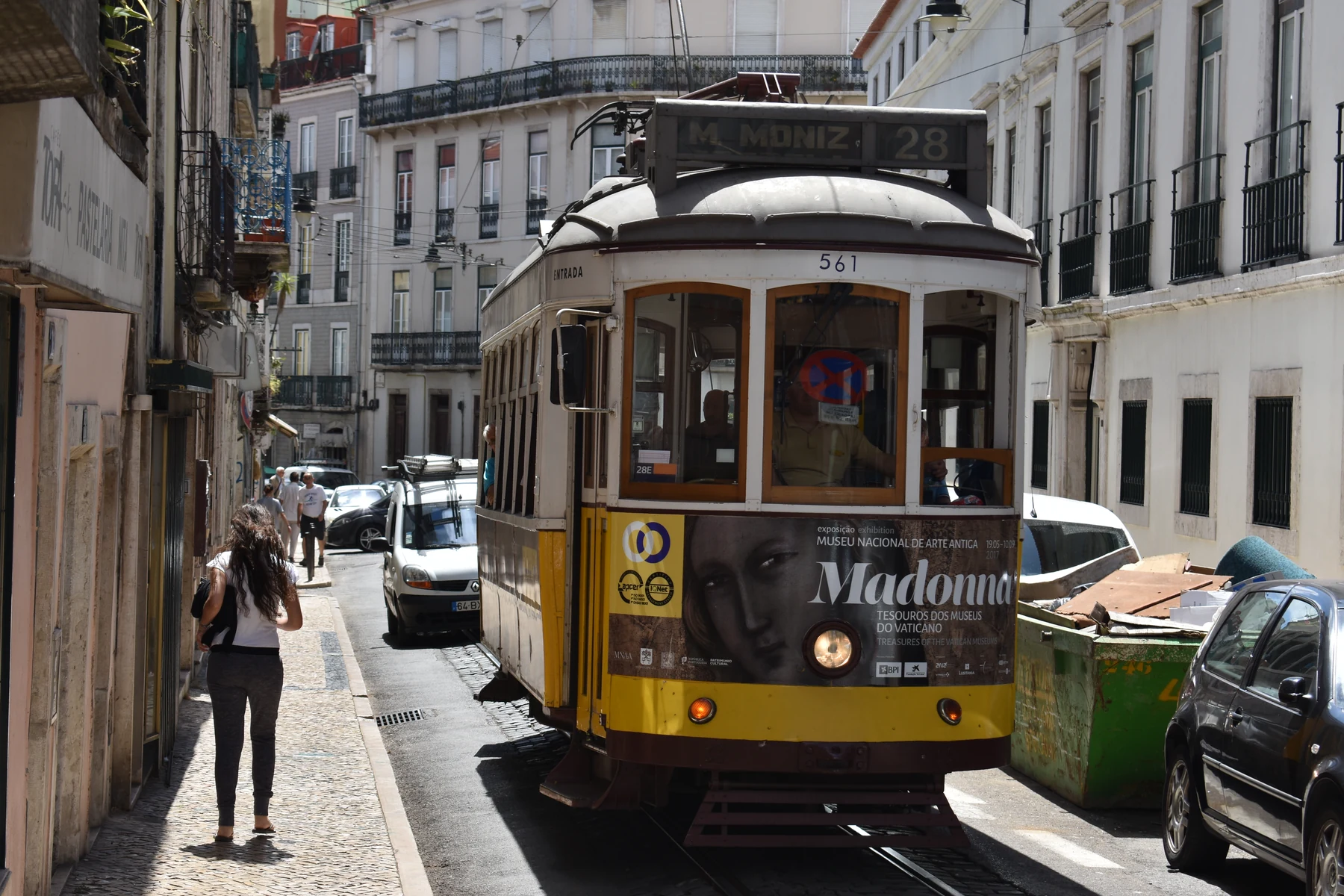

Nearby, the history of Mocambo points towards habitation and community. In her Lisboa, Cidade Africana itinerary, historian Isabel Castro Henriques describes an officially recognised district from the late sixteenth century and a name rooted in African languages. Free and freed African residents helped make an urban area in which households and cultural practices could develop with greater autonomy.
Mocambo's administrative extent changed over time. It should not be reduced to one surviving alley, nor treated as an unchanged Brazilian maroon settlement transferred to Lisbon. The term connects different Atlantic histories, but the Lisbon district also operated within the city's official organisation. Its value is that it makes African participation in building neighbourhood life visible.
This western part of the story holds burial and living together without making either a spectacle. A named street can preserve a trace of inequality; a district can reveal people creating homes and relationships. Neither supplies a full biography of every resident. Together they widen the meaning of African Lisbon beyond the moment of arrival at a port.
12 · Lisbon through evidence
Abolition was a sequence, with different geographies
A walk that discusses the slave trade needs a clear account of what ended, when and where. The most misleading shortcut is to say that Portugal abolished slavery in 1761 and leave the sentence there. A law could restrict movement into metropolitan Portugal while slavery continued within an empire that included territories across the Atlantic and beyond.
The Torre do Tombo exhibition of abolition records distinguishes the 1761 restriction on importing enslaved people into Portugal from the 1773 measure that advanced the gradual ending of hereditary slavery in the metropole. The archive also documents qualifications and later maritime exceptions. The geographical scope and the categories affected by a law matter as much as its date.
In 1836 a Portuguese decree prohibited the export of enslaved people across Portuguese domains. It addressed trading, which is related to but distinct from the legal condition of people already held in slavery. The parliament's archival account sets that measure within a longer legislative sequence. Passing a prohibition did not prove that officials could or would enforce it everywhere.
The parliamentary exhibition's section on this legislative process explains gradualism, entrenched economic opposition and international pressure, including British pressure. Abolition involved contests among people with unequal influence. Owners, colonial authorities, politicians and people seeking freedom did not have equivalent access to the decisions or equivalent reasons for wanting change.
In 1869 the legal status of slavery was abolished throughout the Portuguese monarchy, but people became libertos, a constrained legal category. The exhibition's account of the later stages records the formal ending of that servile condition in 1875 and continuing public tutelage until 1878. These distinctions prevent a celebratory decree from becoming a claim that control over work and movement vanished at once.
Brazil requires a separate line in the chronology. It became independent in 1822; later Portuguese imperial decrees did not abolish Brazilian slavery. The Brazilian National Archive's record of the Lei Áurea identifies the law of 13 May 1888 that ended slavery there. The long relationship between Portugal and Brazil is essential to the Atlantic story, but their legal timelines cannot be merged.

This sequence changes what a visitor should ask of an abolition monument or a famous reformer's biography. Which people did the measure affect? What obligations remained? Who contested them? A named politician's initiative can matter without making the people who sought freedom disappear from the explanation. The right to direct one's own life was the issue being fought over, not just the opportunity for a state to declare itself enlightened.
13 · Lisbon through evidence
From colonial labour to an anticolonial Lisbon
Legal abolition did not end Portuguese colonial rule or all coercion of African labour. The parliamentary exhibition's account of the period after abolition describes systems that stopped treating a person as tradable property while imposing other forms of compulsory work. The legal categories changed; important powers of coercion remained. Portugal's formal ending of compelled labour in 1962 belongs to that later history.
This is not an argument that every twentieth-century worker occupied the identical legal status of an enslaved person in the sixteenth century. It is an explanation of why changing one status did not settle the wider question of control over African lives. Colonial claims of a civilising mission could continue to justify unequal authority and labour obligations.
Lisbon also became a place where people from colonised territories studied, wrote and organised against that authority. The Casa dos Estudantes do Império operated from 1944 to 1965. Created within an imperial framework to support students, it became associated with networks that helped develop anticolonial thought. The ReMapping Memories account places figures including Amílcar Cabral, Agostinho Neto, Mário de Andrade and Marcelino dos Santos within this history.
The house was not a single party office, and attendance did not mean that every member shared the same politics. Social support, meals, literature and cultural events brought people together; political positions developed through those encounters and through experiences elsewhere. The institution's imperial name and the purposes some of its members made of it expose a significant contradiction within the capital.
Women must remain visible in this account. Vânia Maia's reporting on former members includes Maria da Luz, known as Lilica Boal. A student from Cabo Verde who attended the Lisbon house, she later worked with the PAIGC's educational project in Guinea-Conakry. Her trajectory connects education and political organisation across countries; it does not fit a history told only through future male presidents.
The house's former Lisbon setting lies north of the central walk. Treat it as a separate historical circuit rather than claiming that the whole story can be reached in a few steps from Rossio. A social institution can have city-wide importance even when its surviving fabric is modest or its function has changed. The documents, cultural work and relationships explain its significance.
African liberation movements and years of war preceded the overthrow of Portugal's dictatorship in April 1974. Portugal recognised the independence of its former African colonies across 1974 and 1975, as the parliament's history of the democratic transition records. Those processes had different national histories. They should not be reduced to freedom bestowed by Lisbon, or confused with the nineteenth-century ending of slavery.
Later migration, work, family formation and Portuguese-born generations added further African and Afro-descendant histories to the metropolitan region. Their importance cannot be contained within the old centre. The walk is an entry into that wider city, not a claim that African Lisbon ended with decolonisation or exists only where a historical tour can point.
14 · Lisbon through evidence
Belém and the choice of who becomes monumental
Belém deserves a separate visit because its imperial architecture changes the scale and language of the argument. The Padrão dos Descobrimentos projects a procession of named historical figures towards the river. Its height, sculptural ranks and prominent position make selected lives part of the monumental city. That selection is itself worth studying.
The monument is modern. Its official history identifies an original temporary structure for the 1940 Portuguese World Exhibition and the permanent version inaugurated in 1960. Architect Cottinelli Telmo and sculptor Leopoldo de Almeida shaped its design. It belongs to the Estado Novo's representation of maritime expansion, rather than surviving from the age represented by its figures.
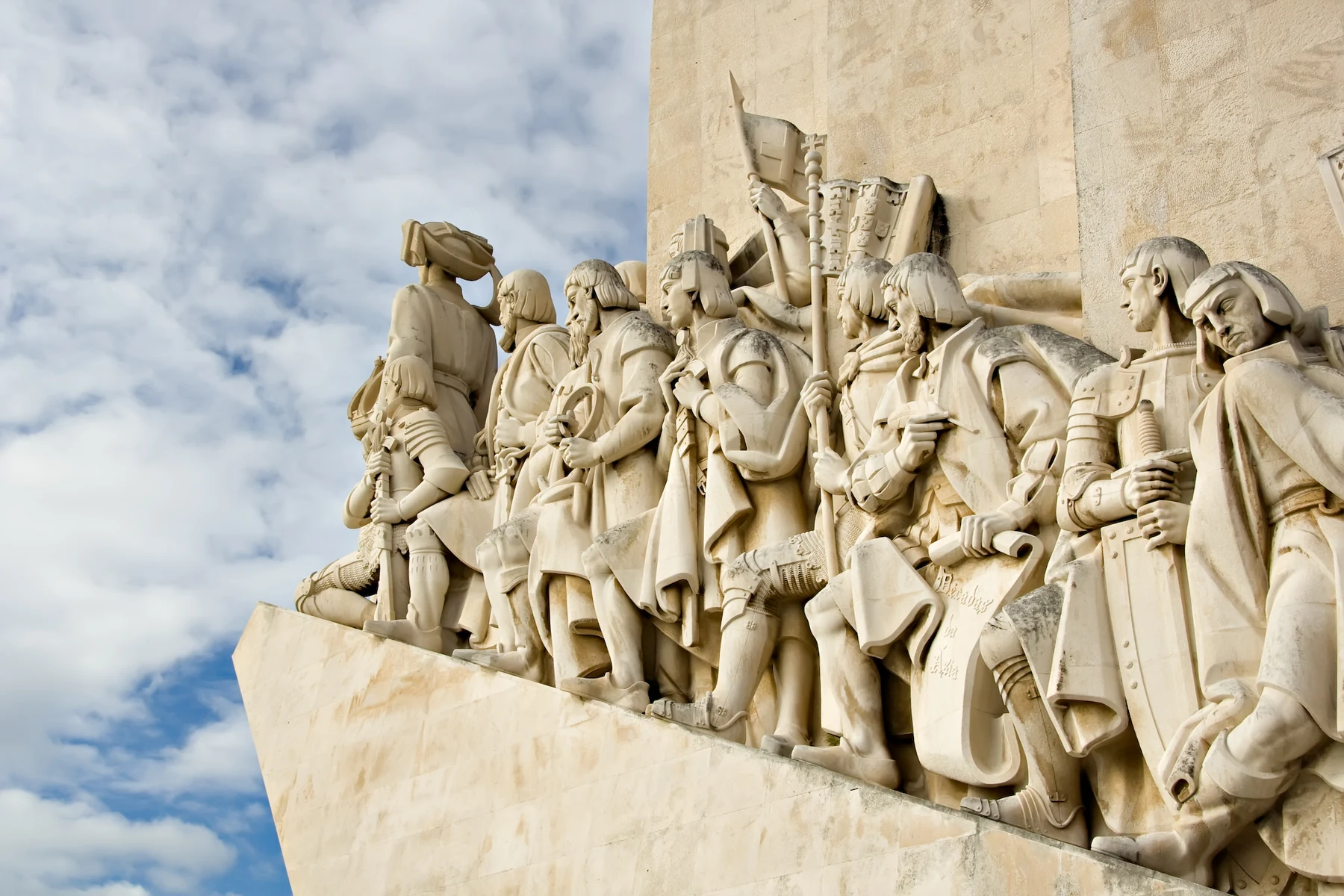

The Contested Legacies discussion of the monument places it within an imperial memory that privileges discovery and national achievement. A visitor can examine that argument through the work itself. Which people receive individual names and commanding positions? Which kinds of labour, violence and encounter fall outside the procession? The point is to understand how a monument constructs a story through scale and selection.
The Jerónimos Monastery and Belém Tower belong to different construction histories. They should not be absorbed into the Padrão's twentieth-century date, nor treated as if every structure expresses an identical political message. Architecture can carry historical uses and later appropriations together. A state can turn an older building into a national symbol without having built it.
Likewise, recognising enslavement within the history of expansion does not require denying navigation, engineering, artistic work or exchange. It requires explaining the relationships and the costs alongside those achievements. A voyage could involve technical skill and imperial violence at the same time. The choices made by a commemorative monument determine how much of that complexity the public sees.
For a traveller, the strongest comparison is between different forms of visibility. Here, selected figures appear in stone at monumental scale. At a fountain, an archive or a brotherhood, many African lives survive through labour descriptions, legal cases, images and collective institutions. The imbalance is a historical subject. It should not be filled by fabricating a missing portrait or staging a symbolic scene beside the monument.
15 · Lisbon through evidence
Memory is also made by communities
The public account of African Lisbon is being shaped by people and organisations whose work extends beyond state monuments. Batoto Yetu Portugal connects dance, education and research into African presence. Its description of this work explains public heritage walks, collaboration with historian Isabel Castro Henriques and efforts to make African histories visible through the city's place names.
Plaques can make a modest but consequential change. A familiar street acquires another documented context; a passer-by encounters a question that a conventional map may omit. A Mensagem de Lisboa's reporting on the plaques describes the collaboration behind a set of twenty. Such work is not simply the addition of attractions. It changes what the city makes available to be known during an ordinary journey.
Djass, the association of Afrodescendants, brought a memorial proposal to Lisbon's participatory budget in 2017. Its account of the project explains a purpose that includes honouring enslaved people and resistance, recognising Portugal's involvement and considering the relationship between African heritage and contemporary discrimination. That is an argument about whose memory should have public space, not merely an artistic commission.
The proposal's history is part of the story whether or not a visitor encounters a finished installation during a particular trip. Plan a visit around a clearly identified existing place or an organisation's actual public programme, rather than an assumed monument. A rendering of a proposal would also be a representation of an idea, not documentary evidence of a structure standing on the riverfront.
Community involvement does not imply that every African or Afro-descendant person holds the same view of commemoration. Nor does it make public institutions irrelevant. Historical research, activism, municipal decisions and artistic choices meet in this field, sometimes productively and sometimes in disagreement. The disagreement can concern location, language, responsibility or what kind of recognition would be adequate.
The parliamentary exhibition's section on memory stresses the different geographical and legal histories contained within the subject. That warning is useful on the street. One memorial cannot represent every experience, but a city that recognises only rulers and navigators cannot claim that its selection is complete either.
Visitors do not need a prescribed feeling at the end of the walk. The useful change is a more accurate understanding of the city and of the people who have shaped it. Attend a public event on its own terms, pay for a guide's work where you choose a guided visit, and keep private grief, worship and daily life outside the camera's demand for an ending.
16 · Lisbon through evidence
Plan the walk around the body as well as the history
The core sequence works best as a small number of meaningful stops rather than a race to collect names. Lower Alfama and the riverfront provide the port-and-labour setting; the Baixa connects it with Rossio and São Domingos. Mouraria is an optional continuation. Poço dos Negros and Mocambo add a western circuit. Belém and the former student-house area each need a separate travel decision.
Ground and slope. The lower circuit can avoid the castle climb, but Alfama's paving, gradients and narrow passages still matter. Steps and uneven stone can interrupt an apparently short route. Wheelchair users, people with limited balance and anyone travelling with a buggy should agree a street-by-street route rather than relying on a neighbourhood's general description. A route can be shortened to the squares and church surroundings without losing its central argument.
Transport. Santa Apolónia and Terreiro do Paço are useful station names for planning approaches to the eastern riverfront; Rossio offers a different endpoint. A station's presence on a map does not establish a usable lift connection on the day. The metro's line and lift status page provides live information. Check the actual entrance, surface connection and return journey together, especially when a mobility aid makes stairs unsuitable.
An indoor stop. The Museu do Fado's visitor information reports wheelchair access and manual wheelchairs available for loan. That supports a decision about that museum, not a guarantee about all the surrounding streets. If an accessible toilet, seat or particular service is essential, ask the venue about the facility you need and its access conditions before building the day's route around it.
Water and rest. Carry drinking water and use deliberate pauses. A historic fountain is not automatically a drinking-water source. The riverfront and large squares can be exposed to sun and wind, while a short uphill detour adds effort quickly. Set the pace for the person who needs the most rest. A seated conversation with a painting or document can deliver more understanding than another hurried climb.
Toilets and food. Include a planned stop at an open public facility or a venue you intend to use; do not assume every café offers unrestricted toilets or that a church can supply them. There is no need to prescribe a particular restaurant as a moral conclusion to the route. Choose food for its own appeal and verify the business's current public information if making a special journey.
Church conduct and photographs. At São Domingos, follow posted instructions and the guidance of staff. Keep conversation quiet, avoid interrupting services, and do not photograph people praying without consent. On residential streets, keep doors and narrow passages clear. Photographing a building or a street name requires a different judgment from photographing a person at close range.
Families and difficult history. For younger visitors, explain concrete distinctions: a worker's skill, an owner's power, a person's name and the right to choose one's life. Avoid graphic spectacle. Let a child ask questions, and let anyone take a break without implying that discomfort is a required measure of understanding. The subject deserves seriousness; seriousness does not require forcing one emotional response.
Choosing a guide. Look for clear explanations of sources, historical uncertainty and the proposed terrain. A useful guide should distinguish a documented event from interpretation and a modern monument from the history it represents. Clarify language, duration, group size, route and access with the organiser for the actual walk you choose. Those practical arrangements cannot be inferred from a compelling tour title.
You can return to the Lisbon desk to pair this route with the hill-and-archaeology story, or the Portugal desk to compare the capital with the Algarve's coast. Each route makes a different part of the country legible. None needs to be compressed into a single day to count as a worthwhile visit.
17 · Lisbon through evidence
Listen to the field notes
The Travel Podcast by ExcursionPass introduces the walking-tour idea in Lisbon African History and Slave Trade Walking Tour. The episode moves from a lower-Alfama meeting area through the central city towards Rossio and raises questions about slavery, African presence and public memory. It is a useful companion for thinking about what a history walk can reveal.
The city becomes richer when those questions are held together: the fountain and the port, the market and the brotherhood, the law and the person seeking freedom, the imperial monument and the community making a different public record. A walk can begin in a square and end with a clearer sense of how much of Lisbon's history still extends beyond it.