Barcelona’s oldest centre is neither a perfectly preserved medieval city nor a twentieth-century fake. It is a more demanding place: Roman walls carrying later houses, a cathedral with a nineteenth-century front, a royal square partly assembled by relocation, the memory of a Jewish community violently broken in 1391, and a picturesque “Gothic Quarter” deliberately shaped for visitors. Learn which stones survived, which moved, which were reinvented and which stories still require care, and the old city stops being scenery.
The bridge over Carrer del Bisbe looks old enough to have watched kings pass beneath it. It has a pointed arch, carved stone, tracery and the dim theatricality expected of a medieval lane. It is also younger than Barcelona’s metro. Joan Rubió i Bellver built the Pont del Bisbe in 1928, when politicians, architects and tourism promoters were turning the cathedral neighbourhood into the coherent Gothic Quarter that visitors now recognise.
A few minutes away, four nine-metre Roman columns are genuinely two thousand years old, but they stand inside later walls and were gathered into their present display after centuries of concealment and rediscovery. Barcelona Cathedral is substantially medieval, yet the façade that makes it instantly legible as a Gothic monument was completed between the late nineteenth and early twentieth centuries. Casa Padellàs looks settled on Plaça del Rei, although it was moved there stone by stone in 1931. On Plaça de Sant Felip Neri, meanwhile, damage that can be mistaken for picturesque age records a fascist Italian air attack in 1938 and the deaths of 42 people, most of them children.
These are not exceptions to the quarter’s story. They are the story.
The usual choice is to call the neighbourhood authentic or fake. Both answers are too easy. Roman Barcino set out a street grid and defensive enclosure that still influence movement. Early Christian, Visigothic, Carolingian and comital Barcelona reused that urban core. Medieval prosperity produced palaces, chapels, guild altars and a cathedral whose unusually broad spaces belong to a real Catalan Gothic tradition. Jewish residents shaped the city’s commerce, administration and intellectual life before violence destroyed their community. Nineteenth- and twentieth-century planners then demolished, selected, moved, restored and invented fabric to make that long past visible in a concentrated tourist district. Present-day residents, workers, worshippers, market traders, civil servants and visitors continue to change the same ground.
The useful question, therefore, is not “Is the Gothic Quarter real?” It is: what kind of reality is this particular wall, window, square or story carrying?
The Travel Podcast by ExcursionPass episode at the centre of this feature begins with a first-day problem. Barcelona can overwhelm a tired arrival. A compact guided walk offers to reduce that confusion by supplying a mental map: Plaça de Catalunya, cathedral lanes, Roman Barcino, Plaça del Rei, La Rambla, La Boqueria and El Born connected by narration rather than by a blue dot spinning on a phone. The episode also preserves the practical anxieties of such a walk—meeting points, headsets, pace, uneven paving and finding the right group.
A 90-minute orientation cannot explain the whole quarter. Follow the route, then open the city underneath it.
Listen while you read
A mental map before the slow return
The mental-map episode This episode asks why a short guided walk can be more useful as orientation than as a monument checklist. It follows the route through the old centre and considers pace, interpretation and finding the guide. Read the complete transcript.
01 · Gothic Quarter
Begin with a map of uncertainties
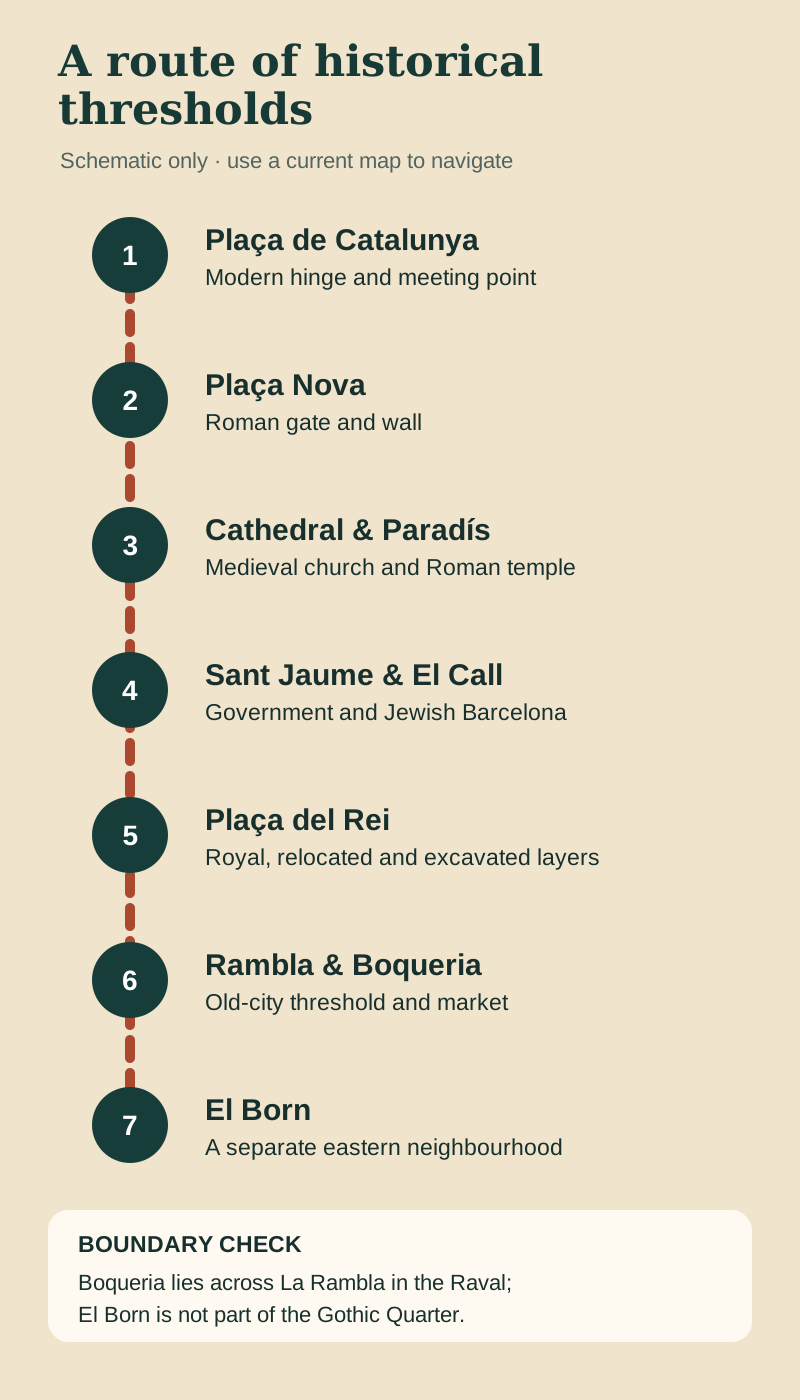
The tour begins at Plaça de Catalunya because the square is a hinge. North and west lie the broad avenues and measured blocks of the Eixample. South and east, streets narrow into Ciutat Vella. Airport buses, metro lines, department stores, fountains, pigeons and traffic compress modern Barcelona into one large open space. A guide’s umbrella is not romantic there; it is an operational device.
The podcast’s walking route describes a 90-minute English-language exterior route joining the cathedral area, Plaça del Rei, Casa de l’Ardiaca, La Rambla, La Boqueria and El Born. This breadth makes sense as orientation. It would be implausible as complete interpretation. No one can properly cover Barcino, the cathedral, medieval Jewish life, the royal palace, civil-war memory and market history in an hour and a half while also crossing the old city.
Use the walk as an index, not an encyclopaedia.
The first skill is to stop treating every aged surface as the same kind of past. Four categories are enough to begin.
Survival describes material that remains substantially where earlier builders put it: parts of the Roman wall, the Temple of Augustus columns, medieval structural fabric in the cathedral, the Saló del Tinell and Capella de Santa Àgata. Survival does not mean untouched. Stone is repaired, openings change, interiors adapt and archaeology reorganises what can be seen.
Reuse describes older material made to serve a later city. Late-Roman fortification incorporated earlier monuments and inscriptions. Medieval buildings leaned on Roman walls. A royal complex became a court, convent and museum. Reuse is not deception; it was how cities conserved resources and authority before heritage became a profession.
Restoration and relocation describe deliberate attempts to recover or concentrate a chosen past. Casa Padellàs moved from Carrer de Mercaders to Plaça del Rei. Façades and windows displaced by the opening of Via Laietana were stored and recomposed. Medieval buildings were stripped of later alterations to approximate an earlier ideal.
Invention describes new work designed to look historical. The Pont del Bisbe is the clearest example. The cathedral’s neo-Gothic façade is another, though it completed a medieval church using an old design reference. Invention can be beautiful and historically consequential. The problem begins when its date and purpose disappear.
The categories overlap. A medieval house can survive, be relocated, receive invented windows and then become a museum. That complexity is not a failure of authenticity. It is the evidence a careful walk should reveal.
02 · Gothic Quarter
Barcino: a small colony with a durable frame
Barcelona’s Roman origin is often inflated into a grand imperial beginning. Barcino was not Tarraco, the provincial capital, nor was it one of the Mediterranean’s great metropolises. Its importance lies partly in the opposite fact: a modest planned colony established a frame strong enough to guide later urban life.
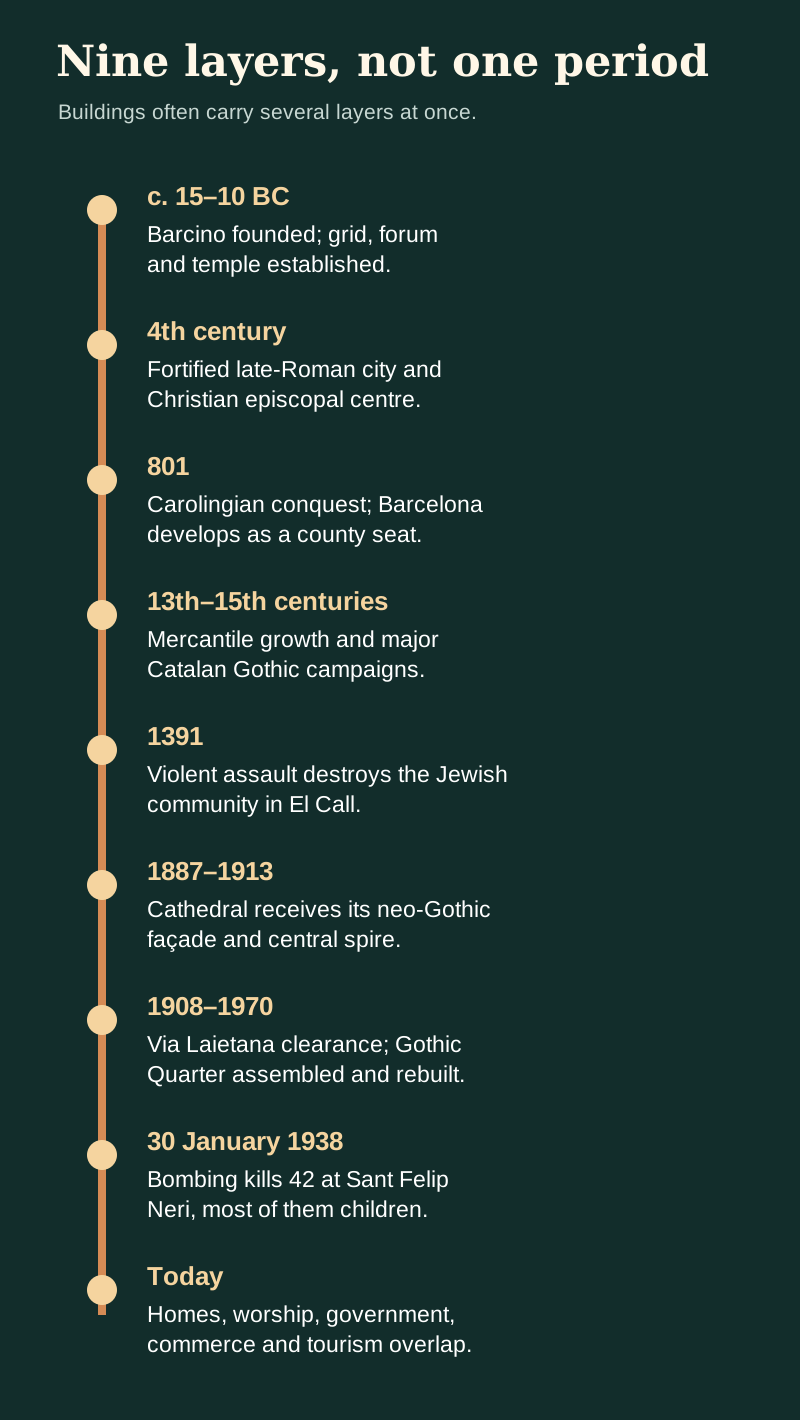
The Barcelona History Museum dates the foundation of Colonia Iulia Augusta Faventia Paterna Barcino to roughly 15–10 BC, under Augustus. It occupied a low hill known in medieval sources as Mons Taber, close to the sea and set within a fertile plain between the Besòs and Llobregat rivers. The Via Augusta and coastal trade connected it to a larger imperial system. Agriculture, wine production, craft and exchange sustained the settlement.
Barcino was planned rather than improvised. Two principal streets—the cardo maximus and decumanus maximus—crossed near the forum. Secondary streets formed a grid. Walls and gates defined the colony; drains, public space and water supply supported it. The forum gathered political, religious, economic and social authority on the hilltop now associated with Plaça de Sant Jaume and Carrer del Paradís.
That buried geometry matters because the modern quarter still makes the body feel it. Carrer del Bisbe and Carrer de la Ciutat broadly follow Roman axes. Gates survive as archaeological traces near Plaça Nova and Carrer Regomir. The forum’s height is almost imperceptible until a visitor climbs Carrer del Paradís and finds a millstone set into the pavement marking the old summit. The city did not preserve an exposed Roman diagram. It built over one.
Walls made from a city’s earlier life
The first enclosure belonged to the colony’s foundation. In the late third and fourth centuries, a much more powerful wall reinforced it with projecting towers. The usual explanation invokes insecurity across the later Roman Empire, but defensive work also expressed civic status and concentrated resources. MUHBA’s archaeology shows building material reused within the fortification, including fragments from tombs and monuments. The wall is therefore Roman twice over: late-imperial defence constructed partly from the earlier city.
Look for this at Plaça Nova, where two cylindrical towers frame a surviving gate and the springing of aqueduct arches has been made visible. At Casa de l’Ardiaca, Roman masonry carries a building whose present form combines Gothic structure, Renaissance courtyard work and a Modernista letterbox. Near Carrer del Sots-Tinent Navarro, the line of towers becomes a long urban edge. At Carrer Regomir, the Porta de Mar and bath remains show how goods and people entered from the waterfront side.
The walls did not merely survive later Barcelona. They helped create it. Strong fortifications made the small city valuable during the political instability of late antiquity. Houses, churches and palaces attached themselves to the enclosure. When a later street turns unexpectedly or a façade swells around a tower, Roman defence is still negotiating movement.
The temple hidden inside a building
_(31271166695).jpg)
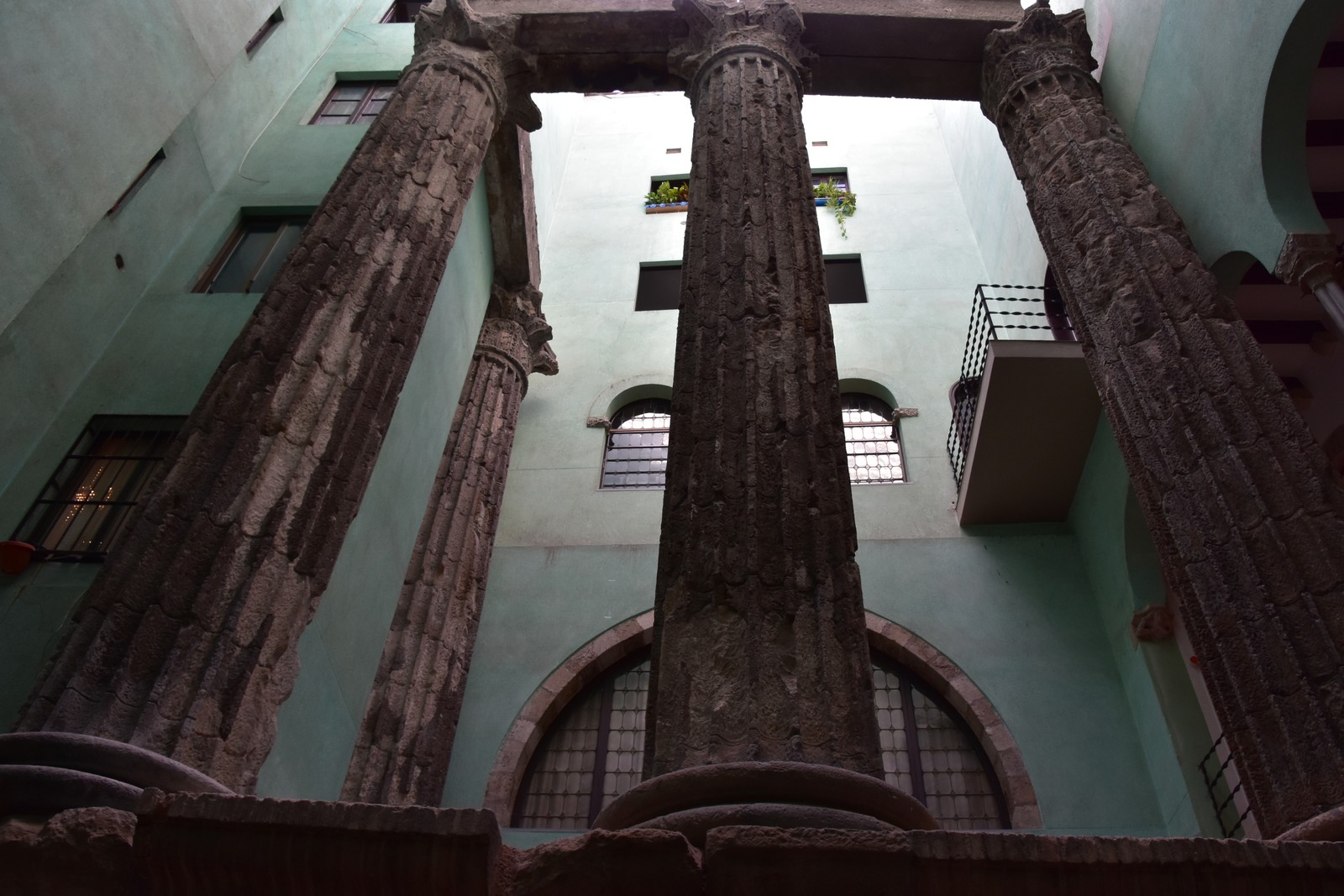
At Carrer del Paradís 10, a modest doorway opens onto the most dramatic surviving statement of Roman public power in the old city. Four fluted Corinthian columns stand about nine metres high, with part of their architrave and podium. They belonged to a temple erected at the forum, almost certainly for the imperial cult, near the colony’s foundation.
The temple did not remain a recognisable ruin through two millennia. Its function disappeared with the imperial system and the expansion of Christianity. Fabric was dismantled, enclosed and misunderstood. Columns became part of later structures. Antiquarians debated them. Three were incorporated into the headquarters of the Centre Excursionista de Catalunya; a fourth, once displayed separately on Plaça del Rei, was reunited with the group in the twentieth century.
The room teaches three lessons at once. First, Roman architecture used height and classical order to turn political-religious authority into urban form. Second, later building can preserve material by trapping it. Third, “discovery” is often a long change in interpretation rather than a single archaeological revelation.
The podcast remembers the columns as a hidden gem. Their value is not that a guide possesses a secret entrance. MUHBA publishes the site and its history. The useful surprise is conceptual: the largest Roman objects on the walk are not in an open archaeological field. They are tenants inside the later city.
Beneath Plaça del Rei, work rather than marble
The underground circuit at MUHBA Plaça del Rei corrects the monumental bias. It passes streets and installations associated with laundry, dyeing, wine and salted-fish production, together with homes, drains and the late-antique episcopal complex. Barcino appears not only as temple, wall and forum but as labour, smell, wastewater, storage and conversion.
This matters because the polished square above can make history seem like a sequence of elite façades. The archaeological city below was full of processors, craftspeople, enslaved people, freed people, traders, officials, clergy, women, children and migrants whose names are much harder to recover than those of emperors and counts. A complete mental map must include systems and ordinary work, even when the tour remains outside.
03 · Gothic Quarter
From Roman stronghold to the city of counts
Rome did not vanish on a date. During the fifth century, imperial administration receded while Christian institutions and Visigothic rulers gained authority. MUHBA describes a mixed population living behind walls strong enough to make Barcino a strategic centre. An episcopal complex grew beside the area of today’s cathedral. The old forum’s political-religious function shifted rather than disappearing.
The early Christian story survives in foundations and fragments beneath the cathedral area: a basilica, baptistery, bishop’s residence and associated rooms altered across late antiquity. Written certainty is uneven. Barcelona Cathedral’s own history distinguishes documented bishops and buildings from reasonable conjecture. That distinction is a model for the whole quarter. A plausible sequence is not the same as an eyewitness record.
Visigothic civil war opened the way to Islamic conquest in the early eighth century. The city, known as Barsaluna, became part of an Umayyad Mediterranean world for a relatively short period. In 801, Carolingian forces took it and made Barcelona a frontier stronghold governed for Frankish kings by a count. The political project of restoring a western Roman empire failed, but the county endured and its rulers accumulated independence.
By the eleventh century, comital power had the resources to rebuild. Ramon Berenguer I and Almodis sponsored a Romanesque cathedral, consecrated in 1058. The palace beside it incorporated Roman and early medieval fabric. Agricultural expansion, taxation, mills on the Rec Comtal, craft and trade brought migrants and investment. The city of counts grew beyond the late-Roman enclosure while continuing to use its symbolic centre.
The alliance of the Count of Barcelona Ramon Berenguer IV with Petronila of Aragon in 1137 joined dynastic interests and opened a larger political horizon. It did not instantly create a modern nation-state, and Barcelona was not the fixed capital of a centralised kingdom. Royal authority travelled. Yet the city gained access to expanding routes, finance and maritime power. Its elites helped fund conquest in Mallorca, Valencia, Sicily and Sardinia; merchants competed in a Mediterranean system that also contained coercion, slavery and war.
The built result was not a single “Gothic Quarter.” It was a dense Christian and Jewish city of parishes, courts, workshops, houses and institutions whose most ambitious fourteenth-century architecture now supplies the district’s name.
04 · Gothic Quarter
Gothic Barcelona: width, commerce and negotiated power
Gothic is both a historical period and a later style label. In medieval Barcelona, it was not a themed surface. It was a way to span rooms, illuminate chapels, organise processions and represent institutions during a period of commercial expansion and civic confidence.
Catalan Gothic often differs from the vertical drama associated with northern French cathedrals. Exterior walls can appear broad and relatively sober. Buttresses contain lateral chapels. Interiors seek wide, unified volumes rather than a dense forest of strongly separated bays. Roof lines and towers may be horizontal or measured. Stonework serves spatial clarity before ornamental excess.
That does not mean decoration was absent. Altarpieces, choir stalls, tombs, sculpture, textiles, painted shields, metalwork and stained glass carried devotion and status. The important distinction is between structure and skin. A visitor who looks only at the cathedral’s ornate exterior front reads the nineteenth-century completion as the essence of medieval Barcelona and misses the genuine Gothic spatial system behind it.
Plaça del Rei: the palace as a political instrument
The Palau Reial Major grew over Roman and early medieval foundations. Before 924, its site already functioned as comital power; by the twelfth century it had become royal. The complex now visible around Plaça del Rei joins the Saló del Tinell, Capella Reial de Santa Àgata, Mirador del Rei Martí and later Palau del Lloctinent, along with the relocated Casa Padellàs.
The Saló del Tinell, built for Peter IV in the fourteenth century, uses a sequence of immense transverse arches to create a broad ceremonial hall. Its grandeur comes from span and rhythm more than from a decorative canopy. The hall made royal presence architectural: audiences, administration and spectacle could occur in a room large enough to gather a political community around a ruler.
The Capella de Santa Àgata, completed in the early fourteenth century while the cathedral was still under construction, rises partly on the Roman wall. Its single nave and timber roof supported on diaphragm arches belong to another Catalan Gothic solution. The later altarpiece of the Constable, painted in 1464 by Jaume Huguet’s workshop, brings courtly and Flemish influence into a concentrated devotional object.
Royal absence changed the complex. Administrative and judicial uses accumulated. The Palau del Lloctinent belonged to a sixteenth-century world of viceregal and court institutions. The Inquisition left its heraldic mark. A community of Poor Clare nuns occupied parts of the palace after 1718. The Tinell became a church space. What visitors now perceive as a coherent medieval royal ensemble passed through long periods when its earlier form was obscured or functionally irrelevant.
The popular story that Christopher Columbus was received by Ferdinand and Isabella in the Tinell after his first Atlantic voyage is memorable and widely repeated. The monarchs did receive Columbus in Barcelona in 1493; the precise room is not securely established. A responsible guide can narrate the documented reception without converting a plausible royal setting into a certain stage.
Plaça de Sant Jaume: no empty forum, but a durable centre
The intersection of Barcino’s principal streets lay near today’s Plaça de Sant Jaume. It is tempting to say that the Roman forum simply became the modern political square. The continuity is spatial and symbolic, not architectural. Roman public buildings disappeared. Medieval churches, streets and institutions transformed the area. Nineteenth-century demolition opened the present square.
Today Barcelona City Hall faces the Palau de la Generalitat. Their opposing façades materialise two public authorities. The Generalitat complex incorporates medieval houses and courtyards but also Renaissance, later and restored work. Carrer del Bisbe connects the square toward the cathedral, passing the 1928 bridge. The route therefore compresses a useful contrast: actual institutional continuity expressed through architecture assembled across centuries.
05 · Gothic Quarter
El Call: recover a community, not a picturesque alley
The word call originally referred to a narrow passage and later to the bounded area associated with Barcelona’s medieval Jewish community. The surviving lane pattern between Carrer del Bisbe, Banys Nous, Sant Sever and Ferran can feel intimate enough to invite romance. That is precisely when the history needs people.
Jewish residents were not sealed outside Barcelona’s economic and political life. MUHBA records their roles as lenders, merchants, craftspeople, tax administrators, royal officials, physicians, scholars and ambassadors. Credit connected trade and monarchy. Legal documents in Latin, Hebrew and Catalan reconstruct leases, purchases, wills and disputes. The neighbourhood contained synagogues, homes, workshops and communal institutions, but its residents worked across the city and negotiated constantly with Christian authorities.
One address makes the social history tangible. MUHBA El Call occupies a medieval building associated with Jucef Bonhiac, a veil weaver. Preserved fabric from the thirteenth and fourteenth centuries anchors interpretation in a working household rather than in a generic “Jewish quarter.” Nearby street names and property boundaries are evidence, but much of the community’s architecture has been altered, repurposed or lost. Claims that a particular cellar or room is an ancient synagogue require documentary and archaeological care.
Salomó ben Adret, born in Barcelona around 1235, became one of the period’s most influential rabbinic authorities. His legal responses travelled through Jewish communities far beyond Catalonia. His life demonstrates why the Call should not be reduced to an atmospheric detour. It was connected to a trans-Mediterranean intellectual world.
That flourishing existed under unequal and increasingly dangerous conditions. Royal protection could be pragmatic and unstable. Church pressure, legal restriction, debt, political conflict and antisemitic accusation shaped daily life. The Black Death intensified scapegoating across Europe. Violence struck Jewish communities in the Crown of Aragon before the catastrophe of 1391.
On 5 August 1391, an assault on Barcelona’s Call formed part of a wave of anti-Jewish violence spreading across Iberian cities. People were killed, property was looted and destroyed, and residents faced forced conversion, flight and the collapse of communal institutions. MUHBA estimates that around three hundred Jews died. Hasdai Crescas, a leading Jewish thinker and communal representative tried with royal support to restore the aljama, but those attempts failed. Subsequent restrictions on Jewish residence obstructed its reconstitution. The destruction of the organised community was a process of violence, coercion and exclusion, not a clean administrative change on a single date.
The consequences did not end at the lane boundary. Converts and their descendants remained part of Barcelona society while facing new suspicion and later inquisitorial scrutiny. Jewish memory was overwritten by Christian uses, street changes and romantic heritage narratives. A walk that points out “secret Hebrew marks” without explaining the people, institutions and violence turns dispossession into a treasure hunt.
The ethical order is the reverse. Begin with the community’s work and ideas. Explain the unequal structures and the 1391 assault. Then ask what material traces can honestly support. MUHBA El Call is valuable because it resists the fantasy of an untouched medieval enclave and reconnects one small building to a broken civic world.
06 · Gothic Quarter
The cathedral: medieval space behind a modern face
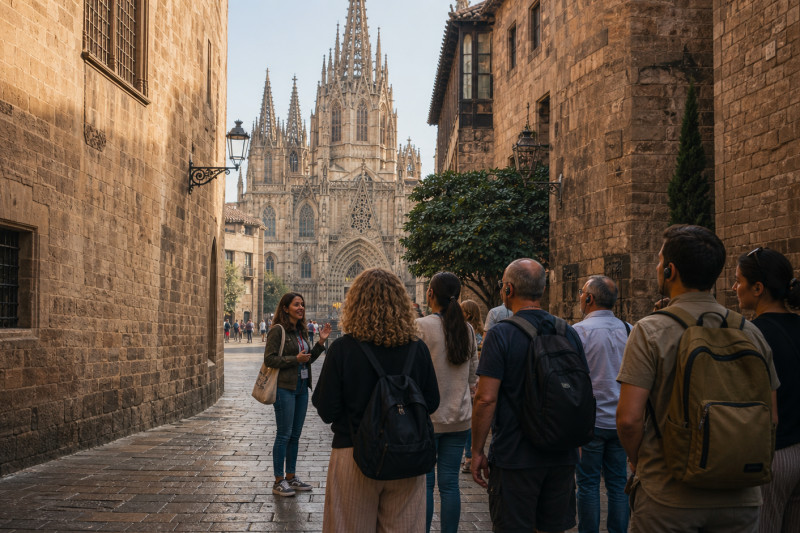
Barcelona Cathedral is dedicated to the Holy Cross and Saint Eulalia. Its site carried earlier Christian buildings and an eleventh-century Romanesque cathedral. Construction of the present Gothic church began on 1 May 1298 under Bishop Bernat Pelegrí and James II. Work proceeded through the apse, chapels, naves, choir and cloister and was substantially complete by the mid-fifteenth century. The western front, however, remained a plain wall.
Enter before judging the exterior. The nave is broad and relatively dark, its lateral chapels fitted between buttresses. Piers rise into rib vaults without the extreme vertical pull of some French Gothic churches. The choir occupies the nave as an architectural and ceremonial object. Work began in 1390; later canopies, carving and painted coats of arms record changing patronage. In 1519, the Order of the Golden Fleece met in Barcelona under Charles V, and the choir stalls received heraldic panels associated with its knights.
The cloister joins architecture, guild memory and living tradition. Chapels were associated with institutions and families. A garden, fountain and pond occupy the centre. Thirteen white geese are popularly said to represent Saint Eulalia’s age at martyrdom. The cathedral documents geese in the cloister since the sixteenth century and presents the numerical link as tradition. It is meaningful as practice, not proof of a fourth-century biography.
The same care applies to Eulalia. Christian presence in late-Roman Barcelona and the cult of a local martyr are historically significant. The elaborate sequence of thirteen tortures often retold on tours belongs to hagiographic tradition. The crypt’s marble sarcophagus, inaugurated in 1339 and associated with the Pisan sculptor Lupo di Francesco, is a material medieval work depicting the saint’s story and the translation of relics. A guide can explain belief, art and civic identity without turning every episode into verified reportage.
How a medieval cathedral acquired its Gothic image
The façade seen from Pla de la Seu was built in the late nineteenth century, followed by the central tower completed in 1913. Its design drew on a fifteenth-century sketch but answered modern ambitions. An 1882 competition considered alternatives. Banker and politician Manuel Girona financed the selected work; Josep Oriol Mestres and August Font were central to its realisation. Sculptors filled the frontage with saints and ornamental programmes. The 1888 Universal Exhibition supplied urgency and an audience.
Calling the façade “fake” misses what it reveals. Nineteenth-century patrons believed completing the cathedral in a Gothic language could express Barcelona’s history and status. Medievalism served religious continuity, bourgeois philanthropy, Catalan cultural identity and urban promotion. The new front also changed the area around it. Once the cathedral possessed a spectacular Gothic face, adjacent ordinary houses and later façades appeared discordant to reformers. The desire for a harmonious quarter followed.
The correct close reading therefore moves in both directions. Inside, identify medieval structure, later furnishings and living worship. Outside, recognise neo-Gothic completion as an authentic document of nineteenth-century values. Date does not cancel meaning; hidden date distorts it.
07 · Gothic Quarter
How Barcelona invented the Gothic Quarter
The neighbourhood was traditionally known as the cathedral quarter. The phrase Barri Gòtic emerged from a modern campaign to collect, restore and stage the old city’s most valued fabric. Art historian Agustín Cócola Gant’s peer-reviewed study traces the decisive work from the demolition for Via Laietana through the restorations and constructions of 1927–1970. His argument does not deny medieval Barcelona. It explains how visitors came to experience its remains as one dense, apparently continuous environment.
Via Laietana cut the old city and supplied a warehouse of stones
Industrial Barcelona wanted circulation, sanitation, administrative space and a modern business avenue. Work on Via Laietana began in 1908; by 1913, the new axis had cut through the historic centre. Homes and streets disappeared. Displacement was social as well as architectural. Working-class residents bore the cost of an urban reform designed partly for finance and movement.
Municipal authorities saved selected architectural material from demolition. Windows, doors, carved fragments, façades and even buildings were stored. The initial museum logic became impractical as the quantity grew. Architects began to propose a different solution: move the best fragments near the cathedral and compose an ideal display of old Barcelona.
This was heritage selection at city scale. Material judged artistically valuable survived; ordinary dwellings and the lives attached to them were more expendable. The modern avenue and the old quarter were not opposite projects. The demolition helped provide the fragments from which a concentrated historic district could be made.
A name, a national past and a tourism product
In 1911, Ramon Rucabado used the expression Gothic Quarter while calling for a unified historic area around the cathedral. Architects and cultural figures had already associated Catalonia’s political identity with a medieval golden age. Josep Puig i Cadafalch’s scholarship on the Catalan house gave reformers an ideal type. Restoring architecture could be imagined as restoring a homeland.
Tourism added another purpose. Barcelona’s 1888 Universal Exhibition had demonstrated the promotional power of a major event. The Societat d’Atracció de Forasters, founded in 1908 by politicians, bankers and business interests, marketed Barcelona abroad and lobbied for urban improvements. The 1929 International Exhibition intensified the effort. A picturesque old centre could give an industrial city the historical prestige that promoters believed visitors expected.
National identity and commercial promotion were not separate lanes. The same Gothic image could communicate Catalan continuity to one audience and sell romantic atmosphere to another. Governments changed; the value of a concentrated monumental district endured. After the Civil War, the dictatorship continued much of the spatial programme while redirecting its political language.
Pont del Bisbe: invention becomes the icon
The bridge over Carrer del Bisbe is a precise object lesson. Joan Rubió i Bellver designed it to connect the Casa dels Canonges with the Palau de la Generalitat. Completed in 1928, it used a neo-Gothic vocabulary of pointed arch, tracery and carved stone. Contemporary critics found it excessive; tourism publicity quickly treated it as historic scenery. It is now one of Barcelona’s most photographed “medieval” views.
Beneath the bridge, a star-shaped vault carries a skull pierced by a sword. The Government of Catalonia’s heritage description identifies religious symbols here, including Alpha and Omega, the first and last letters of the Greek alphabet. These carved objects belong to the bridge’s modern design; their meaning should be read before the stories built around them.
Folklore later attached itself to the skull and blade. Versions claim that removing the blade would destroy Barcelona, or that walking backwards while staring at it grants a wish. These are modern legends without documentary authority. They can be enjoyed as evidence of how an evocative object generates stories, provided the guide says what they are.
The bridge is neither a fraud nor a medieval survivor. It is an authentic 1928 work designed to influence how the past would be seen. Its success is visible every time a camera excludes the modern date.
Casa Padellàs: the house that moved and found a Roman city
Casa Padellàs was built around the turn of the sixteenth century on Carrer de Mercaders. Via Laietana placed it in the path of urban change. In 1931, workers dismantled and reconstructed it on Plaça del Rei. The new location completed the square’s historic composition. Elements were restored and supplemented so the house would read coherently as a late-medieval or Renaissance palace.
The relocation produced an unintended result. Foundation work exposed extensive remains of Barcino. Archaeological excavation expanded under Plaça del Rei, helping create the Museum of the History of the City, opened in 1943. A project designed partly to manufacture historic atmosphere thus uncovered older evidence and created one of Barcelona’s most important instruments for questioning that atmosphere.
This paradox deserves emphasis. The museum’s headquarters is a moved building. The archaeology beneath it is in situ. The square outside combines medieval structures, later restoration and deliberate composition. The institution now explains layers that its own creation helped rearrange.
“Historic density” and the social cost of harmony
Adolf Florensa directed work across the quarter for decades. His method combined restoring medieval buildings in a Gothic style, moving historic buildings and fragments into the area, and harmonising surrounding façades with neo-medieval elements. Windows were added. Later surfaces were stripped or replaced. Ordinary residential fabric gave way to institutions and picturesque compositions. By the 1950s and 1960s, promoters praised the neighbourhood’s concentrated “historic density.”
The phrase identifies both the achievement and the danger. A visitor really can encounter an extraordinary quantity of history within a few blocks. But density was made through selection. Working-class housing and social uses were displaced. Architectural difference was flattened. Objects from separate places and dates were made to look continuous. Tourism did not merely discover the old city; it helped produce the version offered for discovery.
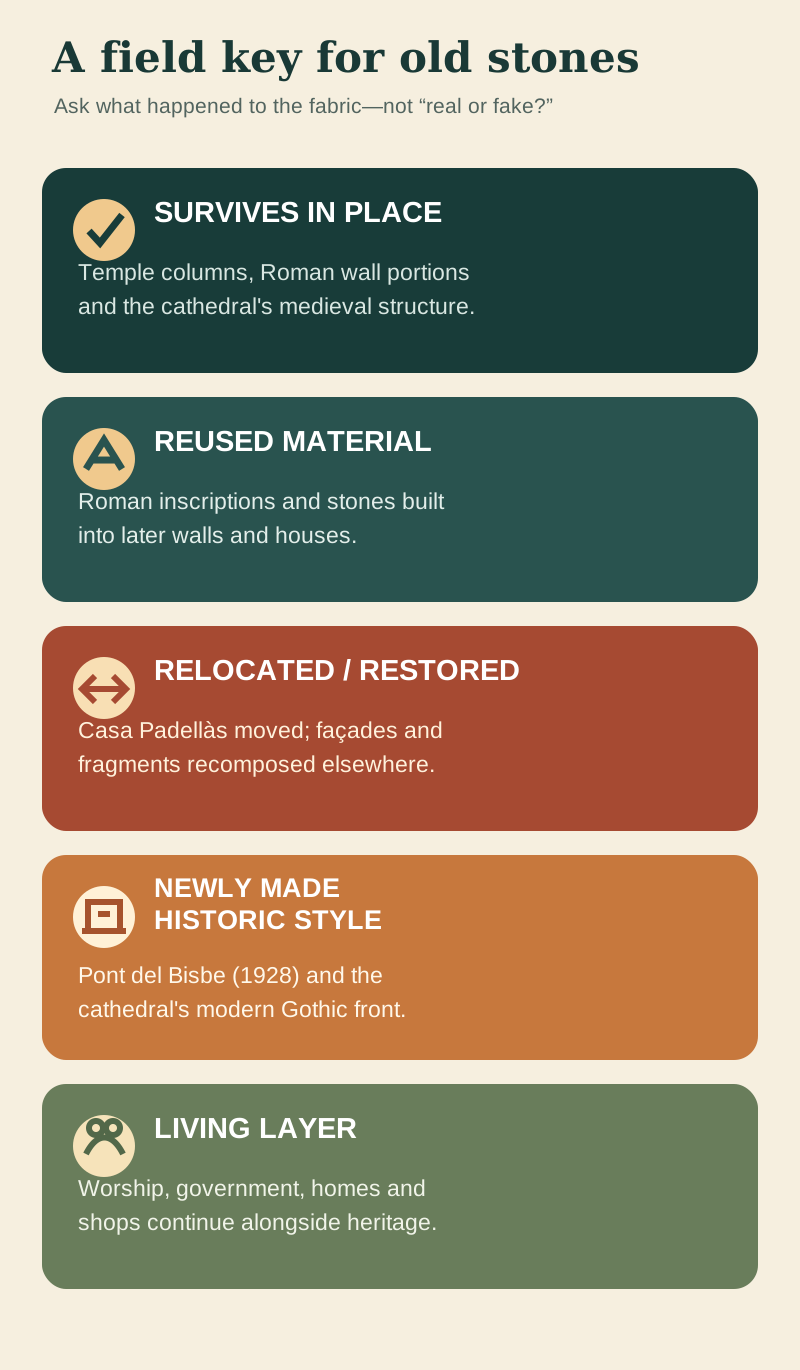
The mature response is not cynicism. The medieval city remains substantial. The Roman wall remains Roman. The cathedral remains an extraordinary Gothic building. The twentieth-century interventions have acquired their own history, craft and cultural meaning. What changes is the visitor’s confidence: beauty no longer excuses a false date, and authenticity no longer requires untouched stone.
08 · Gothic Quarter
Four stops where evidence defeats legend
A good walking route needs places where the method can be practised. Four stops—Casa de l’Ardiaca, Plaça del Rei, El Call and Sant Felip Neri—force different kinds of attention.
Casa de l’Ardiaca: read the joins
The former archdeacon’s house sits against the Roman wall near the cathedral. Its courtyard and façade combine medieval structure and Renaissance intervention. The municipal archive occupies it today. At the entrance, a Modernista marble letterbox commissioned by Lluís Domènech i Montaner in 1902 was carved by Alfons Juyol for the lawyers’ association then based here. The College of Architects of Catalonia’s record explains its allegory: flying swallows suggest the speed justice ought to have, a tortoise its actual slowness, and ivy the entanglements of bureaucracy. This is a documented joke about an institution, rather than anonymous medieval folklore.
The pleasure is not in choosing one period. Roman stone, Gothic institution, Renaissance domestic display, Modernista wit and contemporary archival use coexist. The joins make the building more informative than a purified restoration would.
Plaça del Rei: listen for what the square does not prove
Stand at the bottom of the palace stair and turn slowly. The medieval royal fabric is genuine, but the square’s present coherence is modern. Casa Padellàs arrived from elsewhere. Restoration reopened forms concealed by later uses. Archaeology lies below. The ensemble presents a historical argument: Barcelona as Roman foundation and medieval capital.
The square’s acoustics and enclosure encourage stories. Guides often place Columbus on the stair or in the Tinell. The documented core is that the monarchs received him in Barcelona after the first voyage. The exact room remains uncertain. This is an ideal place to demonstrate responsible narration: retain the consequential meeting, remove the false confidence, and explain why later Barcelona wanted the scene fixed here.
El Call: names before symbols
In the Jewish quarter, begin with Jucef Bonhiac and Salomó ben Adret, not with a supposed magic stone. Explain work, law, trade, worship and the aljama. State the violence of 1391 and the destruction of the community. Only then examine thresholds, property lines and reused fragments. This order prevents absence from becoming decorative mystery.
Sant Felip Neri: damage with a date
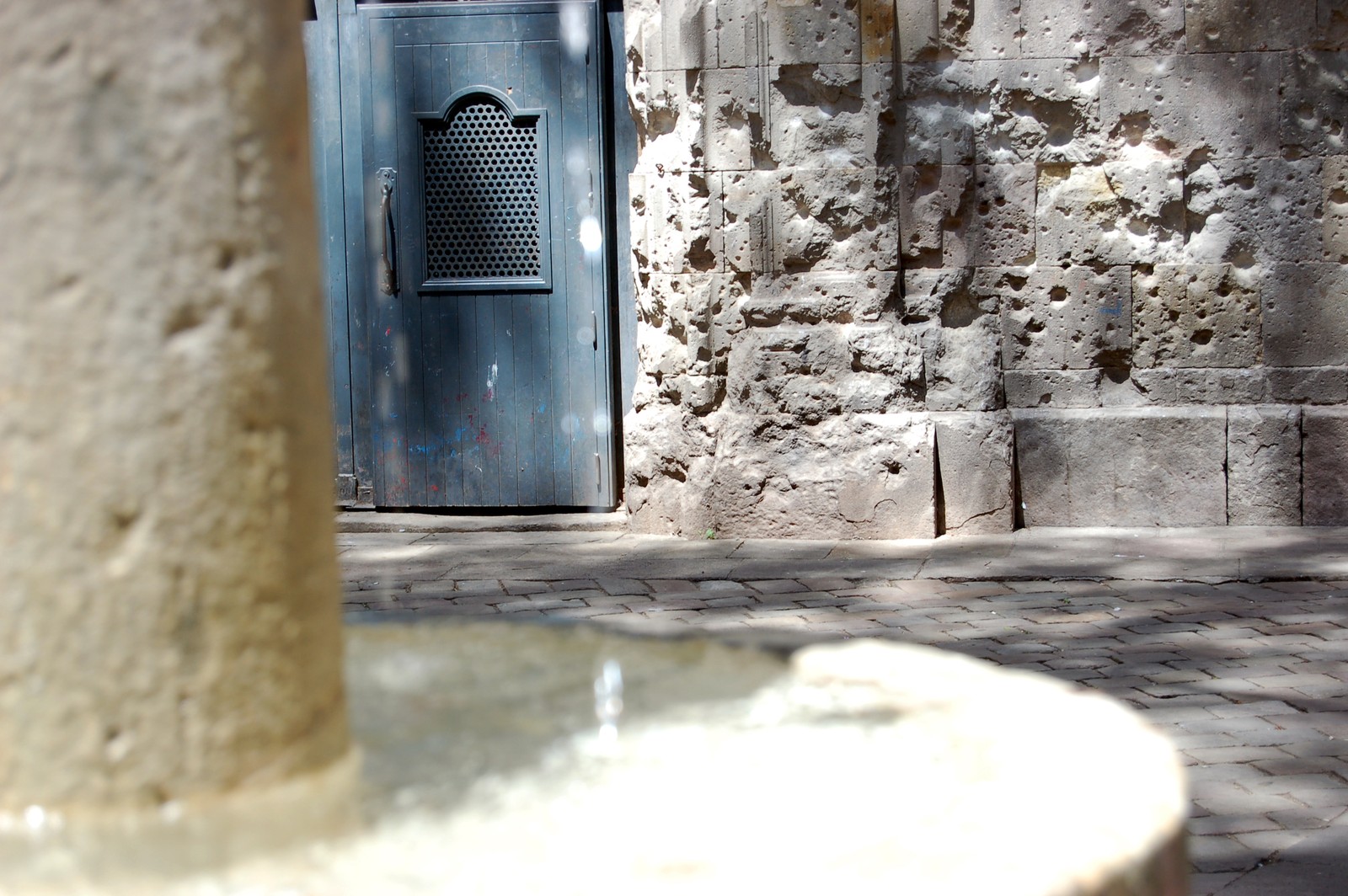

Plaça de Sant Felip Neri is small, enclosed and easy to describe as peaceful. The church’s damaged façade interrupts that language. On 30 January 1938, Savoia-Marchetti S.79 aircraft of the Italian Aviazione Legionaria, allied with Franco’s forces and based on Mallorca, attacked Barcelona. A 250-kilogram bomb struck the square and collapsed the church basement, where children and others had sought shelter. Forty-two people died there, most of them children. A second raid caught rescue work under way elsewhere in the affected area. Across that day’s attacks, the city suffered far broader destruction and death.
For years, dictatorship-era narratives misrepresented the damage. Municipal historical work now identifies the air attack and commemorates the victims. The pockmarks on the church are not bullet holes from an execution, despite a common tour legend, and not the atmospheric wear of centuries. They belong to a documented event in the aerial war against civilians.
The square also demonstrates how beauty can soften attention. Trees, a fountain and a school make ordinary life visible. Children still cross ground where children were killed. The appropriate response is neither melodrama nor a ghost story. Give the perpetrators, technology, date and victims. Explain that the façade has been preserved as public memory. Then allow the material to remain difficult.
09 · Gothic Quarter
From cathedral shade to market noise
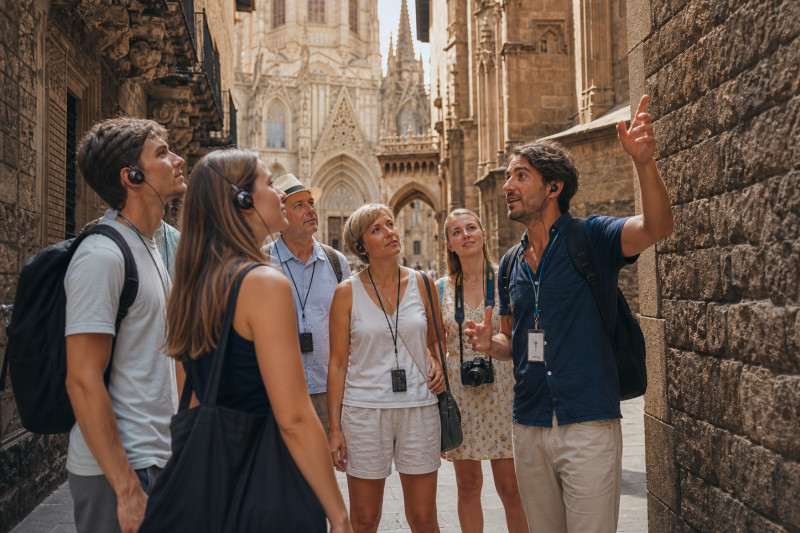
The podcast is right about one physical change: the transition from broad modern streets into the old centre alters scale, light and sound. Walls rise close. The sky narrows. Traffic becomes indirect. A guide’s voice through a headset can create continuity across busy junctions.
Yet the route should not pretend this atmosphere is purely medieval. Shopfronts, wiring, doorbells, surveillance cameras, delivery vehicles, schools and government offices belong to the living quarter. Some lanes are narrow because of inherited plots; others were reopened or restyled. Paving has been replaced. Stone has been cleaned. At night, lighting suppresses modern distraction and strengthens the illusion of historical unity. The mood is real; its interpretation still requires dates.
La Rambla reverses the compression. The promenade opens between the Gothic Quarter and the Raval. La Boqueria sits on the west side, outside the Barri Gòtic’s administrative boundary, even when a walking-tour description folds it into an “Old Town” sequence. That correction does not reduce the market’s relevance. It shows how routes cross districts that history and tourism label differently.
The Boqueria’s official history records meat stalls on the Pla de la Boqueria in 1217. Open-air markets occupied La Rambla for centuries. The present market’s first stone was laid in 1840; its metal structure and later roof belong to the nineteenth and early twentieth centuries. The market is continuity through relocation, regulation and rebuilding—not a medieval hall preserved unchanged.
Its current life is also contested. Traders sell food to residents, restaurants and visitors; tourism changes product mix, crowding and price perception. A 90-minute walk can use the market as an orientation point. It cannot substitute the colours of a stall for an explanation of Barcelona’s food systems or claim that every counter represents timeless local routine.
El Born lies east of the Gothic Quarter beyond Via Laietana. Its medieval commercial and maritime history, Santa Maria del Mar, craft streets and nineteenth-century market deserve a separate article. The tour’s promise to include it should be understood as a transition or introduction. If the guide tries to give the cathedral, Barcino, Boqueria and El Born equal depth, none will receive it.
This boundary lesson is practical. “Gothic Quarter,” “Old Town” and “Ciutat Vella” are not interchangeable. The Barri Gòtic is one neighbourhood within Ciutat Vella. La Boqueria is in the Raval; much of El Born belongs to Sant Pere, Santa Caterina i la Ribera. A guided walk may cross all three because a traveller’s mental map needs connections. An article must still name where it goes.
10 · Gothic Quarter
Folklore without falsehood
The podcast praises a guide who combined medieval love, civil-war resistance and ghost legends. Storytelling helps people retain place. It can also smuggle invention into memory more effectively than any incorrect date.
There is a disciplined way to keep folklore. Identify the genre. Say “a modern legend claims,” “cathedral tradition holds,” or “the story is often told, although the room is uncertain.” Explain when the tale first appears if scholarship allows. Connect it to the community that needed or enjoyed it. Never use a legend to overwrite documented violence.
The thirteen geese belong to living cathedral tradition; they do not establish thirteen historically verified tortures. The sword-pierced skull beneath Pont del Bisbe generates playful modern myths; it does not encode a proven revenge by Rubió. Columbus’s Barcelona reception is documented; the exact Tinell staging is uncertain. Sant Felip Neri’s scars are documented bombing damage; calling them execution bullets is not harmless atmosphere.
Ghost stories can be treated similarly. A tale about a haunted lane may reveal anxiety about enclosure, death, religious institutions or the tourist appetite for darkness. It becomes irresponsible when attached to a named victim without evidence, or when the 1391 assault and 1938 bombing are reduced to spooky colour.
The strongest story in the quarter often needs no supernatural addition. A Roman temple survives inside a later house. A sixteenth-century palace moves and exposes an older city. A 1928 bridge is mistaken for medieval. A market changes form for eight centuries. Children shelter beneath a church during an air raid. History is already strange enough.
11 · Gothic Quarter
Field notes: plan for two speeds
The most useful visit combines a fast orientation with at least one slow interior. The exterior walk teaches relationships. An interior supplies material that the street cannot.
Use the first 90 minutes to choose a return
A short orientation walk is most useful early in a Barcelona stay. Note the Roman gate at Plaça Nova, Carrer del Paradís, Plaça de Sant Jaume, the El Call lanes, Plaça del Rei and the route toward La Rambla. Do not try to photograph every stop. Write down one or two places that require a return.
Choose according to the question that held you:
- Return to MUHBA Plaça del Rei for Roman streets, production installations, late-antique Christianity and the palace rooms.
- Return to the Temple of Augustus for the forum and imperial cult, understanding that the visit is short and the confined site is not accessible to visitors with reduced mobility.
- Return to MUHBA El Call for medieval Jewish life and the 1391 destruction; MUHBA currently identifies this venue as wheelchair accessible.
- Return to Barcelona Cathedral for Catalan Gothic space, the choir, cloister, roof and collections. Worship and tourist visiting operate on different timetables; consult the cathedral’s current official visitor page on the day.
- Return to Casa de l’Ardiaca for architectural layers and the municipal archive courtyard when public access permits.
Check the official visitor pages for opening times, tickets and the distinction between worship and sightseeing before choosing an interior visit.
Accessibility is stop-specific
For a guided walk, ask about kerbs, paving, standing time, stairs, toilets and any interior substitutions before choosing a route. “Walking tour” alone tells you little about step-free access; the useful answer is a description of the actual stops and transitions.
MUHBA’s current guidance distinguishes its venues. Plaça del Rei provides wheelchairs, lifts, ramps and accessible toilets, although a small part of the underground circuit is not accessible. El Call is listed as fully wheelchair accessible. The Temple of Augustus is not accessible to people with reduced mobility. Barcelona Cathedral identifies the Santa Eulàlia gate on Carrer del Bisbe as the accessible entrance. Use MUHBA’s venue-by-venue access guide and the cathedral’s visitor page when planning the return.
Uneven paving affects many visitors beyond wheelchair users. Comfortable, stable shoes are sensible. Heat and crowd density change the effort of standing and moving through the old centre. A guide using headsets can speak without forcing a group to cluster tightly, but even a small group can occupy most of a narrow lane.
Choose daylight according to the evidence
Early morning offers quieter lanes and clearer architecture. Midday makes the contrast between shaded streets and open squares obvious. Evening can improve atmosphere, but darkness conceals modern alterations and encourages the idea of a uniformly medieval quarter. If your goal is to distinguish materials and dates, begin in daylight.
Rain makes paving slick and brings out differences in stone, mortar and drainage. It also turns Plaça del Rei and Sant Felip Neri into reflective photographic stages. Remember that other people use these as routes, workplaces, worship spaces and school surroundings. Do not block thresholds or turn memorial damage into a portrait backdrop.
Keep the meeting point ordinary
The podcast’s practical question—how to find the correct guide in a busy square—deserves as much attention as the first monument. A simple meeting routine helps:
- save the current voucher and operator contact offline;
- verify the precise meeting point and start time stated in your booking;
- arrive early enough to distinguish your guide’s stated sign, umbrella or clothing from other groups;
- keep the booking contact available if you cannot find the rendezvous;
- retain evidence of the rendezvous and communications.
A meeting marker is a practical tool: the historical conversation can begin only after the group has found one another.
12 · Gothic Quarter
When a guide helps—and when to walk alone
The case for a guide is strongest when relationships are invisible. A wall fragment gains meaning when connected to a late-Roman fortification system. The cathedral façade changes when dated to the Universal Exhibition era. A lane in El Call becomes a civic history when linked to work, law and 1391. Sant Felip Neri demands correction of a persistent legend. Live interpretation can organise these changes faster than plaques and phone searches.
A guide also supplies route confidence. The Temple of Augustus entrance is discreet. Plaça del Rei’s archaeology is below sight. District boundaries are not obvious. Headsets can maintain narrative through noise. Questions allow a visitor to test claims rather than accept a recorded script.
Walking alone is better when you want slow observation, interiors, photography or silence. No 90-minute route can include a careful cathedral visit and MUHBA underground circuit. A self-guided return allows the moved stones of Casa Padellàs, the cathedral’s structural breadth and the details of El Call to occupy their proper scale.
The productive combination is orientation followed by autonomy. Take the guided walk as a hypothesis about the city. Return with the categories from this article—survival, reuse, restoration, relocation and invention—and see whether the evidence supports it.
Sources & reporting record
The evidence behind the streets
The links below provide current visitor actions and specialist material for readers who want to continue.
- Complete podcast episode and field question — The Travel Podcast by ExcursionPass.
- Barcino urban history guide — Museu d’Història de Barcelona.
- MUHBA short guide — Roman, late-antique and medieval city history and collections.
- MUHBA El Call — Jewish Barcelona, Jucef Bonhiac, Salomó ben Adret and 1391.
- Barcelona Cathedral history and visitable spaces — official monument chronology, collections and living traditions.
- The invention of the Barcelona Gothic Quarter — Agustín Cócola Gant, Journal of Heritage Tourism, on relocation, reconstruction, tourism and displacement.
- Pont del Bisbe and Casa dels Canonges — Government of Catalonia heritage record.
- MUHBA museum history — Casa Padellàs, excavation and the creation of the city museum.
- The 30 January 1938 bombing and Sant Felip Neri — Museu d’Història de Barcelona.
- History of La Boqueria — official market archive chronology.
- MUHBA’s El Call route guide — the community, 1391 and attempts to rebuild it.
- Casa de l’Ardiaca decoration — College of Architects of Catalonia record of Domènech and Juyol’s letterbox.
The question we carry out