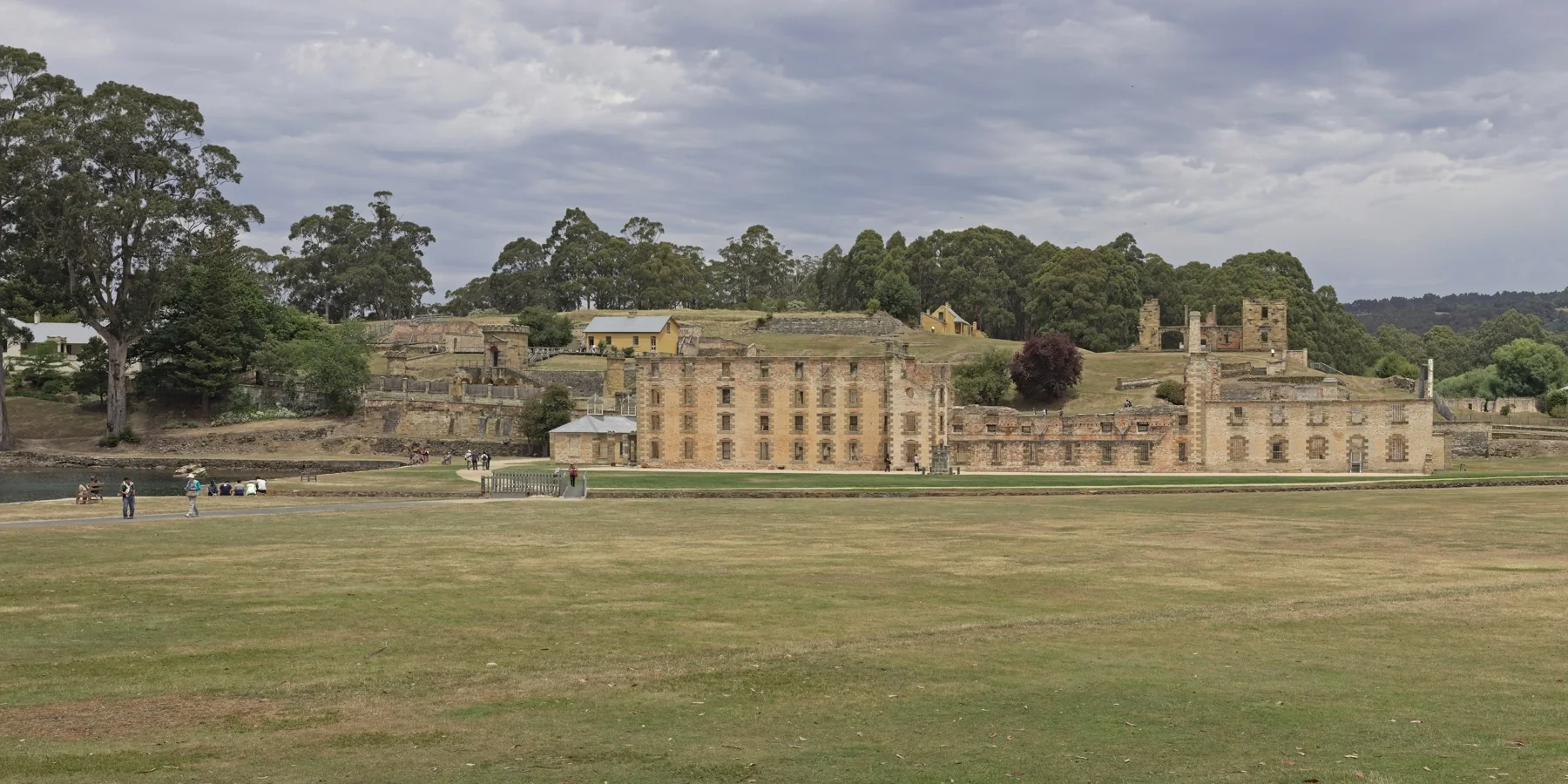

Port Arthur is often approached as a dramatic ruin at the end of a scenic Tasman Peninsula road. Its beauty opens onto a much larger and more difficult history: Palawa Country reshaped by British invasion, a harbour turned into a penal-industrial system, an experiment in punishment and reform, a town that learned to sell its own past, and a place where conservation must hold several histories without making suffering into spectacle.
01 · Port Arthur through evidence
Start with the landscape that the prison story can hide
Port Arthur Historic Site stands on the Tasman Peninsula in south-east lutruwita/Tasmania. The institutional story begins in 1830, but the place does not. Palawa people maintained relationships with the lands, waters and resources of the peninsula over many thousands of years. Archaeological evidence in the wider Tasman National Park includes shell middens, stone artefacts and quarry sites. Such material is not the residue of a vanished culture. Tasmanian Aboriginal communities continue to hold cultural connections, knowledge and responsibilities, and the historic site acknowledges that the land was not ceded. The wider landscape’s shell middens, stone-working places and artefacts need care: leave material where it lies and follow Aboriginal Heritage Tasmania’s guidance.
That point changes the order of the story. British colonisation was not an empty-land preface to convict history. Occupation brought dispossession, introduced violence and disease, and an expanding settler economy. During the 1820s and early 1830s, conflict across Van Diemen's Land intensified into what is now widely called the Black War. Colonial military operations, including the vast and largely unsuccessful Black Line of 1830, were followed by forced removals. Scholarship on the Black War and forced removals distinguishes military conflict from the colonial policies that followed it. Historians have debated the use of the term genocide; research on the documentary evidence makes clear why the destruction cannot be reduced to an accidental clash of cultures. Invasion was catastrophic, and Aboriginal resistance and survival continued.
Port Arthur's penal settlement began in the same year as the Black Line. Those histories were not identical, yet they belonged to one colonial project. Convict labour cut timber, quarried stone, built roads and ships, made shoes and clothing, grew food and maintained the infrastructure through which the colony expanded. The surviving ruins can therefore tell more than a story about British law punishing British offenders overseas. They also reveal how transportation and coerced labour helped a settler colony occupy and transform Country.
The careful visitor holds two truths at once. Transported people endured state violence, separation and forced labour. Their presence also served an invading colonial order whose costs were borne first and most profoundly by Aboriginal people. Neither history cancels the other. The site becomes more legible when victimhood is not assigned to one group in a way that erases another.
02 · Port Arthur through evidence
The road from Hobart is already part of the argument
The common land route from Hobart passes through the Coal River valley, Richmond and the narrow connection at Eaglehawk Neck before reaching the peninsula. A day journey often adds the Tessellated Pavement or the coast near Tasman Arch, Devil's Kitchen and the Blowhole. These are not interchangeable scenic stops. Richmond represents the wider convict-built colony; Eaglehawk Neck shows how geography became security infrastructure; the coast reveals a geological system independent of the prison, although later tourism frequently packaged both together.
Richmond Gaol dates from 1825 and survives as an unusually early colonial prison. Its male and female cells, yard and service spaces belong to a town made through convict labour and settler administration. The nearby bridge, roads, public buildings and farms make the larger point: incarceration did not end at a prison wall. Penal labour entered ordinary infrastructure and private prosperity. A route that sees Richmond only as a photogenic Georgian village misses the labour system that produced its apparent order.
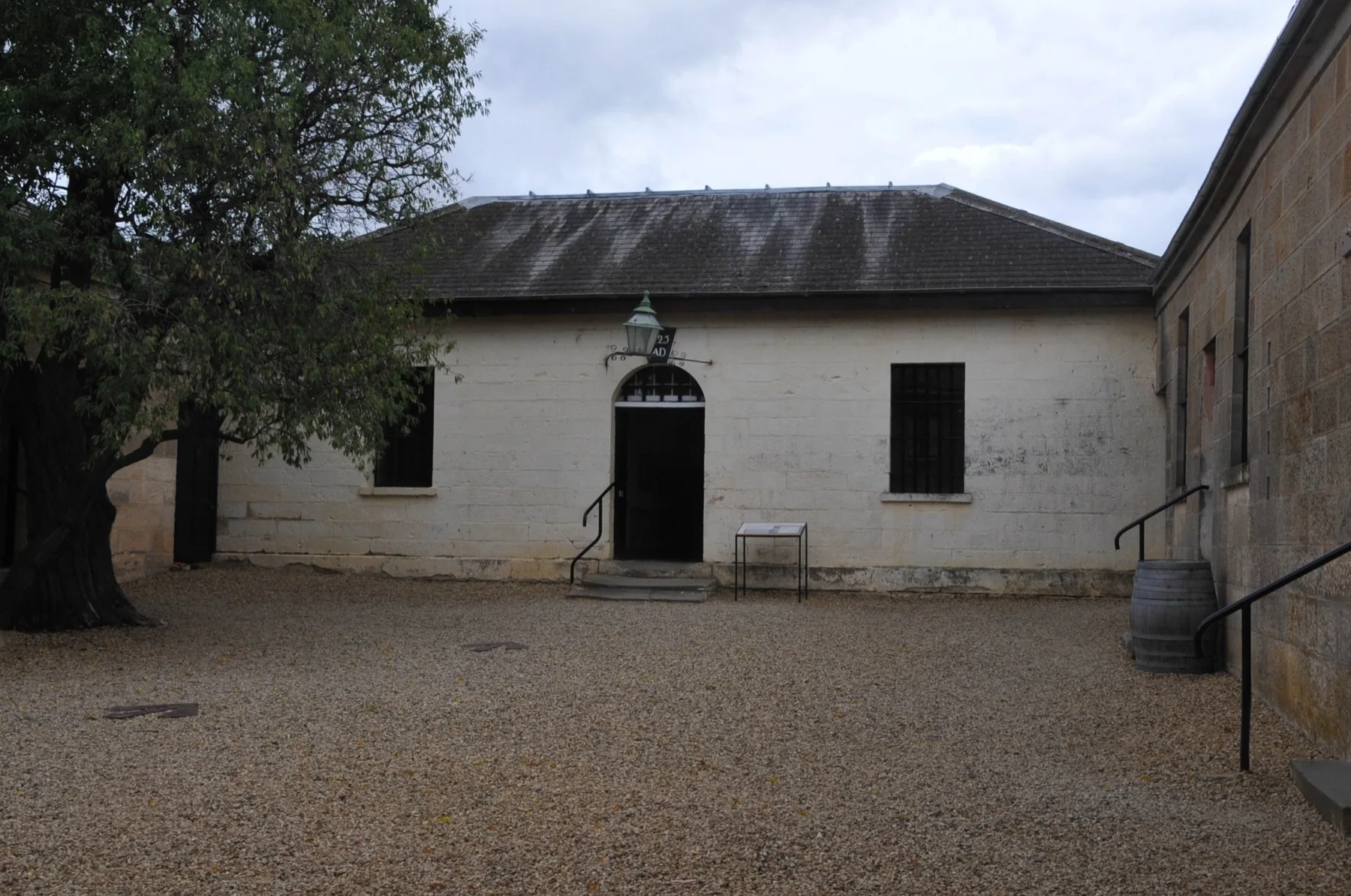

Eaglehawk Neck is the opposite kind of evidence. A sandy isthmus, in places only a few dozen metres wide, joined the Forestier and Tasman peninsulas. Soldiers occupied the Officers' Quarters, patrols watched the shore, and chained dogs formed the notorious Dog Line. The dogs were an alarm: their barking warned the guards. They were not a pack routinely released to hunt fugitives. Some stood on platforms in the shallows, extending the watched barrier beyond the sand. The barrier was never magically complete: people attempted escape by land and water, and the bush itself could disorient and kill. Martin Cash passed the neck twice; on his second escape he and Lawrence Kavanagh and George Jones saved food before swimming Eaglehawk Bay at night. They remained at large for months. The site’s account of the escape shows a planned evasion of surveillance, rather than a miraculous conquest of an impassable cliff. Yet the system made one fact plain to imprisoned men—landform, military surveillance, animals and fear had been assembled into a border.
This corrects a recurring tourism myth. Tasman Arch, Devil's Kitchen and the Blowhole were not the settlement's literal outer walls, and a coastal lookout does not reproduce a transported person's first view. They are spectacular consequences of erosion along joints and fractures in coastal rock. The prison's strategic barrier lay at the neck, backed by distance, water and surveillance. Geology influenced confinement, but it should not be forced into a more dramatic story than the evidence supports.

03 · Port Arthur through evidence
The coast explains deep time, not penal punishment
At the Tessellated Pavement, a broad rock platform is divided by near-rectangular fractures. The geometry can look constructed, but it is geological. Permian siltstone and sandstone were jointed as pressure was released; waves cut a platform near sea level; salt crystallisation and weathering enlarged different parts of the joint network. Where the edges of blocks remain wet, erosion can produce rounded “loaf” forms. Where centres retain water and salt, they may weather into shallow “pans.” The pattern is a record of rock structure, exposure and repeated wetting, not masonry. Mineral Resources Tasmania’s geological guide explains why this coast rewards looking down at a rock surface as well as outward at the cliffs.
Farther along the coast, waves exploit joints and weaker zones to make caves and tunnels. A cavity with an opening above can become a blowhole. Continued enlargement may leave an arch; collapse can produce a deep inlet such as Devil's Kitchen. The Tasman Peninsula also carries towering Jurassic dolerite cliffs, the cooled remains of magma intruded through older rocks. Different stops expose different materials and stages, so “the cliffs” should never become one undifferentiated formation.
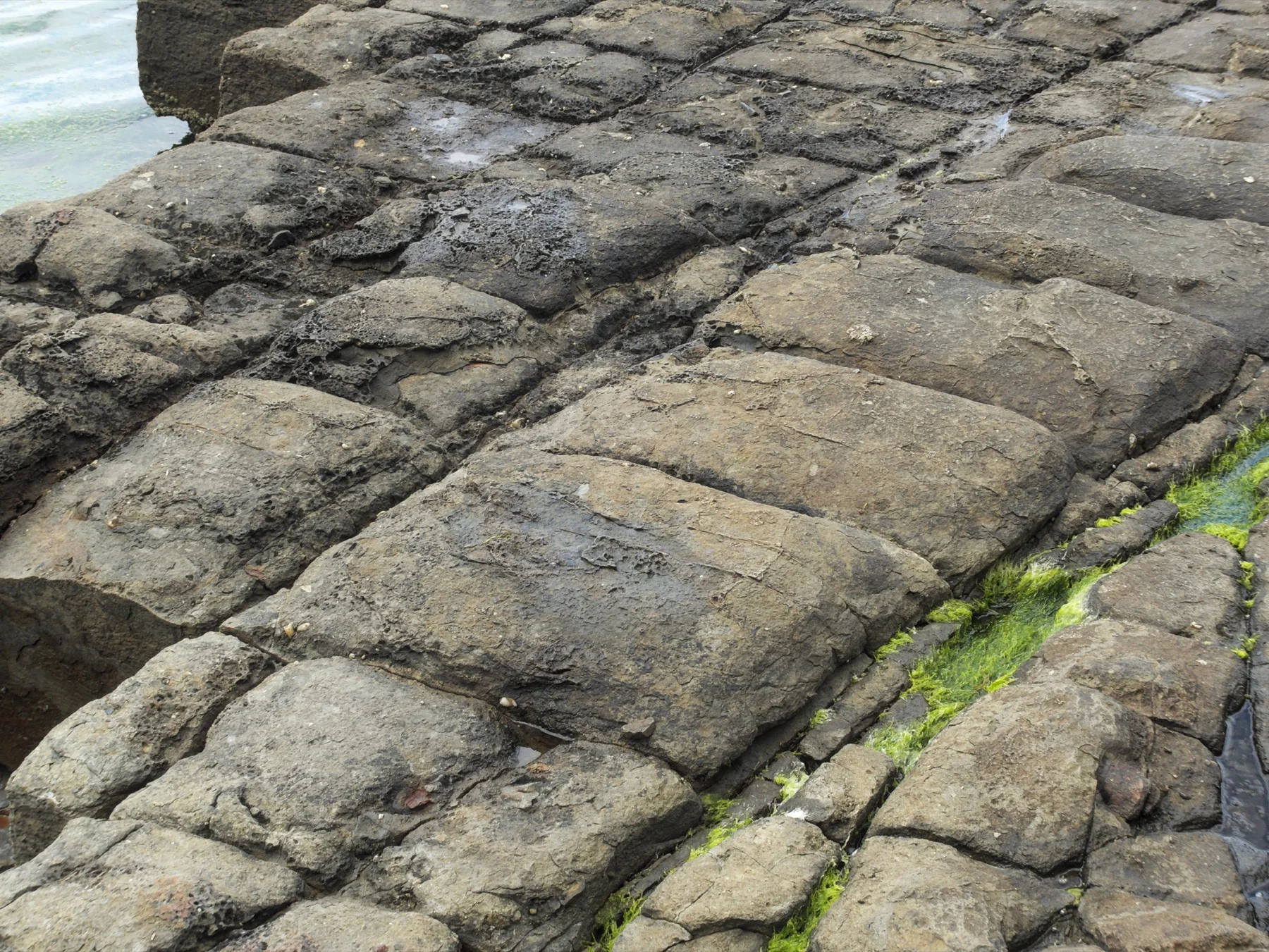

This deep-time reading protects both geology and history from false analogy. It is tempting to make every harsh cliff an emblem of imprisonment. The coast was certainly an obstacle and a resource; weather and sea affected travel, supply and escape. But a geological form does not carry one human meaning. It existed before transportation and continues to change after it. The honest journey lets the coast enlarge the timescale instead of conscripting it as prison scenery.
04 · Port Arthur through evidence
Port Arthur began as timber, then became a system
The British established Port Arthur in 1830 as a timber station. By 1833 it was receiving men sent for secondary punishment—people convicted of further offences after transportation to the colony—while also developing an industrial settlement. Its sheltered harbour, forests, available stone and relative isolation appeared to offer the colonial government three things at once: control, productive labour and an institution distant from the colony's population centres.
“Prison” is therefore too small a word. Port Arthur developed workshops, sawpits, quarries, roads, farms, gardens, stores, barracks, houses, a hospital, a church, a dockyard and systems of water, food and communication. Soldiers, civil officers, medical staff, clergy, skilled workers, servants, wives and children lived alongside the sentenced population. Boats linked the harbour to supply networks. A semaphore system transmitted messages across the peninsula. The settlement was designed as a working community ordered by status and coercion.
Classification sat at its centre. Conduct records followed individuals through offences, punishments, work assignments and institutional transfers. Skills could determine labour; behaviour could alter conditions; age and health shaped later placement. The surviving archive is immense. The historic site’s research account describes identifying Port Arthur prisoners within more than 75,000 conduct records for Van Diemen’s Land. That is a colony-wide body of evidence, not a count of Port Arthur prisoners. Linking it to work, punishment and movement records helps recover named lives from the apparent mass of “convicts.”
Classification did not make punishment rational or humane. Rules could be inconsistent, evidence partial and power unequal. Flogging, irons, confinement, deprivation and exhausting work were real. So were literacy, trade skill, friendship, resistance, negotiation and survival. The archive can recover pieces of those lives, but it cannot turn a brief charge or official remark into a complete personality. Conduct records are evidence produced by the institution, not omniscient biographies.
05 · Port Arthur through evidence
Labour made both discipline and colonial value
The dockyard makes the economic logic visible. Between 1834 and 1848, transported workers built at least fifteen large vessels and more than one hundred smaller craft. Shipbuilding required sawyers, shipwrights, blacksmiths, caulkers and other skilled trades alongside heavy unskilled labour. The yard could train men, extract production and reduce the colony's costs, but its success also created conflict with private employers who objected to state-supported competition. David Hoy, a Scottish carpenter and boatbuilder who arrived in Van Diemen’s Land in 1824, was master shipwright here from 1836 until his retirement in 1848. His supervision connected trade knowledge to the labour of men and boys with little prior training. The yard’s success depended on that transfer of skill as well as on timber and confinement; it was an industrial workplace with an unequal chain of authority.
Elsewhere, men quarried stone, felled and milled timber, fired bricks, made shoes, wove cloth and cultivated food. Work was supposed to punish, reform and finance the institution, aims that did not always agree. A skilled worker might be more valuable in production than under pure deprivation. Training might support a later life after sentence, yet it also increased the output taken from constrained labour. Productivity should never be used as evidence that coercion became benign.
The mill and granary exposed a particularly ambitious failure. Work began in 1842; the waterwheel was first tested in March 1844, and a human-powered treadmill was operating within the following year. A supply system gathered water above the site and channelled it towards the wheel. Water power proved insufficient and unreliable for the intended output, leaving men to supply effort the engineering scheme had promised to save. Debate over the expensive building’s usefulness continued while officials needed more accommodation. Conversion began in 1854 and the penitentiary was in use in early 1857, producing the structure now recognised by its roofless walls. Its history compresses engineering experiment, miscalculation, bodily labour and institutional reuse into one structure.
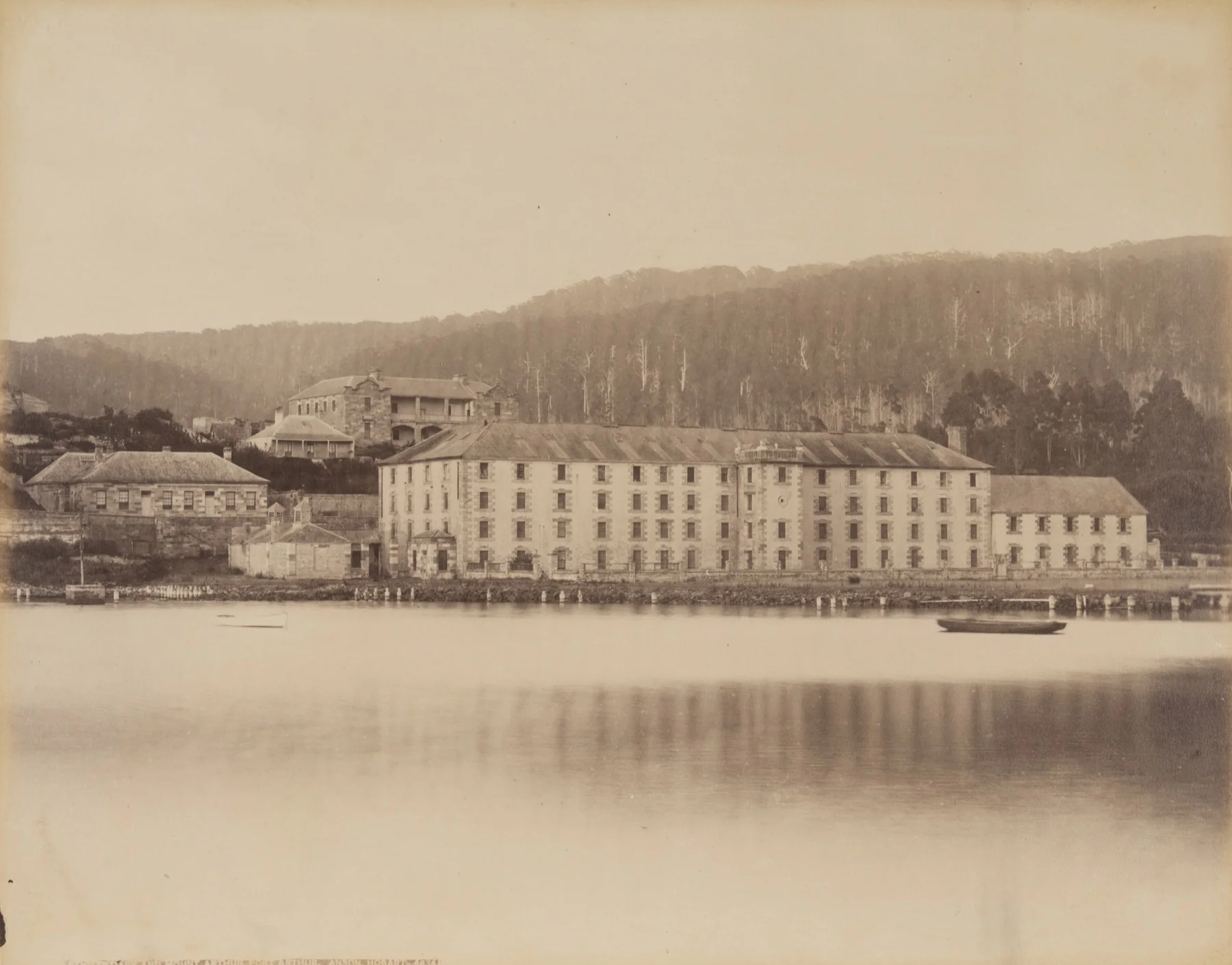

The converted penitentiary contained dormitory accommodation and 136 separate cells, workshops, a kitchen and service spaces. Its familiar ruin can suggest a single-purpose prison block designed in one moment. Reading the masonry against the chronology produces a better interpretation: a failed industrial machine became a carceral building because institutions adapt expensive fabric to new theories and needs.
06 · Port Arthur through evidence
Point Puer put children inside the experiment
Point Puer, established across the water in 1834, was the British Empire's first purpose-built juvenile reformatory. Thousands of boys, many in their early to mid-teens and some younger, passed through before it closed in 1849. Separating them from adult men was presented as protection and reform. Education, religious instruction and trade training in fields such as shoemaking, tailoring, carpentry and boatbuilding were meant to produce discipline and employability.
The claim of reform must be read beside the conditions. The boys were transported far from family, subject to institutional punishment and required to work. Food, clothing, accommodation, health and supervision varied over time. Training could be useful, but it occurred inside coercion. Point Puer was not a modern school unfortunately located near a prison; nor was every boy's experience identical. It was an experiment in managing criminalised childhood through separation, labour and moral instruction.
The boys’ day combined work and instruction. Most were between thirteen and seventeen, although some were as young as nine. Labour took the larger share of their time; schooling, religious teaching and a trade were meant to make the next stage of life possible. Separating children from men changed the organisation of punishment without removing the authority to punish. Point Puer’s closure in 1849 also reflected a change in British policy towards keeping young offenders in institutions closer to home. A visitor looking across to the point should therefore see both an early attempt at a distinct juvenile regime and the enormous distance imposed on the children within it.
William Riley illustrates a different chronology. Transported in 1821 at fourteen, he arrived more than a decade before Point Puer existed. After an attempted-murder conviction in 1833 he was sent to Port Arthur as an adult; in 1835 he killed fellow prisoner Joseph Shuttleworth while working on the church and was executed. The documented biography traces childhood displacement into adult punishment, but it cannot establish an experience at Point Puer. His story makes the passage of time matter: a transported child and a prisoner in a juvenile institution are not automatically the same category.
The peninsula held other children too. Officers and civilian employees brought families; wives performed domestic and social labour; children grew up within sight of barracks, workshops and punishment. Their presence does not soften the settlement. It shows how a penal station could also be a colonial township, with status determining whose family life was protected, supervised, separated or made impossible.
07 · Port Arthur through evidence
Women were present even when the ruins make them hard to see
Port Arthur was overwhelmingly organised around imprisoned men and boys, but women were not absent. The historic site's research corrects a common simplification: female convicts at Port Arthur were generally assigned servants in official and private households, not women sent there as secondary prisoners. They worked in kitchens, laundries, nurseries and domestic interiors that are less monumental than the penitentiary and therefore easier to overlook.
Free women also lived in the settlement as officers' wives, workers and family members. Their experiences differed sharply by class, legal status and relationship to authority. Domestic work sustained the official world represented by the Commandant's House, parsonage and administrative buildings. It also created sites of surveillance and vulnerability. To say only that “families lived here” erases the hierarchy inside the phrase.
Margaret Dalziel offers a route into this less visible population. A literate housemaid from Glasgow, she arrived in Van Diemen’s Land in 1851 under a ten-year sentence for highway robbery. Her first assignment was to James Hurst, a former Coal Mines overseer. After a later assignment she absconded and received eight months’ hard labour at the Female Factory. The site’s biographical research shows domestic service connected to a wider network of assignment and punishment. The record does not explain all her choices, or make her representative of every woman, but it supplies a life with dates and consequences rather than an anonymous household presence.
Look for the distribution of work when walking the site. Laundry, food preparation, nursing, cleaning, childcare and household service leave different traces from a shipyard or cell block. The absence of towering ruins is not evidence that the work was minor. It is a warning that heritage landscapes inherit the visibility priorities of the institutions that built them and of later generations that chose what to preserve.
08 · Port Arthur through evidence
The Separate Prison changed the instrument of punishment
By the mid-nineteenth century, British penal reformers increasingly argued that solitude, silence, surveillance and religious reflection could replace public or bodily punishment with inward discipline. Port Arthur's Separate Prison materialised that theory through several building phases: construction began in 1848, eighteen cells in B Wing were occupied in July 1849, chapel fittings were added in 1851, and the first main phase was complete by 1852. The conservation project’s archival chronology is more useful than assigning the whole building a single opening year. Its radial plan allowed officers to oversee corridors from a central hall. Cells separated men from one another. Exercise yards divided movement. In the chapel, individual stalls prevented prisoners from seeing each other while a service was conducted.
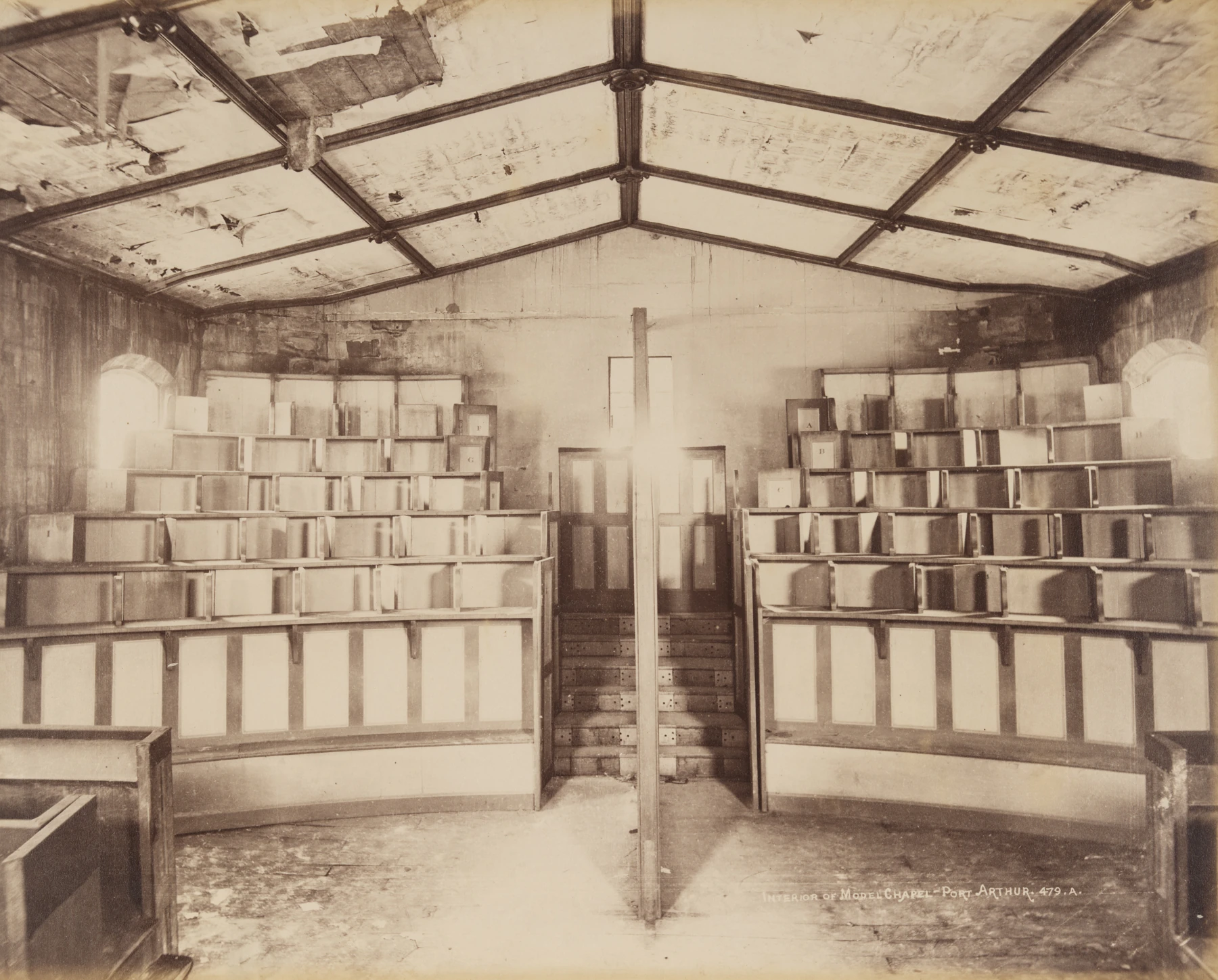

The system is sometimes called “psychological punishment,” a useful shorthand only if it is not treated as a diagnosis for every person. Silence and isolation could cause profound distress; contemporary administrators also believed they were using a modern, morally serious method. The historical task is to understand the reform claim without accepting its confidence. Architecture can reveal the intended regime—separate cells, controlled exercise, central observation—but it cannot by itself tell us exactly how every mind responded.
The chapel makes the contradiction sharp. Religion was offered as a path to repentance while the spatial arrangement denied congregation in the ordinary sense. A person could hear instruction without seeing fellow worshippers. Reform was imagined as an individual encounter supervised by authority. The design did not merely contain prisoners; it tried to structure perception, time, speech and conscience.
This shift did not simply replace flogging overnight. Penal systems accumulate practices. Labour, reduced diet, confinement, surveillance, classification and religious instruction overlapped. The Separate Prison belongs to an international history of prison design, but its meaning at Port Arthur depends on the rest of the settlement. It was one instrument inside a labour colony, not a self-contained philosophical laboratory.
09 · Port Arthur through evidence
Gardens, church and houses were also technologies of order
Port Arthur's cultivated landscape can appear to offer relief from the carceral story. The Government Gardens, church, Commandant's House and officers' residences introduce lawns, flowers, views and domestic scale. Yet these spaces organised rank as carefully as the barracks did. Gardens separated official society from the imprisoned population, staged civility and gave elites controlled recreation. Views across the harbour could be beautiful while movement through the foreground remained regulated. In 1846–47, Commandant William Champ replaced productive hop fields with an ornamental garden intended as a refuge for respectable settlement society. Its ordered paths and planting made rank visible. The gardens seen today are a researched reconstruction, begun in 1991 and completed in 2001 using photographs, drawings, archaeology and botanical evidence; they are not an untouched patch of the convict era.
The large church, built in the 1830s with convict labour, connected attendance and sermons to institutional discipline. Prisoners attended combined services before 1843. When Catholic men refused services whose content conflicted with their beliefs, the appointment of a Roman Catholic chaplain in 1843 created a separate line of provision: first a barracks schoolroom, then a Catholic chapel in the converted penitentiary in 1857. Religious space was negotiated and contested, not a single uncomplicated remedy for wrongdoing. Religion could bring consolation and community, but the administration also used it as moral technology. The picturesque ruin should not dissolve that tension.
Officers' houses likewise reveal a penal settlement that reproduced class and family distinction. The Commandant occupied an elevated, progressively enlarged residence. Servants and workers made that household function. The building's verandas and garden views were not outside the system; they represented the rewards and authority at its top. Moving between a cell, workshop and parlour is therefore a movement across power, not merely across architectural styles.
Water linked these zones in practical and symbolic ways. Mason Cove provided transport and a working harbour. The dockyard converted timber and skill into vessels. The Isle of the Dead received burials. Point Puer isolated boys. A short modern cruise can help orient these relationships, but it must not be narrated as an exact reenactment of every arriving convict's view. Routes, landing places and individual transfers changed. The harbour is primary spatial evidence, not a stage set for borrowed emotion.
10 · Port Arthur through evidence
After transportation, Port Arthur became an institution for ageing and illness
Transportation to Van Diemen's Land ended in 1853, but Port Arthur did not close then. Its population and functions changed. The Paupers’ Depot was built in 1863–64 and the Asylum in 1864–68. Men who were ageing, ill, disabled or unable to support themselves entered the depot; others were housed in the Asylum. The institutional timeline shows new provision growing after transportation had ended, rather than a prison simply winding down. The site increasingly carried the long human consequences of transportation and institutional dependency.
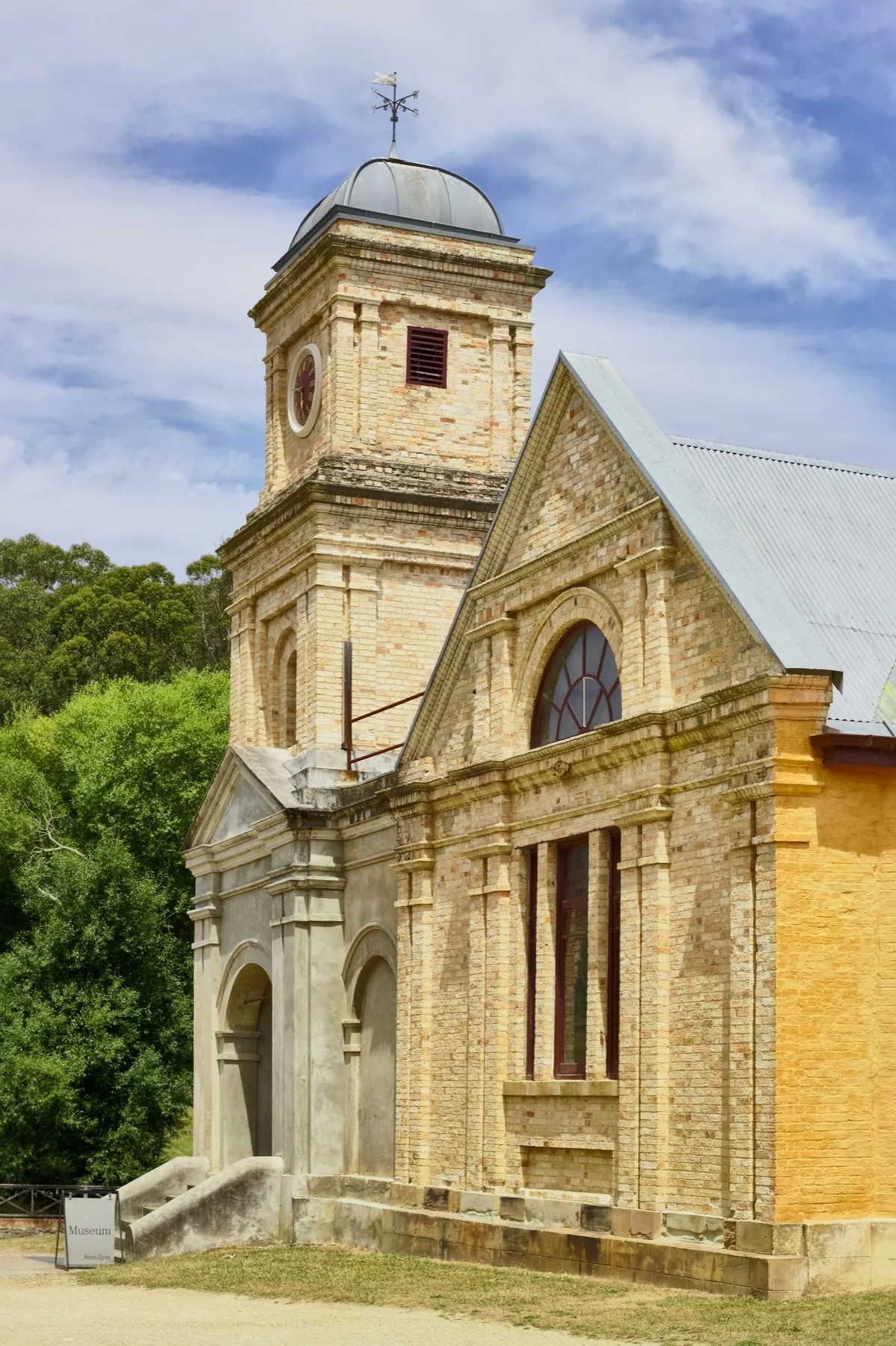

Words such as “pauper,” “invalid” and “lunatic” belonged to administrative classifications of the time. Repeating them without explanation turns historical labels into modern judgements. The buildings instead invite questions about care and control: who decided that a person could not live independently, what treatment existed, how age or injury shaped institutional life, and why a penal station became the place where the colony managed people it had used and then deemed dependent.
The documented life of Mark Jeffrey shows why no category is sufficient. His record includes transportation, repeated punishment, periods at Port Arthur and later confinement on the Isle of the Dead, where he worked as a gravedigger. A dispute over rations led to six months in the Separate Prison; his later island work connected punishment to the continuing labour of burial. Accounts associated with him became part of the site's darker folklore. The evidence supports a difficult institutional biography; it does not require embellishing supernatural claims or turning suffering into entertainment.
Port Arthur formally closed as a penal settlement in 1877. Closure did not remove its residents or its structures. Buildings were sold, adapted or dismantled. People continued to live in the district. The penal landscape entered a new phase in which practical reuse, forgetting, shame, curiosity and commercial interest operated at the same time.
11 · Port Arthur through evidence
Carnarvon learned to sell Port Arthur before conservation was secure
After closure, the settlement became the township of Carnarvon, distancing a living community from the penal name; land and buildings were auctioned during the 1880s. Yet visitors were already arriving. Hotels, guides, photographs and souvenirs developed around the ruins and stories. Port Arthur became one of Australia's early dark-tourism destinations long before that term existed.
Fires in 1895 and 1897 severely damaged former institutional buildings, helping create the roofless forms now treated as the site's visual identity. The ruin is therefore not the untouched remains of the convict era. It is the product of construction, conversion, abandonment, salvage, fire, weather, stabilisation and interpretation. A nineteenth-century photograph showing roofs or floors can be as important as the masonry standing today because it interrupts the illusion that Port Arthur was always picturesque.
The name Port Arthur officially returned in 1927. The Scenery Preservation Board, formed in 1916, had already given the historic landscape a public management framework; the present Port Arthur Historic Site Management Authority dates from 1987. Tourism helped preserve buildings by giving them public value, but it also promoted sensational stories about cruelty, escapes and ghosts. Some accounts were grounded in records; others enlarged anecdote into legend. The tension remains. Visitors often arrive wanting an emotional encounter, while scholarship asks that feeling be attached to evidence rather than manufactured through theatrical certainty.
The productive question is not whether tourism contaminates an otherwise pure memorial. Port Arthur has been a visited place for nearly as long as it was a penal settlement. The question is how tourism behaves: whether it distinguishes evidence from folklore, leaves room for Aboriginal history, avoids treating pain as a thrill, supports conservation and gives readers enough context to make their own ethical judgement.

12 · Port Arthur through evidence
Archaeology and conservation keep revising the visible site
Modern conservation at Port Arthur is not an attempt to return every building to one chosen year. Some structures are roofed and used; some are stabilised ruins; some survive mainly as foundations or archaeological deposits. Each requires a different decision. Reconstructing too much could erase later evidence and create false certainty. Doing too little could allow water, vegetation, salt, wind and visitor pressure to destroy fabric.
Archaeology recovers workshops, drains, yards, domestic spaces, artefacts and changes of use that monumental ruins do not explain. Historical documents supply names, rules and transactions; material evidence can confirm, complicate or contradict the administrative view. A discarded object may show consumption or repair. A foundation can reveal an earlier building phase. Soil and plant evidence can reopen questions about gardens, food and environmental change.
Conservation itself leaves a record. Mortar composition, stone replacement, drainage and structural bracing affect how a ruin weathers and how authentic it appears. At the penitentiary, conservation undertaken in 2012–14 inserted structural support and stabilised vulnerable walls. The building’s apparent openness depends on engineering that permits the ruin to remain a ruin without letting it collapse. Gardens reconstructed from evidence and walls secured with modern support represent different responses to the same question: what can be kept legible without pretending it has never changed? The Port Arthur Historic Site Management Authority publishes current project work because stewardship is part of the public interpretation, not invisible maintenance. The most honest repaired ruin is one whose caretakers can explain what is old, what is intervention and why the distinction matters.
Port Arthur is one of eleven places in the Australian Convict Sites World Heritage property, inscribed in 2010. Together they represent transportation across the British Empire, forced migration, coerced labour and changing systems of punishment and reform. The serial inscription is important: no single place can contain the whole story. Female factories, probation stations, farms, mines and other settlements reveal populations and functions that Port Arthur alone cannot.
World Heritage status does not declare the site morally resolved. It establishes outstanding universal value and obligations for protection. Living communities still decide how colonial history is narrated, whose knowledge is centred and what respectful access requires. Conservation is technical work, but it is also an argument about what future visitors should be able to know.
13 · Port Arthur through evidence
The Isle of the Dead turns records into a social map
The small island in Mason Cove received more than one thousand burials between 1833 and 1877. Officials, soldiers, free people, women and children were buried on higher ground, often with marked graves; many convicts were buried in lower ground without individual markers. Geography continued hierarchy after death.
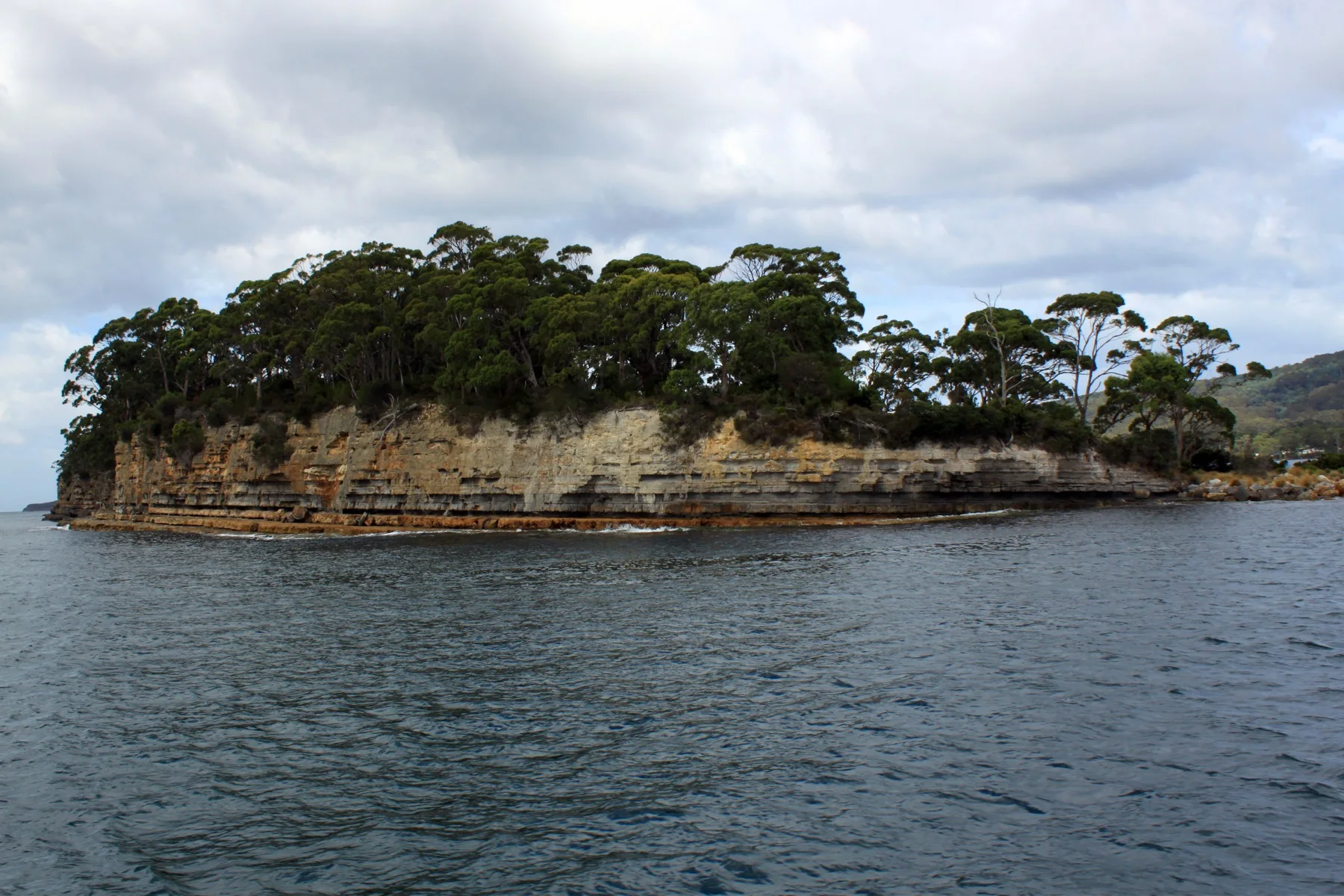

The absence of a headstone does not mean the absence of a person or of evidence. Burial records, conduct documents, newspapers and archaeological work can restore some identities, while gaps remain. One Aboriginal person is believed to have been buried on the island, a detail that connects the cemetery to the colonial violence and displacement beyond the penal population. It must be handled as a documented probability, not expanded into an invented biography.
An island visit therefore asks for restraint. Paths, graves and vegetation are not props for atmosphere. Photography should follow site guidance and avoid turning other visitors' grief or reflection into content. A guide may explain inscriptions, burial organisation and research; the most important response can still be to leave some silence unfilled.
14 · Port Arthur through evidence
28 April 1996 belongs to the place without becoming content
On 28 April 1996, a gunman murdered 35 people and injured many others at and near Port Arthur. The attack caused immense personal and community loss and contributed to major changes in Australian gun laws. The Broad Arrow Café site became the Memorial Garden, created for remembrance and reflection.
This history should be stated plainly, without reconstructing the violence, listing sensational details or using survivors' pain to intensify a travel story. It is not an “extra dark” layer added to convict tourism. It is a recent tragedy with living bereaved families, survivors, responders and community members. The memorial exists on its own ethical terms.
The historic site’s visitor guidance directs people seeking information to a brochure at the Gallery desk and the plaque at the Memorial Garden. It asks visitors not to question guides about the attack: some lost friends or family. Read the provided account, keep voices and photography respectful, and accept that some people may be present for remembrance rather than tourism. No article can prescribe an adequate emotion. It can only refuse spectacle and make room for care.
Holding 1996 beside the convict landscape also clarifies what a place of memory is. It is not a container in which all suffering becomes equivalent. Aboriginal dispossession, transportation, institutional punishment, unmarked burial and mass murder have different causes, actors, records and living responsibilities. They share ground, not meaning. Good interpretation maintains those distinctions while acknowledging that visitors encounter them in one day.
15 · Port Arthur through evidence
How to read the site without racing it
The wider historic landscape covers roughly 146 hectares; the main visitor area described in the site’s FAQ is over 40 hectares. The distinction matters when estimating a walking day. More than thirty buildings and ruins sit within the visitor experience, with substantial distances between some of them. Basic admission is designed around the site, interpretation and a short harbour cruise; additional island experiences require their own arrangements. A boat circuit helps rest tired feet and makes the separation of Point Puer and the cemetery easier to understand, but it is not a substitute for time inside the institutional buildings. Use the official planning pages for the chosen date rather than relying on a fixed itinerary in an evergreen article.
Begin by orienting yourself to Mason Cove and the main zones. The harbour explains transport and separation. The penitentiary and dockyard explain industry and reuse. The church, gardens and officers' houses explain hierarchy. The Separate Prison explains a change in penal theory. The Asylum and Paupers' Depot explain the institution's later population. Point Puer and the Isle of the Dead are spatially visible across water even when a specific visit is not included.
A useful order follows questions rather than photo opportunities:
- From the water or shoreline, ask how harbour, neck and distance formed a transport and security system.
- At the dockyard and penitentiary, trace labour, engineering, production and building reuse.
- In official and domestic areas, compare rank, service and family life.
- At the Separate Prison, examine how architecture attempted to govern mind and association.
- At the Asylum and later institutions, follow the consequences of ageing, illness and dependency.
- In interpretation and conservation areas, look for the transition from Carnarvon tourism to research-led stewardship.
This sequence is not a timetable. The site's size, sloping ground and emotional weight argue for more time, not more stops. Allow at least half a day for the main site and consider a full day when the separate system, domestic buildings and interpretation are central to your visit. If planning a return, check the ticket’s current validity rather than assuming that a second day is included. A pause is part of responsible attention, especially after the Separate Prison, burial landscape or Memorial Garden.
16 · Port Arthur through evidence
Access, weather and personal limits are part of the history day
The site combines paved paths, lawns, slopes, thresholds and heritage interiors. Some buildings and routes are wheelchair accessible; others are constrained by historic fabric. A mobility shuttle has operated during the day, and staff can advise on the most workable sequence. The Isle of the Dead and some additional experiences involve steeper or uneven ground. Use the official accessibility information to confirm the access map, shuttle operation, seating, toilet locations, companion arrangements and any vessel boarding before committing. The Visitor Centre and Gallery offer a useful starting point for discussing the route; being able to reach them does not establish access to every ruin or island path.
Product-specific accessibility is a separate question. A day tour may involve a high vehicle step, fixed pickup, limited space for mobility equipment or a route that cannot be adapted even when the historic site itself can. No generic label such as “accessible” or “small group” resolves transfer, boarding, restraint, storage, hearing, vision, fatigue and assistance needs. Ask the actual operator how each stage will work, including assistance at the vehicle, the site and the boat. Decide which interiors and stops are essential before accepting a route that may leave them out.
Weather on the peninsula can change quickly. Wind and rain alter the harbour, exposed coast and walking surfaces; heat and sun matter on open lawns. Carry layers, water and sun protection, and treat sea-cliff barriers as safety infrastructure. Stay on designated paths, keep behind coastal barriers, and check the Tasmania Parks visitor information before adding an exposed coast walk.
The Hobart return also matters. Adding Richmond, several coastal formations, Port Arthur and every optional experience can turn a history day into a vehicle day. Choose the primary question before departure. If Port Arthur's institutions and memorial landscape are the reason for going, protect enough time there and let a coast stop go. Completeness is not the number of pins reached; it is whether the central subject received the attention promised.
17 · Port Arthur through evidence
A place of memory is made by distinctions
Port Arthur can produce an immediate emotional response: the harbour is calm, the lawns are ordered, the penitentiary is open to the sky, and the contrast with documented coercion is sharp. That response is a beginning, not an interpretation. Beauty neither disproves suffering nor makes it more profound. It shows that landscapes outlast the institutions that tried to control them and acquire meanings those institutions did not design.
The strongest reading keeps making distinctions. Country is older than the settlement. Aboriginal dispossession is not a subplot of convict transportation. Forced labour could teach skills and still be coercive. Reform language could accompany damaging isolation. Women and free families were present without sharing the same status. A ruined wall records fire and tourism as well as incarceration. The 1996 memorial is a living place of grief, not an attraction. Current conservation makes the past accessible without claiming to make it complete.
This is why a descendant connection, when genuinely documented and shared with consent, can add value but cannot replace research. Family history may reveal how transportation travels through generations; it does not make one guide's lineage representative of every convict, officer, Aboriginal family or later resident. A family account belongs beside the institutional archive and the accounts of other communities. Listening well means asking how a personal story connects to that larger evidence, rather than assuming that descent settles every question.
Port Arthur became a place of memory through many acts: record-keeping and forgetting, tourism and scholarship, excavation and repair, renaming and restoration, private grief and public commemoration. No single narrative owns it. The visitor's responsibility is modest but real—to slow down, separate evidence from atmosphere, recognise living relationships to Country, and leave the place less simplified than it first appeared.
18 · Port Arthur through evidence
Listen to the field notes
The ExcursionPass podcast follows the road from Hobart through Richmond and the Tasman coast to Port Arthur. Its central question travels well beyond a day-tour itinerary: how can one journey connect colonial infrastructure, deep geological time, confinement and memory? Listen before the drive or return to it after walking the site, when the distance between harbour, workshops, church, prison and burial ground has become easier to picture.