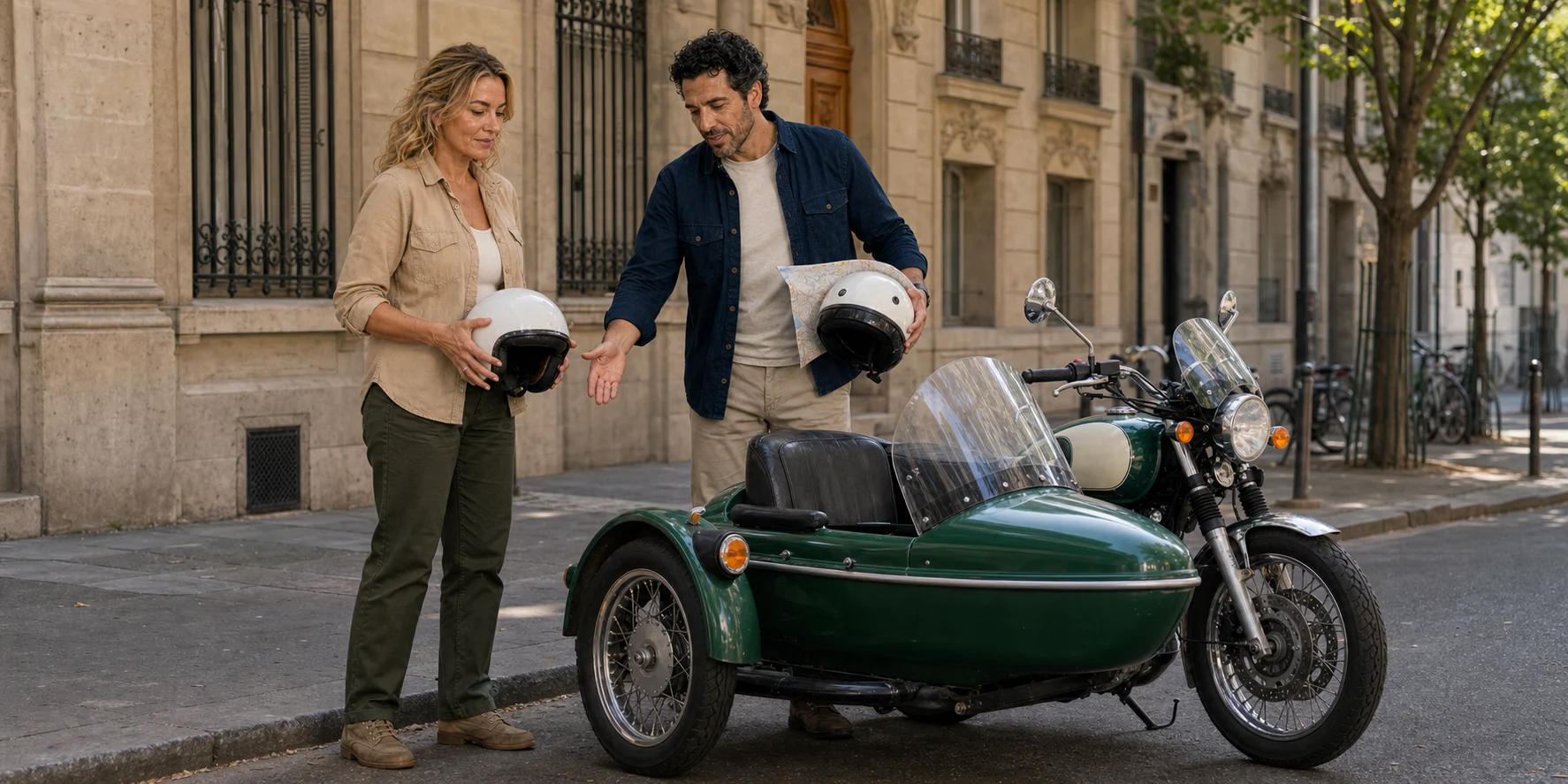
Paris rewards changes of speed. On foot, a single block can hold a doorway, a political inscription, a bakery queue and several centuries of repairs. From the river, the city becomes a sequence of bridges and embankments. The Métro suppresses most of the space between origin and destination. A motorcycle with a sidecar offers another edit: close to the ground, open to wind and street noise, quick enough to connect districts, but exposed enough that the distance between them never disappears.
The format can work at two very different scales: a short orientation through central landmarks and a five-hour day that joins a broader city circuit to the Catacombs. Those are not simply short and long versions of one experience. The first can establish bearings; the second adds a timed institution, a separate exit, food, bags, stairs and a handoff between an open vehicle and a one-way underground route.
Before choosing a route, understand its vehicle. A sidecar is not stable in the manner of a car. Right-hand priority does not explain every great Paris junction: at a signed carrefour à sens giratoire, entering traffic yields to users already circulating. Equipment and intercom arrangements vary by vehicle and operator. The useful route ideas survive only when those distinctions remain visible.
The day begins before boarding, with the physical demands of the vehicle. Above ground, Paris becomes connected urban ground; below, the Catacombs are a separate historical institution. Each deserves attention on its own terms. The central question is not “Which is more exciting?” It is “Which sequence of exposure, transfers, walking and interpretation will help you understand the city?”
First, understand the machine
A sidecar outfit begins with a motorcycle and adds a passenger body and third wheel to one side. Under European vehicle categories, that is an L4e motorcycle with sidecar—not a car and not a symmetrical three-wheeler. The classification describes a type; it does not tell you the seating certificate, payload, brakes or approved passenger positions of the particular machine that will collect you. Those details belong to its registration, construction and operating record.
The distinction is easy to miss when the vehicle is parked. Three contact patches appear to promise automatic balance. At a standstill, the outfit does not require a rider to hold it upright as a solo motorcycle does. Once it moves, however, the mass is offset. The motorcycle, rider and engine occupy one line; the sidecar body and its wheel occupy another. The centre of gravity sits closer to the motorcycle than to the centre of the total width.
That asymmetry explains why acceleration and braking feel directional. With a non-driven chair on the right, acceleration tends to turn the outfit toward the sidecar; deceleration tends to turn it away. The sidecar resists being pulled forward under power, then carries momentum as the motorcycle slows. The Motorcycle Safety Foundation manual hosted by Arkansas describes this rightward/leftward contrast. A driven sidecar wheel, sidecar brake and other vehicle details can change the response. A trained driver anticipates the particular machine rather than fighting a surprise correction.

Turns are unequal too. With the chair on the right, a right turn transfers load away from the sidecar wheel; an empty or lightly loaded chair can lift more readily if speed and steering input are poorly managed. A sharp left turn loads the sidecar differently and can unload the motorcycle's rear wheel. The safe response is not a passenger technique learned from a paragraph. It is trained driving: correct entry speed, smooth steering, appropriate loading, space and anticipation.
The two lateral wheel tracks also make the outfit wide: front and rear motorcycle wheels follow substantially the same line, with the chair wheel offset to one side. A solo motorcycle can change position within a lane while remaining narrow; a sidecar may occupy nearly the width of a small car. Governmental three-wheel motorcycle training guidance warns that lane placement and sudden swerves require different planning. That is an important correction to the romantic image of “threading through” Paris. A sidecar should not be sold as a device for slipping between moving vehicles. Its value is visibility and connection, not lane-filtering theatre.
Passenger weight changes the handling. General three-wheel guidance places a lone passenger in the sidecar and, where a second approved passenger seat exists, the heavier passenger in the chair rather than on the pillion. But this is not permission to rearrange yourselves. The exact vehicle certificate, operator rule and driver's instruction govern. Ask which position you have booked, whether there is a separate pillion seat and handhold, and whether the sidecar has a restraint. Never infer that two small people can share one seat.
Equipment is not decoration
Current French equipment rules require a fastened approved motorcycle helmet for driver and passenger in circulation. They also require CE-marked gloves for both. A high-visibility vest must be available for emergency use, and mandatory lights, signals and exhaust equipment must be roadworthy. For the driver, audio devices worn at the ear are prohibited; helmet-integrated communication equipment is permitted. Confirm that the driver’s system complies and that every passenger can hear instructions.
Those are minimum rules, not a complete comfort system. An open-face helmet leaves more of the face exposed than a full-face helmet. A small windscreen protects the chair passenger unevenly and does little for a pillion passenger. Ordinary sunglasses are not a substitute for protective eye equipment. Rain gear keeps water off only if it fits and can be secured. Gloves that satisfy a label may still be too large, too small or wet from the previous departure.
A booking page should therefore answer concrete questions:
- Are approved helmets and CE-marked gloves supplied in the sizes needed by every passenger?
- Is eye protection supplied, and does the helmet allow prescription glasses?
- Is the intercom built into the helmet, and can every passenger hear safety instructions as well as commentary?
- Which passenger occupies the sidecar, and which—if any—occupies the pillion?
- What step height, handhold and assistance are involved in boarding and dismounting?
- Where can a small bag be secured without affecting the steering, passenger space or exhaust?
- How does the operator adapt the route to conditions, and how are changes communicated?
- Who holds the passenger-transport authority and insurance for the exact vehicle and departure?
A responsible operator should answer that entire list for the exact vehicle and departure. Do not transfer the published promises of one Paris sidecar company to another, even when the machines look similar. Treat equipment, passenger arrangement, loading help, insurance and authority as pre-booking questions; if the answers remain vague, choose a different format.
Communication deserves particular care because the open vehicle creates a paradox. It gives a passenger an unobstructed relationship with the street, but wind, engines, sirens and distance from the driver can make spoken commentary hard to hear. Intercom provision varies. If interpretation is a main reason for booking, confirm how it is delivered to every assigned seat. A route without audible context can become a fast succession of façades.
Paris road grammar: signs before folklore
Paris traffic is not a single aggressive organism and it does not obey a picturesque secret code. It is a regulated system of streets with different limits, signals, bus and cycle infrastructure, pedestrian priority and changing restrictions. The City says most Paris streets are limited to 30 kilometres per hour; encounter zones use 20 kilometres per hour, and some areas are pedestrianised temporarily or permanently. Major axes can have other limits. A driver follows the sign and the situation, not a travel anecdote.
Intersection priority also depends on the controls in place. France does retain a general intersection rule under which a driver arriving from the left yields to a driver arriving from the right when no different provision applies. But the law explicitly allows other controls, and a driver entering a signed roundabout yields to users already circulating. Large Paris places can contain signals, lane markings and designs that are not explained by one sentence about priority. Passengers do not need to solve each junction; they do need to know that competent operation is visible in smooth positioning, legal speeds and respect for crossings and cycle lanes.
The great western arc around the Arc de Triomphe is often used to sell drama. It should instead be used to explain urban geometry. Twelve avenues meet around the monument. The central arch began under Napoleon and became a national commemorative site; the radiating streets acquired much of their present scale through nineteenth-century planning. From a low moving seat, the important observation is not how many lanes a driver can cross. It is how a single monument terminates long views and distributes them back into the city.
The Arc also introduces a theme that returns underground: public care for human remains. The Unknown Soldier was buried beneath the arch on 28 January 1921, after the preceding November’s national procession; the memorial flame followed in 1923. The monument’s official history records that the coffin had rested overnight at Denfert-Rochereau on its arrival in Paris. That gives the northern-western landmark and the southern threshold an unexpected connection. The war memorial preserves a single anonymous individual as a national representative; the ossuary holds commingled remains displaced from many burial grounds. Their histories differ, but both ask visitors to recognise people where identity has been lost.
At every junction, the passenger experience depends on the driver's margin. Hard acceleration and late braking exaggerate the sidecar's yaw. Rapid changes of line turn city reading into self-protection. Smooth speed makes façades, trees and street sections available to attention. The “thrill” of the format should come from openness and scale, not unnecessary proximity to risk.
Read the route as connected ground
An orientation through central Paris can use the Eiffel Tower, Notre-Dame, Arc de Triomphe, Champs-Élysées and Louvre as reference points. A longer circuit can extend north to Montmartre before the separate southern visit to the Catacombs. A moving city route is never a fixed street trace: traffic controls, works, weather and the selected start alter what is practicable. A useful orientation must therefore be schematic, built from spatial relationships that survive route changes.

Begin with the Seine. The river divides the Right Bank from the Left Bank, bends through central Paris, receives the historic islands and gives the city's monuments room to address one another. The UNESCO-listed banks contain medieval, classical and nineteenth-century works in one continuous landscape: Notre-Dame and Sainte-Chapelle around Île de la Cité; the Louvre and Tuileries on the Right Bank; Invalides and the Eiffel Tower farther west on the Left. Even if a sidecar crosses only once, noting the direction of flow and the bank you occupy provides a durable orientation.
The western monumental axis is another organising line. The Arc de Triomphe, Champs-Élysées, Place de la Concorde, Tuileries and Louvre do not form a museum corridor assembled for present tourism. They represent successive regimes and changes in civic use. The Louvre grew from fortress to palace to museum. The Tuileries garden mediated between court and city. Place de la Concorde changed names and political meanings around a space of royal display, revolutionary execution and later national representation. The Champs-Élysées evolved from a formal extension of the garden into a commercial avenue. The Arc turned imperial ambition into a later site of collective commemoration.
A short ride cannot narrate each layer. It can show that the line exists. That is enough if the overview is treated as reconnaissance: note where tree-lined perspective becomes a broad square; where stone façades yield to garden; where the river interrupts the axis; and which place deserves a return on foot. It is not enough if each monument is announced, photographed and discarded.
Notre-Dame provides a different scale. The cathedral is not simply a façade visible from a bridge. Its position on Île de la Cité belongs to the long administrative and religious centre of Paris; its west front, buttresses, roof, square and relationship with the river must be read from different sides. A moving vehicle may offer orientation, but reconstruction, security and traffic arrangements determine where a legal stop is possible. Never interpret a fleeting view as “seeing Notre-Dame.” Use it to place the island, then plan a separate visit.
A small roof-level story complicates the cathedral’s monumental scale. After the April 2019 fire, beekeeper Nicolas Géant feared for three hives below the main roof. ABC reported his footage of bees active at the hives on 21 April, following earlier images showing the boxes intact. This supports an account of surviving colonies, not a census of every insect or a simple biological explanation for survival. The bees draw attention to the cathedral as an inhabited structure maintained by people doing specialised work. From a bridge you will not see the hives; the anecdote gives the unseen roof a human and ecological scale without turning it into a promised tour stop.
The Eiffel Tower likewise benefits from distance. The tower's 1889 iron lattice can appear almost immaterial from Trocadéro or across the river. Close to its piers, the object becomes an operating structure of foundations, lifts, stairs, queues and security. The existing ExcursionPass Paris guide explains that vertical journey in depth. From a sidecar, the useful lesson is the relation between monument, Champ de Mars, river and western city—not a substitute for access.
Two Left Bank buildings make the city’s changing uses especially legible. Louis XIV founded the Invalides in 1670 for soldiers; the royal dome was inaugurated in 1706, and Napoleon’s remains arrived in 1840. A distant view of the dome can introduce the combination of military welfare, royal display and later commemoration, but the courtyards and interiors require a separate visit. Farther east along the river, Orsay was built as a railway station for the 1900 Exposition and opened as a museum in 1986. Its formal stone envelope belongs to the monumental riverfront; its great interior space belongs to railway engineering. Read the façades as evidence of institutions adapting, rather than interchangeable grand Paris buildings.
Montmartre changes the geometry again. It belongs to a different scale of streets from the monumental axis. The hill's gradients, narrow streets and surviving village-scale fragments make vehicle access sensitive to pedestrian pressure, closures and legal routing. The white mass of Sacré-Cœur is only the most visible layer. Quarrying, religious institutions, nineteenth-century annexation, working-class settlement, entertainment businesses and artistic networks all shaped the district. A driver who can safely connect slope to history adds value; a vehicle that merely reaches a crowded photo point does not.
For a return on foot, the Musée de Montmartre’s Renoir gardens offer a more specific artistic geography than a general claim that painters lived on the hill. Renoir stayed on the site in 1875–76. Gardens, studio buildings and nearby entertainment venues place painting within a lived district of work and leisure. Keep that scale in mind when looking uphill from a vehicle: the skyline supplies orientation, while doors, plots and rooms hold the detailed history. Sacré-Cœur, the museum and the Moulin Rouge belong to different settings and visitor experiences; neither the hilltop panorama nor the cabaret façade stands in for the whole district.
The open-air view has benefits—and costs
An open sidecar can make scale physical. The passenger is lower than in a coach, so wheels, kerbs, doorways and street trees occupy more of the field of view. There is no glass reflection between eye and city. Changes in surface—smooth asphalt, paving, drainage channels—can be felt as well as seen. Wind direction and shade reveal the orientation of a street. A hill is experienced as engine load and body angle before it becomes a contour on a map.
But openness also means noise, exhaust, pollen, grit, sun and rain. A helmet changes peripheral sound. Conversation may disappear at speed. The pillion and chair offer different exposures: the pillion is higher and must maintain a secure posture behind the driver; the chair passenger sits lower, more enclosed by the body and windscreen but closer to the sidecar wheel and road edge. The exact comfort difference depends on the machine and weather. No honest article can promise a universal cinematic feeling.
The city bears costs too. A combustion motorcycle emits local pollution and noise, occupies road and parking space and participates in congestion. Paris's low-emission zone applies to motorised two- and three-wheel vehicles as well as cars, with Crit'Air rules that remain mutable. The City also classifies L4 sidecars under light-vehicle parking rules rather than the tariff for ordinary two-wheel motorcycles. That detail is not a passenger chore; it illustrates that the third wheel has civic consequences as well as aesthetic appeal.
Choosing a private motor tour can still be rational for a small group that values a guide, has limited time or wants to connect distant areas without a coach. The responsible comparison is not between “polluting” and “pure” travel. Walking, Metro, bus, bicycle, taxi and private vehicle each allocate energy, space, time and accessibility differently. Ask whether the sidecar replaces several taxi movements, whether the operator keeps vehicles compliant and quiet, whether the route avoids repeated idling, and whether the overview changes what you do next. A short orientation that prevents inefficient backtracking may deliver more value than a longer circuit designed only to accumulate sights.
A short ride: use it as a first chapter
A short sidecar format is not enough time for a general history of Paris, and it should not pretend to be. Its strongest use is at the beginning of a stay, when a visitor needs bearings and has already accepted the physical medium.
A short ride places a premium on the starting point. If pickup consumes part of the listed time, less remains for movement and stops. A fixed meeting place may allow a more coherent route. Confirm whether the listed duration describes vehicle time, total tour time or a scheduled block that includes briefing and helmet fitting.
The format works best with one intellectual task: establish the Seine, one cross-city axis and the relation between two or three places you will revisit. A guide might connect the Arc, Concorde and Louvre as a political and visual sequence, or relate the Eiffel Tower to the river and Invalides. It works less well when every minute is assigned to a photo stop. Stopping, parking, removing gloves, taking photographs, reboarding and merging into traffic all consume the scarce duration.
For a visitor arriving after a long flight, freshness and novelty can be appealing, but wind, noise and motion may also add to fatigue or nausea. Someone who has just flown long-haul should judge balance, hydration and attention honestly. If you are too tired to assess instructions or hold a pillion position securely, postpone.
Weather has a larger proportional effect on a short booking. A shower that requires fitting rain gear can absorb a meaningful part of the experience. Heat can make helmets uncomfortable; cold wind can transform open-air pleasure into endurance. “Rain or shine” is an operator policy, not evidence that conditions are equally suitable. Read the live cancellation and weather terms before paying.
The right endpoint is a plan. After dismounting, you should be able to say: the river bends there; Montmartre is north; the monumental axis runs west; Notre-Dame belongs to the island; the Catacombs are a separate southern visit. If all you retain is a series of helmeted photographs, the format has underperformed.
An evening city circuit is another choice, rather than a shortened Catacombs combination. A longer format can give more room for stops than a short overview while remaining entirely above ground. After dark, illuminated landmarks organise the eye differently: façades may become clearer as silhouettes while kerbs, paving and quieter details become harder to read. Cooler air and glare also change exposure. If photography is the aim, discuss safe stationary stops and time for removing gloves; moving shots compete with secure passenger posture. Choose the evening for its different visual register, then visit museum interiors in a separate block of time.
Five hours: a different category, not a longer highlights ride
A five-hour combination that includes the Catacombs and a lunch interval changes the day from orientation to itinerary. It introduces timed admission, food, bags, bathroom planning, two different physical environments and a handoff between private transport and a public museum circuit.
Before committing, obtain a breakdown of the five hours. Catacombs guidance says to allow about one hour for the underground circuit, but entry processing, descent, ascent and the distance between the entrance and exit add time. Lunch can be a reservation, an informal pause or merely time left for a stop. The city portion may occur before or after the museum. The driver may or may not accompany the underground visit. None of those variables should be inferred from a polished title.
That uncertainty affects value. A combined booking can be excellent when one operator coordinates a timed Catacombs entry, stores no prohibited bags, explains the transition, uses the city route to prepare the underground history and establishes a clear meeting or endpoint at the separate exit. It can be poor when “Catacombs included” means only a ticket handed over at the entrance after an unrelated ride.
The conceptual bridge between the two halves is stone. Paris above contains limestone extracted below. Quarries helped supply churches, walls, houses and palaces; poorly regulated underground excavation later threatened streets and buildings. The municipal response to quarry collapses created the inspection and consolidation system that made an ossuary possible. If the guide establishes that relationship while moving through the limestone city, the combined format has an argument. The Catacombs stop is then a continuation, not a macabre add-on.
The format is also more demanding. Five hours in an exposed vehicle and underground site is not equivalent to five hours in a coach. Boarding may require a deep step into the chair or a leg swing onto the pillion. Dismounting can be stiff after sustained sitting. Then come 131 steps down, a one-way 1.5-kilometre circuit on uneven and sometimes slippery ground, and 112 steps up. There is no lift. The exit is not the entrance. Suitability depends on the whole chain.

Denfert-Rochereau is a threshold, not scenery
The public entrance to the Catacombs is at 1 avenue du Colonel Henri Rol-Tanguy on place Denfert-Rochereau. The square's earlier name, place d'Enfer, survives in the history of the Barrière d'Enfer: a pair of tax pavilions designed by Claude-Nicolas Ledoux for the late-eighteenth-century wall around Paris. Goods entering the city were assessed there. The architecture turned a fiscal boundary into a monumental gateway.
Look closely at the architecture of Ledoux’s paired pavilions. Their columns combine cylindrical and square drums, giving familiar classical forms an unusually emphatic weight. A central arched bay flanked by lower rectangular openings organises the façade. The reference to a ceremonial gateway made a tax checkpoint appear as an entrance into a civic sanctuary. That authority was contested: the Barrière d’Enfer was pillaged and burned on 13 July 1789, renamed Barrière Égalité during the Revolution and returned to fiscal use. When Paris annexed surrounding districts in 1860, the tax boundary moved outward. The surviving buildings consequently belong to an earlier footprint of the city, rather than a gateway positioned at its present edge.
The Catacombs entrance uses one of those pavilions, making the transition unusually dense. Above ground is a former city limit, a traffic circle, a transport interchange and the Lion of Belfort monument. Below is a quarry system that was once outside the dense city and therefore suitable, in the authorities' view, for receiving cemetery contents. The later city expanded around and above both.
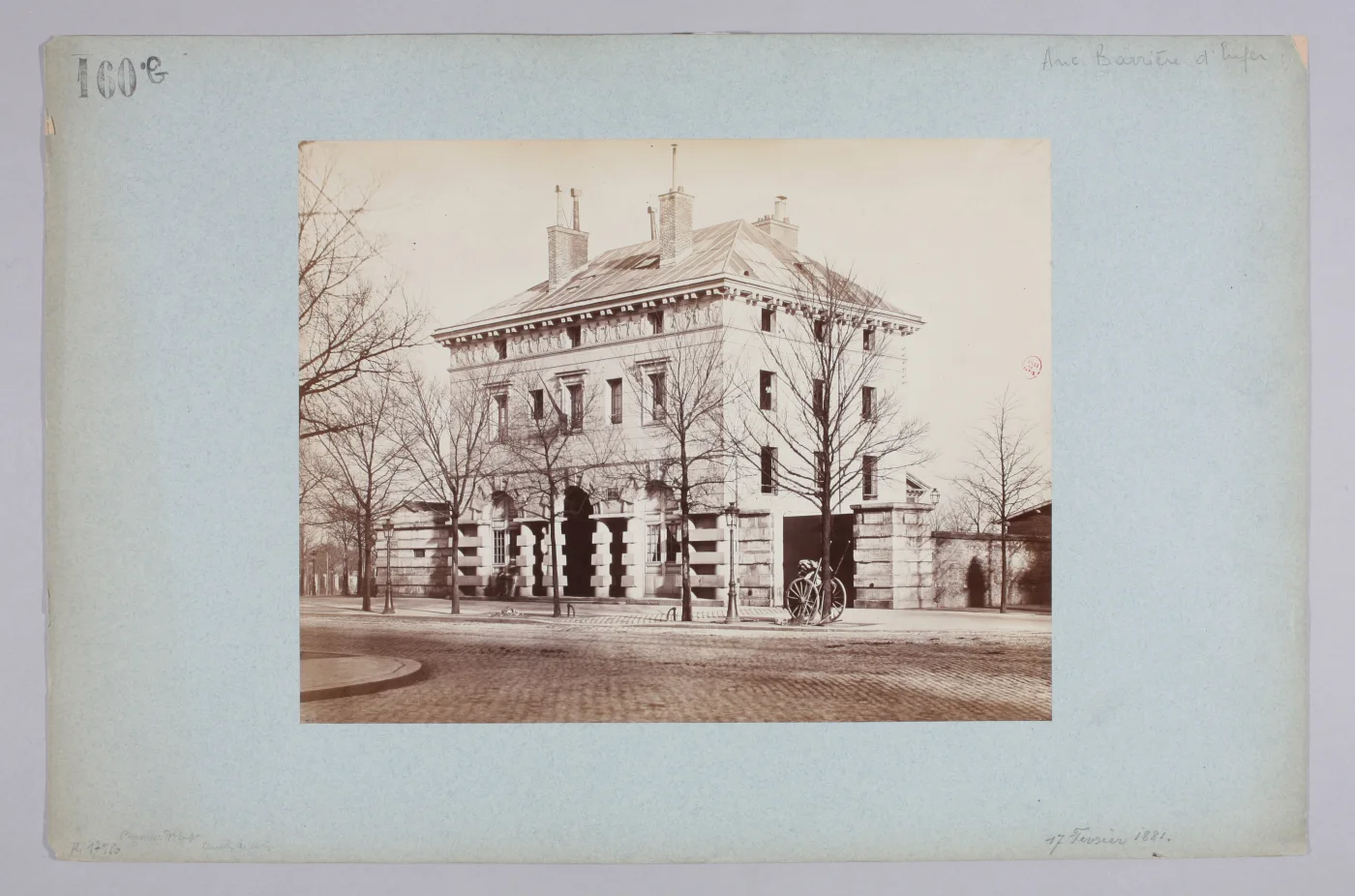
Calling the area simply “the Catacombs stop” erases that surface history. A good transition makes the boundary legible: this was where city, taxation, quarry administration and public health converged. It also makes logistics explicit. The official exit is at 21 bis avenue René-Coty, several blocks from the entrance. If a private tour promises onward transport, ask where and when the driver returns. If it ends after the museum, plan your route from the exit, not from the entrance pin saved earlier.
The museum admits only bags up to 40 by 30 centimetres, requires them to be carried in front or by hand and has no cloakroom. A sidecar's luggage space is already constrained, so storage must be solved before departure. Do not assume a helmet, large backpack or shopping bag can be left securely with the vehicle during an underground visit. The operator must state its storage plan.
The limestone came before the ossuary
The Catacombs circuit descends through rock layers documented by the museum as the remains of a tropical sea. The limestone at quarry level belongs to the Lutetian stage, roughly 40 to 48 million years old. Sediment and marine life accumulated, compacted and became stone containing fossils. “Lutetian” derives from Lutetia, the Roman name associated with Paris, so the geological label and the city are linguistically joined.

People quarried different materials around Paris from antiquity onward. Lutetian limestone became an especially important building stone. Early extraction used open pits where layers reached the surface. As demand and the city grew, quarrying moved underground and galleries followed the useful beds. Workers left supporting pillars or later used masonry and backfill systems to stabilise worked areas. Shafts allowed stone to be raised.
Extraction was productive but inconsistently regulated. Once a gallery was exhausted and access closed, its exact geometry could disappear from public memory while buildings and roads multiplied above. Collapses in the eighteenth century made that invisible inheritance a civic emergency. In 1776, authorities prohibited excavation beneath roads; the following year, a quarry inspection service began the long task of mapping and consolidating dangerous ground.
The inspector behind the early consolidation work was Charles-Axel Guillaumot, appointed in 1777. His task was to make poorly remembered excavations governable: find the voids, relate them to streets above and stabilise them. That is the engineering precondition for the later ossuary. The modern visitor follows a controlled corridor through the consequences of this work, rather than an untouched mine.
This is why the underground cannot be reduced to “ancient tunnels.” The galleries are industrial excavations, administrative records and structural interventions. Quarrymen cut the stone; inspectors added dates, street names, support walls and orientation marks; water and humidity continued to alter surfaces. The public route includes geology and engineering before it reaches human remains.
Two quarry terms help explain the supports. Piliers tournés are masses of limestone left standing as extraction advances around them. Piliers à bras are pillars assembled from blocks; hagues are retaining walls holding back rubble. The useful comparison is with masonry above ground: a load still needs a path to firm support. These terms will reappear in a different material when Héricart’s bone façades retain deposits behind them. The connection is structural, not a suggestion that remains became building stone.
The relationship between void and building is direct. Some stone removed below became architecture above, while the resulting cavities later required reinforcement to support that city. Paris consumed its substrate and then had to govern the absence. The Catacombs make that circular history visible.
Why the cemetery crisis moved underground
By the late eighteenth century, Paris's old parish cemeteries were under severe pressure. The Cemetery of the Innocents, near today's Les Halles, had received burials for centuries. It was not a modern park cemetery with stable individual plots. Graves were reused, charnel houses held bones, and dense urban development pressed close. Complaints about odour and sanitation grew into a public-health and political problem.
In 1780, a cellar wall adjoining the cemetery collapsed under the pressure of accumulated burial material. The episode became a decisive emblem of a longer crisis. Authorities closed the cemetery and eventually chose former Tombe-Issoire quarries, then outside the city, as a destination for transferred remains. The choice joined two municipal problems: unsafe underground voids and overcrowded burial grounds.
Transfers from the Innocents took place from 1785 to 1787, generally at night and with religious observances intended to preserve dignity. Other cemeteries and religious institutions followed over decades. The site was consecrated as the Paris Municipal Ossuary on 7 April 1786. It later acquired the name “Catacombs” by reference to ancient Roman burial sites, although the Paris site began as quarries and became an ossuary through relocation.
The often repeated statement that the Catacombs contain six million Parisians is an approximation, not a count of identified individuals. Remains from multiple cemeteries were moved, mixed and reconfigured. Visible walls contain patterned long bones and skulls; other fragments are packed behind them. The arrangement does not preserve a recoverable person-by-person archive.
That fact changes how the space should be described. It is neither an archaeological tomb discovered intact nor a theatrical crypt created for visitors. It is a municipal response to urban death, constructed from disinterred and commingled human remains. It tells a history of public health and administration, but its material is still people.
Héricart de Thury turned storage into a public argument
The first transfers did not produce the ordered bone façades visitors recognise. Remains were deposited more loosely in quarry spaces. When Louis-Étienne Héricart de Thury became Inspector General of Quarries in the early nineteenth century, he reorganised the public route as a monumental and educational environment. The Catacombs opened to visitors by appointment in 1809.
Héricart de Thury's design alternated skulls with rows of femurs and tibiae to form visible walls, while smaller bones remained behind. He introduced masonry monuments, plaques, poetic and religious inscriptions and named spaces drawing on classical, Egyptian, Christian and Romantic references. Mineralogical and pathological displays framed the site as a place of knowledge as well as mortality.
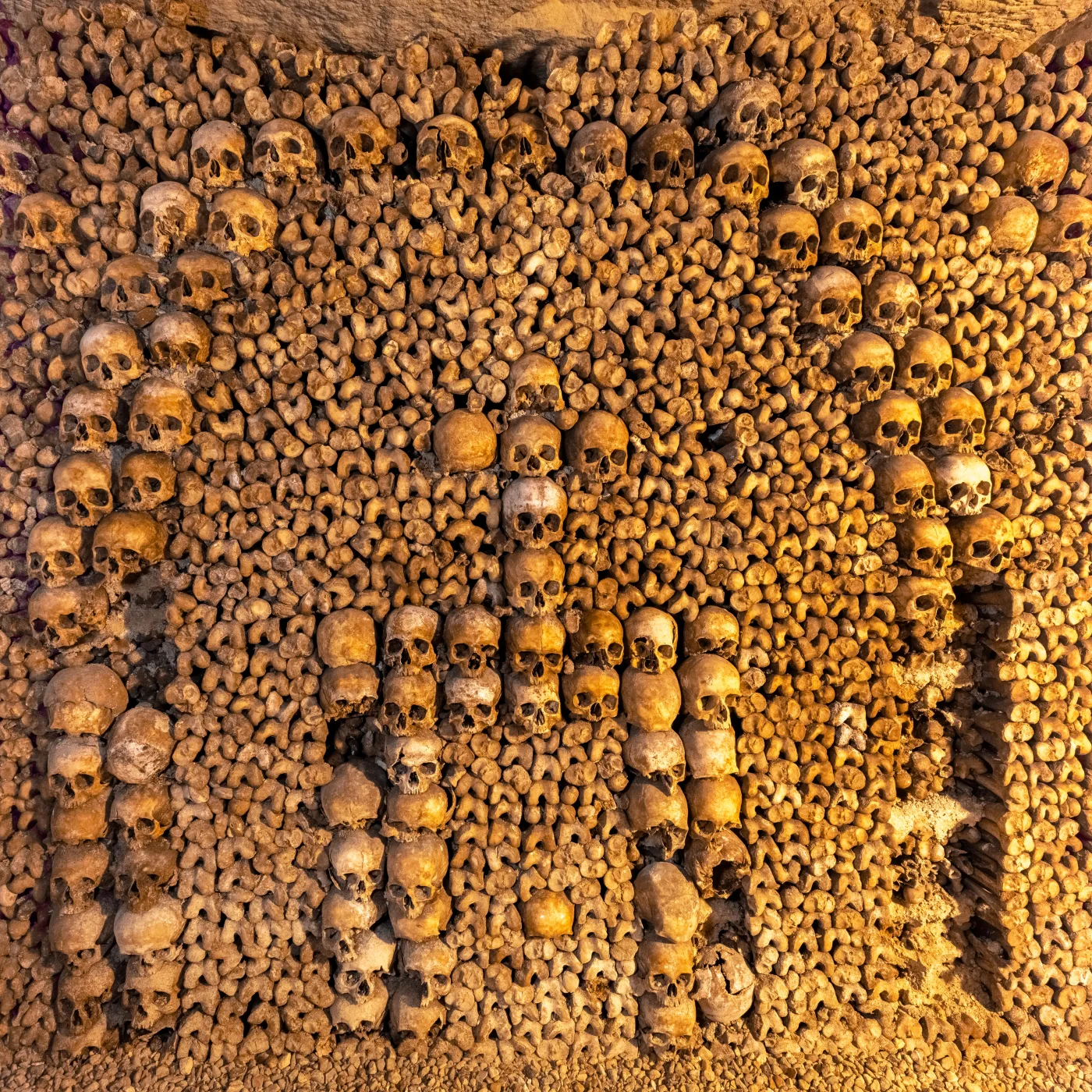
The arrangement creates an ethical tension that cannot be solved by calling it respectful or sensational. The symmetrical walls give order to material that had been displaced from graves; they also turn human remains into a public composition. Inscriptions prompt reflection, but admission and photography make the ossuary a cultural attraction. Visitors inherit that contradiction.
The right response is attentive restraint. Read the dates and cemetery names. Notice how architecture controls movement and gaze. Avoid reducing a wall to a background for a self-portrait. Do not touch the bones or decorations. Theft and attempted theft are prosecuted, but legality is only the minimum. The fact that individuals cannot be named does not make their remains ownerless props.
Conservation is difficult because the underground is humid. Bone, stone, masonry and metal react differently to moisture, temperature and repeated human presence. The museum limits the number of people on site and directs a one-way route partly to manage this fragile environment. Flash, touch, congestion and bags are not merely inconveniences; they can become conservation pressures.
Nadar made darkness into a photographic problem
In 1861, photographer Félix Tournachon—known as Nadar—spent months experimenting with artificial light in the Catacombs. Ordinary daylight photography could not work at that depth, and exposure times were long. Nadar used electrical lighting and employed mannequins when a human figure had to remain motionless within an image. The project was both technical experiment and documentation.
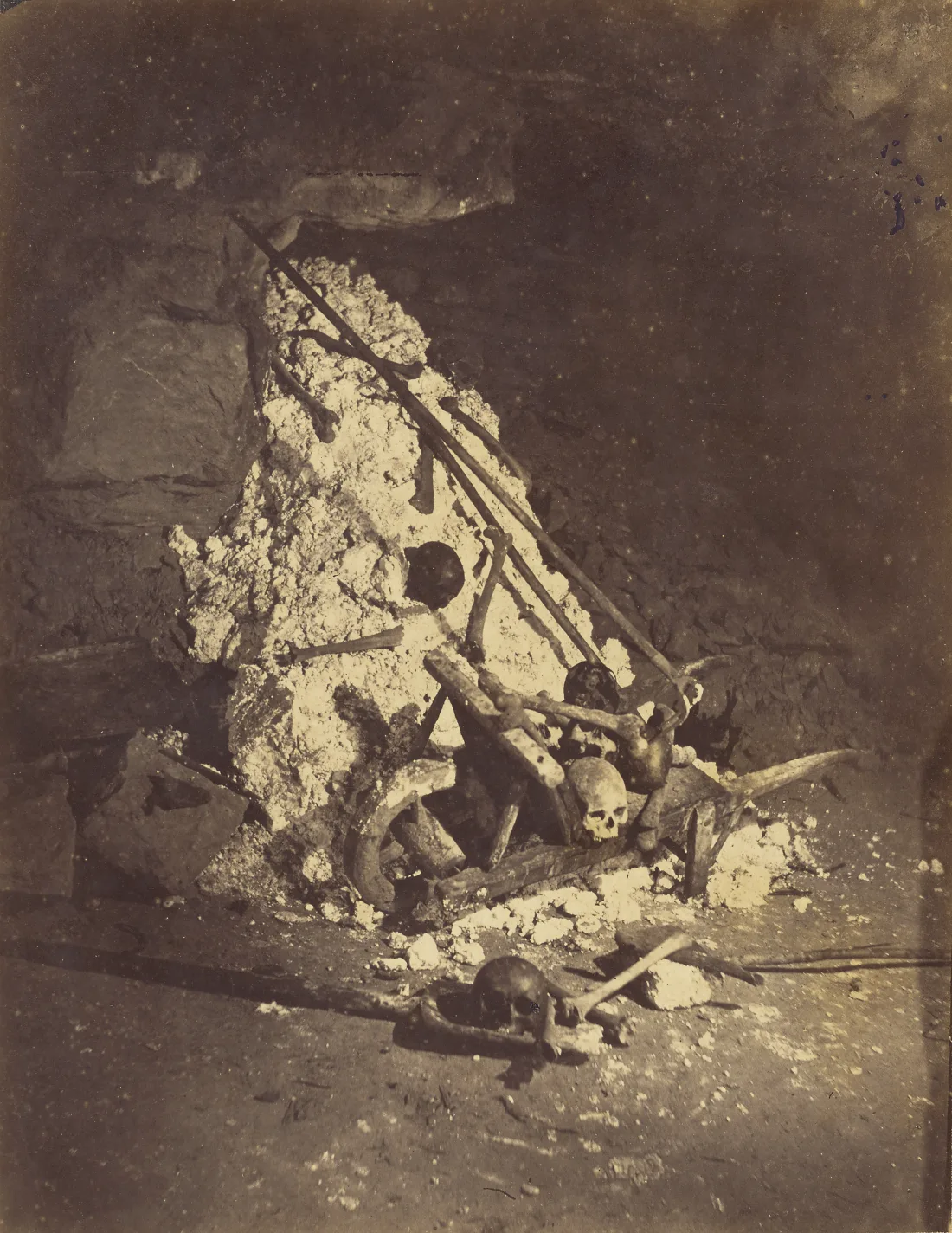
The photographs matter because they reveal stages of the site's construction. Not every deposit resembled Héricart de Thury's formal walls. Piles, supports, tools and rough quarry surfaces remained visible. Photography did not simply capture a timeless underworld; it documented a managed site changing over time.
Nadar’s mannequins expose a practical limit of the technique: a living person could not hold a pose throughout the exposure. A figure in another plate from his campaign may therefore describe scale without recording a worker’s movement. In The Pause, the irregular deposit and rough surfaces deserve equal attention. Compare the photograph with the patterned façade above: the two images show different treatments of the same difficult material, rather than a single timeless underground scene.
The legal circuit is not “the tunnels under Paris”
The official museum stresses that “Paris Catacombs” properly names the ossuary portion of former quarries, not the entire underground network beneath and beyond the city. Popular usage blurs the distinction, helped by stories of unauthorised explorers, hidden rooms and clandestine events. Those stories may belong to the cultural history of the quarries, but they do not describe the ticketed route.
The public circuit is controlled, one-way and finite. It has an entrance, an exit, staff, capacity limits, maintenance, interpretation and rules. Unauthorised quarry access creates risks of disorientation, collapse, flooding, injury and damage. It can also obstruct inspection and conservation work. A legitimate Catacombs product should deliver admission to the official museum circuit, not imply privileged access to illegal spaces.
The ossuary rewards a precise account of how it came into being. Its value lies in the documented connection between geology, extraction, building, collapse, cemetery reform, museography and conservation. Mystery may attract attention; precision sustains it.
Practical Catacombs planning
Reserve the museum visit around the official Catacombs practical information and ticketing. Select the actual date and entry time there before arranging the surrounding journeys. Leave time for the entrance formalities as well as the underground circuit, and plan onward travel from the separate exit.
The durable planning facts are physical:
- The entrance is at 1 avenue du Colonel Henri Rol-Tanguy, place Denfert-Rochereau.
- The exit is at 21 bis avenue René-Coty.
- The circuit is about 1.5 kilometres, one way, with an average on-site duration of about an hour.
- Visitors descend 131 steps and climb 112; there is no lift.
- The museum describes a constant temperature of about 14°C.
- Ground can be uneven and slippery; spaces are narrow and lighting low.
- Suitcases and large bags are not admitted. The museum currently allows bags up to 40 by 30 centimetres, carried in front or by hand, and provides no cloakroom; anyone arriving with motorcycle equipment therefore needs secure storage outside the museum before the timed entry.
- The museum limits the number of visitors on site and requires children under 14 to be accompanied by an adult.
These facts should be evaluated before committing to a combined day. A timed ticket is not a guarantee that every passenger can complete the route. People with restricted mobility, claustrophobia, heart or respiratory conditions, or sensitivity to human remains should read the museum's full warning. The site is not wheelchair accessible and is not accessible with a walker. Blind and low-vision visitors must be accompanied; current conservation rules also restrict the use of white canes within the ossuary.
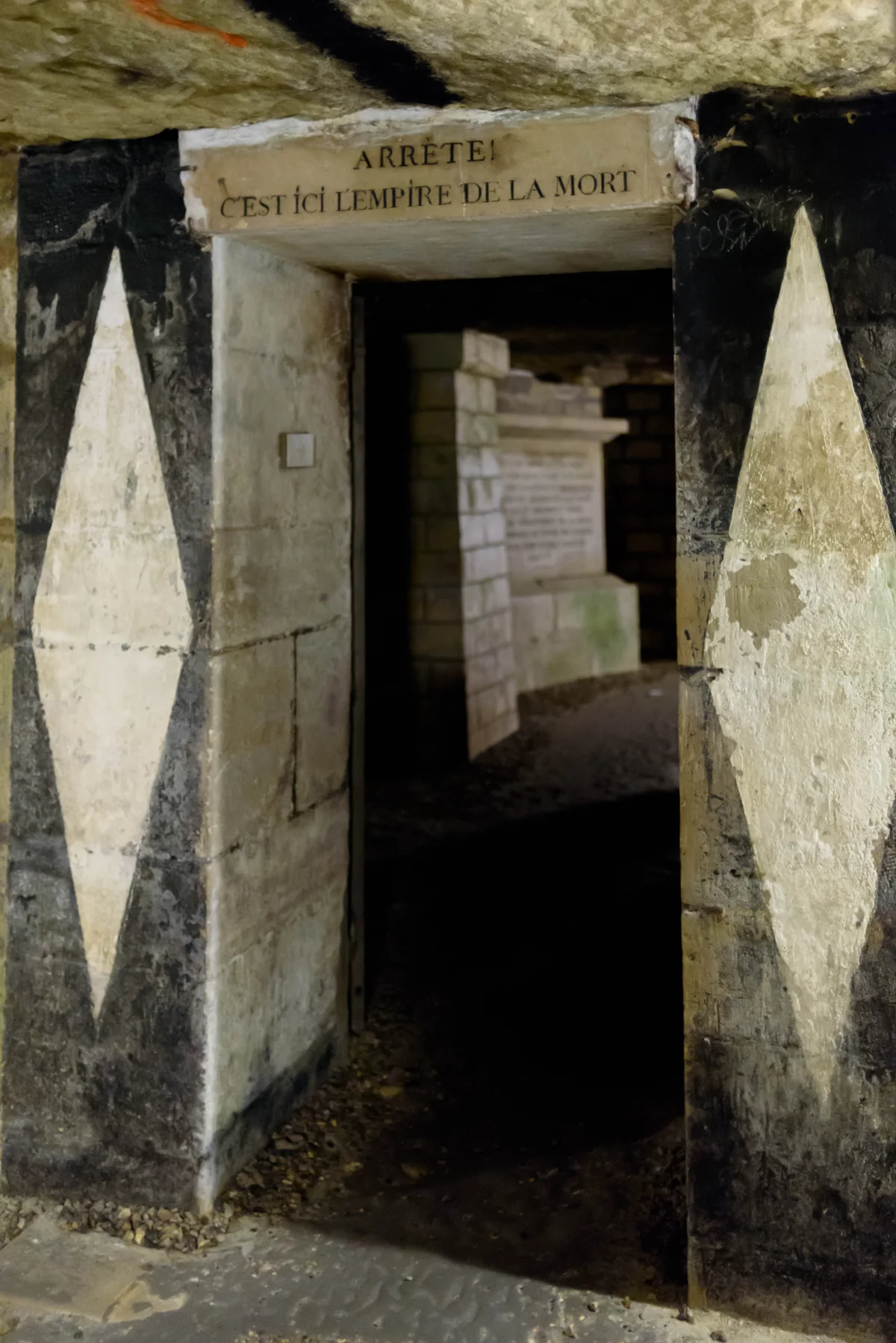
Interpretation is a separate decision from transport. The museum offers an audio guide, while a private combination may provide a guide, an audio guide or admission alone. Ask which applies and in which language. An independent timed visit can give you control of pacing; a knowledgeable guide can connect dates, cemetery names and engineering marks as you go. Either way, leave room to pause without obstructing the narrow route.
Clothing has to work in both halves of the day. Sturdy closed shoes support motorcycle boarding and wet underground ground. A light warm layer may be useful below even on a hot day, but it must fit under any motorcycle protection and travel in storage that the driver has approved. Loose scarves, straps and unsecured clothing are poor choices around a moving motorcycle. Confirm whether the operator supplies rain layers and where your own layer will be carried.
Food requires similar clarity. A lunch interval is not necessarily an included meal. Ask whether food is included, whether a reservation exists, how dietary needs are handled and whether the stop occurs before or after the Catacombs. Do not bring a large food bag to solve an unspecified lunch when the museum has strict bag limits.
How to choose between the two formats
The short and combined formats share a vehicle but serve different planning problems.
Choose the short highlights format when you want an early orientation, can board the exact assigned seat comfortably, accept open-air exposure, and already have a plan for deeper visits. Its success should be measured by the mental map it leaves, not by the count of landmarks passed.
Choose a five-hour sidecar and Catacombs format only when the operator can explain the entire chain: start, passenger position, equipment, city sequence, lunch, timed admission, helmet and bag storage, driver handoff, underground accompaniment and endpoint after the separate exit. It suits a visitor who wants one coordinated day and can complete the museum's stairs and one-way walk.
Choose neither when the operator cannot answer safety and access questions; when fatigue, balance, respiratory or mobility needs make the chain uncertain; when weather creates exposure you do not want; or when a private combustion-vehicle overview does not match your environmental priorities. A walking/Metro day and a separately booked Catacombs ticket may be slower but more controllable. A taxi can solve point-to-point mobility without the open motorcycle posture. A bus tour reduces exposure but also changes scale and route flexibility.
For two passengers, do not assume the experience is equivalent. One may sit in the chair and the other behind the driver. The pillion posture generally demands more active holding and higher mounting; the chair may be easier for some bodies but harder for others to step into. The views and commentary audibility differ. If both want the chair, ask whether two sidecars can be booked. Never let a marketing photograph decide a medical or mobility question.
Price, inventory, cancellation terms and exact inclusions change. Read them in the seller's live checkout, but do not confuse commercial availability with proof that the physical sequence suits every passenger. Obtain written answers to the safety, seat, storage and handoff questions, and save them with the booking.
A final way to read the day
The most coherent sidecar-and-Catacombs day is not a journey from light entertainment to darkness. It is a journey through the city's material systems.
Above ground, the sidecar exposes the road as a designed and contested space: avenues built for perspective and circulation; monuments repurposed by successive regimes; pedestrian, cycle, bus and vehicle claims; speed limits and low-emission rules; the sensory privilege and civic cost of private motor movement. The machine itself makes asymmetry visible. Its offset mass requires skill, smoothness and respect for the lane.
Below ground, Paris exposes the material removed to build it. Limestone became walls and monuments; quarry voids became structural liabilities; inspectors mapped and consolidated them; overcrowded cemeteries supplied the remains moved into an ossuary; Héricart de Thury made that storage legible to visitors; Nadar made its darkness photographable; present conservators manage stone, bone, humidity and crowds.
The bridge between those layers is not thrill. It is administration, engineering and human consequence. The public road and the public ossuary are both regulated spaces shaped by people who usually remain invisible to tourism: drivers, inspectors, quarry workers, cemetery labourers, museum staff, conservators, traffic planners and accessibility specialists.
If the tour helps you see that network, the unusual vehicle has done more than attract attention. It has changed the questions you ask of Paris. Where did this stone come from? Who controls this crossing? What does this monument organise? Whose remains are present? Which part of the route can my body complete? What must the operator prove before I become a passenger?
Those questions survive after the engine stops and after you climb back into daylight. They are a better souvenir than speed.
Listen to the field notes
Explore the two formats in The Travel Podcast by ExcursionPass:
- Paris Vintage Sidecar Highlights Tour — episode 2967398
- Private Paris Vintage Sidecar and Catacombs Tour — episode 2970525
The short episode introduces the open-air city overview; the longer episode connects that view with an underground visit.