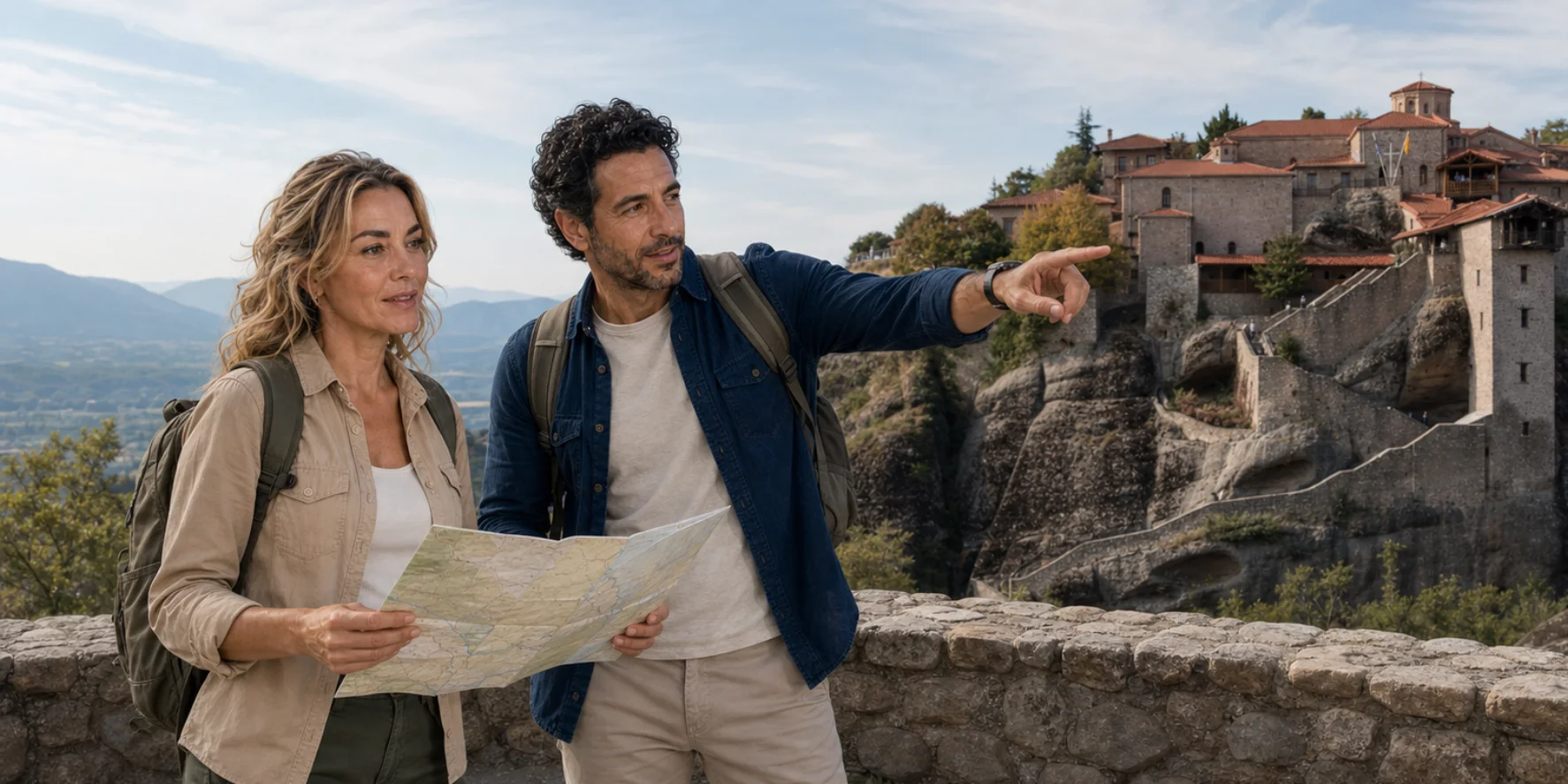
The Athens coach day promises a panorama. Meteora asks for a slower kind of looking: millions of years of rock, centuries of engineered access, six distinct religious communities, and a present-day argument about how retreat can receive the world without becoming a spectacle.
The road from Kalabaka begins by making scale difficult. A wall of grey conglomerate fills the windscreen; then a gap opens and a tiled roof appears where a roof should not be. Around the next bend, another complex occupies a different summit. From the coach, “Meteora” can look like one tremendous arrangement of cliffs and monasteries. It is not. The rock pillars have individual forms. The six active monasteries have different foundations, churches, collections, communities, access routes and opening days. Kastraki and Kalabaka sit within the same cultural landscape rather than below it as mere service towns.
An Athens day trip compresses that complexity. The usual coach format travels to Kalabaka, joins a local road circuit, sees all six monasteries from outside and enters a smaller selection around the day's openings. It may also stop near the old hermit caves. That can be a coherent first encounter. It cannot guarantee a fixed trio of interiors, a complete art history or the solitude suggested by the word “monastery.” Much of the day is transfer; the local hours are decisions.
Historic nets, ladders, pulleys and windlasses made the summits accessible without making access ordinary. Their significance lies in the work they performed: moving people, provisions and building materials across a vertical boundary. Different houses combined these devices in different ways. Later stairs, bridges and roads changed that boundary again, altering both the effort of arrival and the number of people a community could receive.
That change is the real story. Meteora is neither a geological miracle with buildings attached nor a religious theme park whose scenery happens to be excellent. It is a mixed World Heritage landscape, inscribed by UNESCO in 1988 for natural and cultural value. Stone constrained architecture. Architecture reorganised monastic life. Safer access enabled conservation and mass visitation. Tourism supports the surrounding economy while placing pressure on a place still organised around prayer. To visit well is to hold all of those truths together.
01 · Meteora living-landscape field guide
The rock came before the ladder

The familiar shortcut says that an ancient river left a heap of stones and erosion carved it. The outline is useful; the missing time and process matter. During the late Oligocene and early Miocene, roughly tens of millions of years ago, rivers delivered pebbles, sand and mud toward the Mesohellenic Basin. The Meteora Pyli UNESCO Global Geopark interprets the deposits as part of the Pentalofos–Meteora Formation. Sedimentological work describes large channels and steep-fronted delta systems. Loads that had travelled from older mountain rocks accumulated in thick bodies rather than in one catastrophic dump.
Burial, pressure and mineral cement turned those loose deposits into conglomerate: rounded pebbles and cobbles locked inside a finer matrix. Sandier beds occur between them. Later tectonic uplift and faulting raised and fractured the mass. Water entered joints. Freeze and thaw, temperature change, gravity, plant roots and chemical weathering worked along weaknesses. Streams removed softer material. Harder, better-cemented masses survived as towers and walls, some rising about 300 metres.
Look closely at a road cutting or an exposed tower and the surface stops resembling uniform concrete. Pebbles of different sizes and colours sit inside the matrix. Horizontal changes record different pulses of sediment; vertical cracks help define blocks. Rounded cavities called tafoni show weathering operating at smaller scales. Dark streaks track water and biological growth. The rock is resistant enough to stand, porous and fractured enough to change.
That combination explains both the drama and the risk. A summit can support a building while its edges weather. Water must be directed away from roofs, paths and foundations. Rockfall is not a medieval anecdote but a present management concern. Fire in the wooded lower slopes, intense rainfall, heat and visitor traffic belong to the same practical landscape, even though they operate at different timescales.
Geology also set the terms of architecture. A summit is not a blank building plot. Builders used ledges, enclosed irregular rock, stacked rooms where horizontal space ran out and moved supplies vertically. The result is not a single “Meteora style.” Some complexes spread across broad tops; others rise compactly because the summit offered almost no width. At St Nicholas Anapafsas, functions are layered above one another. At St Stephen, a narrow bridge crosses a relatively manageable gap. At Holy Trinity, the isolation remains visible even after steps made entry safer.


02 · Meteora living-landscape field guide
From caves to a community of communities
The first monastic occupation did not begin with large summit compounds. Hermits used caves, fissures and ledges. By the late twelfth century, ascetics were associated with the church of the Virgin at Doupiani, near Kastraki. Their arrangement is usually described as a skete: people lived separately but gathered periodically for worship and common decisions. This balance—solitude without complete disconnection—preceded the great monasteries.
The fourteenth century gave the vertical refuge new institutional weight. Political instability affected Thessaly and the wider Byzantine world; Serbian power expanded into the region; raids and shifting authority made protected sites attractive. Athanasios, a monk associated with Mount Athos, established a coenobitic community on the largest rock around 1340. Coenobitic life meant a rule, common worship, shared work and an abbot, not simply neighbouring hermits. Athanasios called the summit Meteoron, “suspended in the air,” and the name came to describe the wider formation.
Joasaph, born John Uroš into the Serbian ruling family, joined the community and helped expand it. The presence of a former ruler matters because monasteries needed more than spiritual resolve. They required patrons, land, legal protections, skilled builders, painters, manuscripts, vessels and a flow of food that the summit could not produce alone. Aerial isolation depended on relationships across the plain.
Over the following centuries, twenty-four monasteries existed in the wider Meteora complex, according to UNESCO's World Heritage record. Not all flourished at once or on the same scale. Foundations rose, combined, lost members or fell into ruin. The six surviving monasteries are therefore not remnants of one coordinated master plan. They are the active outcomes of different institutional histories.
The sixteenth century brought major rebuilding and painting. Under Ottoman rule, Orthodox monastic houses could function as religious, artistic and textual repositories, although their security, income and population varied. Churches were enlarged or rebuilt; fresco cycles were commissioned; manuscripts and portable icons accumulated. Great Meteoron and Varlaam became especially substantial. St Nicholas received the work of Theophanes the Cretan. Rousanou's compact church was painted within a vertically constrained complex.
Decline also resists a single cause. Changing patronage, conflict, taxation, demographic shifts and the difficulty of maintaining exposed buildings all played roles. Some monasteries were abandoned. Damage during the Second World War and the Greek Civil War added another layer. In the twentieth century, new or renewed women's communities helped restore Rousanou and St Stephen. Conservation, scholarship and tourism altered the resources available to the site.
The present landscape is thus not “frozen Byzantium.” It includes medieval and post-medieval fabric, later repairs, twentieth-century access works, utilities, roads, car parks and communities maintaining daily religious life under heritage regulation. All six major houses remain living communities: Great Meteoron, Varlaam, St Nicholas Anapafsas and Holy Trinity are monasteries of monks; Rousanou and St Stephen are convents. The religious household and the protected monument occupy the same space, with duties that a sightseeing circuit cannot set aside.
03 · Meteora living-landscape field guide
Access was a rule, not a stunt

Long ladders are the easiest historic device to understand. Sections could be drawn up, limiting entry. They also demanded balance, strength and maintenance. Rope nets could carry people or goods. A windlass on the summit wound a rope around a drum; a projecting beam and pulley guided the suspended load. Baskets, sacks, barrels, timber and stone could travel the same vertical route in different containers. Every lift required labour above and trust below.
The surviving apparatus makes skill as important as height. Rope, knots, timber frames and pulleys were working components exposed to load and weather, not symbols alone. A manual hoist needed people to prepare the load, control the drum and receive it at the top. Failures and accidents were possible, but the repeated movement of supplies also depended on practical knowledge. Look at the receiving tower as part of a service system rather than imagining each lift as a solitary test of faith.
Nor was the net “the only way” for centuries. Caves, ladders, steps cut into rock, paths, bridges and hoists coexisted and changed. Different monasteries faced different rock profiles. Some access works are medieval; many of the stairs visitors use today were cut or reorganised much later. Great Meteoron has a demanding stair approach. Varlaam combines a bridge and stairs below the summit. Rousanou's present bridge and staircase create a different rhythm. St Stephen is reached across a short bridge and is the least stair-intensive of the six. Holy Trinity retains a long approach that makes the separation between road and summit tangible.
Safer entry did not simply remove danger. It redistributed effort. A road allows a coach to reach several gates in hours. Stairs move exertion from exposure to climbing. Handrails support many visitors while narrowing circulation. A bridge permits deliveries and conservation work that would be unreasonable by rope. Emergency response becomes possible at another scale. The same changes also bring noise, queues and a daily concentration of strangers to places built around controlled withdrawal.
This is why the historic hoist should not be treated as a theme-park prop. Where a net or windlass survives, read its relation to the tower, storeroom and kitchen. Ask who hauled the line, who prepared the load, how rain and wind affected work, and how much grain a community needed. The remarkable achievement was not one heroic ascent. It was the repetition required to keep a remote household alive.
04 · Meteora living-landscape field guide
Six monasteries, not one view
A panoramic stop can place several roofs in one frame. It cannot tell you which community you are seeing. Use the six as a comparative set: broad summit and narrow summit; monks' monastery and nuns' monastery; celebrated fresco ensemble and quieter architectural evidence; strenuous stair and bridge entry. On a short visit, three well-understood interiors are more useful than six names checked from the coach.
Great Meteoron: institution at summit scale


Great Meteoron, also called the Monastery of the Transfiguration, occupies the largest and highest of the monastic rocks. Athanasios's foundation around 1340 established the coenobitic model that gave Meteora its institutional centre. Joasaph helped enlarge it later in the century. The summit's relative breadth allowed a complex rather than a single compact stack: katholikon, chapels, refectory, kitchen, hospital or infirmary, cells, workshops, cisterns and storerooms.
The present katholikon contains several building phases. A church associated with Athanasios and Joasaph was enlarged in the sixteenth century; the main nave and narthex date to the ambitious programme of the 1540s. Frescoes attributed to the workshop of Tzortzis create a dense theological environment in which walls, vaults and domes carry an ordered cycle rather than decorative illustration. The former refectory, dated to 1557, helps visitors imagine the rule beyond worship: eating together, hearing readings, distributing work.
Collections matter here because a monastery also preserves portable memory. Manuscripts, printed books, vestments, icons, liturgical metalwork and documents connect the summit to workshops, donors and intellectual networks elsewhere. They should not be read as treasure extracted from daily religion. A chalice had a use; a manuscript moved through hands; a founding document structured property and obligation.
Great Meteoron is often the busiest target and one of the more strenuous approaches. The official monastery publishes its own seasonal hours and dress guidance, including a weekly closure and exceptional dates. Those rules are not universal data for all six. If its gate is closed, an exterior view can still show the scale of the complex and the old receiving tower. If it is open, budget enough time that the refectory and service buildings do not disappear behind a rush to the church.
Varlaam: the supply problem made visible


Varlaam stands opposite Great Meteoron but is not its smaller copy. Tradition associates the first occupation with the fourteenth-century hermit Varlaam. The lasting community took shape in the early sixteenth century under the brothers Theophanes and Nektarios Apsarades, members of a prominent family from Ioannina. Their rebuilding turned an abandoned summit into a substantial monastery.
The katholikon is dedicated to All Saints. Its mid-sixteenth-century painting is associated with Frangos Katelanos, an important artist of the so-called northwestern Greek school. The distinction from the Cretan tradition represented by Theophanes at St Nicholas matters: “Meteora fresco” is not one anonymous visual language. Painters and workshops brought different compositional habits to patron programmes shaped by each monastery.
Varlaam’s old hoist tower and net display make material transport especially legible. Another unusually tangible object is its enormous wooden storage barrel, known as the “grandfather”: the Ministry of Culture records a capacity of 12,000 litres. That scale brings the household back into the picture. The engineering question was how to accumulate and store enough water, grain and supplies for a community on a summit. Lime, stone, timber and food had to be raised; a cistern made rainfall into stored water; kitchen and hospital turned supply into institutional care.
The present stair and bridge route reveals layers of access rather than erasing the old system. Look back before entering: the gap, receiving structures and lower path explain more than the isolated silhouette. Inside, treat the museum and church as parts of a living monastery. Photography permissions can differ by room and can change; a crossed-out camera symbol is an instruction, not a negotiation.
Rousanou: architecture under compression


Rousanou sits on a lower but exceptionally narrow rock, so its compactness is the story. The current monastery is associated with the brothers Joasaph and Maximos of Ioannina, who developed it in the sixteenth century. Its buildings occupy the available crown so closely that walls seem to continue the cliff. Projecting wooden galleries and stacked rooms are not picturesque accidents; they are answers to the plan.
The katholikon is dedicated to the Transfiguration and also honours Saint Barbara. Its fresco inscription dates the painting to 1560; the artist is not named there, although the work is attributed to Tzortzis. The cycle fills a small interior with an intensity that rewards slow reading. Rousanou became a convent in 1988, after restoration and periods of abandonment. That renewal matters: its value lies in a modern religious community’s continuity as well as the survival of older fabric. The monastery’s own historical account traces how that continuity was rebuilt.
The current approach uses bridges and stairs and is often described as easier than the highest monasteries. “Easier” remains relative: there are steps, exposure, crowd pinch points and a small interior. A coach group can fill the threshold quickly. Visitors who need space or a steady pace should ask the operator where the vehicle stops, how many stairs remain, and whether there is time to wait for a queue to clear.
Rousanou also offers a lesson in framing. From a road viewpoint it may appear as a perfect object against the valley. From its approach, the building blocks views, the bridge channels bodies and the cliff is close. The second perspective restores the fact that this is a functioning compound, not a model placed on a pedestal.
St Nicholas Anapafsas: a vertical plan and a named painter


St Nicholas Anapafsas rises close to Kastraki on a rock too small for a broad courtyard plan. The name Anapafsas may relate to an early founder or to the idea of rest, but its exact origin is not secure. The architectural evidence is clearer: chapel, church, refectory, cells and service rooms are stacked across levels because there is nowhere else to go.
The katholikon was painted in 1527 by Theophanes Strelitzas, known as Theophanes the Cretan. UNESCO singles out this ensemble as a major work of post-Byzantine painting. Theophanes later worked on Mount Athos, and St Nicholas helps establish the early development of a painter whose workshop would become highly influential. His programme is not “old Bible pictures.” Figures, gestures, inscriptions and architectural frames form a visual theology designed for movement through the church.
Among Theophanes’s scenes here is Adam naming the animals and birds. Adam sits on the left, facing a gathering that includes an elephant, a lion and fantastic creatures. The picture gives the Genesis story a crowded visual form: creation is ordered through an act of naming. Read the variety of bodies and their arrangement around Adam before treating the scene as a nature illustration. Painted creatures belong to an iconographic world, not a survey of Thessaly’s wildlife. Respect any prohibition on photography and use the monastery’s interpretation to locate the scene within the church.
St Nicholas is sometimes omitted from rushed itineraries in favour of bigger silhouettes. That makes it one of the clearest tests of whether a visit values the six as communities or as a greatest-hits skyline. Its climb is real, its interior is small, and its frescoes are one of Meteora's strongest reasons to enter any monastery at all.
Holy Trinity: isolation still readable


Holy Trinity occupies one of the most isolated-looking towers, but its history starts earlier than the church now visible. A decree of 1362 already names it as an organised monastery. The surviving katholikon was built in 1475–1476; its main fresco campaign dates to 1741, while the inner narthex was built in 1689 and painted in 1692. Foundation, building and decoration therefore belong to different centuries. The small summit limits the compound, but the views toward Kalabaka and across the pillars are extensive. The Great Meteoron monastery’s history of the wider community places Holy Trinity within that earlier monastic network.
The approach remains among the most demanding. A path descends from the road area before the climb; stairs cut through or around the rock then rise to the summit. The exact count varies with where a person begins and what is counted, which is why a universal “300 steps at every monastery” is misleading. Someone who reaches the gate may still need time to recover before navigating a small sacred interior.
Holy Trinity also became a film landmark through For Your Eyes Only (1981). The dramatic backdrop can orient a popular-culture visitor, but the buildings offer a longer story. Read the old access point beside the present stair, then the compact katholikon, the later chapel and the view back to Kalabaka. Each answers a practical question: where people arrived, where they worshipped, how the compound grew and which settlement supplied it. The isolation visible on screen was maintained through those everyday connections.
Holy Trinity is a poor place to promise universal accessibility and an excellent place to ask precise questions. How far is the drop-off from the first descent? Are handrails continuous? Is there shade? Will the group pace allow a rest? Can someone who skips the interior remain safely with a view rather than in a vehicle? These answers are tour- and day-specific.
St Stephen: the bridge changes the visit


St Stephen occupies a broad rock above Kalabaka and is approached across a short bridge rather than a long stair. The difference is immediate. Visitors arrive at something closer to a threshold than an ascent. For many people with limited stamina, it is the most feasible of the six; historic surfaces, gradients, door widths, crowds and interior thresholds still require individual checking.
The site preserves an older church of Saint Stephen and a larger eighteenth-century katholikon dedicated to Saint Charalambos. The complex suffered damage in the twentieth century, including wartime destruction, and became a convent in 1961. The women's community undertook restoration and developed museum and devotional spaces. As at Rousanou, revival is not secondary to authenticity. It is the means by which damaged buildings returned to religious use.
St Stephen's broad view over the plain makes the supply network visible. Kalabaka is close; fields, roads and modern development spread below. The monastery was never outside human geography. Land, donors, labour and exchange tied it to settlements even when access across the gap was controlled.
Because St Stephen is physically easier, tour schedules may use it to accommodate a mixed group or a day's opening pattern. Do not assume it will always be one of the three interiors. Do not assume the bridge removes every barrier. What it offers is a different answer to the same central question: how does a religious household establish a boundary without severing its material relationships to the world?
05 · Meteora living-landscape field guide
The art is not décor
The word katholikon means the principal church of a monastery. In the Orthodox tradition, it is organised for liturgy, not for a visitor's linear gallery route. The dome, apse, narthex, nave and side surfaces carry related images. Christ Pantokrator may occupy the dome; the Virgin and Christ child belong to the sanctuary apse; feasts, saints, martyrs and judgement scenes unfold according to location and programme. The architecture teaches by placing the body inside a visual order.
That is why a fresco cannot be reduced to “beautiful Byzantine art.” The painters at Meteora worked after the end of the Byzantine Empire, within post-Byzantine traditions that continued and changed. Theophanes the Cretan brought one highly influential visual language to St Nicholas in 1527. Frangos Katelanos's work at Varlaam belongs to another artistic current. The mid-sixteenth-century decoration at Great Meteoron expresses a larger institution's patronage and space. Similar subjects do not make the programmes interchangeable.
Age does not guarantee untouched fabric. Smoke, humidity, water ingress, earthquakes, earlier repairs and cleaning affect wall paintings. Conservation may stabilise plaster, reveal an earlier layer or leave evidence of loss visible. Brightness is not a simple measure of authenticity; darkness is not proof of neglect. A painted church is also used: candles burn, incense circulates, people venerate icons and services set priorities that a tourism schedule must accommodate.
Begin with the room before the image. How low is the vault? Where does daylight enter? Can the entire programme be seen from one place, or does a pier interrupt it? Then choose one scene and follow its composition. Read the label if one is available. Notice who looks at whom, how architecture is painted, and whether a gesture directs attention beyond the frame. Five attentive minutes can reveal more than filming every wall.
The same discipline applies to icons, manuscripts and reliquaries. An icon is not a portrait in the modern secular sense; it participates in worship. A Gospel book is both text and liturgical object. A reliquary's value to a believer is not exhausted by material, age or craftsmanship. Museums inside monasteries may interpret these objects historically, but the surrounding community has not stopped assigning them religious meaning.
Practical etiquette follows from that status. Silence a phone before entry. Remove a hat when requested. Do not use flash. Obey photography signs even when another visitor ignores them. Avoid photographing worshippers or members of the community without explicit permission. Move aside when a service begins or when local visitors approach an icon. Admission does not purchase unrestricted access to every room or person.
Dress rules belong to the religious life of each house. Great Meteoron and Rousanou publish requirements for covered shoulders and long trousers for men; women are asked to wear a below-knee skirt or long dress, and trousers are not accepted inside Rousanou’s katholikon. Its visitor guidance says skirts are provided at the entrance. Carry an adaptable wrap or skirt rather than depending on a loan garment being available when you arrive. Check each intended monastery’s own notice before setting out, and treat the rule as part of entering a sacred space.
06 · Meteora living-landscape field guide
What the Athens coach day actually reveals
A same-day coach visit from Athens combines a long intercity transfer with a shorter local road circuit around the rocks. The format that shaped the podcast aims to see all six active monasteries from outside, enter a selection around actual openings, stop near the Hermit Caves and return to Athens in the evening. That broad structure helps judge the day. Before booking, confirm the meeting point, vehicle, operating date, duration, inclusions and cancellation terms for the exact departure you intend to take.
The distinction between seeing and entering is essential. The route is designed to show all six active monasteries from the road circuit. It normally enters three that are both open and workable in the day's sequence. The three are not permanently fixed. Weekly closures differ; special religious dates, conservation work, weather or operational changes can alter access. A description that promises Varlaam, Rousanou and Holy Trinity as an immutable trio misleads the reader.
Inside-monastery guiding is another boundary. Commentary on the road or before a gate does not guarantee a licensed guide inside the church. Sacred rooms and museums have their own rules, and a group may enter without its outside guide. Ask the organiser whether interior guiding or an audio guide is included, which languages are supported, and whether you need headphones. That distinction matters particularly if frescoes, manuscripts or Orthodox liturgy are the main reason for your visit.
The Hermit Caves stop brings the route back to smaller forms of withdrawal. Badovas is a small valley between Kastraki and Kalabaka, associated with the monastery of St Nicholas of Badovas, the skete of St Anthony and the cave dwellings of St Gregory. St Nicholas of Badovas is a different house from St Nicholas Anapafsas, one of the six principal monasteries. The local account of Badovas identifies these neighbours; read them as evidence of solitary cells, a skete and a small monastery sharing one landscape. Doupiani belongs to the earlier story of communal organisation nearby, but it is not another name for this valley. A short stop can locate the cavities and surviving structures; it does not guarantee entry into a cave, access to the small monastery or permission to climb. Establish where the group stops and how the site will be explained before choosing the excursion.
A meal pause in or near Kalabaka is a practical part of most same-day formats. Budget for food and monastery admission separately unless the chosen booking explicitly includes them. Check how much time is allowed for lunch, whether there is a choice of venue and what can be arranged for dietary needs. Carry water and suitable snacks for the transfer, so that a short stop does not have to supply every need of a long day.
The physical day is easy to underestimate. A passenger can spend many hours seated, then encounter sun, heat and repeated stairs in a short local window. A person comfortable walking several city kilometres may still find exposed stone steps, handrails, narrow thresholds and quick reboarding difficult. Motion sensitivity, bathroom timing and a late arrival in Athens can matter as much as climbing ability. Confirm the final drop-off before departure and keep a realistic onward plan for the last journey of the night.
This does not make the coach day a poor format. It makes its purpose specific. It is efficient for someone with one available day, no desire to drive, and a priority of understanding the whole formation before sampling interiors. A good guide can connect geology, six institutions and the road sequence while handling parking and opening changes. The format is weak for someone who wants dawn or sunset light, long fresco study, substantial walking, village time or control over rest.
A realistic local sequence
- Orient from the road. Identify Kalabaka, Kastraki, Doupiani and at least four monastic rocks before entering anything.
- Use the first interior for architecture. Read the approach, receiving point, church and service buildings as a working plan.
- Use the second for art. Choose one fresco programme or museum collection and give it sustained attention.
- Use the third for comparison. Ask what differs: community, summit area, bridge or stairs, church date, crowd flow.
- Make the cave stop chronological. Place hermit and skete life before the large coenobitic houses.
- Keep one viewpoint unhurried. Name the towers rather than treating the last panorama as an anonymous photo stop.
If the itinerary reverses that order, the method still works. The goal is to assign each stop a question so that three interiors do not collapse into one memory of dark churches and red roofs.
07 · Meteora living-landscape field guide
Tourism in a landscape built for retreat

The moral question “is tourism destroying Meteora?” is too blunt. Tourism provides work, sustains guides, transport and accommodation, and helps make conservation politically and financially visible. It also concentrates vehicles and bodies along a narrow road circuit and in small interiors. The UNESCO periodic reporting recognises visitor-management mechanisms while also identifying areas that need improvement, including monitoring, resources, education and coordination. It reports that the typical stay is short—often about a day—which helps explain why pressure clusters at famous gates and viewpoints.
The impact is not only a headcount. A bus idling beside a rock wall creates noise and emissions. Informal parking can obstruct the road and emergency access. Feet widen paths and loosen soil. Tripods and posed photographs turn a narrow edge into a queue. Litter travels downslope. A drone can disturb people, wildlife and worship even when its operator is far away. Repeated photography inside a church changes the social atmosphere without leaving a physical mark.
Conservation choices are likewise more complicated than “restore everything.” Mortar must be compatible with historic masonry. Roof drainage has to protect frescoes and cliff edges. New handrails and services must support safety without pretending to be medieval. Rock stability requires geological observation. Fire preparedness must account for wooded slopes and limited summit access. A living monastery may need heating, electricity, communications and safe deliveries; heritage policy has to negotiate those needs rather than imagining an unserviced past.
Visitors can reduce pressure through timing and selection. Staying in Kalabaka or Kastraki makes early starts and a second day possible. Choosing two or three interiors rather than chasing all six lowers the incentive to rush. Walking with a licensed local guide can reveal abandoned foundations, footpaths and village relationships that a road-only circuit hides, provided the route is legal and conditions are suitable. Buying a meal or service locally spreads value beyond a gate ticket.
Behaviour at viewpoints matters. Use established surfaces. Keep clear of the road. Do not climb beyond barriers for a photograph or reproduce a risky pose seen in commercial imagery. Yield space after taking a picture. Sunset is not a waiver of visibility, traffic or edge risk. The most responsible visual may be the one made from the stable, ordinary position.
Religious rhythm deserves equal weight. Opening schedules are not merely a consumer inconvenience. A monastery closes for worship, community work, rest, a feast or a funeral. Even during visitor hours, a church can become unavailable. A respectful itinerary treats that limit as part of the place's continuing purpose, not as service failure.
08 · Meteora living-landscape field guide
Choose the format before choosing the stops

Athens coach day
Choose this when Meteora is the priority but Athens is the fixed base and only one day is available. The main gain is operational coherence: one meeting point, long-distance transport, local guide and a route adapted to current openings. The main cost is the ratio of road time to local time. Bring water, adaptable clothing, a small snack, sun protection and any medication needed for a day that may run late. Keep luggage to the operator's stated allowance and verify the return point rather than assuming hotel delivery.
Ask before paying:
- Is the journey definitely by coach on this date, and what identifies the vehicle at the meeting point?
- How much time is planned in the Meteora road circuit, excluding the Athens transfer and meal?
- Which three monasteries are likely, and when will the final selection be known?
- Are monastery contributions, lunch, audio equipment and hotel transfers included?
- How many steps and how much walking are expected at the likely interiors?
- What happens if a monastery closes, severe weather affects the road, or the coach returns late?
One or two nights in Kalabaka or Kastraki
Choose an overnight when the landscape matters as much as the checklist. A first afternoon can establish the formation and one or two interiors; a second morning can concentrate on art, a trail or a monastery missed because of its closure day. Kastraki places a visitor close to Doupiani and the lower rocks. Kalabaka offers a larger town base and transport connections. Neither base removes the need to check road and trail conditions.
An overnight also changes light and sound. The road circuit is less compressed outside the central coach window. That does not guarantee solitude at sunrise or sunset, when viewpoints can draw their own crowds. It does give the visitor options: leave a congested stop, return on another opening day, or spend longer in a museum without endangering the return to Athens.
Independent rail, car or local tour
Rail can support an independent stay. Use the Hellenic Train journey planner to check the services and connections offered for your travel date, including any bus leg shown as part of the journey. Confirm the last workable return connection and how you will travel from Kalabaka to your accommodation or the monastery circuit. An overnight gives that onward journey more room; a same-day plan needs enough margin for both the intercity trip and local transport.
A car gives control over timing and mobility equipment but adds narrow-road, parking and driver-attention problems. The monastery circuit has scenic pull-offs and abrupt pedestrian movement. The driver should drive, not identify fresco schools through the window. Park only in established places, never block a coach turn or emergency route, and expect popular gates to fill.
A local small-group or private tour can separate the Athens transfer from the interpretation. It is often the strongest choice for a mixed group: the guide can select fewer interiors around stairs, interests and opening hours. Verify whether the guide enters monasteries, which languages are available, and whether “hiking” means a maintained public path or a demanding route with exposure.
09 · Meteora living-landscape field guide
Build the day around real access
Accessibility cannot be summarised as “not wheelchair accessible.” St Stephen's bridge approach is much less stair-intensive than Holy Trinity or Great Meteoron. A road viewpoint may offer a significant landscape experience without an interior. Kalabaka's museums and churches can add context for someone who cannot climb. Yet bridge width, gradients, uneven stone, vehicle drop-off, queues and toilet access remain specific.
Make the determining feature explicit when contacting an operator: maximum continuous steps, need for a handrail, folding-wheelchair storage, accessible toilet, shaded waiting place, hearing support or time needed at a threshold. Ask where a traveller can wait safely if the rest of the group enters. A vague assurance that a tour is “easy” is not a specification.
For travellers who can climb but need pacing, avoid stacking the two hardest approaches without recovery. Use St Stephen or a viewpoint between strenuous entries. Carry less. Stone can be slippery after rain and radiate heat in sun. Wear shoes with secure tread. A walking pole may be useful on approaches but could require storage or care inside a church; ask before relying on it.
Families should prepare children for quiet interiors and edges rather than using fear. Hold hands where appropriate, keep small bodies away from road traffic and do not let a photo request pull the group across a path. A child who has had enough can learn more from naming one tower at a safe viewpoint than from being rushed into a third dark church.
Current facts to recheck
- The official opening and closure notice for each intended monastery, including feast days and extraordinary closures.
- Any booked excursion's meeting point, vehicle, duration, route, language, inclusions and cancellation terms.
- Monastery-specific dress and photography rules; carry adaptable clothing even if wraps are sometimes available.
- Temperature, thunderstorms, wind, wildfire or rockfall advisories, and daylight for any independent walk.
- Hellenic Train or bus operation, especially the final connection of the day.
- Road, parking and trail status from a current local or official source.
Avoid precise opening-hour grids in a saved itinerary. A useful plan is conditional: “If Great Meteoron is open and the group can manage the approach, make it the architecture stop; otherwise use Varlaam and retain St Nicholas for art.” That structure survives change better than a copied timetable.
10 · Meteora living-landscape field guide
A field method for seeing more than the panorama
At each monastery, ask five questions:
- What did the rock permit? Broad courtyard, vertical stack, narrow bridge or long stair?
- How did supplies arrive? Look for a receiving tower, hoist, cistern, kitchen or service route.
- Which century dominates what I see? Foundation, rebuilding, fresco programme, repair and modern access may be far apart.
- What remains religiously active? Church, relic, icon, service, community boundary or visitor rule?
- What did easier access change? Safety, conservation, pilgrimage, tourism volume, emergency response or privacy?
This method prevents scale from becoming rank. Great Meteoron is not automatically the most meaningful interior because it is largest. St Nicholas can carry the strongest painting question. Rousanou can best explain architectural compression. St Stephen can clarify restoration and access. Holy Trinity can make isolation readable. Varlaam can expose logistics.
At the viewpoints, reverse the questions. Identify the town and road before the monastery. Trace vegetation, drainage lines and fractures. Look for a summit without an active community and remember that six surviving houses emerged from a much larger monastic field. Notice where the road makes a photograph possible. The landscape includes the position from which it is consumed.
At Doupiani, return to the beginning. The summit monasteries can make history look like a contest to occupy the highest rock. The caves and skete show a different logic: cells near a common worship point, separation tempered by assembly. Monumentalisation came later.
11 · Meteora living-landscape field guide
What remains when the coach leaves
Meteora's familiar image places a monastery above the world. Its history shows the opposite. The summits were connected to rivers that deposited their rock, faults and weather that shaped it, villages that supplied it, patrons who funded it, painters who travelled to it, farmers and workers who sustained it, and modern roads that carry visitors to its gates. Withdrawal was constructed through those relationships, not outside them.
The six monasteries make that construction visible in six ways. Great Meteoron turned a large summit into an institution. Varlaam organised supply and patronage at a comparable scale. Rousanou built upward when it could not build out. St Nicholas placed an influential fresco programme inside a small vertical house. Holy Trinity preserved the drama of separation through a demanding route. St Stephen used a bridge and later revival to make continuity possible.
The day visitor does not fail by seeing only three interiors. The failure is to mistake three interiors for three versions of the same attraction, or six distant roofs for complete coverage. A focused visit can be honest about its limits: name all six, enter those the day permits, and give each chosen threshold a purpose.
The road back to Athens will still be long. That length can flatten the visit into a sequence of photographs, or it can provide time to reconstruct what the panorama concealed: pebbles becoming rock, solitary cells becoming communities, hoists becoming stairs, prayer meeting conservation, and a living landscape deciding every day how open it can be.
12 · Meteora living-landscape field guide
Listen: Meteora field notes
Hear the human route in episode 2963757 of The Travel Podcast by ExcursionPass. It raises the fear of the old ascent, the six-monastery panorama, the Hermit Caves, the long coach day and the pressure of tourism. The recording is best heard alongside the geological, religious, architectural and practical context in this guide.
Continue through the Greece desk and the Meteora destination guide. For another landscape shaped by faith and difficult access, compare the tidal approach to Mont-Saint-Michel; for a different relationship between sacred space, art and visitor circulation, read the Vatican Museums, Sistine Chapel and St Peter's.