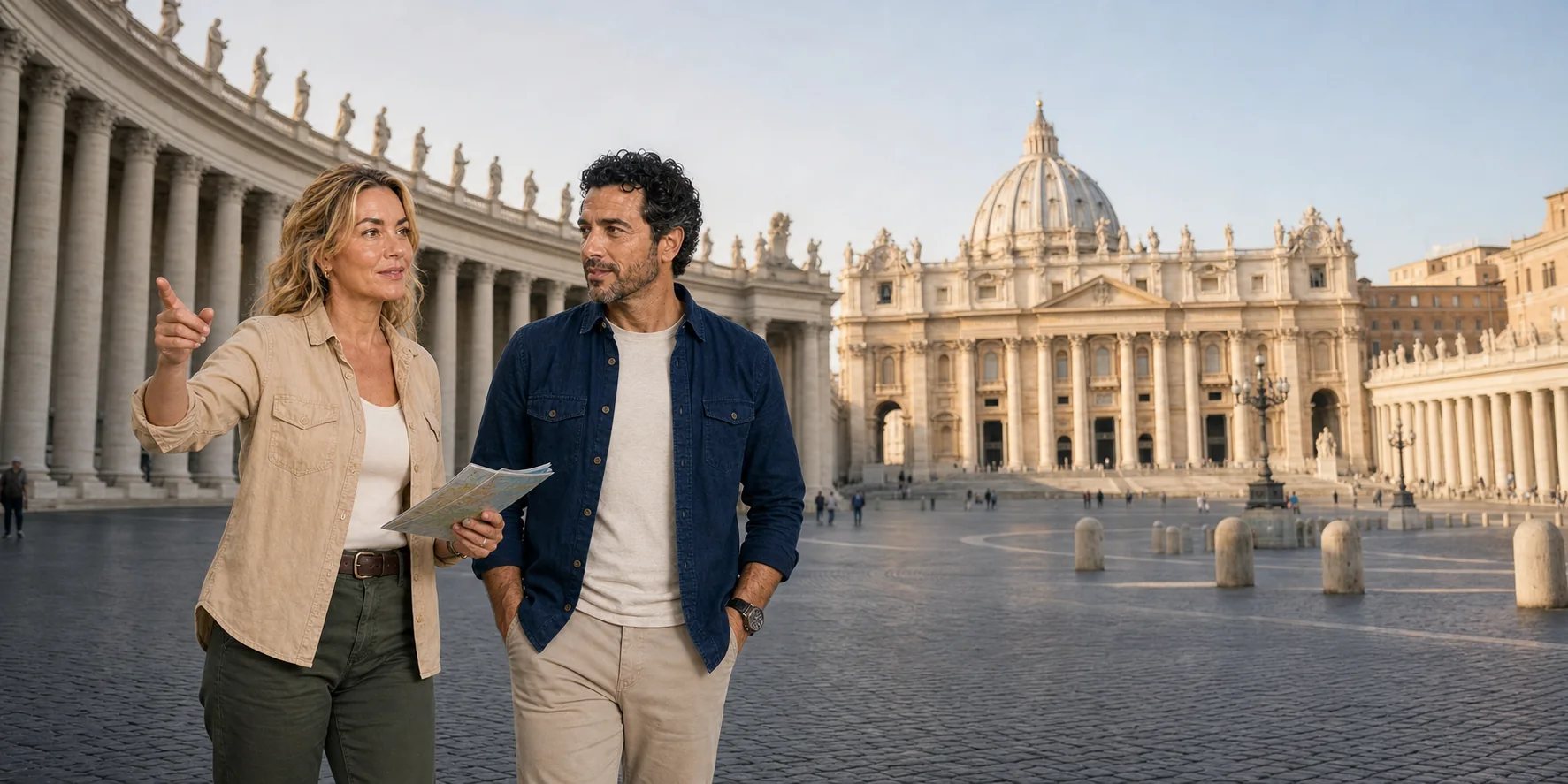

A visit through the Vatican Museums, the Sistine Chapel and St Peter’s Basilica is often sold as one continuous encounter with “the Vatican.” It is more revealing—and more useful—to see three different kinds of space: collections formed by papal power, a chapel that still suspends tourism for worship and conclaves, and a basilica whose architecture must serve pilgrims as well as art history. The boundaries between them explain the route, the rules and what can change on the day.
01 · Vatican route
The route is not one attraction
The most useful way to prepare for this visit is to stop treating “the Vatican” as a single building. A typical guided sequence begins at the Vatican Museums entrance on Viale Vaticano, passes through a selection of courts, sculpture rooms and decorated papal apartments, reaches the Sistine Chapel, and may continue toward St Peter’s Basilica. The physical movement feels continuous. The authority governing each part is not.
The Vatican Museums are an institution of Vatican City State. Their collections grew from papal collecting, archaeology, diplomacy, mission networks and the conversion of palaces into public display. The Sistine Chapel lies on the museum visitor route, yet it is also a papal chapel used for liturgy and the election of a pope. St Peter’s Basilica is a working church and pilgrimage destination with its principal public access through St Peter’s Square. It is not simply the museum’s final gallery.
Those distinctions are practical. A timed museum ticket does not remove airport-style security or control the density inside famous rooms. Permission to photograph in most museum spaces ends at the Sistine Chapel. A guide who can speak through a headset in the galleries must complete the detailed Sistine explanation before the group enters. A museum route that sometimes connects groups toward the basilica does not create a permanent public entitlement to that passage. Liturgies, papal events, conclaves, security decisions and crowd controls can change the sequence.
They are also the article’s central historical idea. The route compresses more than five centuries of decisions about what the papacy collected, how it represented knowledge, how it commissioned art, and where the Catholic Church still performs its public and sacramental life. Understanding those decisions makes the famous works more than a rapid list of masterpieces.

02 · Vatican route
Vatican City State and the Holy See are not synonyms
The terminology matters because it prevents a common historical shortcut. The Holy See is the central governing authority of the Catholic Church, represented by the pope and the institutions that assist him. Its legal and diplomatic continuity reaches back long before the twentieth century. Vatican City State is the small sovereign territory created by the Lateran Treaty of 1929 after the long dispute between the papacy and the Kingdom of Italy. The state provides a territorial basis for the Holy See’s independence; it is not the whole Catholic Church and it is not another name for the Holy See.
The Vatican City State’s own institutional account makes that separation explicit. The Museums and Cultural Heritage directorate belongs to the state’s administrative structure, while the basilica’s meaning extends through the worship and governance of the universal Church. UNESCO’s inscription of Vatican City as a World Heritage property recognises an ensemble in which archaeology, Renaissance and Baroque art, urban design and living religious use overlap.
This is why a border can be visually quiet but institutionally consequential. Visitors usually enter the museums from a street in Rome, pass through controls into Vatican territory, and later emerge near a square whose great colonnades seem to reach back into the city. Bernini’s architecture makes welcome visible; sovereignty, security and operating rules determine how that welcome works.
03 · Vatican route
Begin with a route map, not a masterpiece checklist
The museums are neither a single chronological collection nor a neutral warehouse. They occupy a palace complex built and altered across centuries. Routes rise, turn, narrow and sometimes offer several galleries before reconverging. A guide must make choices. A focused itinerary ends after the Museums and Sistine Chapel; a broader one continues the narrative into St Peter’s Basilica. Neither can include every gallery. The endpoint, permitted route and amount of interpretation matter more than a long list of room names.
The practical sequence has three pressures. First, the museums contain far more than a highlights visit can interpret. Second, celebrated rooms sit within a directional visitor flow, so returning to something missed may be difficult. Third, the final connection to St Peter’s depends on the operating day and the tour format. Good preparation therefore separates essential interpretation from optional completeness.
Attention is a route-planning constraint. Repeated decisions, dense rooms, standing and noise can make late stops less intelligible. Choose a few works before arrival, use the official relaxation areas when needed and let access requirements, interest and energy determine the duration. A shorter focused route can be excellent; a patient visitor following a particular collection may want much longer. There is no single duration that fits everyone.
For a first visit, the strongest intellectual thread is collection, representation and use. In the Belvedere and Pio-Clementino spaces, ancient sculpture shows how Renaissance and eighteenth-century popes used antiquity to establish cultural authority. The Gallery of Maps turns the Italian peninsula into a papal corridor. Raphael’s rooms present philosophy, theology, poetry and law as a coherent programme for papal apartments. The Sistine Chapel changes the terms from courtly representation to worship and judgement. St Peter’s then makes architecture itself carry apostolic tradition, liturgy and procession.

04 · Vatican route
A collection began as an argument about antiquity
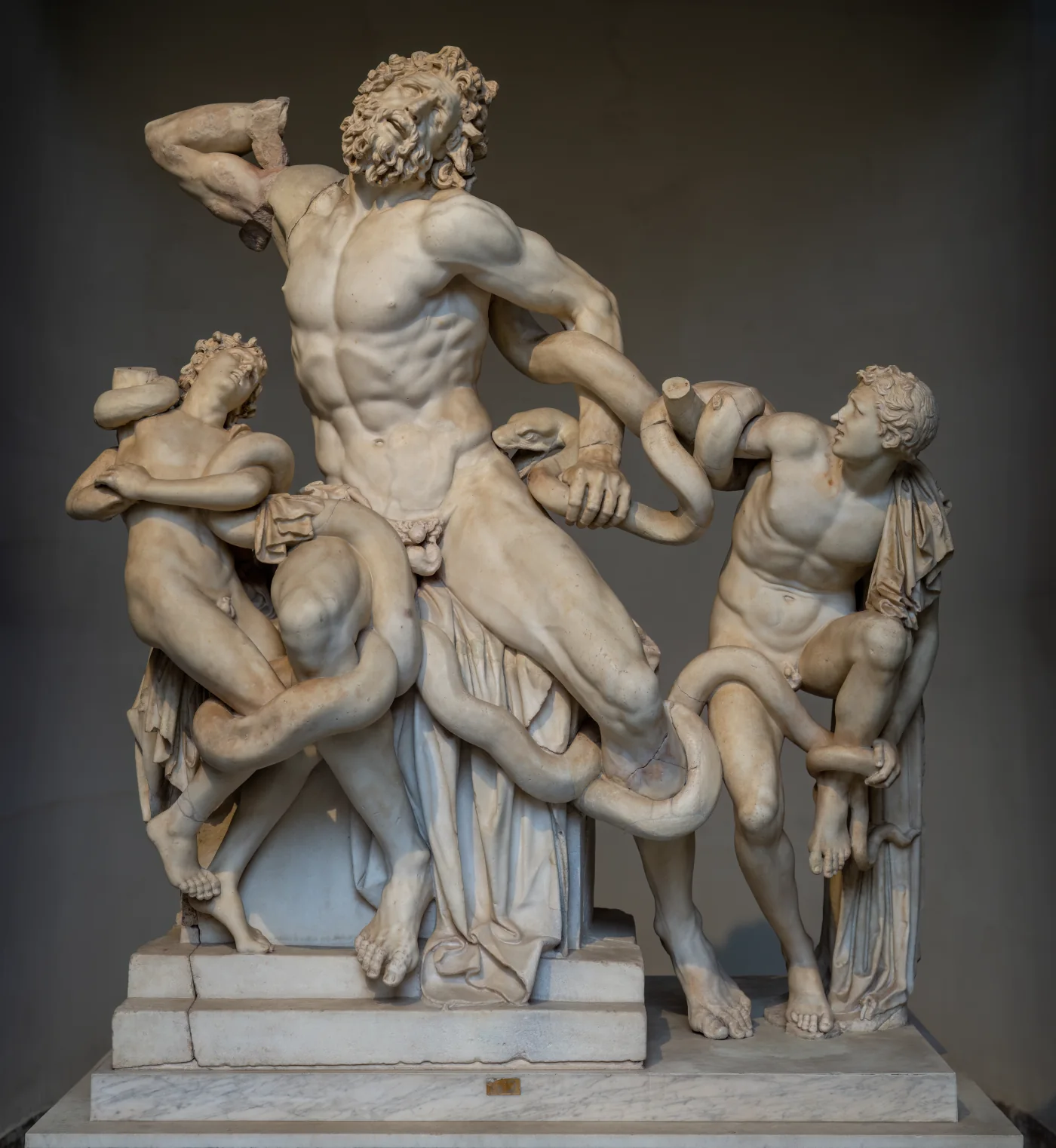
The Vatican Museums often date their institutional story to 1506, when the ancient sculptural group now called the Laocoön was found in Rome and acquired by Pope Julius II. That origin is tidy, but its importance is deeper than a birthday. Renaissance Rome was recovering, buying, restoring and reinterpreting antiquity. To possess major ancient works was to claim judgement about the classical past and to place the papal court among Europe’s centres of learning and power.
The Laocoön group represents a Trojan priest and his sons attacked by serpents. Ancient literary accounts do not resolve every question about the sculpture’s authorship, date or original setting, and the work visible today includes a long history of excavation, loss and restoration. Its broken and reattached bodies are not defects to ignore. They are evidence of the changing assumptions with which later viewers tried to complete antiquity.
The sculpture was displayed in the Belvedere, alongside works such as the Apollo Belvedere. The court became a school of looking. Artists studied torsion, strain, anatomy and emotional expression; antiquarians debated what ancient fragments meant; papal display connected classical form to the prestige of modern Rome. The Museums’ history records how that nucleus expanded into successive museum foundations rather than appearing all at once.
The Museums’ object record traces the group’s discovery in 1506, identification with a sculpture described by Pliny, and immediate acquisition by Julius II. The work entered a Roman culture already studying ancient bodies. Its struggling figures offered artists an unusually forceful model of muscles under stress, movement arrested in stone and suffering communicated through the whole body. That influence belongs to a network of looking and adaptation rather than to one sudden explanation for the Sistine ceiling.
The missing right arm makes that history tangible. Early restorations gave Laocoön an extended arm; the ancient fragment eventually recovered was bent. In the early twentieth century, the Jewish archaeologist and art dealer Ludwig Pollak recognised it among fragments at a stonecutter’s premises near the site of the original discovery. Its later reinstatement changed the silhouette from an outward gesture into a tighter struggle around the head. Looking at the sculpture therefore also means looking at a corrected interpretation.
Pollak’s story extends beyond the object. The Vatican Museums’ account of his discovery recalls his friendship with director Bartolomeo Nogara, who offered him refuge in the Vatican during Nazi persecution. Pollak declined; he was deported and murdered at Auschwitz in 1943. His name deserves to remain attached to the discovery, rather than disappearing into the anonymous phrase “a missing arm was found.”

05 · Vatican route
Pio-Clementino turned a courtly collection into a museum system
The eighteenth-century Pio-Clementino Museum, named for Popes Clement XIV and Pius VI, reorganised and enlarged the antiquities in purpose-built sequences of courts, cabinets and monumental rooms. Its importance is not only the number of statues. Architecture taught visitors how to rank, compare and admire them. Octagonal rooms, domes, controlled vistas and named cabinets translated possession into a public order of knowledge.
The Octagonal Court, descended from the Belvedere display, still carries that history. The larger Pio-Clementino sequence includes sculpture, mosaics, funerary objects and Roman interiors. A guide who stops at one heroic statue should explain the museum-making around it: why this object was acquired, how it was completed or cleaned, and what the surrounding architecture asks the viewer to believe about antiquity.
This is also where the story of a “public museum” needs precision. Access expanded unevenly. Scholars, artists, diplomats and elite visitors did not have identical rights, and the papal collections were entangled with the politics of excavation, export and European competition. Napoleonic seizure carried Vatican works to France; diplomatic settlement after 1815 returned many of them. The galleries therefore embody both cultural stewardship and the power to move objects.
Later foundations widened the story: Egyptian and Etruscan museums in the nineteenth century, a Pinacoteca for paintings, ethnological collections assembled through global Catholic networks, and modern departments for scientific conservation. “The Museums” is plural for a reason. A rapid route through the most famous corridor is one reading of a much larger institution.
06 · Vatican route
The Pinecone Court is a lesson in reuse, not a photo stop
The great bronze pinecone gives its name to the Cortile della Pigna. It is an ancient Roman object whose original function and setting have been interpreted through fragmentary evidence; it was associated with the old St Peter’s complex before being moved into the Belvedere setting in the early seventeenth century. Its scale allows the court to connect Roman bronze, medieval reuse and papal garden design without pretending those phases were planned together.
In the same broad court, Arnaldo Pomodoro’s Sfera con sfera belongs to a radically different moment. The Vatican catalogue identifies the four-metre bronze, dated 1990, as a gift from the artist. Its polished outer shell opens onto a mechanical, wounded interior. It should not be used as a vague symbol for “the world within the world” unless the interpretation is attributed; what the object securely demonstrates is that Vatican collecting did not stop with Raphael and Michelangelo.
The pairing is productive because it breaks a false timeline. The Vatican is not an intact Renaissance time capsule. Ancient material, papal architecture, nineteenth-century museum systems and modern art coexist, sometimes without a single harmonising explanation. The court is best used to ask what it means for an institution built around inheritance to commission, acquire and conserve contemporary work.
07 · Vatican route
Forty maps make geography look governable
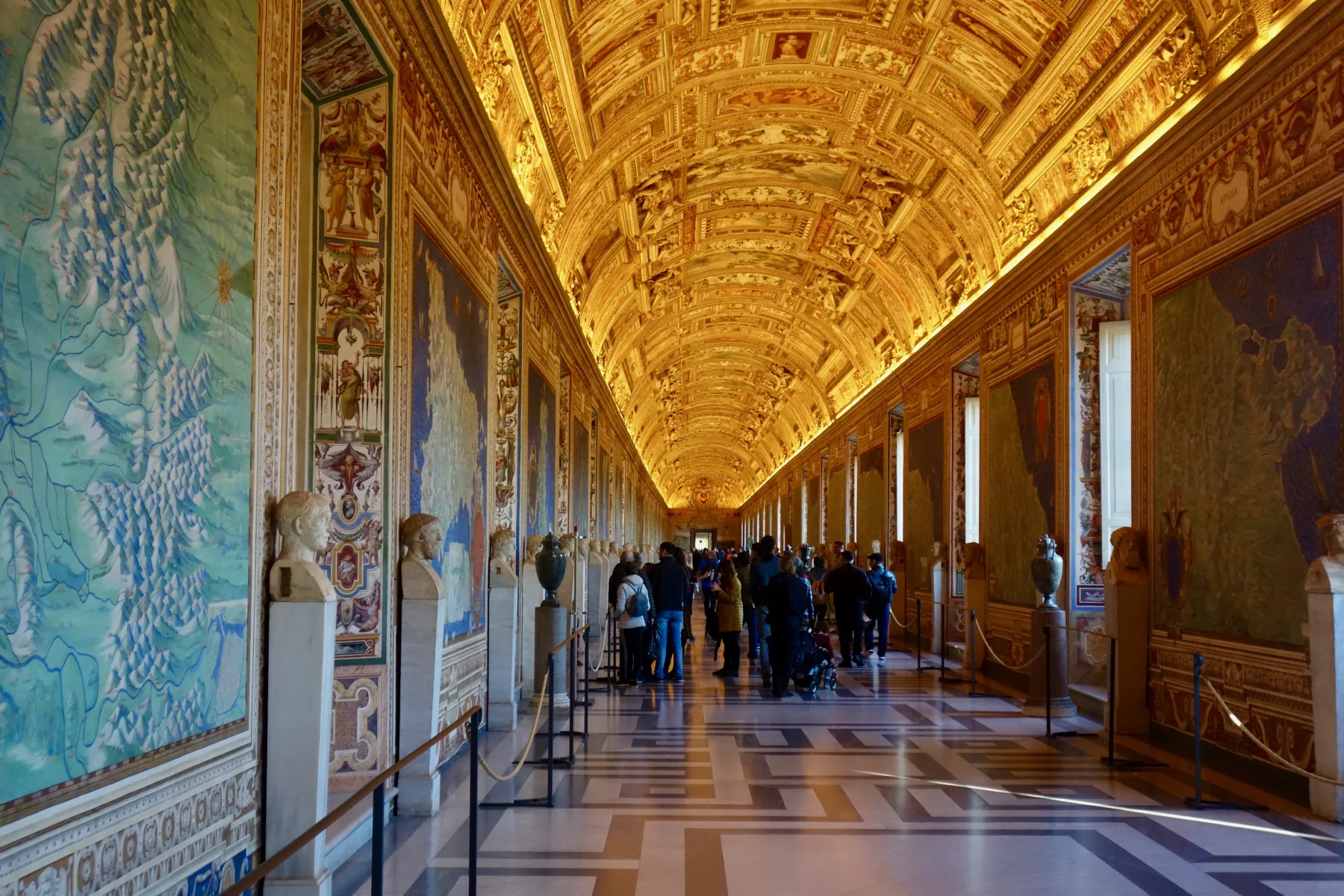
The Gallery of Maps turns a corridor roughly 120 metres long into a walk through the Italian peninsula. Pope Gregory XIII commissioned the programme, with the Dominican mathematician and cosmographer Ignazio Danti directing its geography. Thirty-two of the forty maps describe territories; eight narrower panels show islands, ports and scenes including Malta and the Battle of Lepanto. The wall maps are only part of the argument: the ceiling connects places to episodes of Christian memory.
The Apennines provide an organising spine. Regions on the two sides of the mountains are arranged on opposing walls, allowing the walker to imagine travelling through Italy while remaining inside the papal palace. This was also a collaboration: architecture, cartographic knowledge and teams of painters had to turn varied information into a continuous spatial programme. It makes the gallery more revealing than a collection of handsome coastlines.
The maps are historical documents. Coastlines, scales, place names and political frames differ from those of the present, and the images combine surveying with selective emphasis. Mapping made pilgrimage, communication and ecclesiastical jurisdiction imaginable at a glance. Look for a region you know, then notice how the painter represents mountains, a harbour or a city: the useful comparison is between ways of explaining territory. Conservation has made colour, inscriptions and details legible again, while the corridor still carries a strong directional flow of visitors.
.jpg)
08 · Vatican route
Raphael’s rooms construct an intellectual court
The rooms now known as the Stanze di Raffaello were papal apartments decorated by Raphael and his workshop for Julius II and Leo X. Their subjects cannot be reduced to decorative Renaissance confidence. Theology, philosophy, poetry, law, Church history and papal authority are arranged as mutually supporting fields. The walls stage an ideal court in which ancient thinkers, Christian revelation and contemporary patronage can inhabit one programme.
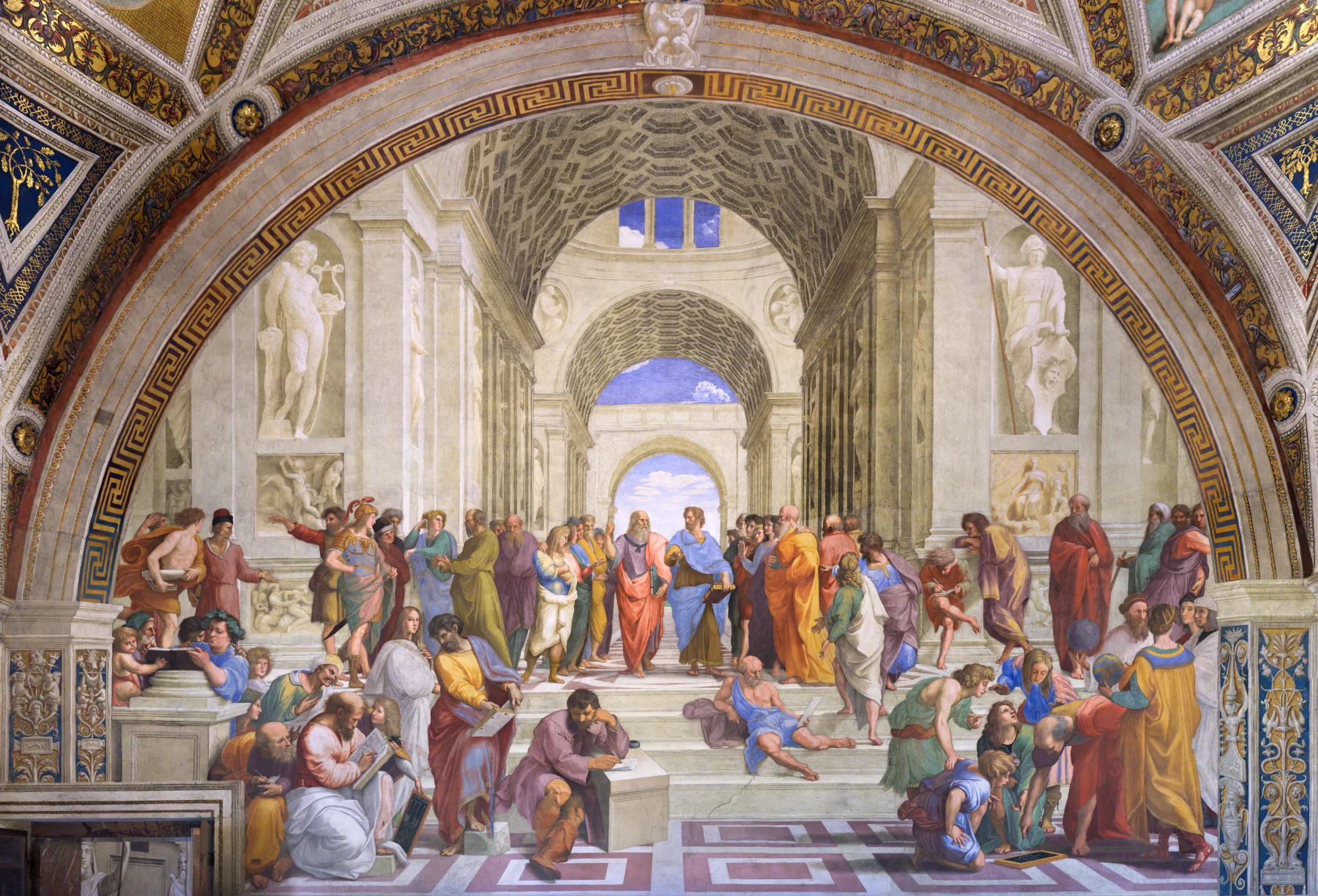
The School of Athens is the best-known image. Plato and Aristotle occupy the perspectival centre, one pointing upward and the other extending a hand across the visible world. Groups around them model different ways of knowing: calculation, geometry, observation, argument and withdrawal. The architecture is painted but monumentally plausible, drawing the mind toward a rebuilt classical grandeur.
Raphael gives the thinkers distinct ways of occupying space. The isolated, brooding Heraclitus in the foreground bears Michelangelo’s features, as the Vatican’s interpretation identifies. Other figures have been associated with artists and patrons around Raphael. A recognisable face can bring the ancient intellectual community into the painter’s present, but it does not establish a private joke or insult. Look first at what the figure does within the composition: withdrawal and concentration balance the animated teaching around him.
Four rooms, four ways to stage authority
In the Stanza della Segnatura, the School of Athens faces a Christian assembly in the Disputation of the Holy Sacrament. Poetry occupies the Parnassus, while law and virtues complete the room’s intellectual programme. The point is the relationship among the walls. Philosophy is given room to reason, revelation gathers its own community, and the whole chamber locates different forms of knowledge within papal patronage. Seeing one famous fresco alone misses that exchange.
The Room of Heliodorus shifts from knowledge to protection. Created for private audiences, it joins the expulsion of a would-be temple plunderer, the miraculous Mass at Bolsena, Peter’s liberation from prison and Leo the Great’s meeting with Attila. Together the stories defend Church property, faith, the pope and Rome. They spoke to Julius II’s political anxieties as well as to theology. The dramatic interruption of an intruder and the light around the imprisoned Peter ask the viewer to recognise intervention in moments when ordinary power seems inadequate.
The Room of the Fire in the Borgo became Leo X’s dining room. Its walls, completed in 1514–17 largely by Raphael’s workshop, retell episodes from earlier popes named Leo: the coronation of Charlemagne, Leo III’s justification, the fire in the Borgo and the Battle of Ostia. The reigning pope’s likeness binds these predecessors to the present patron. The fire scene’s fleeing bodies and rescue gestures make political continuity physically urgent. A papal meal took place beneath a carefully selected history of papal action.
In the Hall of Constantine, a space for receptions and ceremonies, Raphael’s workshop carried drawings into a monumental programme after his death in 1520. The Vision of the Cross, battle at the Milvian Bridge, baptism and Donation of Rome construct a Christian imperial origin story. They show how the sixteenth-century court wished to present its inheritance; a painted historical claim is not automatically a record of what happened in the fourth century. Distinguishing Raphael’s conception from workshop execution also respects the collaboration that made these rooms possible.
For a short visit, choose a question that can travel between rooms: who is authorised to teach, who protects the Church, or how does a patron place himself in history? The answer changes from wall to wall. That is a more useful way to hold the suite together than trying to recognise every philosopher and emperor while following the crowd.

09 · Vatican route
The contemporary collection prevents the Renaissance from becoming a ceiling
The Vatican’s Collection of Contemporary Art was inaugurated under Paul VI in 1973 after a sustained effort to renew dialogue between the Church and modern artists. Works by hundreds of artists now occupy spaces that can be easy to rush through on the way to the Sistine Chapel. That haste creates a distorted impression: as though the institution’s serious engagement with art ended in the sixteenth century.
Modern and contemporary collecting raises different questions from acquiring antiquity. Artists may give works; patrons and institutions choose what represents the present; religious subjects coexist with abstraction, trauma and social history. The collection includes internationally famous names but should not be treated as a celebrity appendix. It records a changing institutional answer to the problem of how visual art can address spiritual, political and human experience after modernity broke many inherited conventions.
The practical lesson is not that every visitor must complete every room. It is that the route’s apparent climax can make everything before it look like prelude. A guide can resist that hierarchy by giving one contemporary work the same disciplined attention normally reserved for an ancient torso or a Renaissance fresco.
10 · Vatican route
Collecting also creates obligations
The Museums’ holdings were formed under unequal conditions as well as scholarly and devotional ones. Archaeological removal, diplomatic gift, purchase, missionary collecting and colonial power do not describe one ethical category. They do demand provenance research and candour. The Anima Mundi ethnological collections are especially important because many objects came from Indigenous communities through the global network around the 1925 Vatican Missionary Exhibition.
Recent returns show that stewardship can include relinquishing possession. In 2023 Pope Francis transferred three Parthenon fragments held in the Vatican collections to the Greek Orthodox archbishop of Athens as an ecumenical gift. In 2025 the Vatican announced the return of 62 cultural items to Indigenous communities in Canada. These acts do not settle every provenance question, and calling every transfer a “gift” can obscure the debate over who had moral title in the first place. They do establish that museum history is current policy rather than a closed chapter.
The Museums now publish collection catalogues, maintain specialist restoration laboratories and support research on ethnological material. Those systems matter only when their findings can change interpretation, access or custody. The responsible question beside an object is not simply “How old is it?” but “How did it arrive, who has spoken about it, and what relationship should continue?”
11 · Vatican route
Conservation is part of what the visitor sees
Frescoes, stone, metal, paper, textiles and archaeological material do not age in the same way. The Vatican Museums maintain laboratories specialising in different media. Conservation combines chemical and structural investigation, archival research, photography, environmental monitoring, preventive care and, when justified, physical intervention. A brighter surface is not automatically a more truthful one.
The tension becomes acute in spaces receiving millions of people. Heat, humidity, dust and carbon dioxide change with crowd density. Cleaning can reveal colour while also provoking debate about glazes, retouching and the desired appearance of age. Barriers and one-way routes protect works but also shape the experience. The conservation system is therefore not behind-the-scenes housekeeping. It is one of the forces that determines what remains visible and how closely it can be approached.
That principle helps with the Sistine Chapel. The room’s colour and legibility result from major late-twentieth-century restoration and continuing maintenance. Cleaning is one stage in a longer cycle of documenting deposits, examining surfaces and adjusting care. Conservation is a recurring obligation in an operational building, rather than a final return to an untouched original.
12 · Vatican route
The Sistine Chapel existed before Michelangelo looked up
The chapel takes its name from Pope Sixtus IV, who rebuilt the earlier Palatine chapel between 1477 and 1480. Its proportions, screen, pavement and walls served a papal ceremonial programme. In 1481–82, a team including Botticelli, Ghirlandaio, Perugino, Pinturicchio and Cosimo Rosselli painted narratives from the lives of Moses and Christ along the walls. The chapel was consecrated in 1483.
That chronology changes how the room is read. Michelangelo did not receive a blank monument. The existing wall cycles presented Moses and Christ in parallel and connected scriptural history to papal authority. The ceiling’s earlier decoration was replaced under Julius II, and later the altar wall was transformed again for the Last Judgment. The chapel is a sequence of commissions whose layers altered one another.
The structure was also made for use. The marble screen helped order clergy and court. The pavement marked ceremonial movement. Windows, choir and altar were not secondary to painting. When visitors look only upward, they risk treating a working chapel as a detachable image surface.
13 · Vatican route
Michelangelo painted a system, not nine isolated scenes
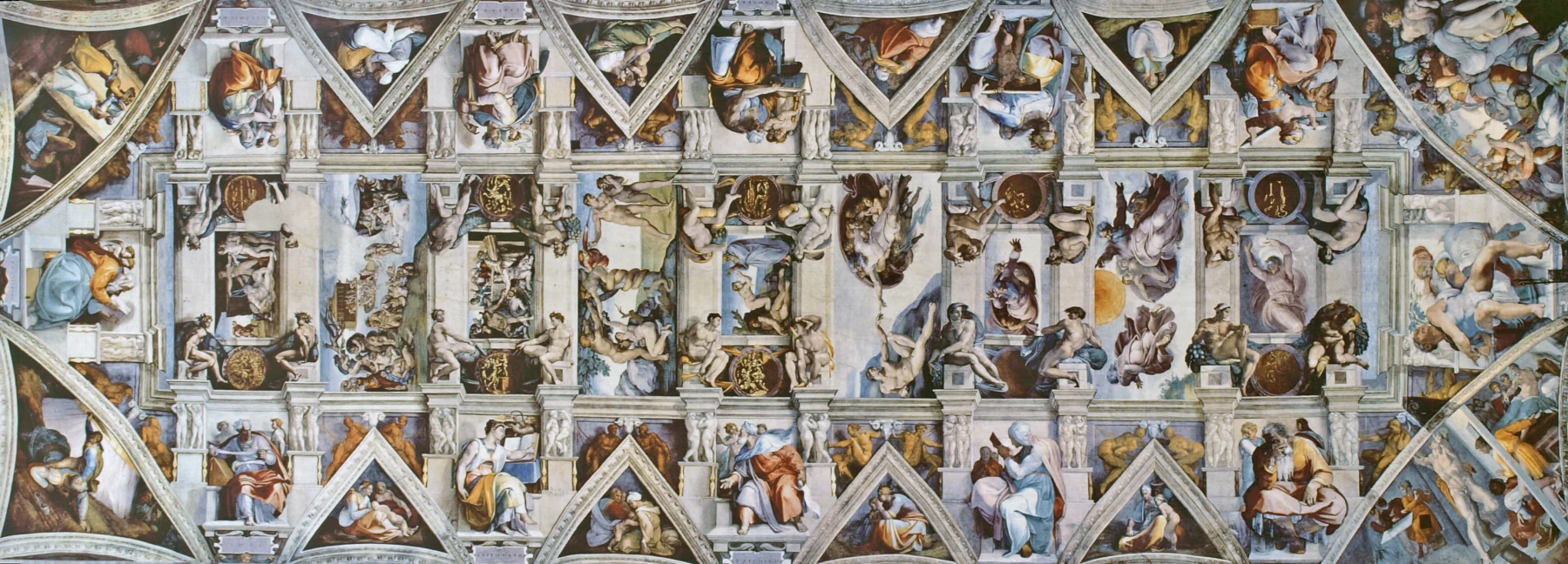
Julius II commissioned Michelangelo to paint the ceiling, completed between 1508 and 1512. The central sequence from Genesis is only one part of an enormous visual architecture. Prophets and sibyls occupy monumental thrones. Ancestors, ignudi, medallions and painted architectural frames connect scenes across the vault. Figures change in scale and pose to be legible from far below.
Read the central stories in three groups. First come acts of creation: light separated from darkness, the sun and moon with vegetation, and land distinguished from sea. Next come Adam, Eve, and the combined temptation and expulsion. The final group follows Noah through sacrifice, flood and drunkenness. Creation gives way to human vulnerability and the problem of beginning again. The ceiling’s moral movement is larger than the famous interval between God’s and Adam’s fingers.
The monumental seated figures around that sequence change the scale of looking. Prophets and sibyls read, turn and attend, while ancestors below bring the programme into generations of human bodies. Painted supports organise all this material as though the chapel had acquired a second architecture. From the floor, choose one central scene and one surrounding figure before trying to scan the entire vault: the relationship between narrative and framing is easier to grasp through a deliberate pair of observations.
Michelangelo worked in buon fresco, applying pigment to fresh plaster in planned daily sections. The method requires coordination: plaster must be prepared, outlines transferred, pigments used within material limits and decisions made before the surface dries. Seams between working days can sometimes be traced. Corrections and areas painted after drying complicate any simple claim that fresco is a purely spontaneous performance.
He did not paint while lying flat. Scaffolding supported work close to the vault; surviving evidence and later reconstructions indicate a platform system secured at wall level. Michelangelo’s comic poem and sketch about the commission exaggerate the physical misery of painting overhead. The bent figure is an expressive complaint, not a construction drawing, but it corrects the comfortable myth of an artist reclining under the ceiling.

14 · Vatican route
The “brain” is a hypothesis, not Michelangelo’s secret confession
In 1990 physician Frank Meshberger proposed in the Journal of the American Medical Association that the mantle surrounding God and the angels in the Creation of Adam resembles a sagittal section of the human brain. The article maps painted forms onto anatomical features and argues that Michelangelo encoded an intellectual gift within the scene.
The resemblance has become a durable popular story because Michelangelo studied anatomy and because the overlay is visually arresting. It remains an interpretation. There is no known statement by Michelangelo confirming the design, and visual correspondences can be strengthened by selecting which painted folds count. Other writers have proposed anatomical forms elsewhere in the chapel, with varying degrees of plausibility.
A responsible guide can show the comparison as a modern hypothesis and explain why it attracts attention. Calling it a proved “Easter egg” changes a published argument into authorial fact. The distinction matters beyond one shape: art history advances through evidence, comparison and debate, not through the confidence with which a secret is repeated.
15 · Vatican route
The Last Judgment changes the emotional and political register
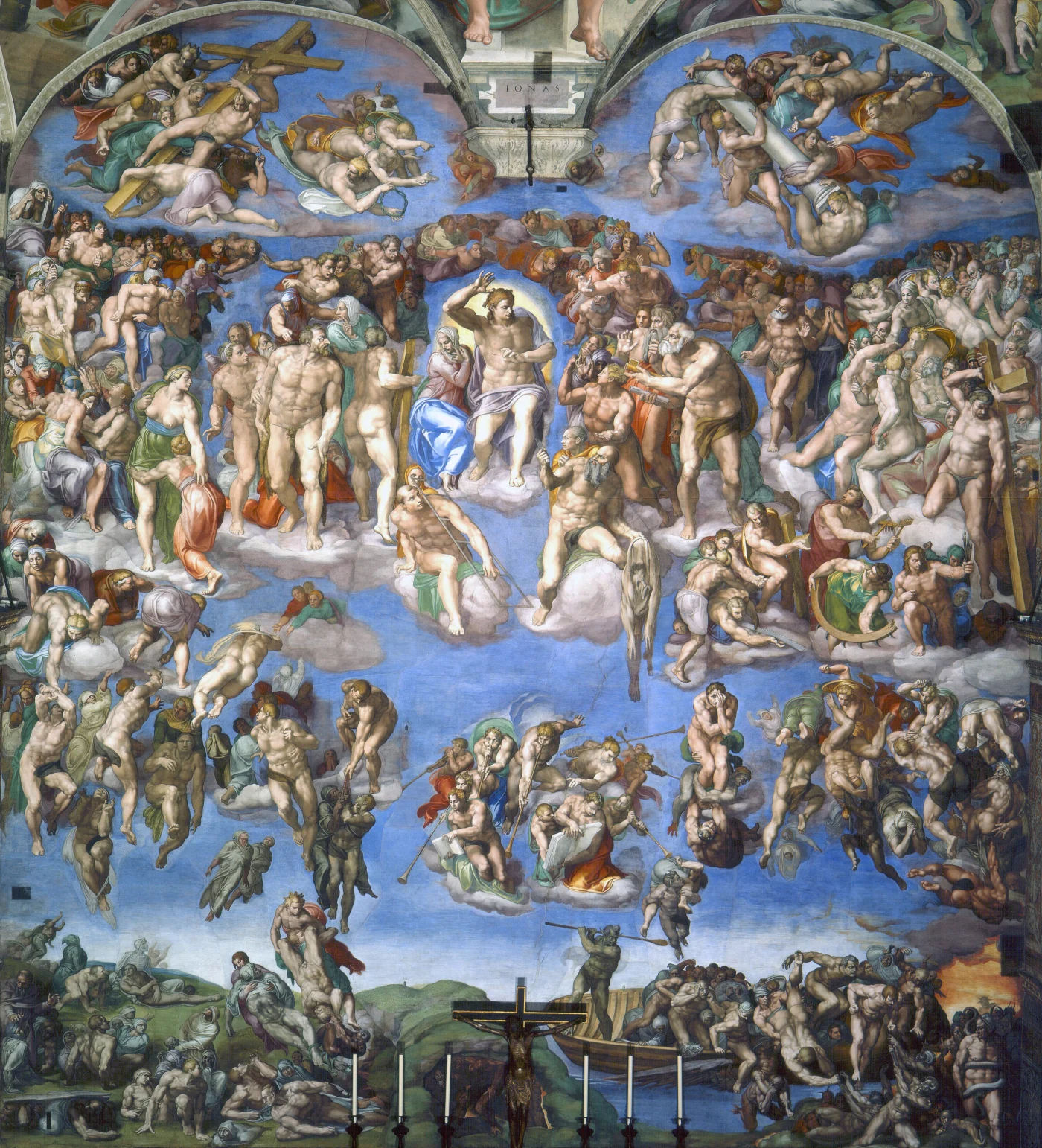
More than two decades after the ceiling, Michelangelo returned to paint the altar wall under Popes Clement VII and Paul III. The Last Judgment, executed from 1536 to 1541, does not extend the ceiling’s architecture in a calm sequence. Bodies rise, fall, twist, resist and gather around a commanding Christ. The wall collapses ordinary scale and horizon into an event of judgement.
The work emerged after the Sack of Rome in 1527 and during intense conflict over reform, doctrine and authority. Its bodies also provoked debate over decorum in a sacred setting. According to Vasari’s early account, papal master of ceremonies Biagio da Cesena objected to the nudity. The familiar revenge story associates him with Minos in the lower-right corner, but the figure’s secure iconographic role is already powerful: Dante’s infernal judge, coiled by a serpent, occupies the opposite extreme from Christ. Repeating a supposed exchange with the pope as recorded dialogue would give legend a certainty it does not possess.
In 1564 a decision linked to the Council of Trent led to coverings over some nude figures. Daniele da Volterra carried out the first interventions and acquired the nickname Braghettone, the breeches-maker; later hands added others. The coverings are evidence of changing religious judgement about Michelangelo’s work. Conservation consequently faces two histories at once: the painted surface and the institution’s successive decisions about what it could show.
The image should not be presented as a simple code in which every figure has one settled label. Some identifications are traditional or well supported; others remain debated. The flayed skin held by Saint Bartholomew is often read as containing Michelangelo’s features, a persuasive but still interpretive act of self-reference. The point is not to drain the wall of story. It is to separate visual evidence, early testimony and later legend.
.jpg)
16 · Vatican route
Restoration revealed colour and intensified debate
The great campaign that began in 1979 and concluded in stages through the 1990s removed deposits and earlier material from the chapel’s frescoes. The result surprised viewers accustomed to a darker Michelangelo: acidic greens, clear blues, pinks, oranges and sharply differentiated fabrics returned. Cleaning also made the artist’s modelling and the speed of some passages easier to see.
The campaign was not universally accepted. Critics argued that some removal may have diminished dry retouching or altered the tonal unity they believed Michelangelo intended. Conservators countered with technical study of plaster, pigment and accumulated surface layers. A visitor does not need to choose a slogan. The dispute demonstrates that “original” is not a self-evident condition after centuries of soot, glue, repair and repainting.
Continuing maintenance addresses what the building produces now: particulate deposits, environmental change and enormous human presence. The Museums’ restoration and conservation departments bring different material skills to this work. Their recurring attention to surfaces makes respectful visitor behaviour one contribution to the room’s long life.
17 · Vatican route
Silence and the camera ban are operating rules, not atmosphere
The Vatican Museums’ current visitor guidance allows personal photography in most collections but prohibits it in the Sistine Chapel. Flash, tripods, selfie sticks and professional equipment face wider restrictions. Absolute silence is required in the chapel; phones should be silent. Guides are expected to explain the room in advance using authorised panels.
This arrangement is why a good tour may seem to pause before the chapel. The briefing is not filler. It lets the guide give visitors three or four visual anchors—perhaps the ceiling sequence, prophets and sibyls, the Creation of Adam and the Last Judgment—before speech stops. Trying to communicate a full iconographic lecture inside would violate the rule and reduce the room to a headset exercise.
The prohibition should not be rationalised with invented technical claims. Modern cameras do not need to be described as uniquely destructive to justify a no-photo rule. The official rule governs decorum, flow and the chapel’s function. Enforcement may feel uneven in a crowded room; that does not convert it into permission.
18 · Vatican route
This is still the room where a pope is elected
The Sistine Chapel’s most consequential modern use is the conclave. When the Apostolic See is vacant, the College of Cardinals gathers under a detailed legal and ceremonial framework to elect a pope. The chapel closes to ordinary visitors, security and communications controls are installed, and ballots are burned to signal whether an election has occurred.
The 2025 conclave that elected Leo XIV reminded visitors that the familiar museum climax can disappear from the tourist route because its institutional purpose takes precedence. That is not an exceptional failure of access. It is the clearest evidence that this room has never become only a museum exhibit.
Other liturgies and papal ceremonies can also affect tourist access. Use the Museums calendar and the pope’s events calendar for the actual date. A weekday rule cannot describe every season or celebration. Leave enough flexibility to approach the basilica independently if the museum-and-chapel sequence and church access do not align.
19 · Vatican route
Do not promise a secret door to St Peter’s
Bernini’s Scala Regia is a ceremonial staircase connecting the Apostolic Palace and basilica precinct. Its name should not be used as a generic label for a museum-tour exit. A connection used by some authorised groups likewise does not create an unconditional visitor right: the transition from chapel to basilica belongs to a particular operating route and day.
The basilica’s official guidance describes public and booked-tour entry from St Peter’s Square, with the appropriate entrance and security control. A guided itinerary may continue to St Peter’s without guaranteeing one particular internal passage. Security, services and institutional decisions govern the movement; using the public approach can involve walking outside the museum complex and joining a separate security process.
Ask the operator one concrete question before booking: “Does the current itinerary include guided basilica entry, and what happens if the internal group connection is unavailable?” The useful answer explains the fallback. A promise of a permanent shortcut is less valuable than an honest plan for separate security and a possible wait.
20 · Vatican route
St Peter’s stands over layers of burial, tradition and archaeology
Christian tradition locates the martyrdom and burial of the apostle Peter near the Vatican hill. In the fourth century, Constantine’s basilica was built over a Roman necropolis and the site revered as Peter’s tomb. The old basilica served for roughly twelve centuries before the present building replaced it.
Twentieth-century excavations beneath the basilica revealed part of the necropolis, monuments and a complex sequence around the place under the high altar. The so-called Trophy of Gaius, a second-century memorial structure known through archaeological interpretation and an early Christian text, became central to arguments about continuity of veneration. Bones discovered in the area were later associated with Peter, but the chain of deposition and identification remains a subject that requires careful language.
The official basilica account presents the tomb of Saint Peter through both tradition and excavation. A historically responsible description does not have to choose between contempt and certainty. Archaeology confirms a Roman cemetery, early memorialisation and an extraordinary continuity of building over the site. It cannot turn an ancient individual’s name into a modern laboratory label with absolute proof.
21 · Vatican route
A basilica this large could not be one architect’s idea
Pope Julius II laid the foundation stone of the new basilica in 1506. Donato Bramante proposed a centrally planned structure under a vast dome, but construction, demolition and redesign extended across generations. Raphael, Fra Giocondo, Giuliano da Sangallo, Baldassare Peruzzi and Antonio da Sangallo the Younger contributed to a project repeatedly altered by technical, ceremonial and political pressures.
Michelangelo took responsibility for the project in the 1540s. He simplified and strengthened the massing and developed the dome design, though he did not live to see it completed. Giacomo della Porta and Domenico Fontana carried the dome to completion with changes. Carlo Maderno extended the eastern arm into the long nave needed for liturgy and created the façade between 1608 and 1612. The basilica was solemnly consecrated in 1626, exactly thirteen centuries after the traditional consecration year of the Constantinian church.
The foundation ceremony gives the immense building a human scale. The basilica’s historian Pietro Zander recounts Julius II’s descent on 18 April 1506 into a foundation pit about seven metres deep, using a ladder. Beneath the first stone were medals made by Caradosso and placed in a vessel. A ceremony about permanence required the pope to enter an active excavation. The recorded gesture joins image-making to engineering: the new church began with measured ground, material foundations and a claim laid down for future generations.
That relay explains apparent contradictions. The dome is overwhelmingly present from the city but can be harder to grasp from directly in front because Maderno’s long nave and façade change the view. A centralised Renaissance ideal became a longitudinal church capable of major processions and congregations. Architecture here is compromise made monumental.

22 · Vatican route
Michelangelo’s Pietà makes stone behave like grief
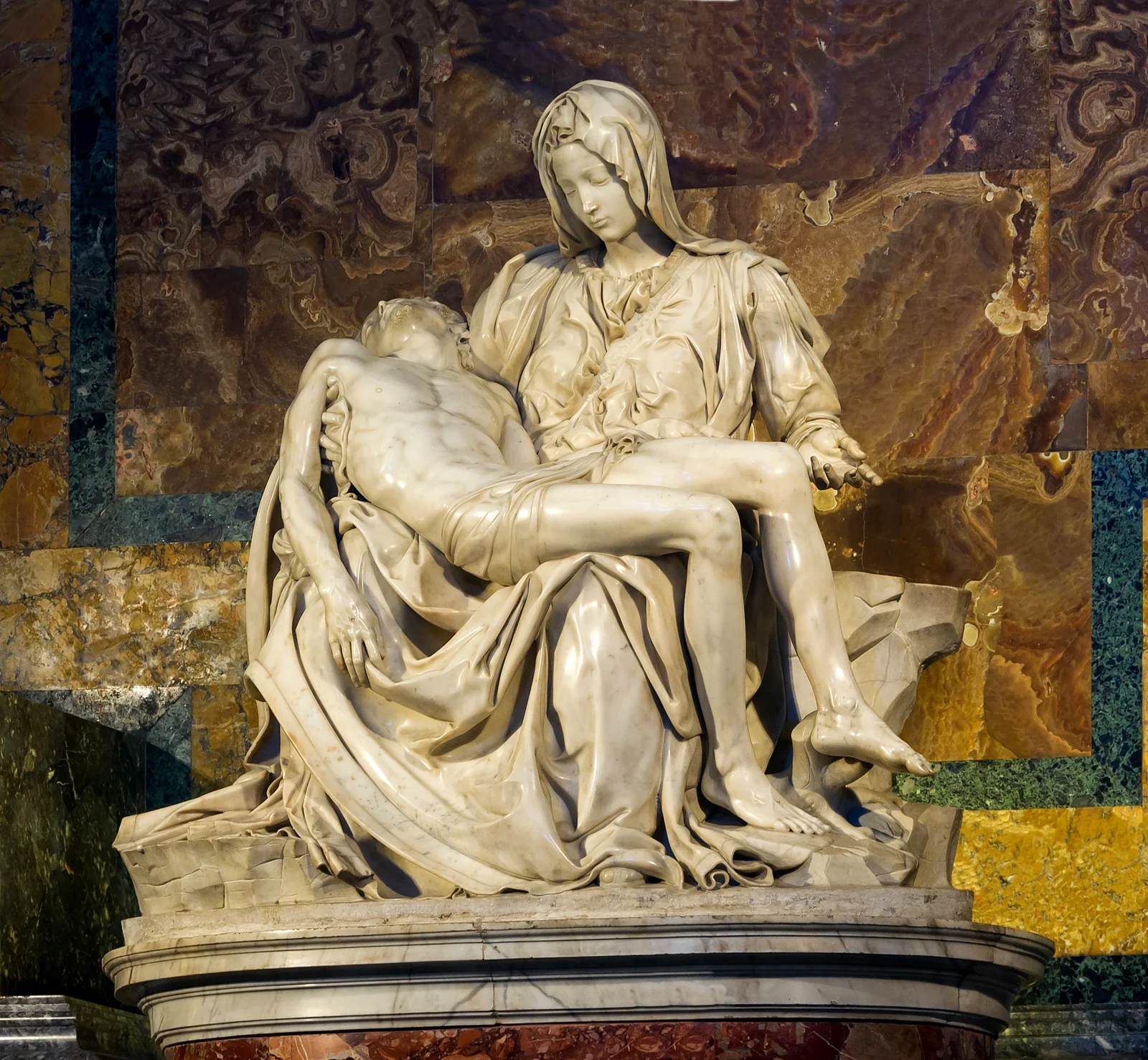
Michelangelo carved the Pietà in the late 1490s for the French cardinal Jean de Bilhères. The marble group presents the dead Christ across Mary’s lap. The composition solves a difficult structural and emotional problem: the adult body must be supported within a stable pyramidal form, while the drapery broadens Mary’s seated figure enough to carry the weight without making the marble look merely engineered.
Mary appears unusually youthful. The choice has invited theological and poetic explanations, but it should not be reduced to one documented statement of intent. What can be seen is a contrast between polished flesh, deep folds and restrained expression. The sculpture draws attention through control rather than theatrical gesture.
It is the only work Michelangelo signed, his name cut across Mary’s sash. That fact has accumulated an anecdote that he acted after hearing the sculpture attributed to another artist; the story comes through later biography and should be presented as tradition rather than witnessed dialogue. In 1972 a man attacked the sculpture with a hammer, damaging Mary’s arm, face and veil. Restoration and the protective glass now mediate every view. The barrier is part of the work’s modern history, not an inconvenience to edit out of photographs.

23 · Vatican route
The dome turns structural force into a horizon
The dome rises on four immense piers around the crossing. Michelangelo’s design, modified during completion, uses paired columns, ribs and a double shell to create a form that is both structural and visible across Rome. From below, inscriptions and architectural members appear proportionate because everything has been scaled for distance. Figures and letters that look readable from the floor are far larger than domestic intuition expects.
Climbing the dome, when current access and physical ability permit, changes the lesson. The visitor moves from a near view of mosaics and the interior cornice to stairs within the curving shell, then to an exterior panorama. Tight, sloping passages and many steps make this a separate physical undertaking rather than a casual add-on to a three-hour museum tour. The official dome page controls current access; lifts reduce but do not remove the stair component to the summit.
The dome also demonstrates maintenance at urban scale. Masonry, metal ties, mosaics, windows and exterior surfaces require inspection and repair. Monumentality does not cancel material ageing. It multiplies the consequences of small failures.
24 · Vatican route
Bernini’s baldachin marks a place rather than filling a room
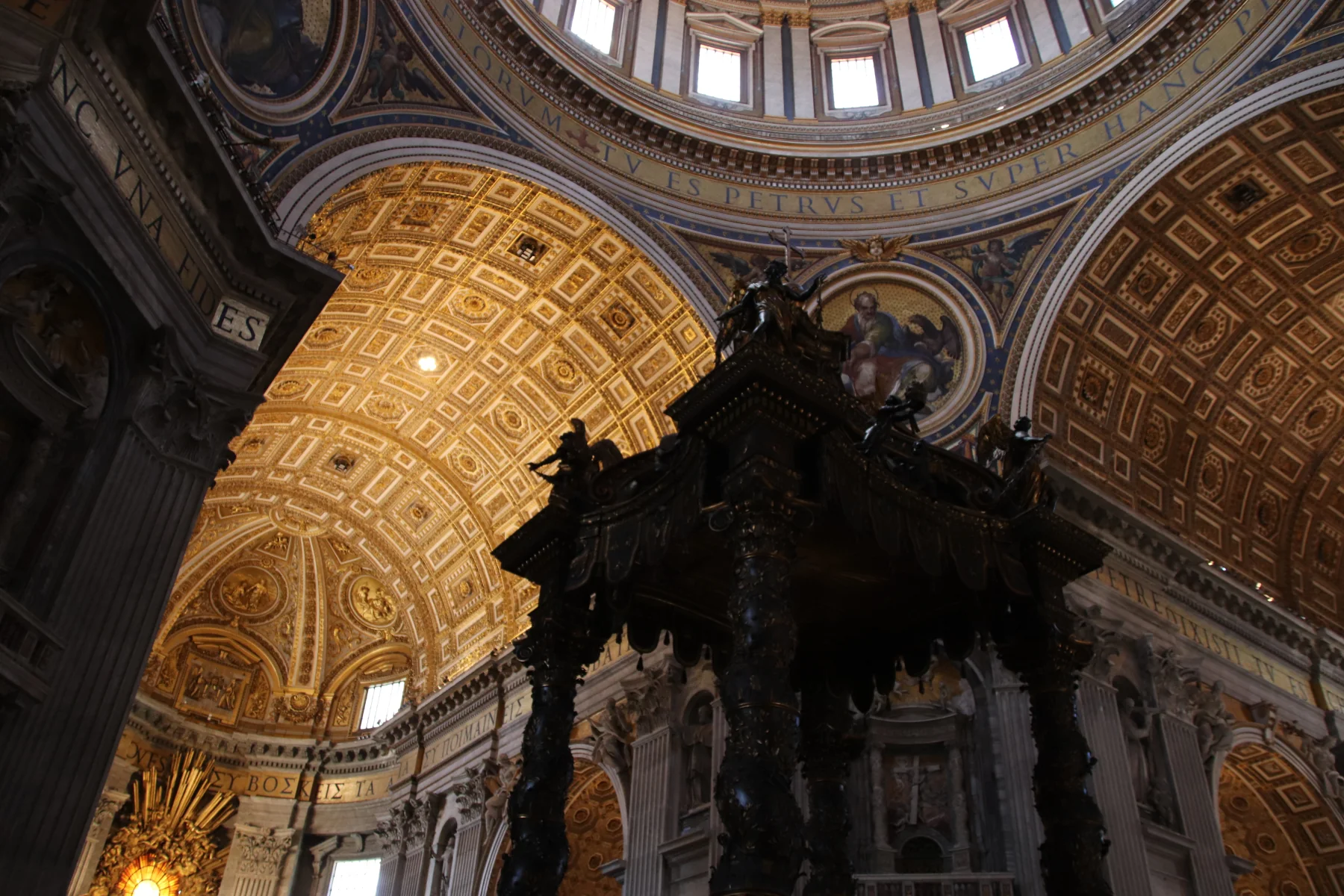
Under the dome, Gian Lorenzo Bernini’s bronze baldachin rises above the papal altar and the traditional tomb site. Commissioned by Urban VIII and made in the 1620s and early 1630s, it borrows the form of a textile canopy but translates it into spiral columns, dark metal and a sculptural crown. Its scale is enormous in ordinary terms; within St Peter’s it acts as a legible marker between floor, dome and burial tradition.
The Barberini bees identify the pope’s family and make patronage visible. The work is neither just furniture nor an independent statue. It coordinates liturgical place, dynastic identity and the vertical line from tomb to altar to dome.
Urban VIII’s removal of ancient bronze from the Pantheon made the project part of a wider argument about appropriation. Archival research discussed by art historian Maarten Delbeke, drawing on Louise Rice, finds that very little, if any, of that metal went into the baldachin; the main destination was artillery. The canopy therefore cannot be explained as a simple transfer of the Pantheon’s roof. Contemporary criticism of the Barberini still matters: it shows how ancient material, papal defence and magnificent new art could compete for public legitimacy. The satire about the Barberini doing what barbarians had not done was a judgement on patronage, rather than a reliable metal inventory.
,_1623-1634_(48466540897).jpg)
25 · Vatican route
The Cathedra and square complete Bernini’s choreography
At the western end, Bernini’s Cathedra Petri surrounds a venerable wooden chair with bronze, figures and the luminous window of the Holy Spirit. The chair itself has several historical layers, including ivory decoration and a ninth-century Carolingian component. It is encased rather than offered as an untouched apostolic object. Four Doctors of the Church support the great bronze ensemble: Ambrose and Augustine from the Latin tradition, Athanasius and John Chrysostom from the Greek. Their pairing makes teaching authority a relationship across traditions. The composition joins inherited material to seventeenth-century theatre, drawing the eye upward toward the dove and the light beyond.
Outside, the elliptical arms of St Peter’s Square, designed under Alexander VII and substantially completed by 1667, organise arrival. Four rows of Tuscan columns form the colonnades; statues crown the entablature; the ancient obelisk anchors the centre with fountains on either side. The official basilica account records 284 columns and 140 statues. Geometry alternately reveals and conceals the rows as a person moves through the piazza.
The often-quoted image of the colonnades as embracing arms is grounded in Bernini’s programme, but welcome operates alongside control. The square can accommodate processions, audiences, liturgies and enormous crowds. Barriers, security lines and reserved zones redraw it for each event. Its beauty is inseparable from logistics.
26 · Vatican route
Dress, bags, identity and access require exact answers
The Vatican Museums require clothing appropriate to a sacred and institutional setting: shoulders must be covered, shorts above the knee and miniskirts are not admitted, and offensive or conspicuous imagery can be refused. St Peter’s current guidance is more specific: shoulders covered for everyone, long trousers for men, and trousers or a skirt below the knee for women. A light layer carried for summer is more useful than trying to negotiate at the door.
The Museums introduced nominative tickets with identity checks, so visitors should carry valid photo identification and make sure the booking name is correct. Security screening is separate from ticket validation. Timed admission reduces one uncertainty; it does not make the entrance instantaneous, waive the security check or guarantee admission after a missed slot.
The Museums provide a cloakroom for restricted items such as large bags, bulky umbrellas and tripods. Check the deposit rules before arrival and keep medicine, documents and essentials with you. A deposit has an important consequence for a route continuing to St Peter’s: you must return to collect it before leaving the Museums. The basilica does not provide a luggage cloakroom. Travelling lightly prevents the final threshold from becoming an unexpected return journey.
Accessibility needs a format-specific conversation. The Museums publish barrier-free routes and disability services, including priority access, wheelchairs and free admission under stated certification conditions. Most museum spaces are accessible, although the barrier-free route can differ from the headline circuit, and the institution says its own standard guided itineraries are not open to wheelchair users. Families with pushchairs are welcomed and guards can direct them to easier routes and dedicated lifts. Those facts correct two bad shortcuts at once: the Museums are not simply inaccessible, and a generic commercial tour is not automatically suitable. St Peter’s provides accessible entry, but a product joining all three spaces must confirm its own route, pace, lifts, steps and companion policy.
27 · Vatican route
Plan around separate calendars
Museum admission, basilica access, dome visits and papal ceremonies run on separate calendars. A building’s opening window is not the same as the last admission slot or the hours for every activity inside it. Reserve museum entry through the official ticket portal for the intended date, then make a separate plan for the basilica. Leave time for security and movement between entrances.
Use the Museums calendar, the basilica’s opening-hours page and the papal calendar shortly before travel. Religious celebrations can limit tourist access even while a church is open. General admission to the basilica is free; official guided experiences, the dome and optional timed-booking services are separate products. A museum ticket does not include those extras.
For a guided booking, the checkout and confirmation govern the price, remaining places, departure, meeting point and transaction terms. Save that confirmation offline and distinguish it from the official destination calendars: each answers a different practical question.
28 · Vatican route
Three honest ways to arrange the visit
Independent museum visit. Book the official Museums entry appropriate to the date, build a short priority list and allow more time than a compressed highlights circuit. This is best for readers who want to stop in less famous collections or control the pace. It does not by itself include a guided basilica visit, and a later move to St Peter’s may require leaving the Museums and using the public square entrance and security process. The Museums provide maps, panels and other interpretive tools, so independence does not mean walking without information; it does mean doing the work of selection yourself.
Guided Museums-and-Sistine route. The focused connected format ends with the chapel rather than trying to add St Peter’s to the same guided session. That narrower endpoint protects more of the available time for the collections and for the guide’s pre-Sistine explanation. It suits a traveller who wants museum interpretation but would rather approach the basilica independently, on another day or not at all. It does not become a quiet or comprehensive visit simply because admission is reserved. Timed access reduces one queueing uncertainty; it cannot promise empty corridors, a private chapel or freedom from security.
Guided route continuing to St Peter’s. The broader connected format links the Museums, Sistine Chapel and basilica as one interpretive sequence. Its advantage is continuity: a guide can carry themes of patronage, ritual and architecture across the institutional threshold. Its constraint is compression and the operating status of the final connection. Confirm that the booked departure includes the guided basilica visit, ask what happens if the group connection is unavailable, and treat the dome or necropolis as separate objectives.
The choice is not between informed travellers and everyone else. It is between depth, coordination, pace and endpoint. A guide adds most value by curating what cannot all be seen and by separating secure evidence from a good story. The official visitor guidance also requires radio headsets for groups of 11 or more, yet equipment cannot rescue weak interpretation. Ask whether the guide approaches the rooms primarily through art history, theology, archaeology or a combination: a pilgrim and a secular museum visitor may both value evidence, while asking different questions of the same chapel.
29 · Vatican route
A field checklist for the actual day
- Recheck the official Museums, basilica and papal calendars for the exact date, including late changes.
- Match every ticket name to the required photo ID and save the voucher, booking message and route notes offline: the Museums state that no museum area has Wi-Fi coverage.
- Confirm the meeting point from the current booking message, not from an old podcast description.
- Ask whether St Peter’s entry is guided that day and what fallback applies if the group passage is unavailable.
- Follow the current dress rules for every part of the route: cover shoulders; for St Peter’s, men should wear long trousers and women trousers or a skirt below the knee. Carry the lightest practical bag.
- Tell the operator in advance about wheelchair use, steps, hearing needs, sensory needs or the need to remain with a companion.
- Expect security at the Museums and, if using the public approach, again at St Peter’s.
- Use the pre-Sistine briefing: identify a few works to find, then put the phone away before entry.
- Treat worship, silence, barriers and staff directions as part of the institution’s operation, not obstacles to the visit.
- Decide in advance whether a dome climb or necropolis visit is a separate objective; neither belongs automatically inside a standard three-hour tour.
30 · Vatican route
A guide should curate the route, not sell a private Vatican
A guide’s most useful task is selection. The Vatican Museums are too large for a highlights visit to be comprehensive, so interpretation should connect a small number of objects and rooms rather than recite a larger number of names. The Gallery of Maps, Raphael Rooms and pre-Sistine briefing earn their place when each advances the route’s central ideas of collecting, representation and sacred use.
Selection is different from spectacle. Reserved admission can be valuable, but it does not purchase an empty museum; a radio headset carries a voice, but it does not guarantee a thoughtful one. Judge early or special access by the booked conditions. Ask how long the group spends in the collections, where the Sistine briefing happens and whether the basilica interpretation is included. Those answers say more about the route than a photograph of an empty corridor.
The field notes are strongest when they recognise that visitors bring different purposes into the same space. Some arrive primarily as pilgrims, others as students of art, archaeology, architecture or power. A capable guide need not flatten those perspectives into agreement. The guide should distinguish devotional meaning from historical evidence, label anecdote as anecdote and leave room for the fact that the Sistine Chapel remains both a canonical work of art and an operating sacred room.
31 · Vatican route
Listen to the field notes
Episode 2963238 of The Travel Podcast by ExcursionPass follows the longer Museums–Sistine–St Peter’s sequence and makes the institutional thresholds audible.
Episode 3001676 of The Travel Podcast by ExcursionPass stays with the Museums and chapel, asking what a guide adds when crowds, selection and interpretation are the real constraints. Heard together, the episodes clarify that the best format is defined as much by its endpoint as by its list of masterpieces.
Episode 3017166 of The Travel Podcast by ExcursionPass revisits the focused route through timed admission, the Gallery of Maps, Raphael Rooms and advance preparation for the Sistine Chapel. It returns to a central problem: how to sustain attention when the collection exceeds the available time. Heard across all three episodes, the route becomes a choice about interpretation, access needs and endpoint.
32 · Vatican route
Continue the journey
St Peter’s Square opens directly into Rome, but the next useful story is not another rushed list of masterpieces. Continue with ExcursionPass’s account of the Colosseum, Forum and Palatine to compare two monumental systems that repeatedly reused antiquity to organise public power. The places are different in purpose and chronology; the shared question is how architecture manages bodies, memory and authority.
For a contrasting national collection whose route is openly rewritten as public memory changes, continue to Madrid’s Reina Sofía beyond Guernica. Its converted hospital and modern-art collection show museum logic operating without the Vatican route’s final transition into a living church.
The Vatican route becomes clearer at the threshold. Before the Sistine Chapel, speech yields to institutional silence. Before St Peter’s, museum logic yields to the operating church. The visit is richest when those changes are not disguised as friction, but recognised as the story itself.