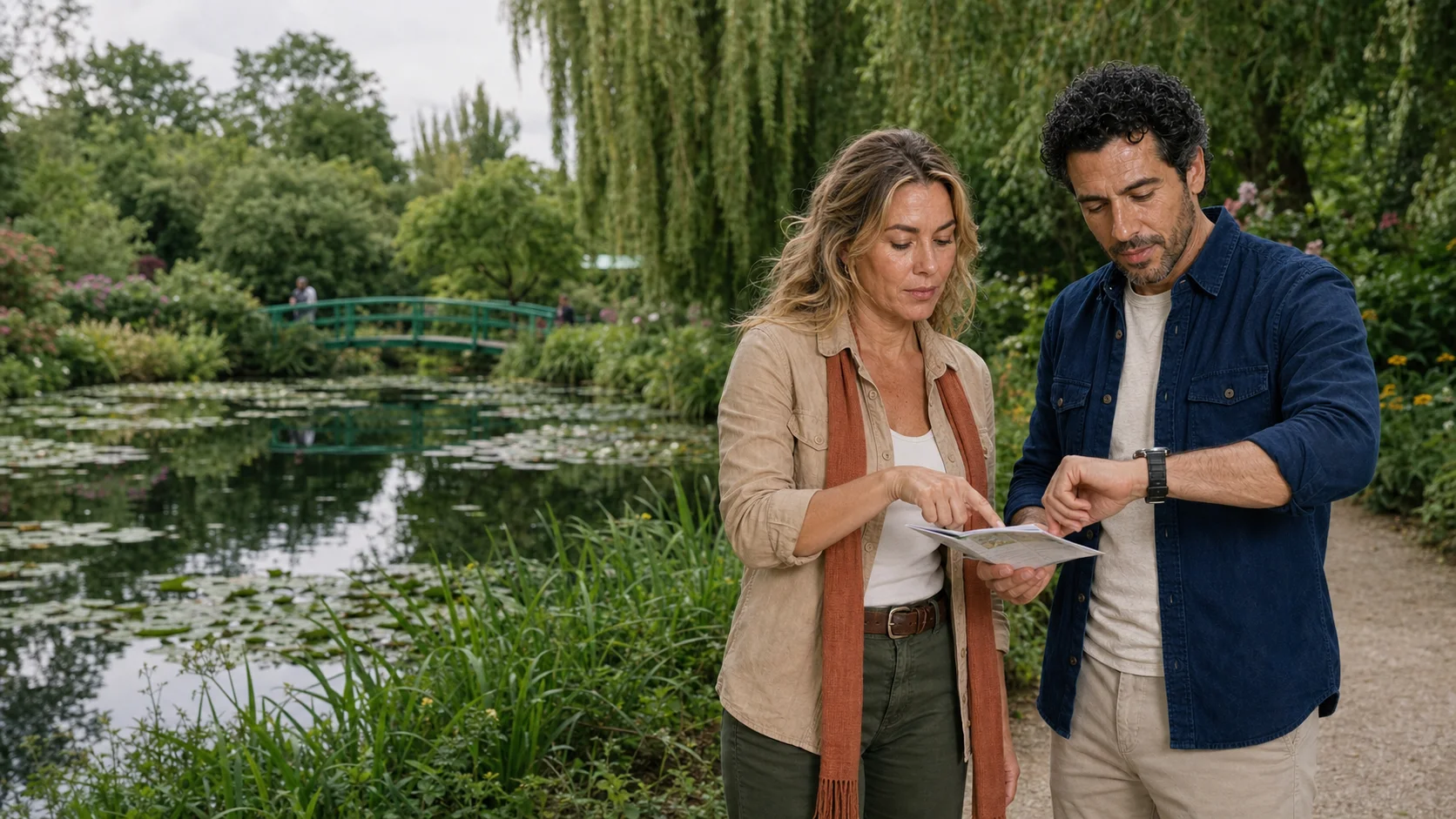
A combined day can connect two of France’s most consequential designed landscapes. It cannot make them equivalent, and it cannot give back the time each place was built to reward. The useful question is not whether both fit on a schedule, but what to protect when they do.
01 · Art, garden and power field guide
The day is a triangle, not a list
Giverny and Versailles are often sold together because a vehicle can connect them in one long loop from Paris. The road connection makes the pairing possible; the difference between the places makes it interesting. One is the domestic landscape of an artist who watched a pond for decades. The other is a royal domain built to organise court, government, water, movement and sight.
The contrast is precisely why the pairing can work. At Giverny, power is local and iterative: lease a house, buy the property, replace trees, order plants, acquire marshy ground, shape water, employ gardeners, adjust a view, paint it again. At Versailles, power is territorial and institutional: move government, align a town and palace, cut axes through land, command enormous workforces, lift water across distance, choreograph access and make hierarchy visible. Both landscapes are constructed. Neither is “nature” left alone. But they were made by different kinds of authority and ask for different scales of attention.

This guide begins at Giverny because the smaller place can be misunderstood more quickly. A pink house, a green bridge and water lilies are easy to recognise; recognition can create the illusion that the work is done. Giverny becomes far more interesting when the garden is treated as a living design, an employer, a water intervention, a family home, a studio resource and a site reconstructed after neglect.
At Versailles, the state apartments, Hall of Mirrors and formal gardens explain the shock of transition. After an artist’s cultivated hectare and pond, the visitor meets rooms that staged access to a sovereign, a gallery that multiplied royal imagery and a landscape whose fountains depended on engineering beyond the horizon. Those are the core of the comparison here. A longer route through Trianon, the Queen’s Hamlet and the park belongs to another kind of day, developed in our Versailles estate guide.
Doing both in one day is therefore not a contest in attraction counting. It is an experiment in switching scale. The practical challenge is to keep that switch legible while managing roads, controlled entries, food, toilets, bags, walking and the possibility that one delay will take time from the only place that cannot move.
02 · Art, garden and power field guide
Giverny is a village, not an origin myth
Giverny lies in Normandy near the Seine valley, with Vernon serving as the usual rail gateway for independent visitors from Paris. Claude Monet moved there on 29 April 1883. The date is firm; the often-repeated discovery story is softer. In a later recollection, his stepson Jean-Pierre Hoschedé said Monet noticed Giverny from the train connecting Vernon and Gisors. The Fondation Claude Monet’s account presents that as recollection rather than certainty, a useful model for handling charming stories without hardening them into documents.
The village had 279 residents in 1883, according to the Foundation. Monet did not arrive at the “birthplace of Impressionism.” By then the movement’s early exhibitions, arguments and urban networks were already part of art history. Giverny became something different: a place of long residence and sustained experiment after decades of financial insecurity, frequent moves and changing artistic fortunes.
Monet first rented the long house with its garden. In 1890 he bought it. That seven-year interval matters. The property was not an instant masterpiece selected in finished form. It offered stability and the possibility of repeated alteration. The village, fields, Seine valley and nearby railway linked rural life to Parisian markets, dealers, museums and visitors. Giverny was secluded enough for concentration, but it was not outside modern circulation.
The independent approach makes that geography visible. The Foundation’s current practical guidance directs travellers from Paris Saint-Lazare to Vernon-Giverny, followed by a local shuttle, bus, taxi, bicycle or other connection. A combined road tour hides the transfer problem and usually reduces the number of decisions. That convenience is real. What it removes is control: you do not decide when the train leaves, how long to remain in the village or whether to wait for a cloud to pass over the pond.
That trade is neither good nor bad in the abstract. It defines the visit. A guided combined day buys coordination. An independent Giverny day buys elasticity. Readers should choose between those values before comparing headline prices.
Rue Claude Monet also continues beyond the Foundation property into a village that existed before the artist arrived and did not stop at his garden gate. The church of Sainte-Radegonde and its cemetery, where Monet and members of his family are buried, give the visit a different scale: not another branded room, but the local ground in which a household became part of village memory. It is a reasonable extension when time and mobility permit, never an inclusion to assume from a product title. A fixed road departure may leave no margin for it; an independent day can decide on the spot.
Vernon is more than the name on the railway station. It is the transport hinge between Paris and Giverny, with the final connection completed by shuttle, bus, taxi, bicycle or walking route. That last link is why “take the train to Monet’s garden” is incomplete advice. It also explains the value of a focused road half-day: the commercial format can absorb the transfer chain, while the independent format exposes it in exchange for control over the village, museums and return.
03 · Art, garden and power field guide
A focused half-day changes the comparison
The later ExcursionPass podcast episode approaches Giverny without Versailles. The house and gardens remain the subject, but the allocation of the day changes. Removing Versailles removes one controlled entry, the cross-site road transfer and the abrupt switch from domestic garden to royal landscape. Paris departure, road or rail, site entry, the narrow house, the passage between Clos Normand and the water garden, food, toilets and the return still compete for time.
The useful promise of a half-day is focus. The Foundation currently suggests roughly an hour and a half to two hours for an unguided visit. That is a planning indication, not a universal pace: it may be enough to follow the house route, read the main garden structures and pause at the pond, but it leaves little room for repeated observation, the church and cemetery, Vernon or another local museum. A traveller who needs slower movement through the house or garden should treat the official suggestion as a starting point rather than a target. Painting and drawing are prohibited within the Foundation property; protect looking time rather than planning to sketch there.
Focus also changes what a guide can contribute. Pre-departure or en-route interpretation can establish Monet’s household, the two gardens, the water intervention and the relationship between repeated observation and painting. Ask whether your chosen format includes guided interpretation inside the property, an entrance handoff or a self-guided site visit. Find out what interpretation occurs before entry, what occurs on site and how much independent time remains. Those arrangements make a larger difference than the word “guided” alone.
A timetable cannot guarantee traffic, entry, seasonal congestion or the pace of a future group. Compare formats by their structure. A focused road half-day exchanges independent transport decisions for a fixed departure and return. An independent visit through Vernon exchanges those coordination benefits for the ability to remain longer, walk through the village or respond to changing light. The combined Giverny-and-Versailles day exchanges still more elasticity for the comparison of two designed landscapes in one continuous route.
There is a fourth relationship worth protecting: Giverny and Paris’s collections. The Musée Marmottan Monet describes itself as holding the world’s largest collection of Monet’s work, substantially enlarged in 1966 through Michel Monet’s bequest. Its holdings include Impression, Sunrise, works across Monet’s career and late canvases from the Giverny garden. The Orangerie provides the architectural culmination of the Water Lilies cycle. Neither museum needs to be bolted onto the same day. Giverny supplies the worked place; Marmottan supplies an unusually broad career and family-bequest context; the Orangerie supplies the enveloping state installation. Separating them can make the translations between garden, canvas and museum easier to see.
For most travellers, the format decision can be stated plainly. Choose a focused half-day when Giverny is the priority but Paris time must remain available. Choose an independent day when elasticity, village context or slow looking matters most. Choose the combined day when the artistic and royal landscapes need to be compared and one date is all that exists. None is the complete Monet experience, because no schedule can combine decades of garden work, hundreds of paintings and several collections into one visit. The best format is the one that protects the part of the question you actually came to understand.
04 · Art, garden and power field guide
The house was a family system before it was a museum
The house faces the Clos Normand in one long, low volume. Its green shutters and pink render have become a brand of their own, but the rooms are more useful when read as evidence of an unusually large household. Monet lived here with Alice Hoschedé and eight children from their two families. Meals, education, correspondence, entertaining, gardening, painting and the work of domestic staff intersected on the property.
The Foundation’s room account separates what survives from what has been reconstructed. The restoration reused furniture, while the paintings displayed in the first studio are reproductions; Monet’s works from the house entered the Musée Marmottan Monet collection. That distinction protects visitors from a common mistake. The house does not contain an untouched studio abandoned at the moment of inspiration. It is a restored interpretive environment built from surviving objects, inventories, research and curatorial choices.
The first studio, used until 1899, shows how work and household life touched. The private rooms upstairs reveal another kind of authorship: walls, colours, views and objects were arranged. The yellow dining room and blue kitchen are not neutral containers. They are environments made through colour, furniture, ceramics, utensils and daily service. A timed visitor may move through them quickly, but the domestic scale is the point. The great Water Lilies did not emerge from a solitary hut. They belonged to a property where family schedules, employees, deliveries and meals continued around an increasingly successful artist.
Monet’s Japanese prints sharpen that reading. The Foundation documents 211 prints on display and another 32 in storage, including work by Hokusai, Hiroshige and Utamaro. They were collected, framed and hung across rooms rather than sealed in a study cabinet. Their compositional lessons—cropping, asymmetry, serial views, strong silhouettes and compressed depth—were part of the visual environment of the household.
It is tempting to jump from those prints directly to the green bridge and call the garden Japanese. That shortcut erases the specificity of both traditions. Monet’s water garden is a late-nineteenth-century French property shaped by a collector who admired Japanese art, imported plants and built an arched bridge. It is not a faithful Japanese garden, and Japonisme was also entangled with unequal systems of collecting, translation and European fashion. The prints offer a documented relationship, not permission to turn cultural influence into decorative shorthand.


The studio photograph also corrects a second myth: repeated observation did not mean small, spontaneous canvases made only outdoors. Monet worked between garden, memory and studio. Late panels required purpose-built space, assistants, stretching, moving and sustained revision. The house-and-studio visit is strongest when it restores those material conditions instead of presenting Impressionism as a single quick glance translated immediately into paint.
05 · Art, garden and power field guide
Clos Normand is abundance under management
When Monet arrived, the roughly one-hectare garden in front of the house contained an orchard and kitchen garden. A central path ran between cypress and spruce, with beds edged in clipped box. The Foundation’s history of Clos Normand describes a sequence of deliberate removals and replacements. Box came out. Spruce gave way to metal arches. Apple trees were replaced by cherry and Japanese apricot trees. Roses and nasturtiums took over the main walk; bulbs, irises, poppies, peonies and other plants created changing colour fields.
The result can look loose, but looseness is designed. Vertical arches set a rhythm over the central path. Taller plants create screens and accents. Rectangular beds can carry concentrated colour. The house remains a terminal view, sometimes framed and sometimes half-obscured. A plant may contribute leaf shape before bloom, then flower, seed and disappear. The garden is composed in time as much as space.


That is why “living painting” is an attractive but insufficient phrase. Paintings do not need irrigation, soil improvement, pest decisions, deadheading, propagation, replacement or safe visitor paths. Gardens do. The appearance of abundance depends on gardeners controlling competition while allowing enough variation to avoid a municipal flower-bed effect. Climate, disease, storms and the timing of a season alter what can be shown.
The modern garden adds another layer. It is a reconstruction based on evidence and stewardship, not vegetation continuously preserved since Monet’s last morning. After his death in 1926, the property declined. His son Michel later bequeathed it to the Académie des Beaux-Arts. In the 1970s Gérald Van der Kemp led restoration with head gardener Gilbert Vahé: dead trees were replaced, beds cleared, paths widened and the Japanese bridge rebuilt. Those interventions made public visitation possible, but they also changed the physical record.
Season should therefore shape expectations. The Foundation explicitly presents spring, summer, autumn and winter as different gardens. An April visit is not a failed August. A hot summer can accelerate flowers. Rain can flatten some planting and deepen other colours. Late-season seed heads and foliage show structure that peak bloom hides. The useful question is not “Will it look like the famous image?” but “What is the garden doing now?”


On a compressed visit, protect at least one pause in Clos Normand. Do not spend it hunting for a precise match to a reproduction. Choose a structural question instead: how does the central axis lead to the house; where do arches turn a path into a tunnel; how do hot and cool colours alternate; which plants make a screen; where has maintenance kept the design from closing in on itself? Those questions work in almost any month.
06 · Art, garden and power field guide
The water garden was purchased, diverted and worked
The water garden occupies land on the other side of the road and railway from the house. Monet acquired the first parcel in 1893 and expanded it later. The Foundation’s water-garden account records that water from the Ru, a branch of the Epte, was diverted to create and sustain the pond. The site was not found as a complete natural mirror. Land purchase, permission, excavation, water control, planting and continuing care made it.
This does not make the pond artificial in the sense of lifeless. It makes it a designed ecology. Water level, flow, silt, shade, aquatic plants, algae, fish, insects, trees and bank vegetation interact. The same willow that creates a long reflection can cast shade over other planting and drop material into the water. Water lilies need space and management. A picturesque surface is the visible moment of a biological and hydraulic system.
Monet employed a gardener to remove dead leaves and keep the water clear enough for the desired reflections. That detail is more revealing than another adjective about tranquillity. The view associated with solitary genius depended on daily labour. Gardeners propagated, weeded, dredged, pruned and managed water. Suppliers moved plants. Carpenters and painters maintained structures. The pond’s stillness was produced.


The curved bridge supplied a strong horizontal form against drooping willows and vertical reeds. Its green paint tied it to the site’s other garden structures, while its arch and overhead wisteria created a changing frame. From one side it closes a view; from another it becomes a platform; in paintings it can flatten into a band near the top or dissolve into later, denser surfaces.
The earliest water-lily paintings date from the late 1890s. They did not exhaust the subject. Monet repeatedly shifted viewpoint, horizon, season, light, scale and degree of description. Some works retain bridge and banks. Others eliminate the horizon so that sky appears only as reflection and the canvas becomes difficult to orient. Repetition was not failure to find a new subject. It was the method by which one place could generate different pictorial problems.


This is the central cost of a fast Giverny visit. A visitor can recognise the bridge immediately, take a photograph and move on. Monet’s work asks for the opposite operation: notice that the pond is not the same from minute to minute, then return. No tour can supply decades, but it can protect a few consecutive minutes in one position. That is more faithful to the site than collecting every viewpoint at walking speed.
07 · Art, garden and power field guide
Water Lilies outgrew the pond without leaving it
The phrase “Water Lilies” covers a vast body of work, not one picture. The Musée de l’Orangerie traces a cycle developed over roughly three decades, around 300 paintings in all, including about 40 large-format works. By the 1910s the pond had become the basis for panels that surrounded rather than merely faced the viewer.
The Grande Décoration changed the architectural problem. Eight panels, about two metres high and extending roughly 91 metres in total, were installed in two oval rooms at the Orangerie after Monet’s death. The museum explains how Monet worked with architect Camille Lefèvre on the east-west sequence and elliptical rooms. Natural light, curved walls and the absence of a single conventional horizon turn looking into bodily movement.
That installation also belongs to history beyond the garden. Monet offered the decorative ensemble to the state in the aftermath of the First World War, and his friend Georges Clemenceau played a major role in bringing the project to completion. The paintings can be meditative, but they should not be emptied into generic wellness imagery. Their scale, gift, delays, studio labour and post-war context are part of the work.
Monet’s eyesight complicates the late period. Cataracts are documented, as are difficulties distinguishing colours, the labelling of paint tubes, medical consultations, surgery on one eye and the use of tinted lenses. A medical-historical review of Monet’s cataracts and treatment helps establish that chronology. It does not authorise diagnosis by canvas. Colour change can involve impaired vision, but also artistic intention, pigment, lighting, memory, ageing materials and revision. “He painted red because cataracts made the world red” is too simple.
The best way to connect Giverny to the Orangerie is therefore not to say the pond became the paintings. The pond was one worked source. Paintings restructured it, and the Grande Décoration restructured those paintings around architecture. Garden, canvas, studio and museum formed a chain of translations.
For a traveller with more than one day, that chain suggests a powerful pairing: Giverny and the Musée de l’Orangerie on separate visits, with enough time between them to remember what was lost and invented. For a combined Giverny-and-Versailles day, the Orangerie remains context rather than another stop. Adding it would turn depth into collection.
08 · Art, garden and power field guide
Restoration keeps the argument visible
The present property belongs to the Académie des Beaux-Arts and is managed through the Fondation Claude Monet. Stewardship has to serve several things at once: a historic home, a living garden, fragile interiors, scholarship, public access, visitor safety and an image known worldwide.
Those goals can conflict. Widening a path may protect planting and accommodate crowds but alter a historical proportion. Replacing an ageing tree may preserve long-term structure while changing shade immediately. Keeping the pond photogenic may require interventions that are invisible to visitors. Opening the house to many people increases wear. Restricting bags, drawing, picnics and re-entry can feel inconvenient, yet each rule responds to limited space and conservation.
Current visitor information says to allow roughly 1.5 to two hours for an unguided visit, recommends advance booking, and notes that an exit is final. It also states that the gardens are accessible to wheelchair users while the house is not. Those are not footnotes. They determine what a whole visit can be.
Accessibility begins before the gate. An accessible garden does not guarantee an accessible vehicle, meeting point, toilet sequence, meal stop, security process or transfer at Versailles. Wheelchair users and anyone who cannot stand for long should ask the operator about every link: step-free vehicle boarding, secure mobility-aid storage, distance from parking to entrance, surface and gradient, companion arrangements, rest opportunities, accessible toilets, the house exclusion and a plan if the group splits.
The same whole-chain logic applies to sensory and cognitive access. The house can be tight and crowded. Gardens contain glare, uneven brightness, pollen, insects and dense movement. A quiet pause may be difficult at peak time. A guide can help with orientation. Good planning sets priorities, makes meeting points explicit and preserves food and rest.
09 · Art, garden and power field guide
Versailles is the same medium at a different scale
The transfer from Giverny to Versailles moves between two arguments made with plants, water, path and controlled view. At Giverny, these remained tied to a household and an artist’s changing practice. At Versailles, they became instruments of court and government. Understanding that difference gives the Palace rooms and gardens a sequence, rather than making them a second collection of famous views.
A house enlarged into a seat of government
The Palace began with Louis XIII’s hunting pavilion. His son Louis XIV transformed and expanded it, installing court and government there in 1682. The Palace’s institutional history makes the starting point clear: Versailles was a country residence, not a defensive fortress. Successive building campaigns made the residence the centre of an urban and territorial composition. The relationship between house and surrounding land was deliberate, as it was at Giverny, but the resources and political consequences were altogether different.
Inside, access mattered as much as decoration. A royal apartment could serve official acts, public passage, evening gatherings and carefully differentiated encounters with the sovereign. A room called a bedroom did not necessarily function like a modern private bedroom. What a visitor should read is the relation between use, threshold and image: who could reach a room, what they did there and what the king’s presence or absence meant.
The King’s State Apartment makes that legible through a series of rooms with distinct functions. Mars was a guard room and later a setting for music and dancing at evening gatherings. The Mercury Room’s ceremonial bedchamber could become a games room. Its magnificent silver furniture was melted in 1689 to finance the War of the League of Augsburg. The Apollo Room served as a throne room from 1682; its silver-covered throne met the same fate. These are useful checks on the impression of inexhaustible wealth. Display depended on resources that war could consume.
The furniture visible now also belongs to the Palace’s later history. The Mercury Room’s present bed was brought in under Louis-Philippe as Versailles became a museum. Do not treat everything in an interior as a single surviving moment from Louis XIV’s reign. As at Monet’s house, objects, reconstruction and interpretation need to be distinguished.
Mirrors make the garden part of the room
Jules Hardouin-Mansart’s Hall of Mirrors replaced an exposed terrace in the building campaign of 1678–1684. Its 73-metre length joins spatial movement to royal representation. Seventeen garden-facing windows answer seventeen mirrored arches containing 357 mirrors. Look across the room before looking along it: the garden, other visitors and reflected light are drawn into the interior.


The official gallery history explains another purpose of that abundance: French mirror manufacture demonstrated a challenge to Venetian dominance in a luxury industry. Charles Le Brun’s thirty ceiling compositions presented the king’s successes in war, diplomacy and government. The decoration is an argument made by the monarchy about itself. Admire its craft while asking who commissioned the story and whose perspective is missing from it.
The gallery was not permanently a ballroom. Daily crossing, waiting and meeting were central uses; exceptional receptions intensified that ordinary theatre of proximity. The ambassadors of Siam traversed it to meet the king in 1686. In another political world, the Treaty of Versailles was signed here on 28 June 1919. The same room has carried different performances of authority. A short visit can understand this without cataloguing every ceiling scene: choose one image, then relate it to the long approach and the garden-facing windows.
The garden continues the royal language
André Le Nôtre’s work from 1661 extended Palace geometry through parterres, paths, groves and a long central axis. The open view and the enclosed grove offered different experiences. A grove could conceal a smaller composition until a visitor entered; the axis made a distant destination seem already possessed by the eye. Walking reveals the difference between seeing a horizon and reaching it.
Latona and Apollo give the main sequence a mythological structure. In the fountain programme, Latona protects her children Apollo and Diana; the Lycians who insult her are transformed into frogs and lizards. The Marsy brothers’ sculpture makes Ovid’s story visible in bodies and water. Further along, Apollo rises in his chariot in the gilded-lead group made by Jean-Baptiste Tuby after Le Brun’s design. The sun god was the king’s chosen emblem. These are myths deployed within royal representation, rather than records of events. Read the sequence alongside the Palace imagery: sovereign order is being presented as a natural and cosmic order.


Water made this performance possible and exposed its limits. Versailles did not have an effortless supply at the required height and volume. Reservoirs, pumps, pipes and aqueducts connected the spectacle to work elsewhere. The Machine de Marly, associated with Rennequin Sualem, used fourteen large wheels on the Seine and successive pumping stages to lift water towards the Louveciennes aqueduct. It was a vast attempt to make geography obey an architectural intention. Compare it with Monet’s local diversion of the Ru: both gardens intervened in water, but one served a pond and the other an expansive royal system.
Louis XIV even wrote garden-viewing routes. The Palace documents versions extending four to eight kilometres. Sequence itself was part of the presentation. A combined-day visitor cannot reproduce that scale while also seeing Giverny; a terrace-to-Latona view or a focused walk towards Apollo can still reveal how the near and far parts relate. Check the garden programme before expecting fountains to operate or every grove to be accessible.
Restoration is part of both landscapes
Royal residence ended when Louis XVI left Versailles for Paris in 1789. Louis-Philippe’s Museum of the History of France opened in 1837; later, curator Pierre de Nolhac helped recover the central Palace’s royal appearance. The building’s identity has therefore been remade as well as preserved. Contemporary conservation keeps fragile interiors, sculpture, trees and water infrastructure available to the public. Authenticity involves evidence and choices, not simply leaving everything alone.
This is the strongest connection to Giverny. Both places conceal labour beneath an image of composure, and both depend on continuing stewardship. The difference is audience and authority: a household’s evolving artistic resource versus a court’s political choreography. Protect one interior question and one garden question at Versailles. Trianon, the Queen’s Hamlet and the wider park reward a separate estate-scale day, rather than a hurried addition after Monet’s garden.
10 · Art, garden and power field guide
A long tour is not a full day of looking
Any advertised duration includes the machinery of the day: meeting, check-in, departure, three road legs, parking or drop-off, two controlled sites, security, walking between vehicle and entrance, toilets, food decisions, regrouping and return. It is not time divided only between paintings and fountains.

Traffic is not the only variable. Giverny entry can slow at a busy period. The house is narrow. A person who needs more time on steps may separate from the garden group. At Versailles, timed or group access does not eliminate security, bag checks, walking to the correct entrance or congestion in state rooms. A garden programme can change ticket conditions. Weather can increase walking effort or close a route. A delayed start can remove the lunch margin that kept the afternoon humane.
The practical answer is not a minute-by-minute fantasy. It is a hierarchy.
- At Giverny, protect one structural reading of Clos Normand and one uninterrupted pond pause. The house comes between them if it is accessible and meaningful to you.
- At Versailles, protect one Palace argument and one garden argument. Do not treat every open room and fountain as compulsory.
- Keep food, water, toilets and the meeting point outside the competition. They are infrastructure, not wasted time.
- Agree in advance what will be dropped first if the day contracts. Optional garden distance is easier to surrender than a timed entrance or group departure.
This hierarchy also reduces repeated decisions made under uncertainty. Walking and standing, visual and verbal information, crowding and choice place different demands on a visitor. More interpretation is useful only while there is enough energy to absorb it. A guide can reduce navigation and interpretive decisions. The guide cannot make the body stop needing rest.
11 · Art, garden and power field guide
What a combined guided day establishes
A coordinated road day can connect Giverny and Versailles without asking the traveller to solve the rail and cross-region transfer chain. The broad promise is clear: guided interpretation, shared transport and access to both headline sites within one long day. The exact operating date, language, group capacity, route order, meeting point, vehicle, included ticket categories, accessibility support and transaction terms remain booking facts rather than stable editorial facts.
The booking record and final voucher should be treated as the authority for who meets the group, where, in which vehicle and under what conditions.
“Skip the line” can describe a particular ticket or group-entry arrangement. It cannot remove security, late arrival, capacity control, crowding or a walk from vehicle to entrance. Ask what the phrase removes: a ticket-purchase queue, a timed-entry queue, or something else. Then ask what remains, and whether Palace interpretation is live, audio-guided or independent.
12 · Art, garden and power field guide
The practical chain: from alarm clock to return
Meeting point and punctuality
Use the voucher, open its map link before departure and save the operator contact offline. Identify the exact side of a street or entrance, not only a landmark name. Confirm how long the vehicle can wait and what happens after a missed departure. A combined day has less recovery room than a single-site visit because the first delay propagates through two controlled entries.
Confirm whether pickup is included or whether the day begins with your transfer to a meeting point. In the second case, include early-morning public transport frequency, walking with bags, accessibility and the possibility that a taxi stops on the wrong side of a large avenue. Treat the stated departure time as wheels moving, not arrival time.
Transport and route order
Some combined itineraries place Giverny first, which can protect the garden earlier in the day, but route descriptions are not traffic guarantees. Ask about vehicle type, seat belts, child restraints, air conditioning, luggage allowance, comfort breaks and mobility-aid storage. Maximum group size does not reveal vehicle-step height or aisle width.
Independent travellers face a different chain. The Foundation currently directs rail passengers through Vernon-Giverny. Versailles lists approaches by RER and mainline trains. Plan the actual journey with official rail tools. A combined independent day is possible on paper but usually adds transfers through or around Paris. If transport research begins to dominate, split the sites.
Tickets and security
Ask for the exact Giverny and Versailles ticket categories in writing. At Giverny, confirm house and both gardens. At Versailles, distinguish Palace, formal gardens, fountain or musical-garden programme and any estate component. A Palace ticket is not automatically an estate passport. A garden may be freely accessible on some dates and ticketed under a programme on others.
The Palace’s ticketing guidance explains timed-entry and professional-group arrangements. Musical Fountains and Musical Gardens dates vary across the season. Check the rules for your selected date. Security can restrict bags and slow entry even with prepaid access.
Food, water, toilets and bags
Meal inclusion varies and is not a small detail in a long day. Ask whether there is a defined meal stop, whether food can be carried in the vehicle, and whether eating is permitted at the proposed place. The Foundation prohibits picnicking inside its property and offers no luggage storage for large bags. Carrying too much makes both sites harder; arriving without water or food margin makes the transfer brittle.
Use toilets when the schedule offers them, not only when urgency does. Ask where the next accessible toilet is and whether the vehicle remains available. At Versailles, distances between Palace, gardens and parking can turn a simple return into a schedule decision. If medication or food must remain cool, confirm the operator can support that requirement rather than assuming a vehicle will stay nearby.
Season, heat and rain
Giverny’s public season runs from spring into autumn; check the Foundation’s dates and hours for the year of your visit. Flowers change across that period. Versailles garden programmes also change by date. A single wardrobe must handle shade beside the pond, sun and reflected heat on formal gravel, interiors and rain during transfers.
Wear shoes for hard floors, gravel and long standing. Carry a compact rain layer and sun protection. Avoid bringing a large umbrella into dense paths and security queues. In heat, reduce optional garden distance before sacrificing water and rest. In rain, surfaces can become slick and the house may feel more congested as visitors move indoors.
Walking and the cognitive switch
No responsible planner should guarantee a universal step count. The distance depends on parking, gate, chosen paths, closures, group position and whether you double back. Ask instead for the longest continuous walk, the steepest or roughest surface, the amount of standing, the number of stairs and the availability of seats.
The switch between sites is also real. Giverny rewards small differences: a reflection, planting edge, room colour, print crop. Versailles announces scale, crowds, gilding, protocol and long axes. Use the vehicle leg to reset. Eat, drink and decide on the Versailles priority before arrival. Do not spend the entire transfer consuming more background material.
Accessibility is the whole chain
The Foundation currently says the gardens are wheelchair accessible but the house is not. Versailles publishes accessibility routes and assistance, while also warning through its planning material that some garden surfaces are difficult. Neither statement establishes the accessibility of the combined commercial day.
Before booking, request written answers about meeting-point kerbs, vehicle boarding, lift or ramp, transfer assistance, mobility-aid dimensions and weight, secure storage, accessible toilets, companion policy, garden surfaces, Palace entry route, seating and the plan when one site component is inaccessible. A promise of “reduced walking” is not equivalent to step-free access.
Families should make the same chain explicit. Age eligibility does not prove that a child can manage the walking, quiet observation, long vehicle periods and late return. Confirm restraints and supervision. Choose fewer priorities rather than turning both sites into endurance tests.
13 · Art, garden and power field guide
Four formats, four different promises

Combined guided day
Choose this when you have one free day, both names matter and coordinated road transport is worth more than elasticity. The guide can connect the places, handle regrouping and reduce navigation. The format is strongest for a first comparison, not exhaustive study. Protect one garden question at Giverny and one power question at Versailles.
The cost is dwell time and margin. You cannot wait for different light, add Trianon impulsively or remain in the Orangerie rooms back in Paris. A delay at either site changes the rest. The format also places the most trust in the operator’s exact current execution, so the voucher and written access answers matter.
Two independent days
Choose this when Monet, garden design or Versailles history is more than a headline interest. A full Giverny day can include Vernon, the village, house, both gardens and pauses without turning the pond into a checkpoint. A full Versailles day can choose Palace and formal gardens, or build an estate route through park and Trianon.
The cost is another day, more ticket decisions and self-managed transport. The reward is recovery time. Weather can be absorbed. Lunch can be a meal rather than an emergency. Different mobility needs can shape each day instead of being forced through one vehicle schedule.
Giverny-only day
Choose this when the household, prints, plants, water and the transformation into painting are the actual subject. Pair the trip intellectually—not physically on the same day—with the Musée de l’Orangerie or Musée d’Orsay. Use seasonal change as content, not disappointment.
This format gives up the royal counterpoint. It also exposes independent transport details and can still be crowded. Advance tickets do not make the narrow house spacious. Arrive with two or three questions and let the garden answer them differently than expected.
Versailles estate day
Choose this when power, water engineering, court ritual, territorial design or Trianon matters most. The Palace and formal gardens alone can fill a day. Adding the park or Trianon requires distance and separate access choices. The ExcursionPass estate-scale guide explains why a bicycle can reveal the park without turning prohibited gardens into a ride.
This format gives up Monet’s domestic counterpoint. It gains coherence. The Palace is no longer an afternoon crescendo after another major site; it becomes the centre of a landscape whose rooms, gardens, canal, retreats and service systems can be related.
14 · Art, garden and power field guide
How to look when time is fixed
If the combined day is already booked, depth is still possible. It requires refusing the fantasy that depth means more stops.
At Giverny, begin with the house as a household, not a shrine. Notice how windows connect rooms to the garden and how Japanese prints occupy daily space. In Clos Normand, identify the structural path and one colour relationship. At the pond, stand still long enough for reflection and surface to separate. Look at what maintenance is doing: clipped edge, staked plant, cleared water, repaired path. Then leave one recognised view unphotographed. Memory is also a form of selection.
During the transfer, name what changed. Giverny’s axes are domestic and garden-scale; Versailles extends alignment toward the horizon. Giverny’s water serves a pond ecology and a painter’s serial observation; Versailles water served programmed spectacle and royal representation. Both needed labour. Both conceal intervention. The difference is not art versus power. It is how art, power and work are organised.
At Versailles, do not search for a second Giverny. The formal garden is not a larger flower garden, and the Palace is not a reward for finishing the outdoors. Read one interior threshold: who could enter, who waited and what the room made visible. Then read one landscape threshold: terrace to parterre, parterre to fountain, fountain to canal. If time permits only the near garden, let the long axis explain what remains beyond reach.
The combined day succeeds when the two places remain distinct at the end. If all that survives is “beautiful gardens,” speed has flattened them. If you can describe how a household garden became an artistic instrument and how a royal landscape became political choreography, the comparison has earned its cost.
15 · Art, garden and power field guide
Listen for two allocations of the day
The first podcast conversation follows the central planning question: can two iconic places fit without turning them into a checklist? Listen for the change in scale between the intimate water garden and the territorial reach of Versailles, and for the practical pressure created by roads, controlled entries, meals, walking and regrouping.
A coordinated small group offers a defensible answer: yes, Giverny and Versailles can fit into one day. But “fits” describes a transport and ticket achievement. A memorable visit needs a smaller number of protected observations and enough context that speed does not masquerade as completeness.
The second conversation removes Versailles and asks what a focused Giverny half-day can protect. Listen for the relationship between house, Clos Normand and water garden: domestic colour, planted structure and a pond that became a sustained artistic subject. Together the episodes help frame the choice between a comparison and a concentrated Monet visit. For either format, use the current booking record and voucher for the arrangements on your selected date.
16 · Art, garden and power field guide
The choice speed makes for you
Monet spent more than four decades at Giverny. The garden changed as his household, finances, eyesight, ambitions and workforce changed. The pond generated years of return. The largest Water Lilies panels demanded a studio and ultimately an architecture. A fast visit does not betray that history, but it should make its own compression visible.
Versailles makes a different claim on time. Its distances, controlled approaches and dispersed systems resist the Palace-only postcard. Even Louis XIV’s garden routes were sequences. The present visitor adds security, conservation, crowds and ticket boundaries to the older choreography.
One day can hold both places if the goal is comparison. It cannot hold every room, every path, every layer of art history and every practical contingency. The more honest promise is also the more interesting one: Giverny will show how sustained attention can build a world from a garden; Versailles will show how a state tried to build a world at landscape scale. The road between them is not empty time. It is where the unit of attention has to change.
Choose the combined day for that change. Choose separate days when either world deserves to remain open longer. In both cases, check the live facts, protect the body’s needs and leave enough unfilled time for a place to become more than its famous image.
17 · Art, garden and power field guide
Listen: Giverny at two speeds
These Travel Podcast by ExcursionPass conversations examine the same garden under two allocations of time: a compressed Giverny-and-Versailles comparison and a focused Giverny half-day. Listen as companions to the editorial choice, then use the planning checks below for the booking you actually select.
18 · Art, garden and power field guide
Current checks before you book
- Recheck the selected booking record for operating date, language, duration, group capacity, route order, meeting point, transport, ticket categories, guide format, inclusions, cancellation terms and emergency contact.
- Use the final voucher for the meeting point, operating identity and contact details.
- Confirm Giverny house plus both gardens, and note that the Foundation currently describes the gardens as wheelchair accessible while the house is not.
- Confirm the exact Versailles Palace entry, audio-guide or live-guide arrangement, garden programme, security rules and what “skip the line” removes.
- Check food, water, toilet opportunities, large-bag restrictions and whether the vehicle remains available between sites.
- Request whole-chain accessibility details in writing: meeting point, vehicle, mobility-aid storage, surfaces, toilets, seats, Palace route and the plan if the group splits.
- If slow observation, Trianon, the full Versailles estate or the Orangerie Water Lilies rooms are essential, choose a single-site or two-day format instead.