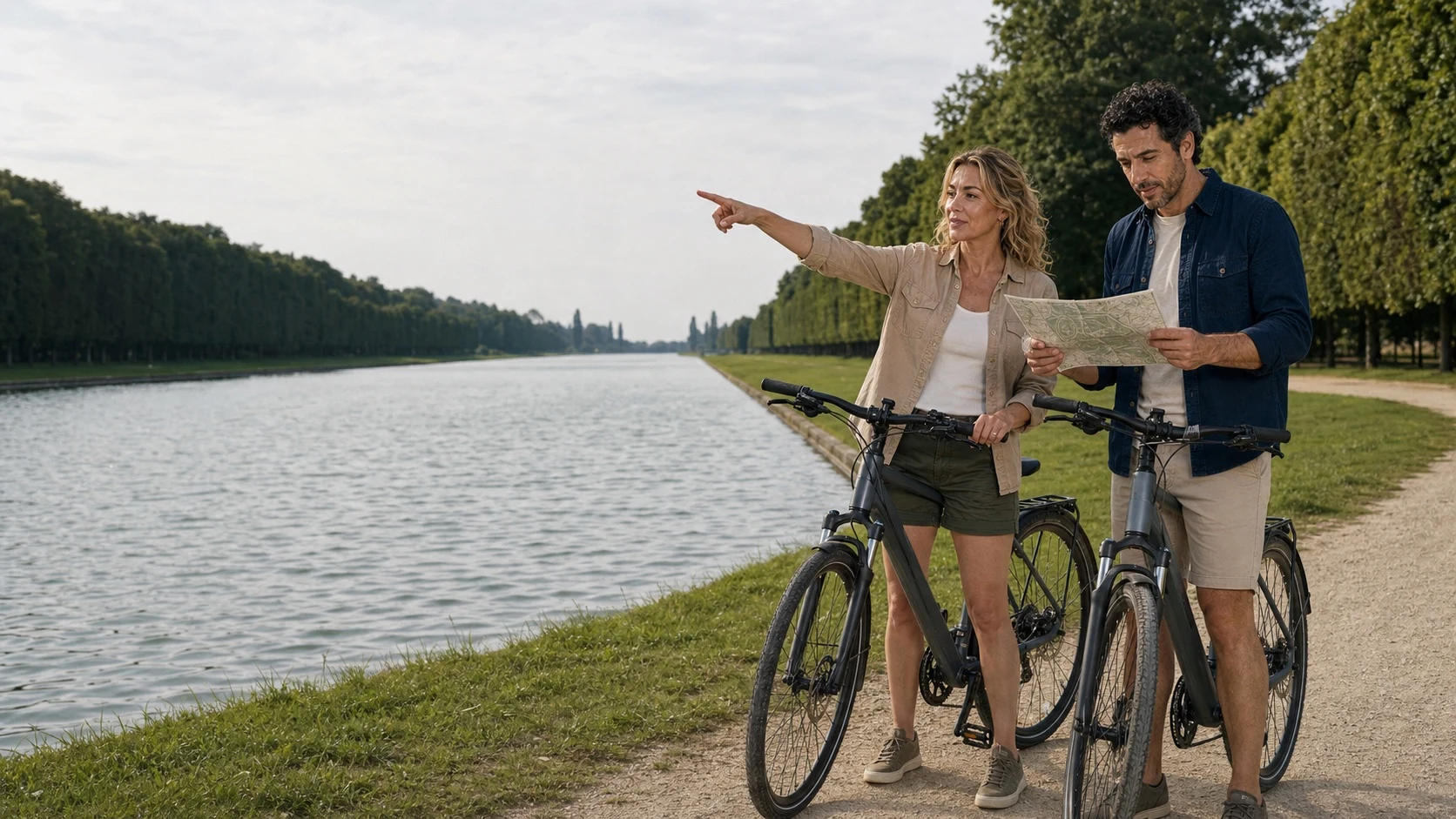
A bicycle does not make Versailles smaller. It makes the distances legible—between town and court, spectacle and machinery, formal garden and working park, royal performance and the private worlds that still depended on labour.
01 · Versailles estate field guide
Versailles begins where the palace postcard ends
The familiar image of Versailles is compressed: a gilded gate, a façade, a strip of clipped hedge and the infinite glitter of the Hall of Mirrors. The real domain resists that frame. It joins a planned royal town to a palace, formal gardens, a vast park crossed by the Grand Canal, two Trianon palaces and the Queen’s Hamlet. The Palace describes the estate as more than 800 hectares. That number is useful, but distance becomes convincing only when the palace has receded behind trees and another royal residence is still ahead.
This is what a bicycle can reveal. It changes the unit of attention from room to landscape and from object to system. A broad park path can show why a canal is an axis rather than a decorative pond. The separation between the main palace and Trianon makes “retreat” feel spatial, not rhetorical. A detour around water or woodland exposes the engineering hidden beneath a fountain display. The market in town becomes part of the story because a court was also an enormous appetite that had to be supplied.
But the bicycle is not a master key. Current official cycling guidance permits cycling in the park and notes a mixture of paved and dirt surfaces. It also prohibits bicycles in the Palace gardens and the gardens of Trianon. Palace rooms are, of course, walked. A responsible bicycle day is therefore a sequence of modes: street, park path, bicycle rack, garden walk, threshold, interior. Any account that turns those boundaries into one seamless ride misunderstands both the rules and the design.

That distinction also protects the history. The gardens were made for controlled approaches and unfolding views, not modern through-traffic. The park operates at another scale. Trianon changes the register again. The Palace concentrates public rank and royal imagery; the retreats complicate the idea of privacy; the Hamlet turns cultivated informality into architecture. Cycling links those arguments without pretending that movement is the same as understanding.
02 · Versailles estate field guide
A hunting lodge becomes a machine of government
Versailles did not begin as the inevitable centre of France. Louis XIII had a hunting lodge built here in the 1620s, away from Paris and close to game. Under Louis XIV, beginning in 1661, the site became a continuing construction project. Louis Le Vau extended and enveloped the earlier lodge; André Le Nôtre reorganised the landscape; Charles Le Brun directed an interior programme saturated with royal imagery; Jules Hardouin-Mansart added major wings and the Hall of Mirrors. The official history of the Palace makes the essential point: what visitors now read as a unified monument is the work of multiple campaigns and many makers.
In 1682 Louis XIV established court and government at Versailles. This was more than a royal change of address. Ministers, courtiers, guards, artisans, clerks, suppliers and servants were pulled into an environment where access to the king could be staged and observed. A Palace account of Versailles as capital records 36,000 workers on the site in 1685, a reminder that the image of effortless magnificence rested on extraordinary organisation and physical labour.
Architecture helped order this society. The king’s rooms were not simply private chambers. Movement toward them passed through graded spaces and encounters. The king’s highly scheduled day—from the rising ceremony through worship, councils, meals, walks and evening retirement—made ordinary bodily routines into political access. The documented rhythm of Louis XIV’s day explains why a doorway or position in a room could carry social meaning: proximity was witnessed, and rank could be performed.
The palace also required a back-of-house city. Kitchens, stores, offices, stables and lodgings sustained the polished route seen by the court. The Grand Commun, built opposite the Palace to house food services for the royal household, is one surviving piece of that infrastructure. Its existence matters because Versailles was never only the king looking outward. It was thousands of people moving food, fuel, linen, messages, water and waste inward and outward every day.
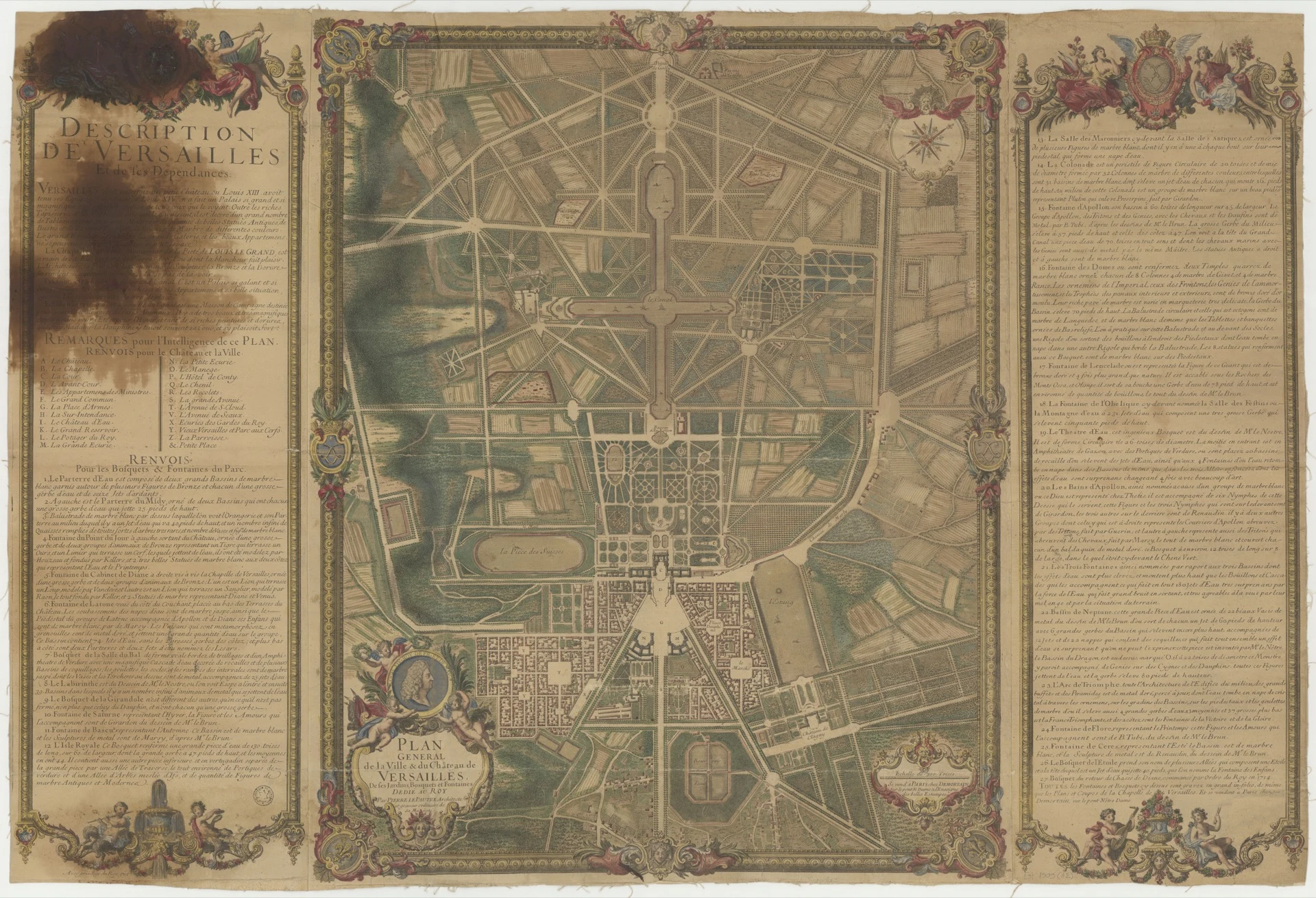
The historical plan should not be mistaken for a modern access map. Paths have changed, buildings have been restored or repurposed, vegetation has matured and visitor management creates present-day thresholds. Its value is interpretive. Versailles appears not as a house with an oversized garden but as a field of aligned institutions: town, court, spectacle, supply, water and retreat.
That total design helps explain Versailles’ international influence and its place on the UNESCO World Heritage List since 1979. Yet influence is not the same as a single author imposing a finished idea. The estate evolved across reigns, regimes and restoration campaigns. The bicycle rider encounters that accumulated work in distance; the walker encounters it in sequence and detail.
03 · Versailles estate field guide
The market belongs to the royal city
A market stop can easily become travel shorthand: “shop like a local,” assemble a picnic and move on. Versailles deserves a more precise reading. The Marché Notre-Dame predates the mature Palace. The City of Versailles dates its foundation to 1634 under Louis XIII and its confirmation and organisation under Louis XIV in 1669. It was part of the provisioning structure of a growing royal town, not a quaint accessory added for visitors.
This changes what to notice. The market’s four squares and covered halls sit within an urban fabric whose scale was shaped by proximity to court. Food here connects agricultural hinterland, municipal regulation, commercial labour and royal demand. A bicycle tour may use the market pragmatically—for a pause or picnic purchase—but the important story is the relationship between appetite and power. The polished Palace required networks of production and exchange far beyond its gates.
The exact stall mix, opening pattern and a tour’s purchase time can change. Consult the City of Versailles’ market information for the day you intend to visit. A guided tour can also alter its sequence. Confirm food inclusions before counting a pastry, cheese, wine or picnic purchase as part of the day.
If the market is open when you visit, use it to ask practical historical questions. Who fed the court? Which foods were seasonal or prestige goods? Where did ordinary commerce meet royal consumption? Even without a purchase, that frame turns a pleasant square into part of the Versailles system.
04 · Versailles estate field guide
Le Nôtre’s garden is an argument in perspective
From the Palace terrace, the garden appears to submit to a single gaze. Straight lines run toward the horizon; pools repeat the sky; clipped vegetation makes living material look architectural. This is an achievement of design, but it is also an illusion. The ground falls away. Cross axes interrupt the main axis. Groves hide rooms behind green walls. Water features appear, vanish and reappear as the visitor changes level.
André Le Nôtre’s work at Versailles built on decades of garden practice and collaboration. The central east–west line extends from the Palace through the Latona and Apollo fountains toward the Grand Canal, while secondary paths organise movement across it. The Palace’s account of Le Nôtre emphasises his command of perspective and the coordination of landscape with architecture. The garden does not merely decorate the building; it projects its ordering principles across terrain.
The groves resist a quick axial reading. Enclosed by trellis, hedges or trees, they functioned as outdoor salons and performance settings. Their designs changed repeatedly with taste, maintenance and royal use. Some survive in substantially altered form; others have been restored from historical evidence. The official history of the groves describes a landscape of successive creations rather than an untouched seventeenth-century original.
This is why the no-bicycle rule in the formal gardens is not an inconvenience to evade. Walking slows the sequence to the speed at which the design works. The surface beneath the feet changes. A hedge that looked flat from the terrace becomes a wall. A fountain is heard before it is seen. A path that seems symmetrical may be compensating for slope and distance. Even the best bicycle day needs protected walking time here.
Beyond the formal garden, the park expands the visual grammar. Tree-lined avenues and the cruciform Grand Canal stretch the axis into a landscape designed for movement, boating, hunting and spectacle. The canal is not simply an elongated reflecting pool. It gives the estate a distant centre, divides routes and magnifies the effort required to move between the Palace and Trianon.
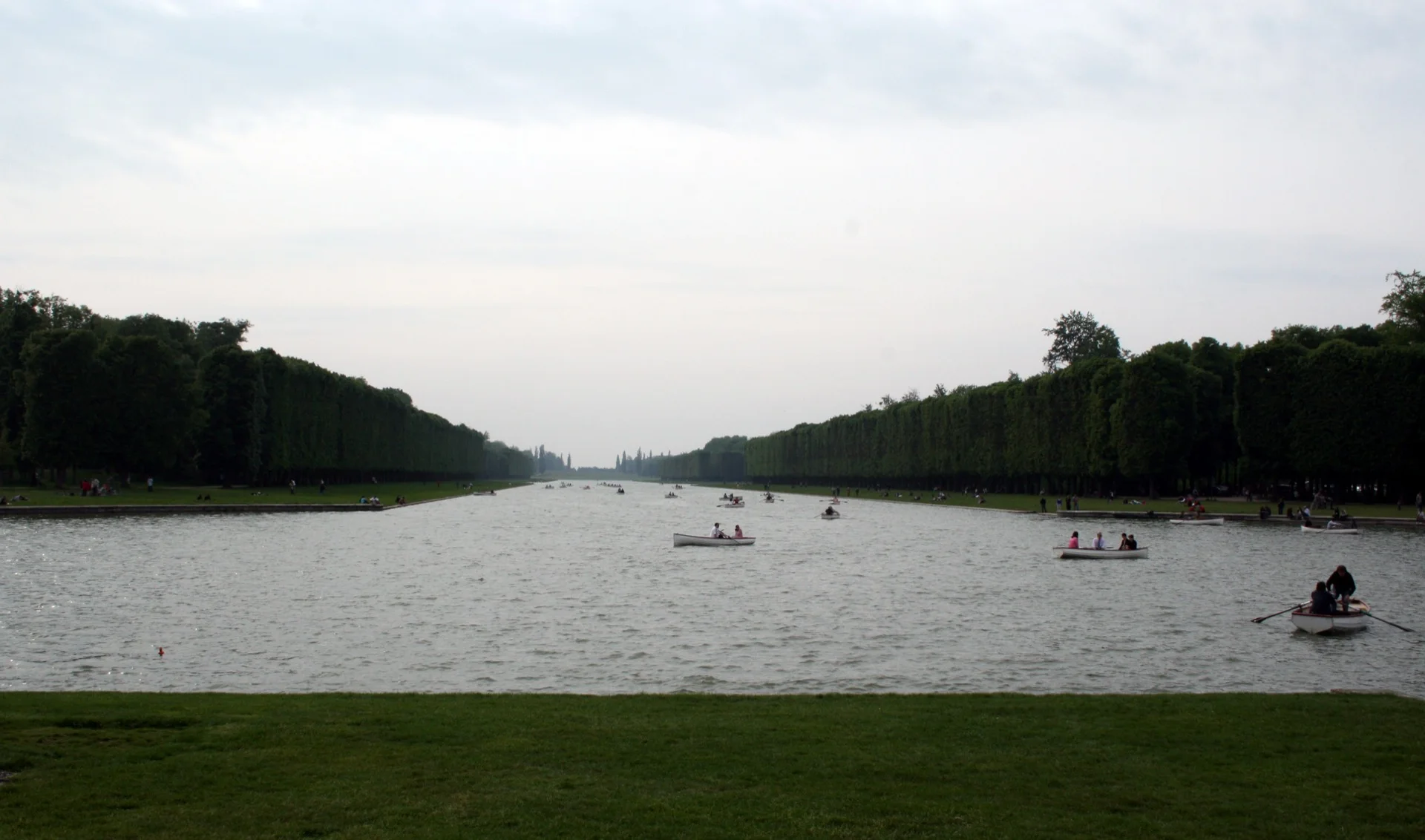

On a bicycle, the canal’s apparent simplicity breaks apart. Shorelines take time to follow. Cross arms create choices. The Palace can disappear even while the organising axis remains. The rider experiences a useful contradiction: the landscape looks geometrically controlled, but its scale exceeds a single glance.
05 · Versailles estate field guide
Water is the estate’s invisible monument
Versailles was a difficult place for the water display Louis XIV wanted. Local supply was limited, the terrain created lifting problems and the expanding number of fountains increased demand. The effortless jet of water seen by a courtier therefore concealed reservoirs, pumps, pipes, valves, aqueducts, repairs and expert workers.
Early systems drew on nearby ponds and raised water from local sources. As the garden grew, engineers pursued more ambitious schemes. The most famous was the Machine de Marly, built on the Seine at Bougival between 1681 and 1685. Fourteen large water wheels powered a staged system of pumps intended to lift water uphill toward the Louveciennes aqueduct and onward to the royal domains. It was celebrated as an engineering marvel and employed a large workforce, but it was expensive, maintenance-heavy and delivered less water than hoped. The Palace’s history of water at Versailles is unusually candid about both ambition and disappointment.

This engineering should be understood as a system, not a gadget. Water wheels converted river current into mechanical motion. Reciprocating pumps raised water through successive levels because a single lift was impractical. Timber and metal components worked under continuous stress. Long runs of pipe leaked. Reservoirs created buffer and pressure. The aqueduct carried water across the upper landscape. Each link required builders and operators.
The Liège-based engineer Rennequin Sualem drew on the mining pumps of Wallonia when designing the machine. Moving water out of underground workings supplied knowledge that could be redirected toward a royal spectacle. His contribution connects Versailles to an industrial landscape beyond France: the court’s display depended on specialist skills as well as money and command.
At the fountains, the Francine family and other hydraulic specialists managed another layer of scarcity. When the king and court moved through the gardens, fountain keepers could coordinate flows so that nearby displays came alive while more distant jets were reduced. The sequence created the impression of abundance without supplying every effect at maximum force all the time. Spectacle depended on timing.
That fact changes the meaning of a fountain. Apollo rising from the water is iconography; the jet is engineering; the decision about when it runs is court choreography; the labour that makes it repeatable is administration. A single feature belongs simultaneously to art history, hydraulics and politics.
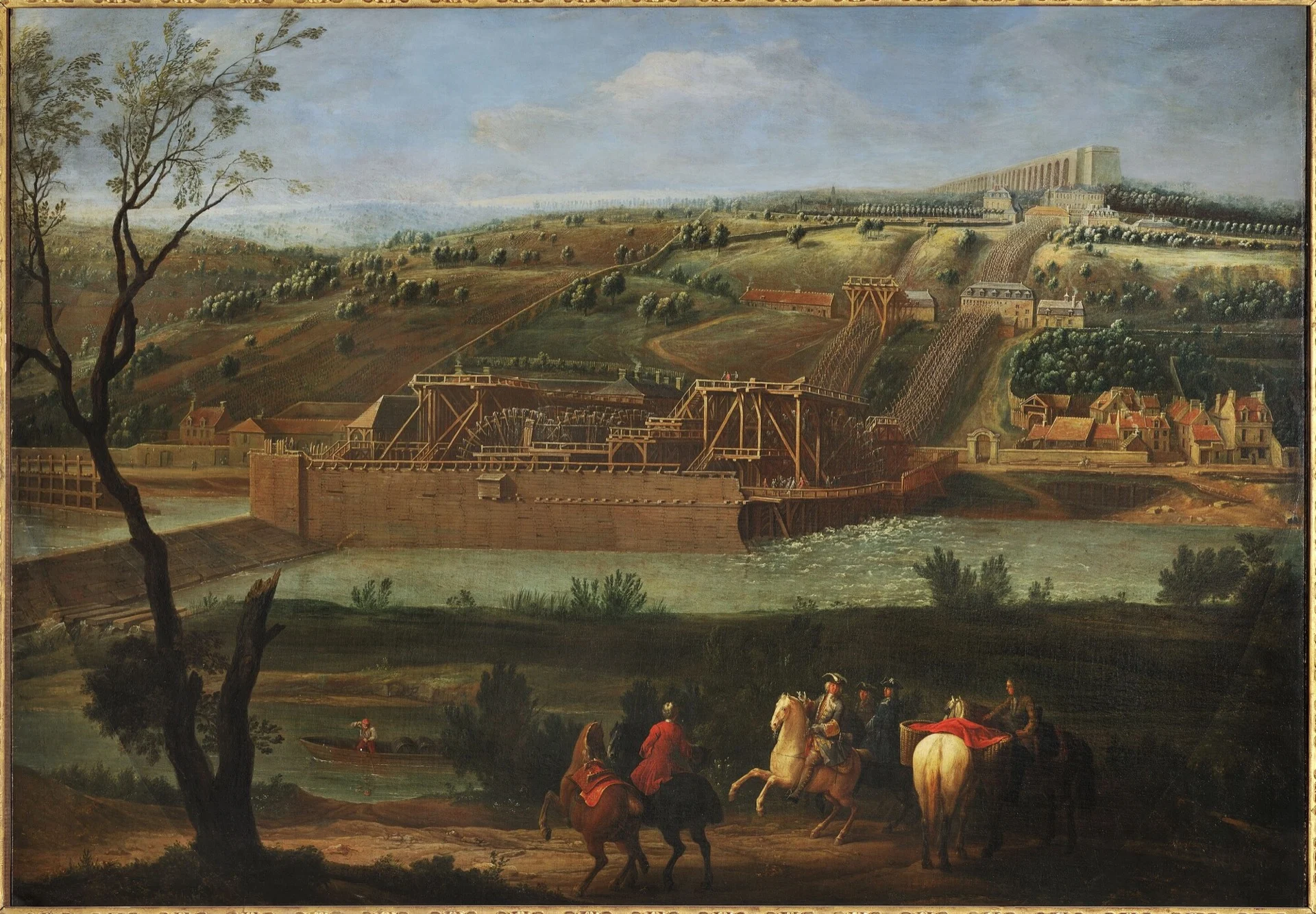
The Machine de Marly was not the only water project, and its image should not imply that every drop at Versailles came from it. Reservoirs, pond systems and other works contributed at different times. Nor did a seventeenth-century solution remain frozen. The hydraulic network was modified, replaced and restored across centuries. What persists is the governing problem: water at Versailles is a managed resource presented as natural abundance.
The modern system also makes reuse visible. Closed-circuit pumps return water from the Grand Canal to the Montbauron reservoir, from which gravity feeds the fountains. Fountain engineers conserve older techniques alongside modern machinery, and many valves still require manual operation. The canal is therefore more than a distant line in a garden view: it participates in the water network that makes the spectacle possible.
For a present-day visitor, fountain operation remains scheduled and seasonal rather than guaranteed by the existence of a basin. Check the official programme and the admission entitlement for the day you plan to visit. Treat a dry fountain as evidence of a system with constraints, not as a failed photograph.
06 · Versailles estate field guide
Why the bicycle works in the park
The bicycle’s great advantage is not speed alone. It keeps the body connected to the terrain. A rider feels the length of an allée, the drag of an unpaved surface, the pause imposed by a crossing and the extra distance created by water. This is enough effort to make scale memorable without turning every transfer into a long walk.
The park is the right place for that advantage. Official guidance distinguishes it from the Palace gardens and Trianon gardens, where bicycles are prohibited. In the permitted park, paths can be paved or dirt. Weather changes them. Loose gravel, mud, heat, wind and other users affect comfort. A route that looks flat on a promotional page may still involve cambers, rough patches, stopping, starting and controlling a bicycle in a group.
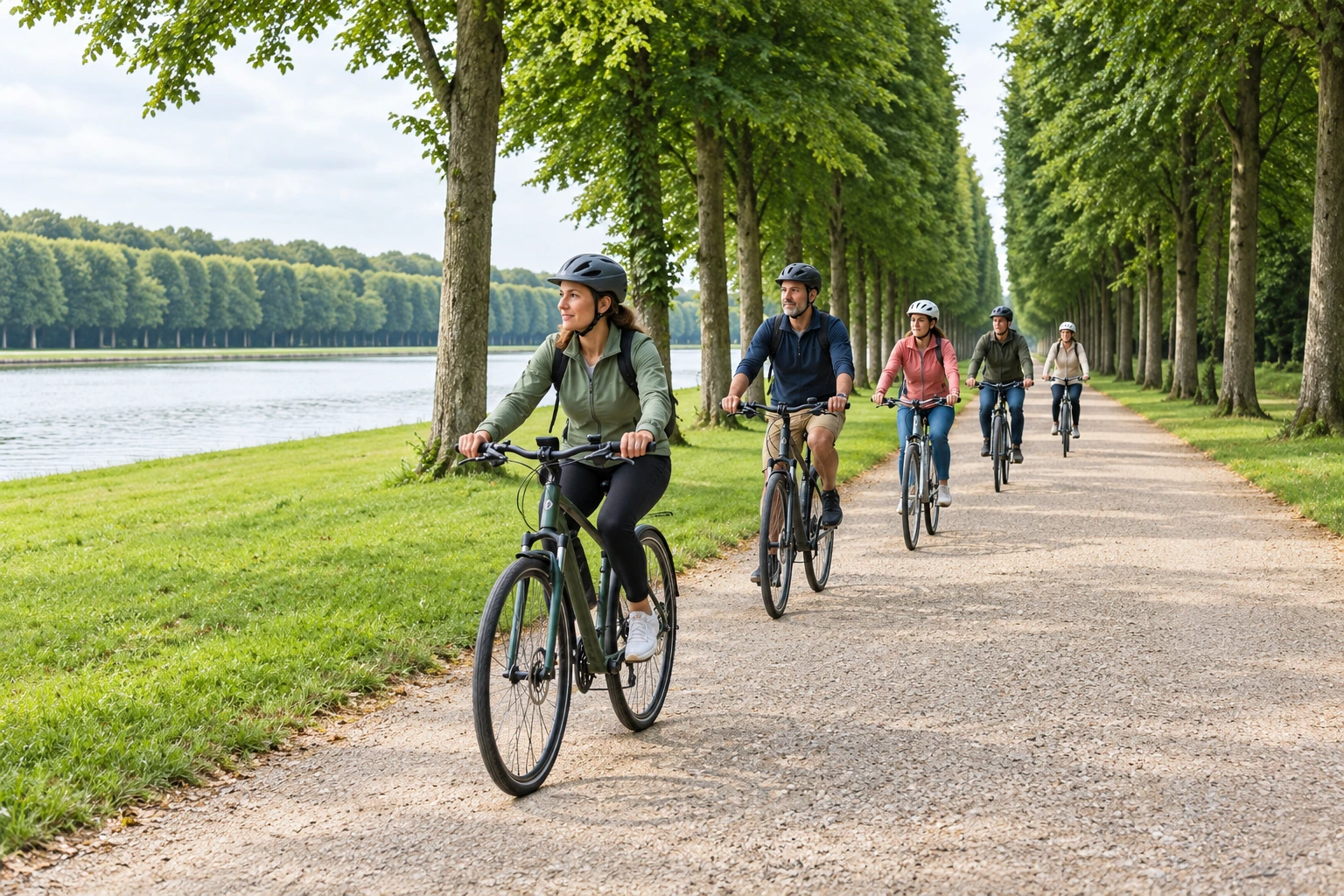
That distinction matters for planning. “Can ride a bicycle” is not a complete suitability test. A participant may need to start from a standstill on gravel, look behind while holding a line, brake predictably near pedestrians, follow group instructions and remain comfortable through repeated mounting and dismounting. Bicycle fit and condition matter. So do the operator’s current rules for young riders, seats, trailers, helmets, bags and maximum loads. None should be inferred from an old photograph or podcast anecdote.
Independent visitors have another option: official bike hire within the estate. Rental points, opening periods, prices, equipment and last-return times are mutable, so confirm them directly. Independent riding offers control over pace and pauses, but it transfers route planning, ticket coordination, bicycle return and contingency decisions to you.
Whichever format you choose, plan the day as a set of protected transitions. Park the bicycle before walking into a prohibited garden. Keep the key or return token secure. Do not assume a rack will accept every lock. Allow time to find the correct entrance after dismounting. If a timed Palace slot is part of the day, work backwards from it rather than treating the interior as an optional finale.
The best bicycle sections are often the least photogenic: the stretches that reveal how far the Trianon estate sits from the main Palace, how woodland interrupts a view, or how the Grand Canal reorganises movement. Those are not dead minutes between attractions. They are the evidence for why Versailles was built as a domain.
07 · Versailles estate field guide
Grand Trianon: withdrawal without simplicity
Louis XIV wanted a place where he could step away from the most public demands of the main Palace. In 1670 the Porcelain Trianon offered an early retreat, named for its blue-and-white tile decoration. It proved fragile and was replaced. Jules Hardouin-Mansart’s Grand Trianon, completed in 1687, used pink marble, pale stone and a low, garden-level composition joined by an open colonnade.
The contrast with the main Palace is immediate. The Grand Trianon spreads laterally rather than climbing toward a dominant central block. Rooms and gardens appear closer to one another. The colonnade opens the building to air and landscape. The scale feels intimate by Versailles standards.
But “private” is relative. A royal residence required guards, food, furnishings, gardens, heating, cleaning, transport and rules of invitation. Louis XIV could choose a smaller circle here, yet the setting remained constructed and serviced. The retreat did not suspend hierarchy; it changed its audience.
The official history of the Grand Trianon also prevents the building from being sealed inside one reign. Napoleon refurnished and used it. Later French governments found new roles for it, including state hospitality. Every phase altered what visitors now see. The building is both a Louis XIV retreat and a record of later regimes negotiating the royal inheritance.
08 · Versailles estate field guide
Petit Trianon: a change in architectural language
The Petit Trianon belongs first to Louis XV, not Marie Antoinette. Ange-Jacques Gabriel designed it in the 1760s within the king’s botanical and experimental garden environment, and it was completed in 1768. Its compact cubic form and carefully differentiated façades mark a shift toward neoclassicism. Ornament is controlled; proportion and surface carry the argument.
Louis XVI gave the estate to Marie Antoinette after his accession. Her association with the building became so strong that the earlier scientific and court context is often erased. Restoring the chronology makes the place more interesting. The Petit Trianon was already a royal experiment in cultivated privacy before it became the centre of the queen’s personal domain.
The building’s rooms still organised service as well as withdrawal. Devices and circulation could reduce visible encounters between household labour and elite occupants, but invisibility is not absence. Food arrived. Fires were tended. Rooms were cleaned. Gardens were redesigned and maintained. The architectural pursuit of privacy produced more elaborate boundaries between those being served and those serving.
The official Petit Trianon account gives the necessary anchors: Gabriel, Louis XV, completion in 1768 and the later queen’s use. A visit should preserve that sequence instead of beginning with a tragic celebrity narrative.
09 · Versailles estate field guide
The Queen’s Hamlet is not a peasant-costume anecdote
The Queen’s Hamlet turns an ideal village into a royal landscape. Rustic buildings gather around a lake; thatch, half-timbering, gardens, a tower and a mill compose a rural image. Its meaning lies in the relationship between aristocratic reception, picturesque design and a separate productive farm. Reading those functions together explains more than the familiar peasant-costume tale.
Richard Mique designed the Hamlet from 1783, and the ensemble was largely complete by 1786. It extended the queen’s English-style garden, where irregular paths, water, varied planting and composed views rejected the straight-line grammar of the main gardens. The village was not one undifferentiated fantasy. The Palace’s history of the Queen’s Hamlet describes three areas: a reception zone around the Queen’s House, a more secluded zone and a working farm area intended to supply agricultural products.
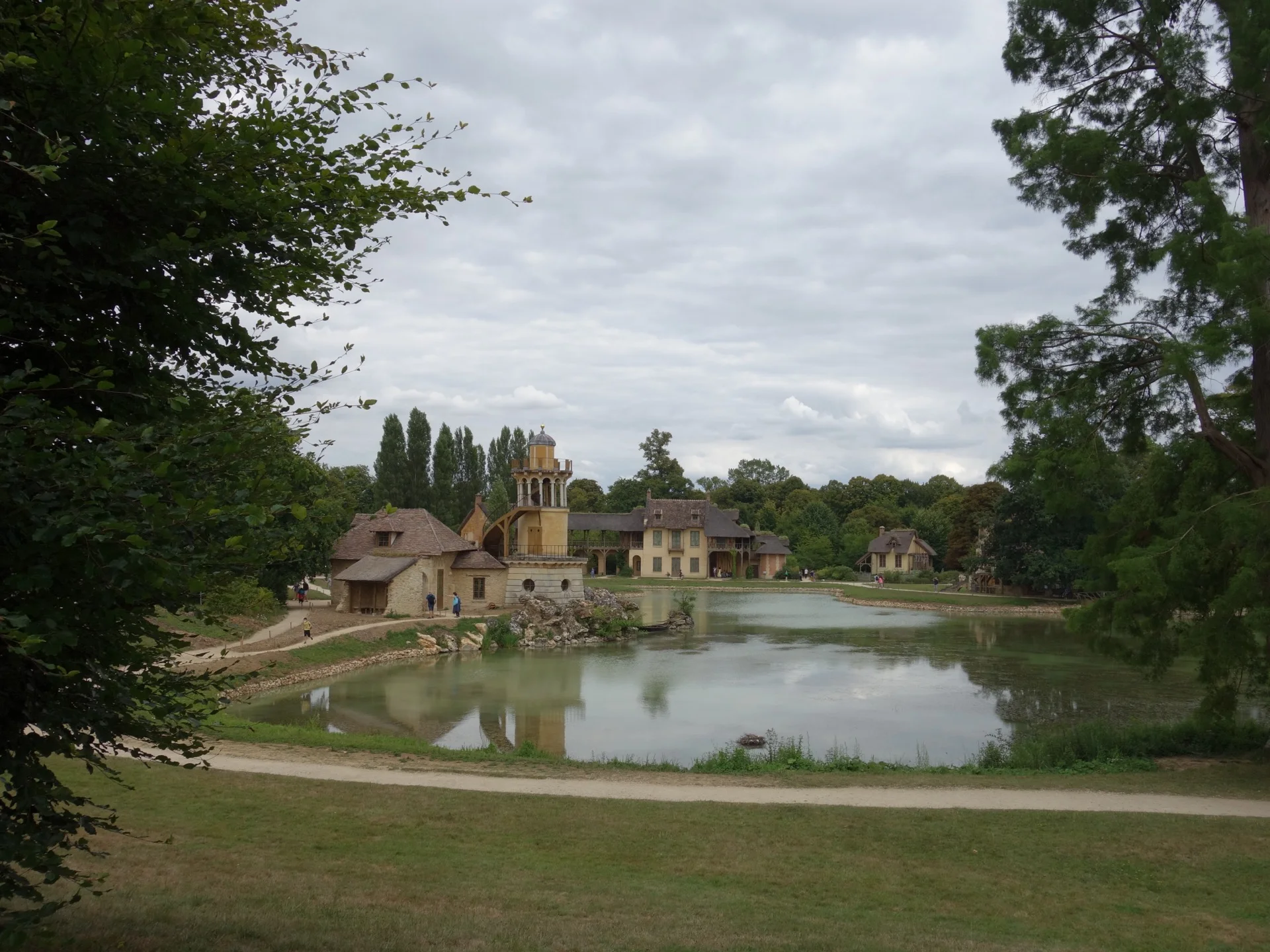

Several details puncture the simplified myth. The mill’s wheel was decorative rather than a working grain mechanism. The productive farm was a distinct area with workers and animals. Reception buildings used rustic exteriors to frame sophisticated social use. Vegetable plots, dairies and agricultural activity did not erase the difference between royal leisure and labour.
This does not make the Hamlet less artificial; it lets us describe the artifice accurately. The picturesque style valued irregularity, surprise and emotional association. A building could look weathered while being new. A village scene could be carefully arranged to appear spontaneous. The queen’s experience of rurality was protected by ownership, service and controlled access.

The Hamlet also has an afterlife. Revolutionary damage, nineteenth-century changes, twentieth-century restoration supported by John D. Rockefeller Jr. and more recent work all shaped the ensemble. The farm was reconstructed in the early twenty-first century. Visitors are therefore not looking at a sealed 1786 survival. They are looking at a conserved cultural landscape whose authenticity lies in documented relationships, materials, uses and restoration choices—not in pretending nothing changed.
This is a good place to slow down and test what the bicycle day has achieved. The ride explains why the queen’s domain could feel removed from the main Palace. The walk explains how the removal was designed. Neither supports a cartoon of effortless pastoral innocence.
10 · Versailles estate field guide
The Palace is not a reward left over at the end
A bicycle itinerary can accidentally demote the Palace to a timed interior after a full outdoor day. That is a mistake. The building is the political and symbolic engine from which the rest of the estate makes sense. If the schedule leaves only exhausted minutes for its rooms, the day has protected reach at the expense of meaning.
Inside, do not treat the State Apartments as a succession of decorated boxes. Ceiling paintings, marble, textiles, furniture and room names created a programme of comparison between the king and classical or planetary figures. Charles Le Brun’s direction connected decorative arts to political narrative. Royal workshops and court suppliers turned material excellence into a claim about French power and production.
The Hall of Mirrors is the most concentrated example. Hardouin-Mansart designed the gallery during the building campaign of 1678–1684, and Le Brun developed its painted programme. Seventeen window bays facing the gardens answer seventeen mirrored arches on the inner wall. Across those arches, 357 mirrors multiplied light, movement and the garden view. At 73 metres long, the gallery was both a passage and a theatre of rank.
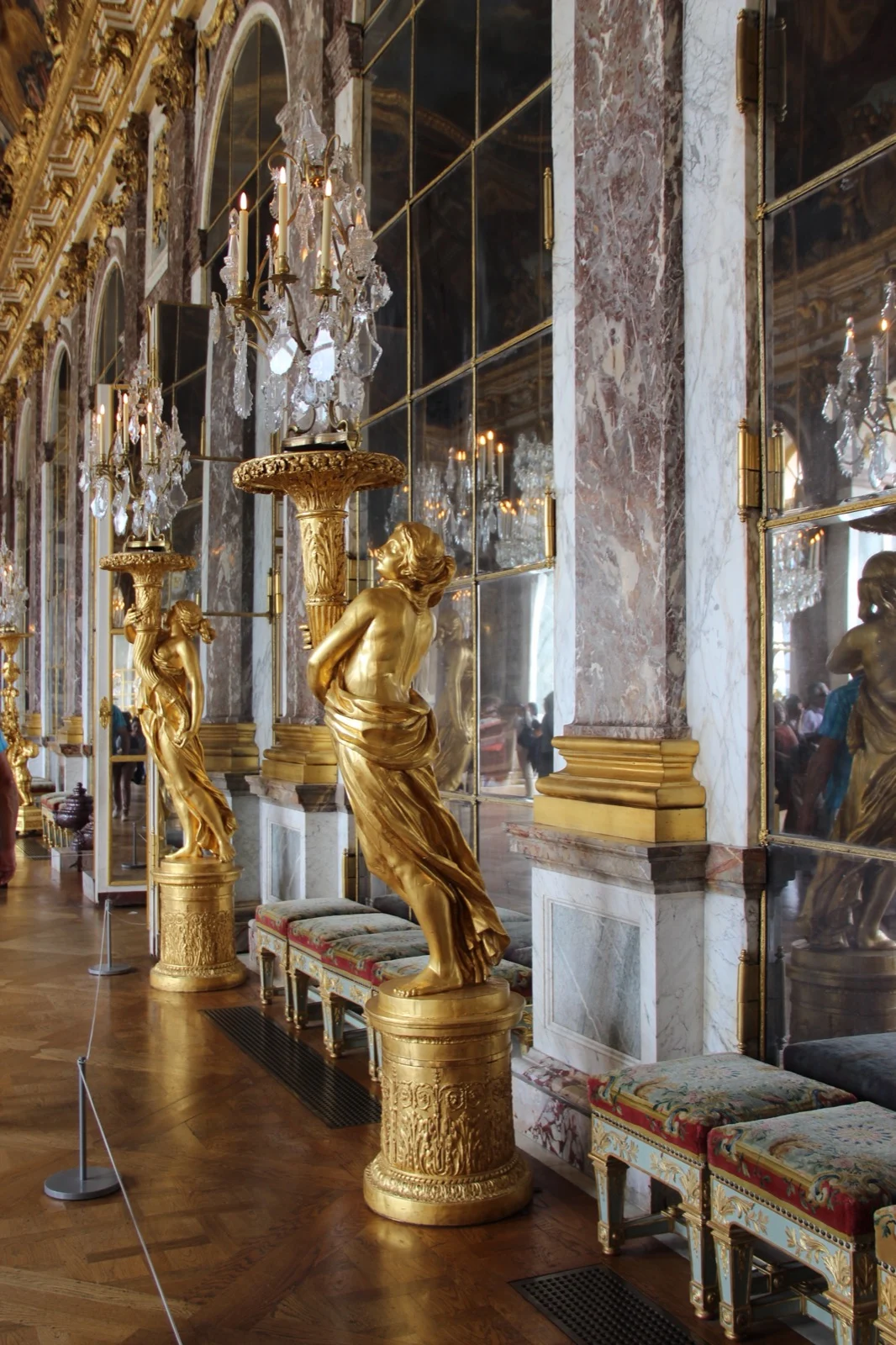

Mirrors of this scale also spoke to manufacture. Venice had dominated high-quality mirror production; the French crown’s ability to assemble such a gallery supported a broader policy of attracting skills and developing luxury industries. The material itself participated in state competition.
The gallery’s later uses complicate the triumphal programme. It received ambassadors and court events. The German Empire was proclaimed there in 1871 after France’s defeat. The Treaty of Versailles was signed there in 1919. The same room has been made to represent royal monarchy, national humiliation, international settlement and present-day state ceremony. Its meaning is not contained by Louis XIV.
The official Hall of Mirrors history supplies the dimensions, mirror count and key events, but the room itself supplies another fact: it is usually experienced among other visitors. Crowding changes perception. Reflections fragment. Photography competes with looking. If you want to understand rather than merely confirm the room, pick two details—the relation to the garden and one ceiling scene, for example—and give them sustained attention.
A guide cannot make the gallery private, remove the security threshold or guarantee a particular density of visitors. A good guided route does something more useful: it gives the room an intellectual structure. Before entering, decide which claims the mirrors, ceiling and garden-facing windows were built to make. Inside, let the guide locate those claims, then protect a short interval for looking rather than trying to record every surface. The goal is not to outmanoeuvre a crowd but to keep the crowd from dictating the whole experience.
Elsewhere, court ritual becomes spatial. The king’s bedchamber was a place of ceremonial rising and retiring, not simply sleep. The Queen’s Apartments carried dynastic and public roles. The chapel staged rank vertically and horizontally. Doors, antechambers and sightlines sorted access. Service routes and the Grand Commun remind us that every polished public sequence depended on work that visitors were not meant to notice.
The Palace has also changed through removal and return. Revolutionary sales dispersed furnishings. Later governments transformed parts of the complex. Louis-Philippe opened a museum dedicated to French history in the nineteenth century, altering rooms to fit a national narrative. Modern restoration has reconstructed ensembles through research, acquisition and conservation. “Original” at Versailles can mean surviving fabric, documented recreation, returned object or a historically informed arrangement; those categories should not be collapsed.
11 · Versailles estate field guide
Doors, beds and the grammar of rank
To read court ritual, start with the distance between a person and a doorway. Versailles’ etiquette governed who could approach important figures, when they could do so, how they addressed them and even which kind of seat they could use. The Palace’s account of the courtiers describes a varied society of nobles, officeholders, workers and visitors. Attendance could bring allowances, accommodation and opportunities for favour; offices could be inherited or bought. Military and administrative service also mattered. The system rewarded proximity, but court society cannot be reduced to every noble spending a fortune on clothes until resistance became impossible.
The Bull’s Eye Antechamber makes the mechanics easier to understand. In 1701 Louis XIV moved his bedchamber and combined two earlier rooms into this larger waiting space. Its name comes from the oval œil-de-bœuf window. The documented history of the antechamber describes successive entrées: admissions to the king’s rising ceremony assigned by rank or function. Physicians and royal children belonged to the intimate first admission; other courtiers entered at later stages. Waiting here was therefore participation in a controlled sequence, rather than simply delay before a meeting.
The King’s Bedchamber occupied the centre of the Marble Courtyard façade from 1701. Rising and retiring ceremonies made the bed a focus of public access; Louis XIV died here in 1715. The threshold between waiting room and chamber could turn a domestic act into a visible distribution of honour. On a permitted room route, ask the guide to explain who stopped at each threshold and who was admitted further. That question recovers the function beneath the furnishing.
Even the textile surface carries more than one date. The crimson-and-gold design from Louis XIV’s reign is not known in sufficient detail; the modern reweaving used a documented brocade commissioned in the 1730s. The royal silk record distinguishes that evidence from a surviving 1701 ensemble. Reading a restored room means looking at its court function and its later reconstruction together.
12 · Versailles estate field guide
The Royal Chapel makes hierarchy visible
The Royal Chapel extends the court’s ordered world into worship. Completed in 1710, it was Louis XIV’s final major architectural addition to the Palace. Jules Hardouin-Mansart presented the design in 1699; after his death in 1708, Robert de Cotte brought the work to completion. The official chapel history explains the combination of tall windows and Gothic references with an upper classical colonnade. Its dedication to Saint Louis also connected the Bourbon monarch to a royal saint and ancestor.
The two levels followed a palatine chapel tradition. The king and royal family occupied the tribune; lateral galleries accommodated other privileged participants, while officers and members of the public attended in the nave. The arrangement made rank visible during a shared religious ceremony. It was more differentiated than an image of every aristocrat forced onto the same ground-floor position. Notice how galleries, supports and sightlines join the religious space to the wider grammar of controlled access.
The painted vault gives the height a theological programme. Antoine Coypel painted God the Father at the centre, Charles de La Fosse the Resurrection in the apse, and Jean Jouvenet the descent of the Holy Spirit above the royal gallery. The Palace’s chapel study also records the organ installed in 1710, built by Robert Clicquot and Julien Tribuot. Paint, sculpture, architecture and music formed one ceremonial environment. A ceiling becomes easier to read when you locate its distinct scenes rather than treating the whole surface as undifferentiated splendour.
Light belonged to material history as well as devotion. The royal glass manufacture, founded in 1665, supplied the Hall of Mirrors and glass for the chapel windows. Clear glazing was an expensive technical achievement. The exterior restoration completed in 2021 repaired roofs, structural timber, sculpture and windows; analysis helped distinguish early glass from later replacements. The restoration account reveals how much skilled work sustains the apparent unity of the room.
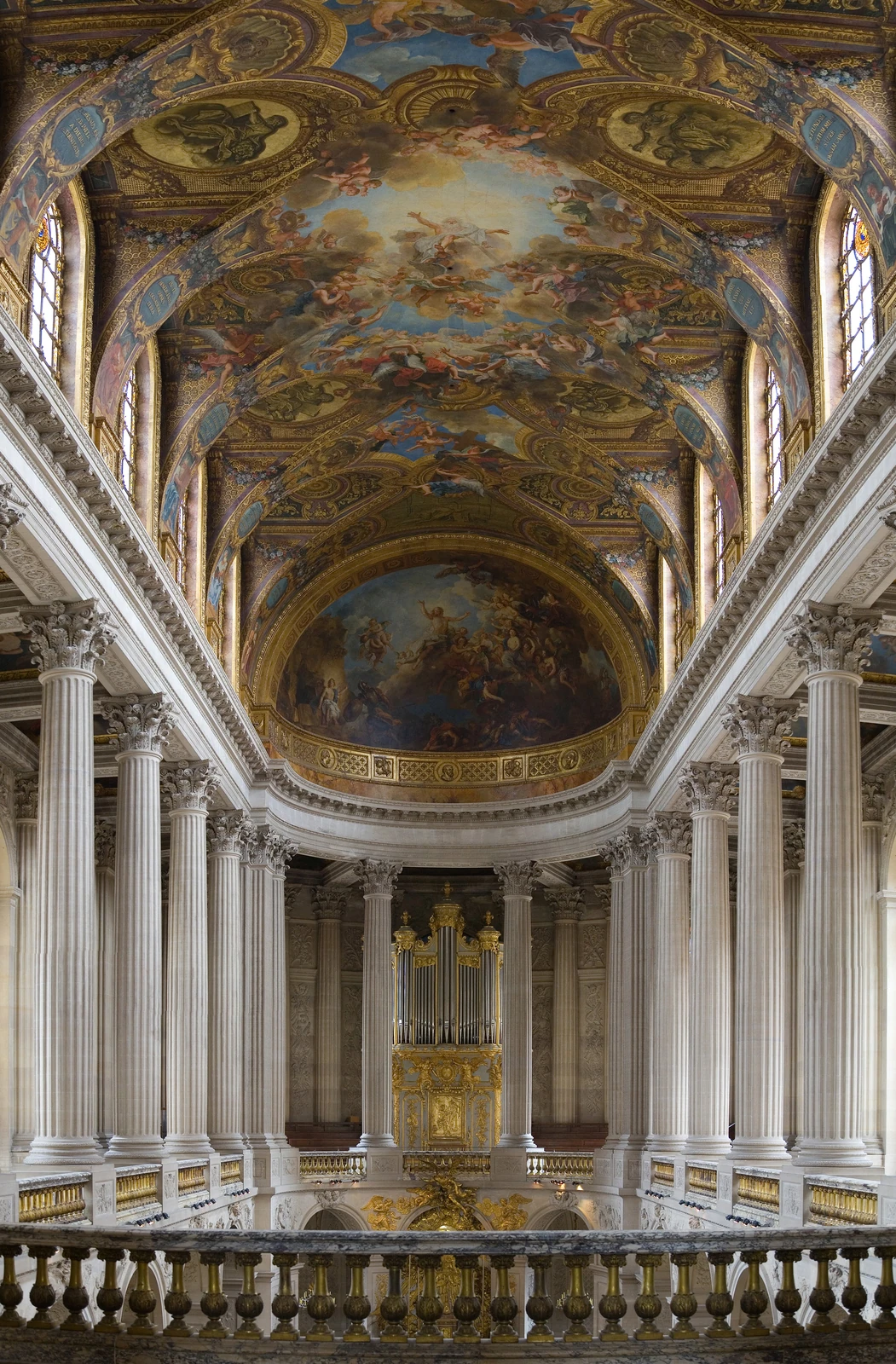

Use the chapel as an interpretive connection between rank, belief and craft. Viewing points and admission vary with the ticket and visit programme, so confirm what your route permits before making the interior or royal tribune a required stop. Its historical role remains useful to understanding the Palace even when the day’s route offers only a limited view.
13 · Versailles estate field guide
Revolution, museum and conservation are part of the visit
The Palace’s scale can tempt a simple explanation of the Revolution: extravagant building exhausted France, and the country rebelled. The crisis was more complicated. Eighteenth-century wars, borrowing and expenditure strained royal finances; attempts at fiscal reform in 1787 met resistance from the Assembly of Notables and the law courts. The argument became a dispute over who could consent to taxation and represent the nation. Louis XVI called the Estates-General in 1788, and it assembled at Versailles in May 1789. The George Mason University history project, with its linked contemporary documents, traces that passage from debt to contested authority. Versailles helps make privilege visible, but a ceiling or fountain cannot by itself explain a political revolution.
Versailles’ court function ended through political crisis, not graceful succession. In October 1789, after women from Paris marched to Versailles amid bread scarcity and revolutionary tension, the royal family was taken to Paris. The Palace lost the resident court that had made its spaces operate as designed.
The complex survived because later regimes found uses for it. Museum, national memorial, diplomatic stage and heritage site layered new purposes onto royal architecture. Those uses sometimes preserved and sometimes transformed. Restoration choices have also reflected the evidence and priorities available in different periods.
UNESCO’s inscription recognises the Palace and Park as a major work of human creative genius with enormous influence, but World Heritage status does not freeze a living site. Storms, disease, wear, climate, crowds and changing conservation knowledge affect buildings and landscapes. Trees are replanted. Roofs and galleries are repaired. Decorative surfaces are cleaned. Water systems are maintained. Access may close around that work.
The result is a productive tension. Versailles is an image of permanence sustained by continuous intervention. The bicycle rider sees young and mature planting, closed paths and service movement across the domain. The Palace visitor sees conservation barriers or missing objects. These are not intrusions on the “real” Versailles; maintenance is one of the realities that has always made the estate possible.
14 · Versailles estate field guide
A guided Palace route protects attention, not access
A Palace-and-gardens guided visit answers a different question from a bicycle day. The bicycle format asks how town, park, canal and retreats fit together across distance. A Palace-led format asks how to read a dense sequence of rooms without letting ornament flatten into one uninterrupted impression of gold. Both belong to the same Versailles system, but they allocate time differently.
The useful interior sequence begins before the Hall of Mirrors. In the State Apartments, a guide can identify how ceiling programmes, room names, portraits and materials built a language of monarchy. Doorways and antechambers then become evidence of graded access rather than corridors between highlights. By the time the group reaches the gallery, the mirrors are no longer an isolated superlative: they connect French manufacture, garden perspective, court movement and later diplomatic history.
Guidance does not override the institution operating around the group. Official security rules say that bags are checked systematically and that every visitor must cooperate with entrance controls. Timed admission manages access to the Palace; it is not a promise that security or movement inside will be instantaneous. A reseller's phrase such as “priority” or “skip the line” must therefore be separated into exact questions: priority to which checkpoint, at what entrance, and with which controls still applying?
Pacing matters more than a heroic promise to cover every room. Ask what the guided portion actually includes, where commentary is permitted, whether headsets are used, and where the guide leaves the group. A shorter route with clear interpretation can be more valuable than a rushed catalogue. If the ticket also permits independent garden or Trianon time, treat that as a second phase with its own distances, opening framework and access rules—not as effortless surplus after the Palace.
Preserve options as well as a timetable. Carry only what will pass the current bag rules, know which part of the estate you most want to understand, and keep enough uncommitted time to slow down outdoors or shorten a route if conditions demand it. Check the official practical information page and live calendar when choosing the date.
15 · Versailles estate field guide
A driver and a guide solve different problems
A privately arranged day with a chauffeur and a guide can remove several coordination tasks: finding the right suburban train, reaching a meeting point and organising the return. It also allows the conversation to begin with your interests rather than a group’s shared brief. Its value depends on how those two roles join up. The chauffeur manages the vehicle and road journey; the guide interprets the place and helps shape the time spent there. Establish which person accompanies you at each stage and whether the guide’s time extends beyond the Palace.
The useful preparation is specific. A first visit might prioritise the State Apartments, the Hall of Mirrors and enough garden time to understand the axis. Someone interested in court ritual might prefer an explanation of chapel, antechamber and bedchamber relationships. A return visitor might want Trianon and the landscape to lead. Discuss those priorities before the day, then ask which can be accommodated within the actual ticket and room route. A private group does not make a public monument private.
Handled transport also changes the balance of energy. It can preserve attention for the interiors and remove the cycling demands of balance, braking and bicycle return. The remaining estate distances still matter. Being dropped near an entrance does not transport you between every room, garden and retreat; Trianon requires its own transfer and walking plan. Build rest and seated time into that plan when needed, and distinguish a shorter walk from a fully accessible route.
Before booking, confirm pickup and return boundaries, the actual vehicle and passenger capacity, child restraints where relevant, transfer assistance, the named ticket entitlements and the meeting procedure if chauffeur and guide arrive separately. For an accessibility requirement, check the complete sequence from vehicle to entrance, interior route, toilets, gardens and return. The Palace’s accessibility information helps identify institutional provision; the transport operator must establish what its vehicle and assistance can support.
Finally, leave a margin between the estate programme and the return commitment. Road travel still involves traffic, and a carefully paced visit can overrun if its priorities are unclear. Agree on the point at which the guide’s service ends and the return vehicle is met. The strongest reason to choose this format is the ability to spend attention deliberately, with the movement and interpretation organised around the same realistic day.
16 · Versailles estate field guide
A bicycle day is a sequence of transfers
The practical quality of a Versailles bicycle day depends less on one headline inclusion than on its transitions. A successful route coordinates transport from Paris, meeting the group, bicycle fit, urban riding, food, permitted park paths, bicycle parking, walking at Trianon, timed Palace entry and the return journey. Each transition can consume attention and time.
Paris to Versailles
Choose the railway station in relation to your first stop. Line L connects Paris Saint-Lazare with Versailles Rive Droite, a useful approach to the town and Notre-Dame market. Other Paris routes reach different Versailles stations, so compare the walk from your arrival station with the agreed meeting point or estate entrance. Check the journey planner for your travel date and allow time to find the group or doorway after arrival. Use the official Transilien Line L page and the Versailles Rive Droite station page close to travel.
Work backwards from the meeting deadline. Allow time to find the correct exit and walk or ride to the rendezvous. Do not assume a guide can wait for a late train. Ticket and fare rules change; use Île-de-France Mobilités rather than an old podcast price.
Meeting point and city riding
Confirm the written meeting point on the live voucher. Versailles has traffic, pedestrians, market activity and junctions before the estate paths begin. “Bike tour” does not mean every metre is separated from vehicles. If street riding is a concern, ask the operator to describe the start and finish rather than relying on a generic safety adjective.
Arrive early enough to report fit problems. Saddle height affects control. Brakes should be understood before movement. Ask where belongings go and what happens if the bicycle develops a fault. A pannier visible in one photograph is not a guaranteed feature of every bicycle.
Park, gardens and Trianon
Use the bicycle for the permitted park connections. Dismount where rules require and wherever crowding makes riding inconsiderate. The gardens of the Palace and Trianon are walking spaces under current official guidance. The exact rack and entrance used by a group may change with operations.
At Trianon, protect enough walking time to distinguish Grand Trianon, Petit Trianon and the Hamlet rather than turning them into one stop. The Trianon Estate page notes that it is roughly a 30-minute walk from the main Palace under ordinary conditions, which explains the attraction of a bicycle. Check its official access information near the visit because opening arrangements and available routes can change.
Palace entry
A product that includes Palace access still needs a current written check: which ticket, which timed entry, which entrance, whether the guide enters, which rooms form the guided route, how long remains inside and what happens if earlier stages run late. The 2026 ticketing page, timed Passport information and official FAQ are the controlling references for independent planning.
Bag restrictions matter on any Versailles day. The current Vigipirate guidance says bags are checked systematically and excludes bags larger than 55 by 35 by 20 centimetres. The separate left-luggage page describes lockers for smaller items but does not make storage a universal solution for prohibited luggage. A comfortable riding or day bag may therefore fail at the stricter Palace threshold. Pack small, keep essentials secure and recheck the rule rather than assuming a tour ticket bypasses it.
Weather and physical load
A long day combines outdoor exposure with walking and standing indoors. In hot weather, exposed paths and uneven shade increase the effort of the outdoor sections. Rain affects path surfaces and braking. Wind is felt around open water. Shade is uneven. The Palace interior may still feel crowded after a cool ride.
Carry water within the rules, protect skin, and use clothing that works both on a bicycle and in a major monument. Ask for the operator’s written weather policy. “Runs rain or shine” does not explain lightning, extreme heat, cancellation, route substitution or refund conditions.
Accessibility is not a synonym for less walking
Cycling may reduce continuous walking for some people, but it introduces mounting, balance, braking, group pace and transfer requirements. It should never be described as universally accessible. Conversely, a person who does not ride may still experience much of Versailles through official accessible routes, assistance, the little train, electric vehicles where permitted or a carefully limited itinerary.
The Palace maintains an accessibility planning page. Use it to build a chain: station or parking, surface, security, toilets, assistance, lifts or ramps, rest points and return. Ask the tour operator separately about bicycle adaptations, transfer help and the consequences of sitting out one segment. An accessible day is one in which every link works for the individual visitor.
17 · Versailles estate field guide
What a guided bicycle day should clarify
A full-day guided format can connect the royal town, park, Trianon and Palace without asking the traveller to coordinate every transition alone. That broad shape suits the estate-scale question of this story. Its success, however, depends on the unglamorous details that determine whether a particular rider can participate comfortably.
Before committing, ask for the exact meeting point, station and ticket arrangement; the amount of public-street and park riding; the total distance; the bicycle type and fit range; helmets, locks and baggage provision; the policy for young riders; mechanical support; and the response to weather or a delayed train. Confirm which Palace and Trianon tickets are included, the timed-entry arrangement, whether the guide enters the Palace, and how the return journey works.
Accessibility needs its own chain of questions. A general claim that a tour is easy or family-friendly does not establish mounting assistance, an adapted cycle, a safe alternative for someone who stops riding, step-free transfers, suitable toilets or enough seated rest. If any answer changes whether you can join the day, obtain it in writing from the current operator.
The guided option is therefore a format, not a guarantee. Its value lies in joining interpretation to movement; its suitability lies in the exact operating details for the date and the individual traveller.
18 · Versailles estate field guide
Choose the question before the vehicle

Choose a guided bicycle day if estate scale, connected storytelling and handled group logistics matter most. The trade-off is dependence on a fixed pace and bounded time inside each component. Confirm the live transition details.
Choose independent cycling if you are confident navigating, fitting a rental window around timed entry and responding to weather or closures. You gain control of pauses and lose the guide’s interpretation and group coordination.
Choose a Palace-and-gardens-first day if interiors, decorative arts, court ritual and slow walking in the groves are the priority. You may see less of the park and Trianon, but the places you do see can receive deeper attention.
Choose a guided Palace route followed by independent estate time if the rooms need interpretation but you want to control the gardens or Trianon pace yourself. Confirm the exact ticket entitlement, guided endpoint and remaining access. This format buys a framework for attention, not exemption from security, crowds, surface conditions or walking distance.
Choose a mobility-assisted plan if cycling would create more barriers than it removes. Start with official accessibility information and design the whole chain around transfers, surfaces, seating, toilets and assistance.
Choose a private driver-and-guide day when handled transfers and tailored interpretation are your priorities. Agree on the estate components, ticket entitlements and rest requirements before the visit. Its usefulness depends on the actual vehicle, guide service and route; private transport does not remove public security checks or garden distances.
Choose a combined Giverny and Versailles day if the central question is whether two icons can fit into one managed excursion from Paris. Accept the trade-off of fewer transport decisions and less time at each destination. Decide whether that balance fits the journey you want.
19 · Versailles estate field guide
Giverny is a separate question, not an extra chapter
A combined Giverny-and-Versailles day asks whether two major places can share one managed excursion from Paris. The physical and interpretive cost is different from a bicycle day devoted to Versailles: Monet’s home and gardens and the royal estate divide one finite day, so handled transport is purchased with less time inside each landscape.
Our separate guide to Giverny and Versailles in one day examines that compression directly. Use this bicycle story for estate-scale depth and the combined-day guide when the real decision is whether the pair belongs in one itinerary.
For a different comparison of patronage and designed landscape, read Fontainebleau and Vaux-le-Vicomte. Vaux concentrates house, decoration, water and garden into one seventeenth-century programme; Fontainebleau accumulates nine centuries of sovereign reuse. Together they clarify what Versailles borrows, enlarges and makes specific to its own court system.
Keeping the questions distinct helps the traveller. Adding Giverny to the bicycle route would not make Versailles more complete. It would blur the lesson the estate teaches most forcefully: distance is content, and attention has limits.
20 · Versailles estate field guide
What to recheck before travel
Check these details close to your travel date so that transfers, tickets and pace fit together:
- A guided product’s date, language, duration, group size, participant rules, cancellation terms, meeting point and return arrangements.
- Whether train tickets, food, bicycle equipment, Palace ticket, timed entry, named room sequence, headsets, guide access inside the Palace, gardens and Trianon are included in writing.
- Live Transilien service and the station that best matches the confirmed meeting point.
- Palace, gardens, park and Trianon opening hours; timed-entry rules; fountain or garden programmes; exceptional closures; systematic security checks, current bag dimensions and available left luggage.
- The current bicycle boundary, rental operation, permitted surfaces and bicycle parking.
- Heat, storm, wind and path conditions, plus the operator’s written response to severe weather.
- Accessibility arrangements across every transfer rather than a general label.
If your chosen combination does not fit the time available, rebalance the day around your main interest. More time in the Palace can deepen court history; more park time can strengthen the landscape reading; more time in town can recover provisioning and urban design. A good visit is coherent even when it is not exhaustive.
21 · Versailles estate field guide
Three ways to organise attention
The three Versailles episodes approach one domain through different uses of time. The bicycle route makes the relationship between town, park and retreats visible in movement. The Palace-and-gardens route concentrates interpretation in the interiors before leaving room for independent exploration. The driver-and-guide format asks what a more individually organised day can do with the same public estate.
Choose between them by locating the moment at which help would make the greatest difference. If the unfamiliar scale of the domain is the obstacle, a park ride can build a mental map. If painted ceilings and ceremonial rooms feel impenetrable, focused guidance can supply a thread. If transport and a fixed group pace consume attention that you would rather spend looking, a tailored day can join those tasks to your priorities.
The historical sequence remains the same whichever format you choose: Louis XIII’s lodge, Louis XIV’s transformation and move of government, Louis XV’s Petit Trianon and the later queen’s domain. The vehicle changes the approach to that sequence. It does not turn its separate reigns, buildings or functions into one royal story.
Keep one question for each transition. On leaving town, ask how the court was supplied. At the canal, ask how geometry becomes distance. At Trianon, ask who could withdraw and who continued working. At the Palace, ask how a doorway, seat or ceremonial sightline allocated power. Those questions make the day coherent even when you choose a limited route.
22 · Versailles estate field guide
Listen: Versailles as scale and attention
Listen to the three approaches to Versailles: movement across the domain, interpretation inside the Palace, and a day organised with a driver and guide. Each offers a different starting question for the visit.
Listen to “Versailles Palace Bike Tour with Marie-Antoinette Estate by ExcursionPass.”
Listen to “Versailles Palace Guided Tour with Garden Access.”
Listen to “Private Versailles Palace Tour with Driver and English Guide.”
The most useful listening questions are not “Will my day happen exactly like this?” or “Will a guide remove every queue?” They are “Which distances and contrasts do I want the day to make visible?” and “Where would interpretation help me look more carefully?”
23 · Versailles estate field guide
Use the bicycle to build a map
If you choose a guided or independent bicycle day, give yourself three assignments:
- At the market, identify the royal city as a provisioning system rather than treating the stop only as picnic shopping.
- In the park, use the Grand Canal and the distance to Trianon to measure the scale that the Palace terrace compresses.
- On foot, compare how the formal gardens, Grand Trianon, Petit Trianon, Hamlet and Palace each control visibility, service and access.
Those assignments make the day resilient. A fountain may be dry, a path may close or a room may be crowded, but the underlying questions remain available.
24 · Versailles estate field guide
The distance is the conclusion
Versailles is often described through superlatives: largest, grandest, most lavish. Distance offers a better language. The gap between Palace and Trianon measures a desire for selective retreat. The length of the Grand Canal turns perspective into movement. The climb from the Seine toward Marly measures the labour hidden inside a fountain. The separation between market and royal table measures a supply network. The threshold between park and garden changes a bicycle ride into a walk.
Seen this way, the estate is not one king’s finished monument. It is a changing system built by architects, artists, engineers, gardeners, water workers, cooks, farmers, guards, cleaners, craftspeople and restorers; used by courts, governments, museum makers, diplomats and visitors; damaged and repaired; made public and continually managed.
The bicycle earns its place because it can hold more of that system together in one day. Then it must be left behind. Versailles becomes intelligible through the alternation: ride far enough to feel the domain, walk slowly enough to see how it was made.