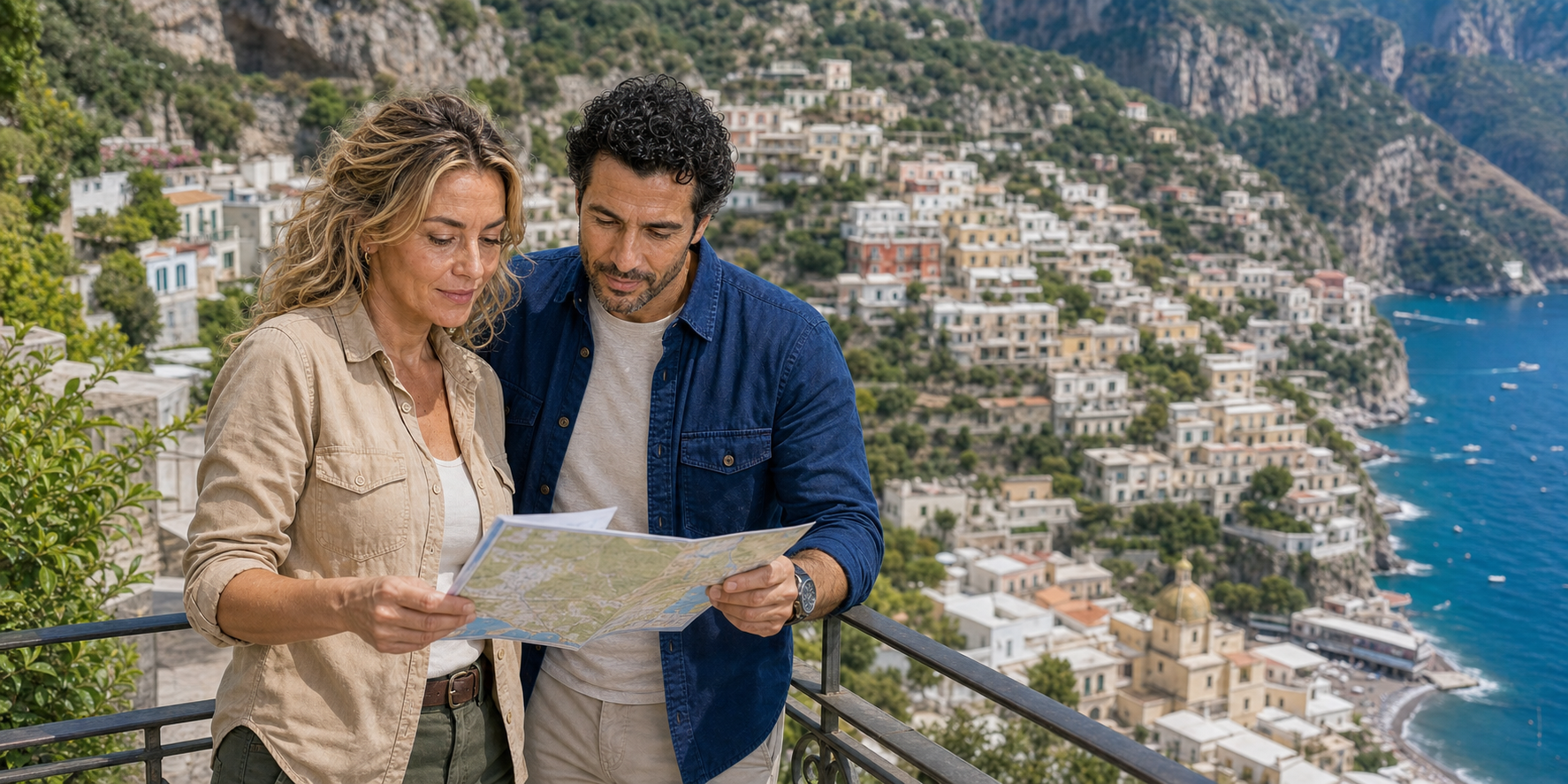
The seduction begins with four names. Sorrento. Positano. Amalfi. Ravello. Each carries enough visual recognition to stand for an entire holiday, and a day-trip title can make them sound like four beads on one string. From Naples, however, the string has a knot: a rail leg toward the Sorrento Peninsula, a handoff to a road vehicle, the bends of State Road 163 and a final climb from Amalfi to Ravello. Every transfer and curve spends time. Every town asks for a different kind of attention.
The podcast route compresses the four places into a single day from Naples, using rail for the gateway leg and road transport for the coast. That format makes the central trade-off unusually clear. A four-stop coastal day is a sampler, not four complete town visits. Its promise is orientation: compare a peninsula plateau, a near-vertical resort, the mouth of a former maritime city and an upland terrace in one moving sequence. Its cost is depth.
This distinction matters because the Amalfi Coast is routinely consumed as a row of views. UNESCO inscribed it as a cultural landscape: a steep physical setting reshaped over centuries by settlements, terrace walls, orchards, vineyards, routes and continuing work. The famous panorama is not nature with picturesque buildings sprinkled over it. It is the visible result of geology, water, engineering, cultivation, trade, maintenance and argument over who can move through the landscape today.
The route can be exhilarating without being effortless, and beautiful without being benign. Traffic management changes. Rain can destabilize slopes. Sea services are seasonal and weather-dependent. Stairs that look incidental on a map can determine whether someone reaches a beach or spends a stop near the road. Heat, motion sensitivity, a child's restraint needs or a badly specified transfer can transform the day. None of those realities diminishes the coast. They make it legible.
01 · Amalfi Coast landscape field guide
Start with the map the marketing leaves out

Naples is the gateway to this route, not the beginning of the UNESCO property. Sorrento is a different kind of threshold. It stands on a tuff plateau facing the Bay of Naples, west of the Lattari Mountains and outside the Costiera Amalfitana World Heritage boundary. Its centre is relatively coherent, while deep ravines and the cliff edge interrupt direct movement toward the water. Calling Sorrento “the Amalfi Coast” flattens a useful geographic distinction: the peninsula connects the two, but their shorelines, outlooks and settlement forms differ.
The route turns south and east toward Positano, where the mountain face falls abruptly into the sea. From there, State Road 163 works along ledges, folds around ravines and repeatedly exchanges open water views for rock cuts and built-up stretches. Amalfi appears at the mouth of the Canneto valley, where a compact urban core opens from the waterfront and runs inland. Ravello requires leaving the shore and climbing to a terrace high above it.
That shape explains the day's arithmetic. Four dots on a booking page are not four equal units. Sorrento may involve relatively level central streets but a large change in height to the marina. Positano may offer an immediate overlook from the road while the lower town demands steps and time. Amalfi compresses waterfront, cathedral square and an inland valley into a tight footprint. Ravello exchanges shore access for upland architecture and long views. A driver may cover the road between them; a visitor still has to negotiate the vertical distance inside each place.
The sequence also distinguishes transport problems. Rail is efficient for reaching a gateway but does not run along the Amalfi Coast. Road transport joins all four named stops but shares limited space with buses, delivery vehicles, residents, emergency services, scooters and private traffic. Sea transport can connect coastal ports in season and reveal the escarpment from below, yet it does not reach Ravello, may require separate tickets for stopovers and can change with weather and sea state. There is no hidden mode that makes every constraint disappear.
02 · Amalfi Coast landscape field guide
The landscape is a maintained structure

UNESCO's listed property covers 11,231 hectares across fifteen municipalities on the southern side of the Sorrento Peninsula. Its account emphasizes the meeting of mountains and sea, but also the human adaptations that made steep slopes productive and habitable: terracing, orchards, vineyards, scattered rural buildings, concentrated towns and routes between them. Four main coastal settlements—Amalfi, Atrani, Maiori and Minori—sit within a broader system of upland and shoreline communities. Sorrento is not one of those municipalities; Ravello is.
The geological base is the Lattari range, a limestone and dolomite mass whose slopes are cut by short valleys and watercourses. Thin soils, dramatic gradients and intense rainfall episodes create constraints that cannot be designed away. People responded by building retaining walls and terraces, directing water, selecting crops, linking levels with paths and stairs and locating buildings where rock and access allowed. The result can look inevitable because it has survived. It is not.
A terrace wall is not merely an attractive pattern under lemon trees. It resists soil pressure, sheds or channels water and supports a working surface on a slope that would otherwise be difficult to cultivate. It needs inspection and repair. Vegetation needs pruning. Pergola frames need maintenance. Produce must be carried along narrow access routes that may not accept machinery. When cultivation becomes economically precarious or a wall is neglected, the visual landscape and slope behaviour can change together.
The same logic applies to the coast road. State Road 163 is often described as if the mountain generously supplied a scenic balcony. The modern coastal connection took shape through nineteenth-century road building. It is an engineered insertion: cut into rock, carried on retaining structures, fitted through settlements and continuously maintained. It created a longitudinal link between places that had long depended heavily on sea routes, paths and local tracks. Its views are real; so are the labour and public spending that keep it open.
Official civil-protection guidance treats landslides and hydrogeological hazards as processes, not dramatic exceptions. Rain infiltrates soil and fractured rock, runoff concentrates, drainage can be overwhelmed and slopes can fail. ANAS records from a major Amalfi landslide show the practical consequences: surveys, rock stabilization, debris removal, structural design, traffic interruption and coordination among road managers, regional authorities and municipalities. A road closure is not an entertaining local quirk to defeat with a clever shortcut. It can be a safety perimeter around a changing slope.
For a traveler, the responsible conclusion is simple. Check official weather alerts and road notices close to departure. Accept that a route may change or contract. Do not pressure an operator to enter a restricted area or improvise around barriers. The work that holds a road or orchard against the slope is part of the landscape, as essential to its survival as the buildings that catch the eye.
03 · Amalfi Coast landscape field guide
Four stops should retain four identities

Sorrento: the gateway on a plateau
Sorrento's first lesson is that a coastal town need not descend gently to the sea. Its historic centre occupies a plateau above cliffs of volcanic tuff. Ravines, including the Vallone dei Mulini near the centre, reveal how water cut through that rock. Marina Piccola and Marina Grande sit below the upper town, reached by roads, stairs and lifts whose status should be checked rather than assumed. The height difference is part of Sorrento's identity and a practical constraint.
The urban texture rewards attention at street scale: lanes, courtyards, church fronts, citrus behind walls and views that appear at the end of built corridors. In a compressed stop, the useful choice is not to chase every viewpoint. It is to decide which Sorrento to read. A short central loop can show the plateau town. A descent toward a marina can show the relationship with fishing and sea transport, but it consumes time and creates a return climb or a dependency on a lift. A four-stop excursion may not allow both.
Sorrento also introduces lemons, inlaid wood and hospitality commerce, but it should not absorb the identity of the Amalfi Coast's Sfusato lemon or imply that every citrus object is locally made. A shop label is evidence of a product claim, not proof of where fruit, ceramic or wood was produced. Read origin and certification carefully.
Inlaid wood gives that advice a material test. Sorrentine tarsia constructs a picture or ornament from fitted pieces of wood veneer; differences in grain and colour do work that paint might do on another surface. The Museobottega della Tarsialignea, housed in the eighteenth-century Palazzo Pomarici Santomasi, places nineteenth-century furniture and objects beside the history of local workshops, materials, techniques and decorative subjects. Its collection connects a skilled craft with the town's development as a destination. A tabletop becomes evidence of both making and selling, rather than a souvenir detached from a place.
Look for how separate pieces meet, how grain changes direction and how a figurative scene is assembled from a limited material palette. Those are questions a visitor can carry into a workshop or museum without pretending to judge an object’s origin by sight alone. A brief central stop can introduce the craft; a close museum visit requires its own time and an admission check. The distinction matters because “shopping time” and learning how an object is made are different uses of the same interval.
The town is a transport hinge. Rail and road services approach from Naples; buses and private vehicles continue toward the south coast; seasonal sea routes use nearby ports. That makes Sorrento convenient, not frictionless. Any organised rail-and-road itinerary should identify the station, carrier, ticket responsibility, assistance arrangement and vehicle handoff. Independent travelers need to build the same chain themselves, with enough margin that a missed or inaccessible connection does not collapse the rest of the day.
Positano: distance measured in stairs

Positano is the stop most likely to be mistaken for an image rather than a system. Seen across the ravine, pale buildings appear to pour down toward the dome of Santa Maria Assunta and Spiaggia Grande. The composition is powerful because construction follows small shelves on a steep slope. It is also a warning: the attractive closeness of roof, beach and road conceals a large change in level.
The town's history is deeper than its modern fashion identity. Beneath the church area, the official Museo Archeologico Romano interprets part of a Roman villa affected by the eruption of Vesuvius in AD 79. That buried domestic complex does not turn a quick street stop into an archaeological visit—entry is separately ticketed and opening conditions are mutable—but it prevents a false chronology in which Positano begins with twentieth-century tourism.
The excavated dining room, or triclinium, offers a particularly close view of that earlier coast. Its Fourth Style wall painting combines imaginary architecture, mythological pictures, floating figures, floral details and relief stucco. The painted wall creates depth inside a real room; a white mosaic floor with a dark border defines another surface of the dining space. Bronze utensils add the material scale of preparing and keeping food to the decorative display. This was a wealthy domestic setting, rather than a cross-section of every Roman household on the shore.
The museum's account also describes the work behind the surviving colour: removing volcanic deposits, stabilizing plaster, matching fallen fragments and returning them to the wall. What looks like an intact image is partly the result of excavation and patient conservation. That gives the villa a place in the coast's larger story of maintenance. Roman painting, a lemon terrace and the modern road need different expertise, but none remains legible simply by being old.
Maritime exchange, fishing, local agriculture and later visitor economies all shaped the town. The road brought new forms of access; postwar writers, artists and fashion trade helped enlarge its international reputation. Today, boutiques and hospitality occupy much of the visible centre. Yet people also live, deliver goods, collect waste, attend school, reach homes and maintain services along the same narrow routes visitors use.
A short stop should be honest about its level. An overlook can explain settlement form without claiming the beach. A road-level walk can reach shops and partial views but not necessarily the water. A full descent to Spiaggia Grande should include the energy and time needed to return, as well as crowding and heat. Someone using a wheelchair, a walker, a pushchair or limited-stamina walking needs a verified step-free plan, not the reassurance that the town is “close.” Even an able walker should treat footwear, shade and return time as route decisions.
If Positano becomes the shorter photographic stop, the view can still be interpreted: identify the dome, trace the buildings down the ravine and notice how the road holds a higher line. What it cannot become is a claim that the traveler explored Positano. Photography and visitation are different experiences.
Amalfi: the harbour and the valley
Amalfi's compactness can create the opposite illusion. The waterfront, bus area, Piazza Duomo and cathedral staircase are close together on a map. Behind them, the town extends into the Canneto valley, a narrow industrial and water landscape associated with paper making. The seaward opening and inland corridor explain why Amalfi became both a port and a manufacturing place.
From the middle of the ninth century, Amalfi developed as an autonomous duchy and commercial power with Mediterranean connections. Its merchants and ships linked southern Italy with Byzantine and Islamic trading worlds. The city's political independence ended through Norman incorporation in the twelfth century; Treccani places its annexation under Roger II in 1131. Later conquest, competition, storms and changing trade patterns reduced its power, but the medieval maritime identity was not invented for tourists.
The surviving Arsenale della Repubblica—an arcaded structure near the waterfront—makes the maritime story material. It is not a complete medieval shipyard frozen in time; it is an adapted civic and cultural space whose fabric supports interpretation. The cathedral complex makes another layer visible. Its staircase, striped façade, bell tower, crypt and cloister bring together rebuilding and decoration from different periods. A fast look at the exterior does not include admission, access to every component or the time needed to interpret those layers.

The Chiostro del Paradiso was built in 1266–1268 as a burial place for Amalfi's nobles. Its interlaced arches and slender columns enclose a small garden; funerary chapels, sarcophagi, marble and painted surfaces make the space more than a pleasant courtyard. The complex joins this cemetery cloister to the crypt and to the older Basilica del Crocifisso, now the diocesan museum. Read it as a sequence of spaces with different jobs, rather than one uniformly medieval building.
The crypt adds a specific Mediterranean journey. In 1208, Cardinal Pietro Capuano brought the relics of Saint Andrew from Constantinople following the Fourth Crusade. Their arrival established a focus of devotion that later altars and sculpture continued to elaborate. The history connects local worship with movement across a sea also shaped by commerce and conquest. Treat the relics as objects of living religious significance, give worshippers space, and distinguish the cathedral staircase from the separately managed interior visit.
Paper making belongs to the same topography. Water from the valley powered mills; production knowledge and trading networks made Amalfi paper a significant craft. The Museo della Carta occupies a former mill and preserves machinery and processes, while the valley itself explains why workshops were located inland rather than on the open waterfront. Again, a museum is a separate visit, not an automatic inclusion in a four-stop excursion.
The starting material was cloth: cleaned and sorted linen, cotton or hemp rags. Water-powered wooden hammers broke the fabric down to usable fibres. Diluted pulp was gathered in a mesh-bottomed frame; water drained away, leaving a thin layer that could be laid on felt, stacked, pressed and dried. The making of a sheet depended on both the papermaker's handling and the mill's flow of water. The finished surface carries a sequence of physical operations, not merely the romance of a medieval town name.
The passage from mill to museum has a named custodian. Nicola Milano, a member of an Amalfi paper-making family, kept family mills working after the Second World War. After his last mill closed in 1969, he donated it to the foundation created in 1971 for the museum. That is a conservation story about a working process being saved when its commercial setting changed. It also changes how to look at the valley: water, machinery, labour and memory belong together, rather than making paper an ornamental label for a shop window.
The town manages competing uses of a tiny centre through seasonal pedestrian controls, resident exemptions and local transport linking the centre with hillside fractions. Municipal beach-access services can improve one part of a visit during their operating periods. Those local measures do not establish an accessible journey from Naples: rail, transfers, vehicle boarding and the actual town route still have to work as one chain.
Amalfi's most productive short visit begins with one question: maritime city or valley city? The harbour, arsenal and cathedral square support the first. The paper museum and inland watercourse support the second. Trying to perform both in a rushed interval may yield only transit between attractions. Choosing one produces understanding.
Ravello: the cultivated high ground
Ravello is not a beach town above the beach. It is an upland settlement with its own history, reached by a climbing road from the Amalfi area. Its position changes the terms of the journey. The sea becomes a plane below terraces and gardens; the coast reads as a connected mountain face rather than a series of waterfronts.
Medieval mercantile families built churches and palaces here, and later patrons, artists and travelers added new associations. Villa Rufolo's layered architecture and gardens are closely tied to Ravello's cultural identity and performance tradition. Villa Cimbrone offers another garden-and-view complex. Both are separately operated attractions with mutable hours and admission. A day-trip title that names Ravello does not itself include either villa.
Villa Rufolo makes the layers unusually clear. Its thirteenth-century palace and courtyard, with superimposed orders of interlacing arches, belong to the wealth and architectural ambition of medieval Ravello. The garden celebrated today has another history. In the nineteenth century, the Scottish patron Nevile Reid made the villa a summer residence and developed its planting with exotic species. The view is old; the composition through which visitors see it has repeatedly been remade.
Local gardener Luigi Cicalese helped turn Reid's planting ambitions into a living garden. Villa Rufolo's history preserves correspondence about plants, including the practical problem of propagating a prized peony. Cicalese later photographed the town, published postcards and became mayor. His work links horticulture to the circulation of Ravello's image: the person tending the landscape also helped others picture it. A garden vista contains choices about plants, labour and framing long before a visitor raises a camera.
One documented visit helped carry that image into music. On 26 May 1880, Richard Wagner came to Ravello by mule after visiting Amalfi, accompanied by his wife Cosima and the painter Paul von Joukowsky. At Villa Rufolo he recognized a setting for Klingsor's enchanted garden in the second act of Parsifal; he recorded his response in the Pensione Palumbo guestbook, and Joukowsky later supplied designs for the opera's scenery. The episode explains a powerful association between Ravello and performance. It does not mean Wagner wrote the whole opera here, or that a present garden is an untouched survival of what he saw. The useful story is how a designed place became the model for another designed world.

Villa Cimbrone is a separate expression of the same attraction to cultivated high ground. Its gardens were extensively redesigned in the early twentieth century, drawing on English landscape and botanical traditions. A historic residence now operates as a hotel, while the garden has its own public admission. The distinction helps set the visit's purpose: a garden walk is an encounter with planted space, built framing and the coast beyond, rather than access to every room of a historic house. Choose between the villas by the experience desired and the time available, including the walk from the town centre.
Ravello's public centre can still be meaningful without a ticket. Piazza Duomo, the cathedral exterior, lanes, garden walls and glimpses over cultivated slopes show how the settlement occupies a terrace above the road-and-port system. But the famous designed viewpoints are not interchangeable with street views. If a traveler books primarily for a particular villa garden or concert, the operator must confirm time and admission rather than relying on the place name.
Ravello also changes the timing risk. Reaching it and returning requires the same constrained road corridor used by residents, service vehicles and public buses. Current SITA material treats Scala–Ravello–Amalfi as a specific route, a useful reminder that the upland connection is a transport leg of its own. On a four-stop tour, Ravello cannot be added without subtracting time elsewhere.
04 · Amalfi Coast landscape field guide
The Sfusato lemon is infrastructure you can taste

The Limone Costa d'Amalfi IGP specification defines the Sfusato Amalfitano: a local lemon ecotype with an elongated, tapered form, cultivated in a named production area under specified rules. IGP is the Italian abbreviation for Protected Geographical Indication, or PGI. Regional agricultural material connects that fruit to terraced cultivation and pergola structures that help protect trees. Certification matters because “Amalfi lemon” is otherwise easy to use as generic decoration.
The landscape behind the label is labour-intensive. Stone walls create narrow plots. Growers manage soil and water on steep ground, maintain supports, prune trees, protect fruit and carry harvests along stairs and paths. The system limits large machinery. A crate of lemons at road level contains invisible vertical journeys. Terrace abandonment is therefore not only an agricultural loss; it can alter cultural knowledge, wall maintenance, drainage and the pattern UNESCO recognizes.
The culinary uses are broad: peel and juice in cakes, creams, granita, savoury dishes and drinks; preserves and liqueurs; fresh fruit and confectionery. Limoncello is the most internationally marketable outcome, but it should not stand in for the whole crop. Nor should a bottle prove that the lemons came from a certified grove. Look for the PGI wording and producer information if origin matters.

Ceramics make the lemon visible even where no orchard is present. Yellow fruit, cobalt blue and green leaves cover bowls, plaques and tiles. That is a legitimate design tradition and a modern visitor economy, but origin deserves the same discipline as food. Ask where an object was made. Distinguish hand-painted work from printed decoration. Buy because the piece and its maker are worth supporting, not because a motif is automatically evidence of local production.
A four-stop road day is unlikely to explain the farming system from inside a grove. It can still train the eye. Look above and behind houses for horizontal terrace lines. Notice netting or pergola frames. Identify access stairs that are work routes rather than scenic paths. Read a cultivated slope as an active workplace. That change in attention is more durable than treating a lemon product as a souvenir category.
05 · Amalfi Coast landscape field guide
State Road 163 is shared civic space
The Amalfitana is famous for engineering views into motion. It is also the only practical road connection for many daily needs. Residents commute. Hotels receive linen and food. Shops take deliveries. Builders carry materials. Waste vehicles work. Buses hold people who are not sightseeing. Ambulances and fire services need space. Visitors arrive in coaches, vans, taxis, rented cars and on scooters. The conflict is not “locals versus tourists” in the abstract; it is many legitimate and speculative uses competing for a narrow corridor.
Traffic policy makes that conflict visible. Alternating-license-plate rules and other seasonal controls have been used on the SS163 during high-pressure periods, with dates, hours and exemptions set in current official notices. Regional transport authorities continue to invest in integrated coastal mobility and congestion responses. These measures are not proof that every journey is gridlocked. They are evidence that demand requires management.
Road width, sight lines and the space for vehicles to pass change along the route. Rock cuts, buildings, curves and larger vehicles create different demands at different points. A licensed driver's skill helps manage those conditions; it cannot create extra road space or remove a restriction. The coast's transport story is the repeated work of sharing, repairing and reorganizing a constrained corridor that serves both daily life and a large visitor economy.
The visitor's contribution begins before boarding. A smaller shared vehicle may occupy less space per passenger than multiple private cars, but occupancy, vehicle class and routing determine the real comparison. Use only identified, licensed transport. Arrive at the confirmed meeting point on time, keep bags within the stated allowance and do not ask for unauthorized roadside stops. Respect pedestrian controls and residents' entrances. If motion sickness is likely, seek medical advice appropriate to the traveler and choose a transport format whose seating and stopping pattern are acceptable.
Time is part of road ethics. When an itinerary loses minutes, the pressure to “make them up” should fall on the stop list, not on driving behaviour. A responsible itinerary shortens or removes an element when conditions require it. Travelers should know in advance who makes that decision, how changes are communicated and what fallback protects the return journey.
06 · Amalfi Coast landscape field guide
Rail, road and sea solve different problems

A train-and-minibus itinerary is a plausible response to the long approach from Naples. What matters is not the label “train” but the chain: exact Naples station and meeting point; ticket and carrier; whether anyone accompanies the rail leg; destination station; platform or exit; walking distance to the vehicle; assistance with disruptions; and the return arrangement. Napoli Centrale has an official Sala Blu assistance service for passengers with reduced mobility, but that station service must be arranged under its own conditions. It does not guarantee a step-free connecting station or an accessible road vehicle.
Public buses cover coastal corridors, including Sorrento–Positano–Amalfi and the Amalfi–Ravello area, with seasonal schedules. They can be useful for travelers who accept queues, standing risk, transfers and less control over timing. They also serve residents; a visitor's scenic ride is another person's commute. The live SITA timetable and notices, not an old blog or podcast price, should govern planning.
Sea services offer an illuminating alternative. From the water, the relationship among cliff, ravine, terrace and town is easier to see. Current operator material shows seasonal links involving Naples, Positano, Amalfi and other ports. But published timetables can change, sailings can be suspended and Ravello remains inland. Some operators require separate tickets when breaking a journey at an intermediate port. Luggage, check-in and missed-connection rules vary. “Take the ferry instead” is therefore not a complete contingency plan.
Private and rental-car travel offers autonomy but transfers risk to the traveler: traffic controls, parking scarcity, navigation, fatigue and vehicle restrictions. A four-stop day from Naples by private car may devote a disproportionate share of attention to the car itself. A hired driver or organized vehicle can remove navigation and parking work from the passenger. Knowing the licensed operator, transport terms and responsibility for each connection makes that arrangement clear.
The best mode depends on the desired experience. Choose road for the connected sequence and Ravello. Choose sea for coastal perspective and selected port stops, accepting weather and transfer conditions. Use rail for gateway movement. Combine them only when connection responsibilities are explicit and time buffers are real.
07 · Amalfi Coast landscape field guide
Build a time budget, not a wish list
If an itinerary is advertised as seven hours, that does not mean seven hours in the four towns. The clock includes meeting, gateway travel, alighting, any vehicle handoff, road travel between stops, parking or legal drop-off, regrouping, delays and the return. The useful calculation begins with the timings of the particular service being considered, including where its stated duration starts and ends.
Instead, evaluate the day through a depth budget:
- Gateway time. How much of the stated duration passes before the coastal sequence begins? Does it include the rail leg, and where does the clock start?
- Handoff time. How far is the train-to-minibus transfer, who leads it and what buffer exists for a late train?
- Road time. What is the planned order, and what legally permissible drop-off points are used?
- Stop time. Which place is the shorter photo opportunity? Are stops guided, escorted or free time, and where does any assistance end?
- Return protection. What margin protects the return train or the advertised finish?
The answer determines whether the tour matches the traveler. Someone seeking orientation may value seeing all four settlement types even briefly. Someone intent on the Roman remains in Positano, Amalfi's paper mills, the cathedral complex or a Ravello villa should choose a narrower day or an overnight base. Admission, opening hours and queues cannot be squeezed into a schedule merely because a landmark appears near a stop.
Clarify what “guided” means within that time. A driver concentrates on the road; an onboard assistant may explain the route or organize regrouping; a qualified guide may lead interpretation on foot. These roles can be combined or split between people, but a label does not establish which town walks or museum visits receive guidance. Free time leaves the visitor responsible for choosing a route and returning to the meeting point. A short overlook stop can still show the settlement's shape, provided that it is described as an overlook rather than a guided exploration of the town.
An optional boat outing from Amalfi is a second itinerary inside the first. If one is offered during the town stop, establish its boarding point, sailing and return duration, and the time needed to rejoin the road group before paying. Time on the water competes with lunch, the cathedral, the paper museum and unhurried streets; a coastal panorama cannot be added without spending some of that interval. For someone who wants the cliff's shape from below, the exchange may be worthwhile. For someone who came for Amalfi's religious or industrial history, staying ashore may be the better decision.
This is not an argument against fast travel. A sampler can be intellectually coherent when it has a question. Compare how each town occupies topography. Follow the change from Bay of Naples plateau to south-coast slope. Track how road access altered older sea-facing communities. Notice where visitor economies concentrate. The failure comes when a sampler is sold or remembered as mastery.
08 · Amalfi Coast landscape field guide
Accessibility, children, heat and motion are route questions

Accessibility requires an itinerary, not a badge. Ask the operator to describe every segment in writing:
- the exact station entrance and platform access;
- whether rail tickets and reserved assistance are included;
- walking distance, gradients, curbs and surfaces at the handoff;
- vehicle step height, wheelchair space, securement and whether a traveler must transfer to a seat;
- drop-off point and actual pedestrian route in each town;
- stairs, steep slopes, rest points, shade and accessible toilets;
- how a mobility device is carried and whether it reduces passenger or luggage capacity;
- who assists during an evacuation, disruption or missed connection.
Families need the same end-to-end clarity. Confirm the minimum age, child classification, seat or restraint type, who supplies and installs it, luggage allowance for a pushchair and the exact walking expectations before booking. A generic “family friendly” label cannot establish legal restraint provision or make a steep town route suitable for a particular child.
Heat compounds vertical travel. Italy's Ministry of Health publishes current heat-risk guidance and city bulletins. On high-risk days, the safest plan may require less exposed walking, more water and shade, slower pacing or a different day. A vehicle with air conditioning is useful comfort, not a guarantee against heat illness during stops. Travelers with medical conditions should seek individual clinical advice rather than relying on generic tour copy.
Motion sensitivity deserves the same seriousness without drama. Repeated bends and stop-start traffic can provoke symptoms. Practical responses may include discussing medication with a clinician or pharmacist, avoiding heavy meals or alcohol, looking toward a stable horizon where possible and choosing a transport format with tolerable motion. Seat selection and stops depend on the operator and cannot be promised editorially.
Toilets are a planning issue, especially for children, older travelers and people with gastrointestinal or continence needs. “There are cafés” is not a useful toilet plan. Ask where scheduled facilities are available, whether purchases or fees are required and what happens during a delay. A full multi-stop day needs clear answers.
09 · Amalfi Coast landscape field guide
Tourism pressure is experienced at the front door
Amalfi's own sustainable-tourism material describes a shrinking resident population alongside thousands of visitor beds. Those numbers should not be converted into a morality play in which every visitor is harmful or every local business is exploitative. They identify a structural pressure: housing, public space, transport and services must support both a resident community and peaks of temporary population.
The consequences appear in ordinary systems. Deliveries compete with pedestrian windows. Apartments can shift from long-term housing to visitor accommodation. Waste volumes rise. Seasonal employment expands while year-round work may remain uncertain. Buses serve both residents and day-trippers. Agricultural terraces require labour even when hospitality offers different income. Municipalities invest in traffic controls, beach access, local minibuses and cultural infrastructure while managing finite land and tax capacity.
A day visitor cannot solve those systems through one purchase. They can avoid making them worse. Use legal transport and official paths. Do not block doors or stairs for photographs. Keep voices low in residential lanes. Do not treat work terraces as public viewpoints. Buy from businesses that disclose where goods are made. Carry waste until a proper bin is available. Follow water restrictions and pedestrian controls. If a place is too crowded to move without invading private thresholds, choose another street or stop.
The more consequential decision is itinerary design. Four brief stops concentrate arrivals at familiar nodes. A longer stay can distribute time, support evening and morning economies and make public transport or walking more feasible. A focused day in one or two towns can spend more with fewer transfer impacts. An organized shared vehicle can consolidate trips, but its sustainability depends on occupancy, vehicle, routing and operator practice—not the word “tour.”
The coast's debates are not external to its beauty. The maintained terraces, inhabited streets and working road are the landscape visitors came to see. Conservation that protects façades while displacing residents or abandoning agricultural labour would preserve an image while weakening the system.
10 · Amalfi Coast landscape field guide
A practical decision tree for a four-stop day
A four-stop route is best understood as a comparison day. Before choosing a format, work through these decisions.
Choose the four-stop sampler if the main aim is geographic orientation; the traveler accepts that at least one place may be only a photo stop; everyone can tolerate a long, multi-transfer day under the stated conditions; and no single ticketed attraction is essential.
Choose a narrower road excursion if Positano stairs, Amalfi's cathedral and paper valley, or a Ravello villa deserves real time; the group needs predictable rest and toilets; or an in-depth cultural visit matters more than the number of names reached.
Choose a coast-and-sea combination if the view from water is central and the traveler accepts seasonality, separate tickets, port access and weather disruption. Build buffers and verify the current sailing; never use a ferry connection as an unconfirmed rescue for a tightly timed train.
Choose an overnight base if the group wants early or late hours, a garden or museum visit, a slower meal, agricultural context or the ability to adapt around heat and congestion. One night changes the coast from a road sequence into a place with morning deliveries, evening public space and time to climb without watching a minibus departure.
Before booking any organised version, obtain clear answers to the following:
- legal operator and transport subcontractors;
- exact Naples meeting point and station;
- rail carrier, ticket inclusion and disruption responsibility;
- exact transfer point and escorted walking distance;
- vehicle type, capacity, licensing, seat belts and child restraints;
- route order, approximate stop-time ranges and usual photo stop;
- guide or onboard assistant role, language and credentials;
- admission inclusions and exclusions;
- accessibility across rail, handoff, vehicle and towns;
- luggage, pushchair and mobility-device rules;
- toilet and meal plan;
- cancellation, missed-train, road-closure, heat and severe-weather contingencies.
Those are not luxury details. They define whether the itinerary works for a particular traveler. If the answers are absent or contradictory, choose another format rather than turning marketing shorthand into operational assurance.
11 · Amalfi Coast landscape field guide
Listen to the coastal journey
The route discussed in the ExcursionPass Travel Podcast raises the useful question running through this journey: how much breadth is worth the compression? A plateau, a vertical town, a former maritime capital, an upland settlement, lemon terraces and a nineteenth-century road each explain the next. Listening to the route can help a traveler decide which relationships to follow and where to slow down.
Four stops can reveal that system if the day protects the differences. They can also reduce it to four hurried photographs. The deciding factor is not enthusiasm. It is whether the route and its responsibilities are specified honestly, whether the traveler chooses depth consciously and whether everyone remembers that the road runs through other people's home.
Podcast: Amalfi Coast and Sorrento from Naples: four stops in one day
Evidence and planning
Sources behind the journey
- UNESCO: Costiera Amalfitana cultural landscape.
- MUTA: Sorrento wood inlay and the museum palace.
- Positano Roman museum: the villa and conservation.
- Treccani: Amalfi medieval history; cathedral complex; how Amalfi paper is made.
- Villa Rufolo: garden work and Wagner’s visit; Villa Cimbrone: house and garden.
- Campania: Limone Costa d’Amalfi IGP.
- Civil Protection: hydrogeological risk; ANAS: road controls.
- SITA Sud current timetables; Travelmar timetable and connection questions.
- Italy Ministry of Health: heat-risk guidance; NHS: motion sickness.