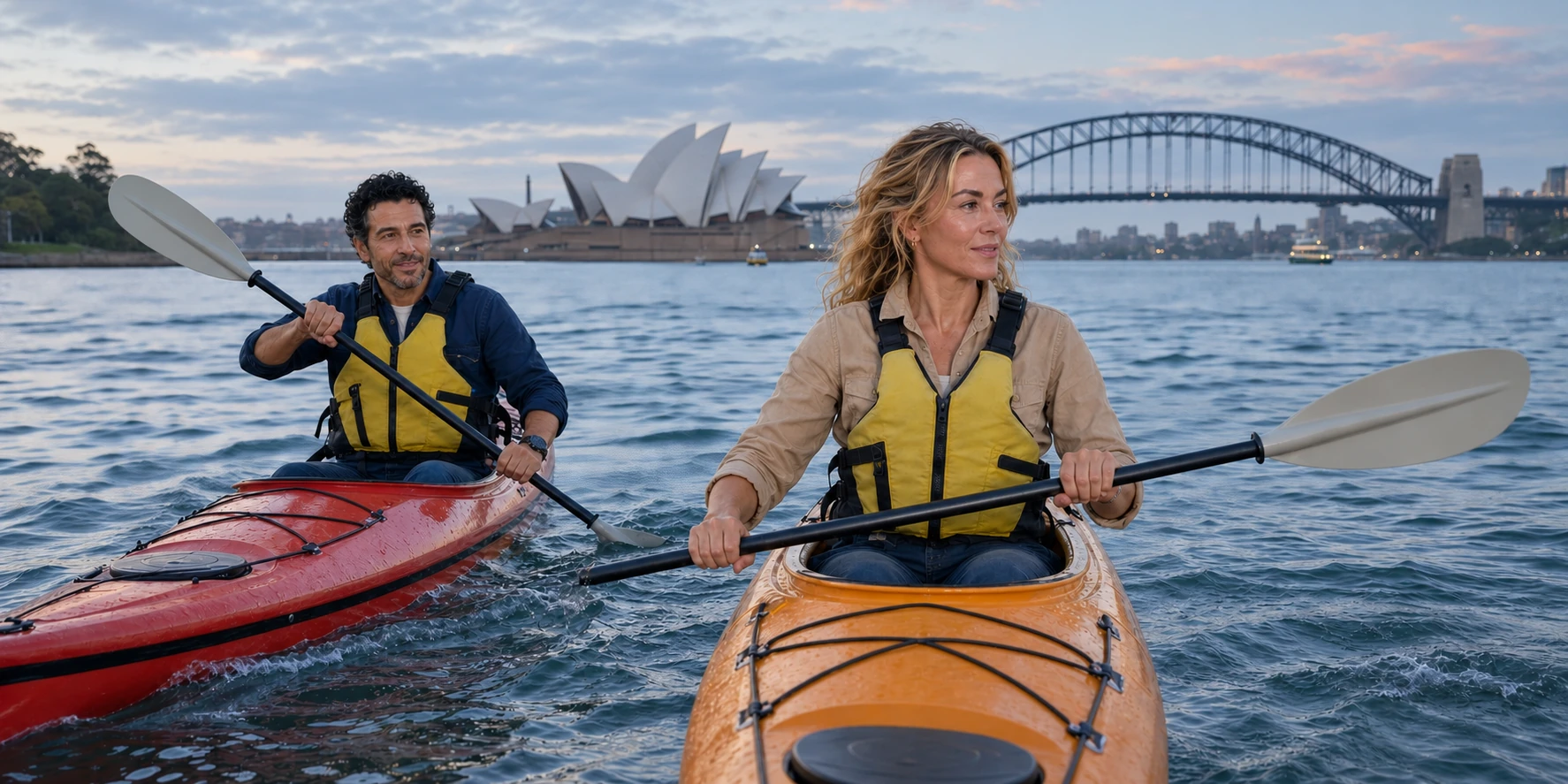
A sunrise paddle does not grant private possession of Sydney Harbour. It gives a small boat a changing angle on living Gadigal Country, an altered estuary, a working port and two structures whose materials were designed to negotiate light. The reward is not a guaranteed orange sky. It is learning how to move through all of those systems without pretending they have disappeared for the photograph.
01 · Harbour field guide
First light changes the harbour; it does not empty it
Before sunrise, Sydney's most reproduced objects begin as differences in tone. The Sydney Opera House shells hold a pale edge before the sky has chosen a colour. The Harbour Bridge is initially a dark arch with small points of working light. Apartment windows, navigation marks, ferries and service vessels reveal that the city is already operating. Then the horizon brightens, metal and tile separate from silhouette, and water that seemed almost black starts returning broken pieces of the sky.
That transformation is the genuine promise of a sunrise kayak. The false promise would be “Sydney Harbour to yourself.” Port Jackson remains a transport corridor, a place of work, a naval and commercial waterway, a living estuary and Country whether a tour group launches at 5 a.m. or noon. A quieter surface does not become an unowned surface. A small craft gains a lower, slower viewpoint, not priority over ferries, restricted zones, wildlife or everybody else's morning.
This distinction matters because it changes what counts as a good tour. The measure is not whether cloud opens at precisely the right second, a guide holds the kayaks in a perfect formation, or every landmark fits into one phone frame. It is whether the briefing makes a participant more competent; whether the route responds to real conditions; whether the group can read traffic and light; whether the story starts before the icons; and whether everyone returns without asking the harbour to behave like a controlled set.
The connected podcast frames the tour as a test of whether a very early alarm is worth answering. Its useful tension is larger than that verdict. A visitor wants quiet, close landmark views and freedom inside an individual boat; a low-profile craft on a working harbour requires visibility, group discipline and acceptance that the route belongs to conditions. The worthwhile question is therefore not whether every morning reproduces a sales photograph. It is what a paddler can understand at water level, and what responsibilities come with that viewpoint.
The result is more interesting than the sales version. Sunrise is not a product placed on top of Sydney Harbour. It is a short astronomical interval inside a much longer environmental and human chronology.

02 · Harbour field guide
There is no permanent “sunrise time”
Geoscience Australia places the start of morning civil twilight when the sun is six degrees below the horizon. Apparent sunrise is the first appearance of its upper edge at an ideal horizon, with standard atmospheric refraction allowed for. Those definitions prevent a practical misunderstanding. A sunrise booking may require arrival before twilight, during it or close to sunrise depending on season and the time needed to brief and launch the group. A clock time copied from July cannot be applied to December; the booking confirmation sets the meeting time.
Light also changes unevenly. A clear eastern horizon may brighten while the western city remains in shadow. Cloud can diffuse colour without producing a dramatic disc. High cloud may hold warm light; low cloud may obscure the event; marine haze can flatten distant contrast. Buildings and headlands affect what a person at water level sees. Astronomical sunrise is calculable. The photograph is not.
Low light creates operational consequences before it creates atmosphere. PFD fit and paddle handling should be checked where people can see them. NSW requires canoe and kayak paddlers to carry a waterproof torch at night, between sunset and sunrise, to help prevent collisions. Visibility to others matters as much as a paddler's own view. Bright clothing, a visible craft and the guide's lighting arrangements help make a small, low object legible against shoreline lights and dark water. Ask how the group will be seen before launching.
The eye needs time to adjust. A bright phone screen used continuously at the marina can make the water beyond it harder to read. A photograph can wait until after launch instructions, group signals and traffic expectations are understood. Anyone who needs prescription lenses, hearing support or a different communication method should establish that on shore. Once kayaks spread out, a missed hand signal or unheard direction becomes harder to repair.
Cloud cover alone may not cause an operator to cancel. That is reasonable: a clouded morning can be visually subtle and safe. The inverse is equally important. A colourful horizon does not neutralise a strong-wind warning, poor visibility, unsuitable water state or a participant who cannot control the boat. “Will there be a sunrise?” is therefore a weak pre-departure question. “Are the conditions suitable for this group to launch?” is the useful one.
03 · Harbour field guide
The current tour begins in Rushcutters Bay
The connected experience is a guided Sunrise Kayak Tour — Single Kayak operated under Sydney Kayaking Tours. The operator's information places the launch at 1B New Beach Road, Rushcutters Bay, at the marina beside D'Albora. It describes a format of roughly one and a half to two hours, adjusted to conditions, with kayak, paddle, lifejacket, a safety and paddling briefing, guide support, photographs or video and a post-paddle breakfast benefit.
Treat 1B New Beach Road as orientation, not as permission to navigate from a magazine page alone. Marina access, meeting instructions, start time and operating terms can change; the booking confirmation is the live document. The operator advises that parking is limited and that public transport or rideshare may be easier. It also advises using toilets before departure, because the water portion has no bathroom break, and explains how personal belongings are handled at the shop. Confirm each point for the actual booking.
Allow roughly one and a half to two hours for the advertised format, then check what the departure actually includes. Briefing, launch, landing or a post-paddle benefit may occupy part of that window. Confirm transport to the marina and the size of the paddling group, rather than assuming a pickup or a fixed number of guests. The operator and live booking confirmation must answer questions about age, fit, assistance, cancellation and the time spent on the water.
A post-paddle breakfast benefit can be welcome after a cool start, but it is peripheral to the safety and quality of the water experience. Confirm the venue, value, redemption and dietary options rather than choosing the tour for a meal promise. The durable value lies in equipment, instruction, route judgement and guide attention, not in a refreshment that may change.
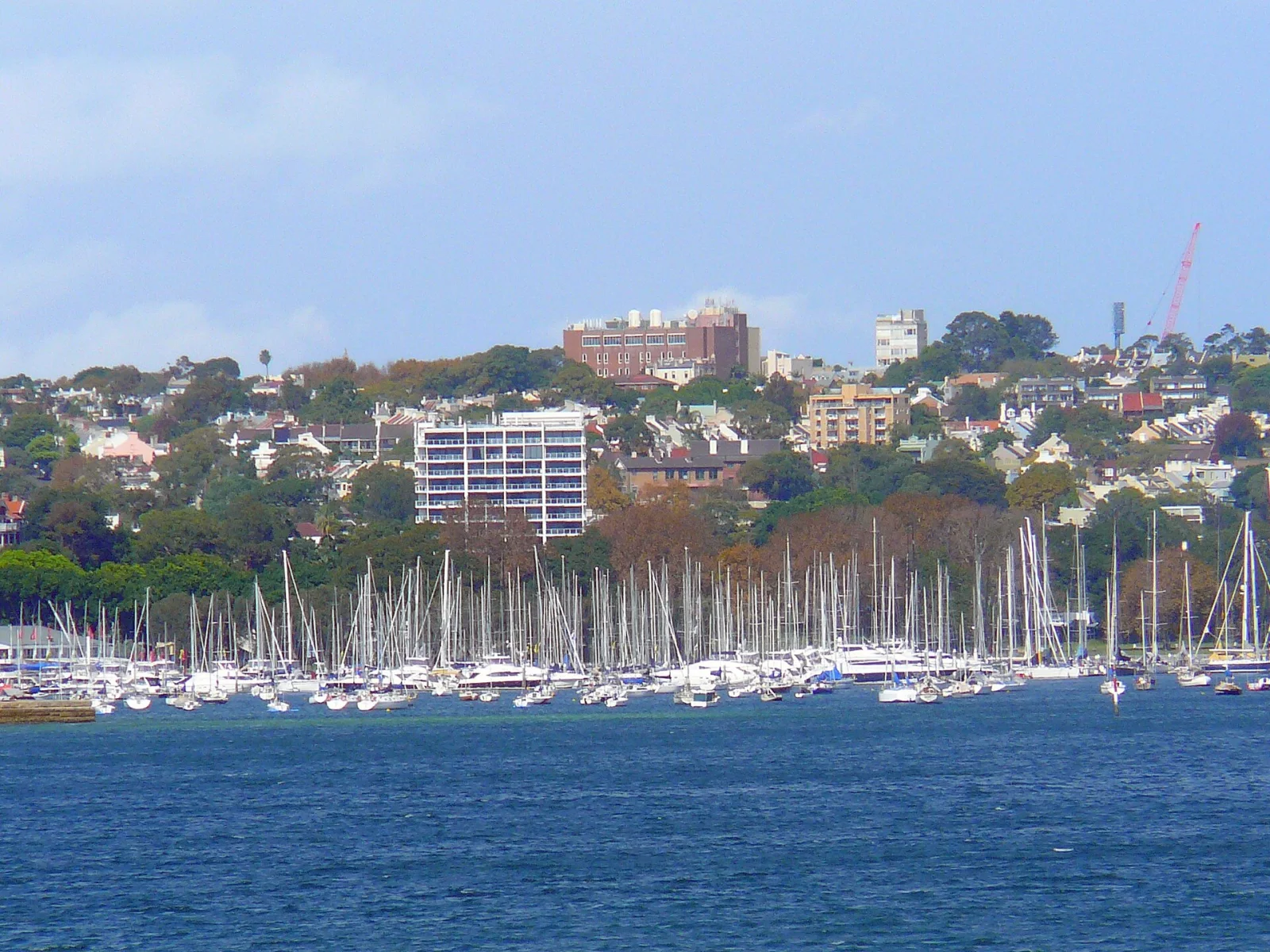
The launch matters because it lets the journey begin precisely. Rushcutters Bay is not simply a convenient eastern pocket from which to point kayaks at famous architecture. The shape of the shore records an older water system, colonial transformation and modern marina use. What looks like the edge of the city is one of the places where the city has repeatedly rebuilt its edge.

04 · Harbour field guide
Rushcutters Bay is an altered creek and marsh edge
The City of Sydney's adopted park plan places Rushcutters Bay on traditional Gadigal land and records Kogarah as a name associated with the place. It describes a low-lying marshy area at the mouth of a freshwater creek before extensive colonial alteration. Rushes gathered there supplied the English name. Drainage, reclamation, a stormwater channel and seawall gradually changed a wet margin into parkland, roads, buildings and formalised harbour edge.
Reclamation took place in the nineteenth century, including work in the early 1880s, and the reserve was dedicated for public recreation in December 1885. The City's park plan records the change through drainage, embankment and seawall. Part of what a visitor now reads as firm shore occupies a former water-and-marsh relationship. The channel entering the bay is urban drainage infrastructure carrying a catchment toward the harbour; it also separates the City of Sydney and Woollahra portions of the park.
Beginning with Gadigal Country does not mean placing a short acknowledgement before the “real” city story. The Country is continuing. The south side of Port Jackson, from the coastal entrance into the inner harbour, holds relationships, knowledge, names and histories that did not expire when the shore was surveyed or filled. City of Sydney's Yananurala project makes that continuity visible along the foreshore through Aboriginal stories and public interpretation. A commercial kayak tour should not be mistaken for a First Nations cultural tour, but neither should it reproduce an empty-harbour myth.
At dawn, the altered shoreline can be read through ordinary details. Hard seawall replaces a gradual wet edge. Masts and pontoons occupy protected water. Apartment slopes shed rain toward drains. Park, road and marina divide human uses into neat zones while the tide continues across their boundaries. The kayak sits low enough that the distinction between wall and water becomes physical: one is a surface that reflects chop; the other is the medium carrying it.
This history should also change environmental language. Rushcutters Bay is not “pristine” because it is quiet before breakfast. It is an urban embayment connected to an estuary with real habitat and real contamination pressures. Conservation here is not preserving a scene untouched by people. It is improving ecological function, water quality and shared access in a place people have transformed for generations.
05 · Harbour field guide
A single kayak transfers both control and responsibility
The product's “single” label is not a minor seating preference. In a tandem, propulsion, cadence and steering are distributed between two people. In a single, one paddler controls the hull's speed and heading. That can feel direct and rewarding. It also makes every correction, pause and acceleration visible in the boat's movement.
The first task is fit. A properly fitted PFD should stay in place without riding over the head. Foot contact and seat position help the paddler connect torso rotation to the hull. A paddle held too tightly tires hands and forearms; a stroke pulled mainly with the arms makes two hours feel much longer. A shallow, close-to-the-hull entry usually supports efficient forward travel, while wider sweep strokes change heading. The guide's instruction for the exact boat takes priority over any generic technique description.
Independence should not be confused with isolation. A guided single-kayak group still travels as a system. Each paddler must remain close enough to receive instructions and far enough away to use a double-bladed paddle without striking another hull. The person at the front cannot assume everybody behind is comfortable. The person at the back cannot quietly stop without communicating. A guide needs room to observe and reach participants.
Capsize planning belongs in the briefing even on sheltered-looking water. NSW paddle-safety guidance tells a paddler to remain with the craft, because the boat supplies flotation and is easier for rescuers to see than a head alone. The exact assisted-recovery method depends on equipment, conditions and training. A participant should know what the operator expects after entering the water, how to attract attention and whether re-entry practice is part of the format.
A single kayak is neither inherently brave nor inherently more dangerous than a double. Suitability depends on the paddler, boat, guide ratio, water, traffic and weather. A confident paddler may value independent rhythm. Two people who need shared propulsion or closer support may prefer a double if the operator offers one. What matters is choosing the format before arrival and confirming that the chosen seat fits the body and capability that will use it.

06 · Harbour field guide
The route is conditional by design
A brochure can turn the harbour into a neat procession of named places. The more credible promise is a guided view when conditions allow. A small craft leaving Rushcutters Bay may have sightlines toward the Opera House and Harbour Bridge, but a responsible guide can shorten, shelter, delay or change the line because of wind, traffic, visibility, group performance or restrictions.
A leisure-map line cannot grant access through naval areas or determine where to cross a working channel. Garden Island is an operating defence and dockyard precinct with navigational and security boundaries. Follow the guide's authorised line and current harbour restrictions. A landmark can be visible across water without being a place a kayak may approach or circle.
The useful orientation is simpler. The party launches from Rushcutters Bay, learns the boats in relatively protected water, and then follows a guide-selected inner-harbour line. Shore edges, safe crossing decisions and group cohesion matter. Landmark views are consequences of the line, not rights attached to the ticket. The party returns to the same launch unless the booking confirmation explicitly says otherwise.
NSW's paddle-safety guidance recommends staying near shore where appropriate, keeping a proper lookout and passing behind larger vessels. “Near shore” is not an instruction to scrape along seawalls, enter restricted water or ignore reflected wake. “Pass behind” is not a guarantee that a vessel will hold course for a photograph. The guide interprets those principles against the actual harbour.
Route flexibility is therefore evidence of quality, not failure to deliver. A short, controlled paddle that keeps the group together may provide better architecture, light and ecology than a rushed dash toward an icon. A guide who turns the group inside the bay because conditions have changed is not withholding Sydney. They are reading it accurately.
Garden Island also explains why this is a working shore. The Royal Australian Navy's history traces its English name to the vegetable garden planted by HMS Sirius's crew in February 1788. A naval depot followed in 1865. Wartime construction joined the island to Potts Point to create the Captain Cook Graving Dock, opened in March 1945. A dry dock allows ships to be repaired out of water: closeable dock space is pumped dry around the vessel. The industrial shore therefore records food supply, imperial naval power, wartime engineering and continuing maintenance. None of that history turns a defence boundary into a recreational shortcut.
Fort Denison – Muddawahnyuh is another compact layer of harbour history. The rocky outcrop became the colonial penal site called Pinchgut and was later fortified. Its round sandstone Martello tower makes the small island recognisable, while a less conspicuous instrument ties it to every paddler's planning: the site has served as Sydney's official tide measurement point since 1857. The long record matters because tides are measured against a consistent place over generations. Seeing the fort from water is distinct from landing there; a guided paddle does not include island admission or permission to stop.
The Royal Botanic Garden's shore offers a different continuity. The garden was established in 1816 on Gadigal Country, following the colony's early agricultural experiments. Behind the green waterfront, Cadi Jam Ora places native plants beside the First Farm story. Colonial crops struggled with unfamiliar seasons and soils; the comparison challenges the idea that land was awaiting imported knowledge. The garden's Gadigal story journey is led by Elders Aunty Rhonda Dixon-Grovenor and Uncle Dean Kelly. That interpretation deserves time on land and attention to its named custodians. A passing kayak view can locate the garden in the harbour landscape, but cannot substitute for listening to the people whose Country it occupies.

07 · Harbour field guide
Sydney Harbour is a port before it is a panorama
Port Authority of New South Wales describes Port Jackson as a confined and congested waterway for the purposes of large-vessel passage planning. That language is deliberately less romantic than travel copy. It reminds a paddler that ships need predictable room, pilots work with limited manoeuvrability and harbour traffic operates through rules invisible in a scenic photograph.
At sunrise, commercial intensity may be lower in one reach and active in another. Ferries begin or continue services. Workboats move. Marina craft depart. Navigation lights can appear closer or farther than expected against a dark background. A vessel moving slowly can still produce a wake that reaches a kayak after the engine noise has shifted elsewhere. Hard seawalls and steep shore structures reflect wave energy rather than absorbing it like a beach.
A kayak's advantages are also limitations. Its shallow draft and small size allow an intimate water-level view. The same low profile makes it harder to see from a wheelhouse. Bright clothing, a visible craft, predictable direction and group formation help. Sudden crossings, stopping for a camera in a traffic line, or assuming a powered vessel can steer around the group transfer risk to people with less room to respond.
Sound behaves in complicated ways around water and buildings, so avoid the romantic shorthand that water absorbs urban noise into silence. Engines, voices, birds, paddle splash and reflected sound change with distance, wind and shoreline. A calm interval may make a small sound more noticeable. That is an observation about contrast, not evidence that the city has vanished.
The right mental model is shared water. Kayakers are legitimate participants when they follow rules and operate safely. They are not intruders who must apologise for existing, and they are not privileged viewers who make everyone else an intrusion. The guide's job is to occupy the space predictably and briefly enough that several uses can coexist.
08 · Harbour field guide
A PFD is the beginning of the safety system
NSW requires canoe and kayak paddlers on enclosed waters to wear a lifejacket at night, between sunset and sunrise, and when paddling alone; other requirements also apply, including for children and open waters. For a guided sunrise departure, put on the supplied PFD as instructed, have the fit checked and keep it on throughout the water portion. An always-wear practice also follows NSW paddle-safety advice. Colour alone does not show that a jacket is approved, suitable or fitted correctly.
Safety continues outward from the PFD. The operator should account for the craft, paddle, communication method, first-aid and rescue equipment appropriate to the trip. Before sunrise, the required waterproof torch belongs alongside the plan for keeping the whole group visible. Participants need secure clothing and footwear suitable for splash and water contact. Loose bags, cameras and bottles should not compromise the cockpit or disappear after a capsize.
NSW guidance emphasises weather checking, group travel, visibility, lookout and remaining with the craft. Those ideas are mutually reinforcing. A PFD buys flotation, not awareness. A bright jacket helps another vessel see a paddler, not avoid a crossing created too late. A guide provides local decisions, not immunity from a participant's failure to disclose a limitation or follow a stop signal.
Historical NSW incident analysis covering 2010–2020 repeatedly identifies collision and capsize among paddlecraft incident types and points to lookout, judgement and inexperience as recurring themes. That dated statewide report should not be converted into a risk rate for this tour. It is useful because its themes are ordinary. Serious events need not begin with exotic weather. They can begin with a small boat not being seen, a turn made without enough room or a capsize for which the group was not prepared.
Before launch, ask how the guide signals stop, regroup and emergency. Identify who carries communication and what happens if the group separates. Confirm whether the route stays within reliable mobile coverage; do not assume it. Know which item you must keep on your person rather than inside a loose bag. The best briefing makes everyone less dependent on improvisation.

09 · Harbour field guide
Wind matters more than a sunrise icon
The Bureau of Meteorology issues a Sydney Enclosed Waters forecast with current warnings, wind and weather. Check it close to departure because the relevant forecast is live, not the one visible when a tour was purchased. Marine warnings are operational information for the actual day: they can override a scenic plan, but a warning from another date says nothing about a future morning.
Average wind is not the whole experience. Bureau guidance explains that gusts may be considerably stronger. A kayak responds at the water surface and to the paddler's exposed body. Wind can push the bow off line, widen a group and make a straightforward return tiring. Buildings and headlands can create shelter in one pocket and a sudden increase beyond it. A safe start inside Rushcutters Bay does not guarantee the same effort farther out.
Tide also changes water level and flow relationships, though it should not be reduced to “high tide good” or “low tide bad.” The Bureau's tide service and Fort Denison predictions give a harbour reference. Local wind, pressure, runoff, vessel movement and shoreline shape affect what a paddler actually feels. Tide is one input for the guide, not a consumer shortcut that converts a date into approval.
Air and water temperature need separate plans. A cool pre-dawn arrival can become a warmer, brighter return. Splash and wind chill can cool a stationary paddler. Cotton clothing that stays wet may be uncomfortable even when the city forecast seems mild. The operator should advise what to wear for the season; participants should disclose temperature sensitivity and bring a dry layer for after landing.
Marine forecasting is probabilistic and area-based. It cannot describe every gust beside every headland. That uncertainty is not a defect. It is why official information, operator experience and direct observation are combined. A guest should never pressure a guide to launch because an app shows a sun symbol, nor assume a weather-related change is a commercial excuse.
10 · Harbour field guide
The Opera House was designed to receive changing light
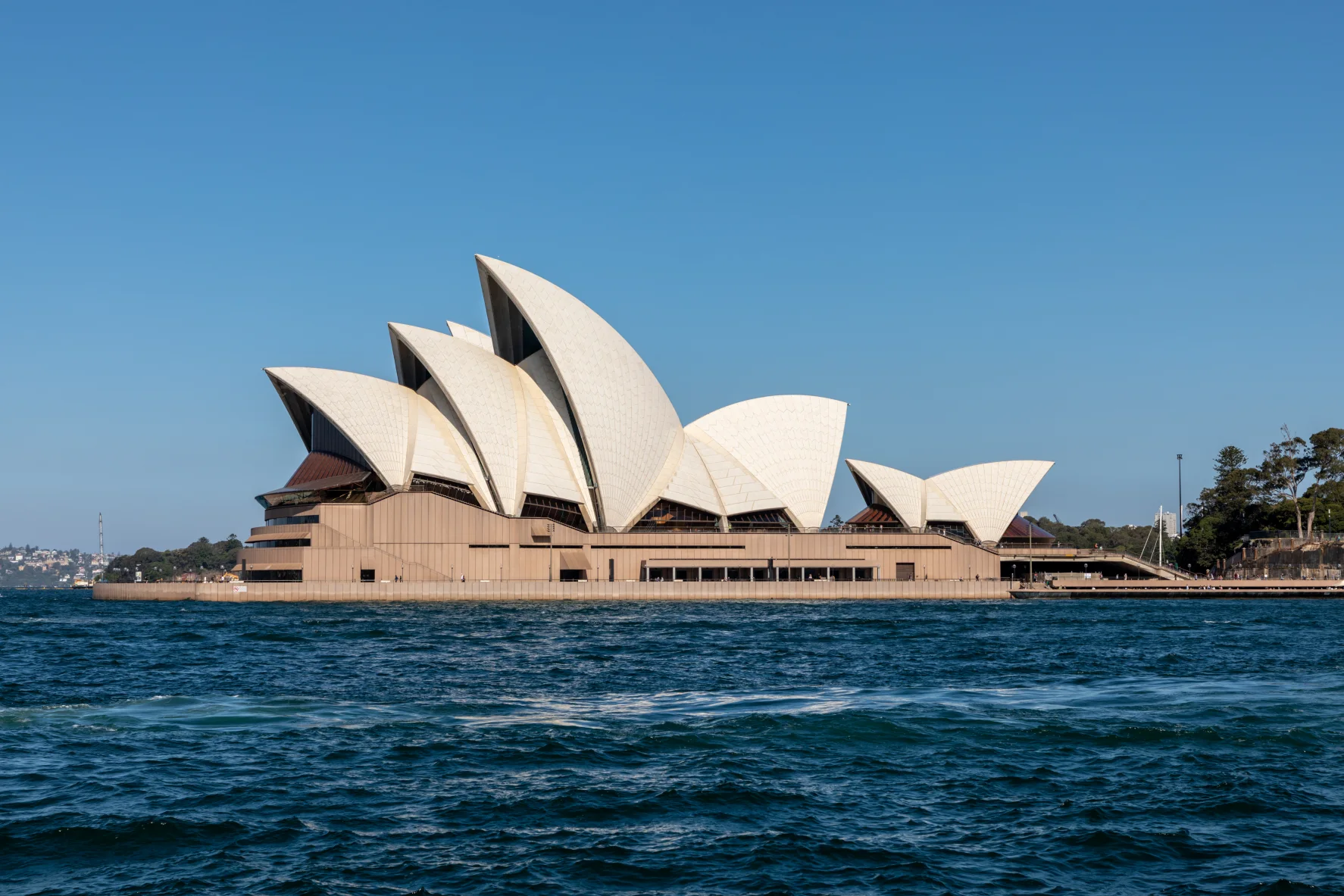
From water level, the Sydney Opera House is less like a clean logo than it appears in outline. The shells overlap. Podiums and service edges become visible. Water breaks the building's reflection. As the sky brightens, the roof surfaces do not behave like smooth white paint. Their ceramic skin changes by angle and condition.
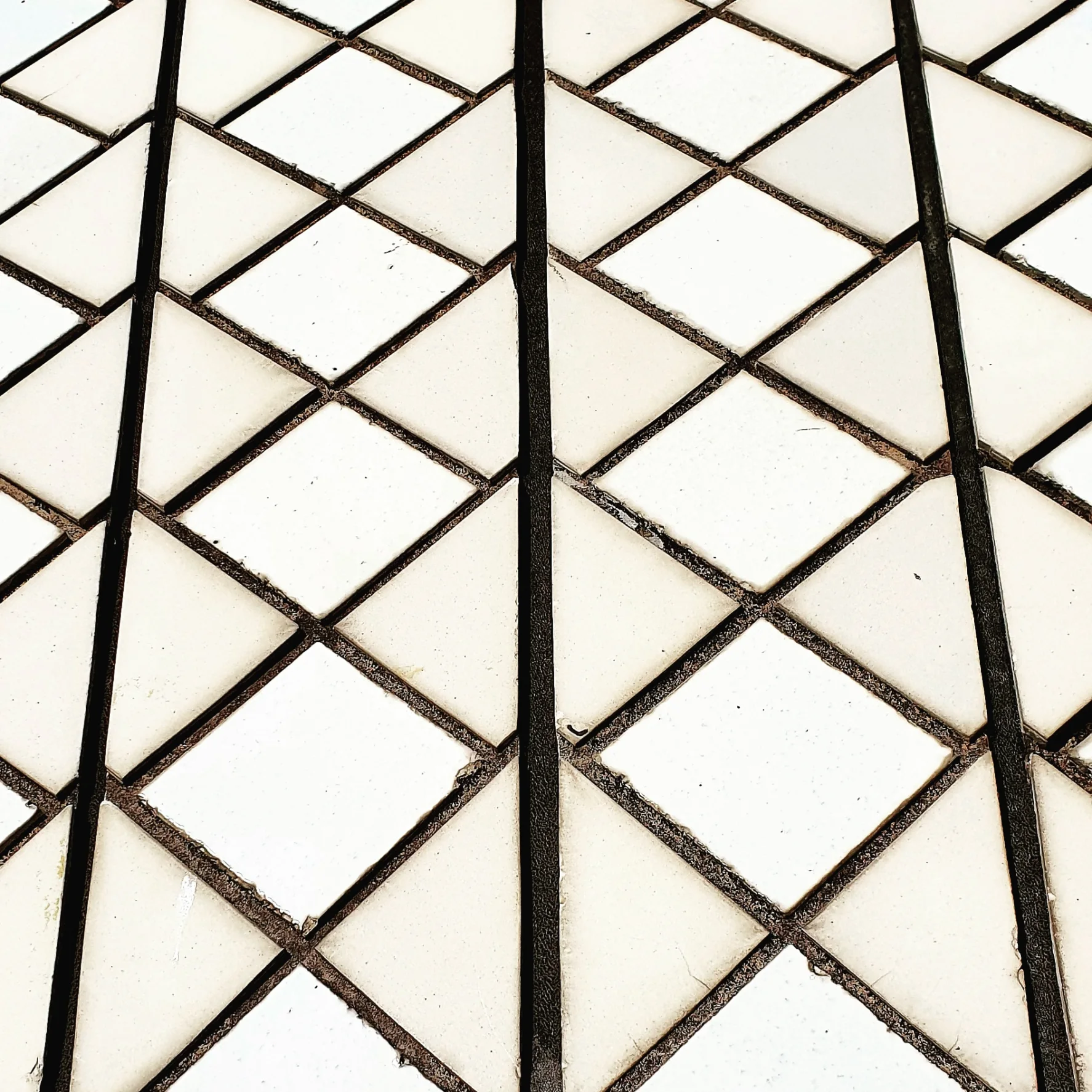
The breakthrough had a concrete model-making story. Utzon stacked the different roof models and recognised that their surfaces could be drawn from one sphere. A common radius allowed repeated formwork and prefabricated ribs instead of treating every sail as an unrelated curve. The Opera House's account of the spherical solution describes an engineering method, rather than the popular story about peeling an orange. The tiled chevrons were made in a factory beneath the Monumental Steps. From the water, those repetitions remain subordinate to the larger silhouette, yet they are what made its apparent freedom buildable.
Jørn Utzon's shell problem was famously resolved through a shared spherical geometry, allowing curved pieces to be rationalised and prefabricated. The roof surface was organised into tile chevrons. Sydney Opera House records 4,228 such chevrons and explains that the tile finish was developed to create whiteness and gloss in relation to harbour and sky without becoming a harsh mirror. That makes sunrise more than a coloured background. It is a demonstration of the material brief.
At first light, a paddler may see one shell edge brighten while another remains subdued. Overcast light can make the pattern quiet; stronger sun can separate glossy and matte responses. Water-level movement continuously changes the viewing angle, so the building refuses the single frontal image used on posters. The kayak provides an architectural section in motion.
The point beneath the building has a much longer identity. The Opera House uses Tubowgule for this resource-rich place, where shell middens record Aboriginal use long before the modern roof. Colonial limeburners later consumed those shells. Woollarawarre Bennelong was a Wangal man kidnapped on Governor Arthur Phillip's orders in 1789, who became an interlocutor between Aboriginal people and the colony. Phillip had a hut built for him on the point in 1790. Bennelong travelled to Britain with Yemmerrawanne in 1792 and returned in 1795; his name survives on the point, but the relationship began in coercion. Fort Macquarie subsequently occupied the peninsula, followed by tram sheds before the Opera House. The shoreline view holds both continuing Country and a succession of appropriations.
A close kayak approach is not necessary to read the Opera House. A conditional sightline is enough to understand the building at water level. Restricted zones, traffic, wind and guide decisions matter more than reproducing a promotional angle. For a deeper land-side account of the Opera House's engineering and political history, the related Sydney Harbour electric-bike feature follows the building at a different speed. From the water, the essential interpretation is that surface, geometry, Country and harbour light are inseparable.
,_Opera_House_--_2019_--_2130.jpg)

11 · Harbour field guide
The Harbour Bridge is an instrument of scale
The Harbour Bridge opened in 1932 as transport infrastructure: rail, road and pedestrian connections carried by a great steel arch. Its symbolic power came partly from the engineering fact. At water level, the arch does not float above a skyline. It transfers through massive end structures toward shore, while deck, traffic and maintenance occupy the horizontal line beneath it.
A kayak makes the dimensions felt without needing to recite all of them. The observer is almost at the surface. The deck sits high. The arch spans a broad navigable opening. A ferry moving under it becomes a scale reference, and the ferry then becomes a reminder not to drift into a traffic line merely to study the comparison.
Sunrise separates the bridge slowly. Steel members that read as one dark shape begin to show depth. Warm light may catch an edge while the underside remains cool. The effect is not guaranteed and need not be dramatic. The engineering remains legible in flat light because loads still move through repeated truss members toward the arch and foundations.
The bridge story also resists a lone-genius shorthand. John Bradfield's public role was central, but design, fabrication and construction involved government engineers, Dorman Long and a large workforce. Building approaches changed neighbourhoods and displaced residents. A sunrise view can honour the object without pretending its making was socially weightless.
As with the Opera House, a distant view can be the responsible one. The group does not need to paddle under the deck to understand it. If wind, traffic or guide judgement keeps the route east, the bridge remains a reference on the horizon. A tour that treats distance as failure teaches the wrong relationship to a working harbour.
12 · Harbour field guide
The harbour is a drowned valley, not a blue stage
NSW's environmental profile describes Sydney Harbour as a drowned river valley estuary. Rising sea level flooded an existing landscape, producing branched water and headlands rather than a basin excavated for the city. The agency's profile of the harbour interior, which treats the Lane Cove and Parramatta rivers and Middle Harbour as tributaries, gives an estuary area of about 29.1 square kilometres and an average depth around 13 metres. Its catchment figure belongs to that profile, not to the combined drainage of all Port Jackson's tributaries. The useful category is a flooded geological system connected to land far beyond the immediate shore.
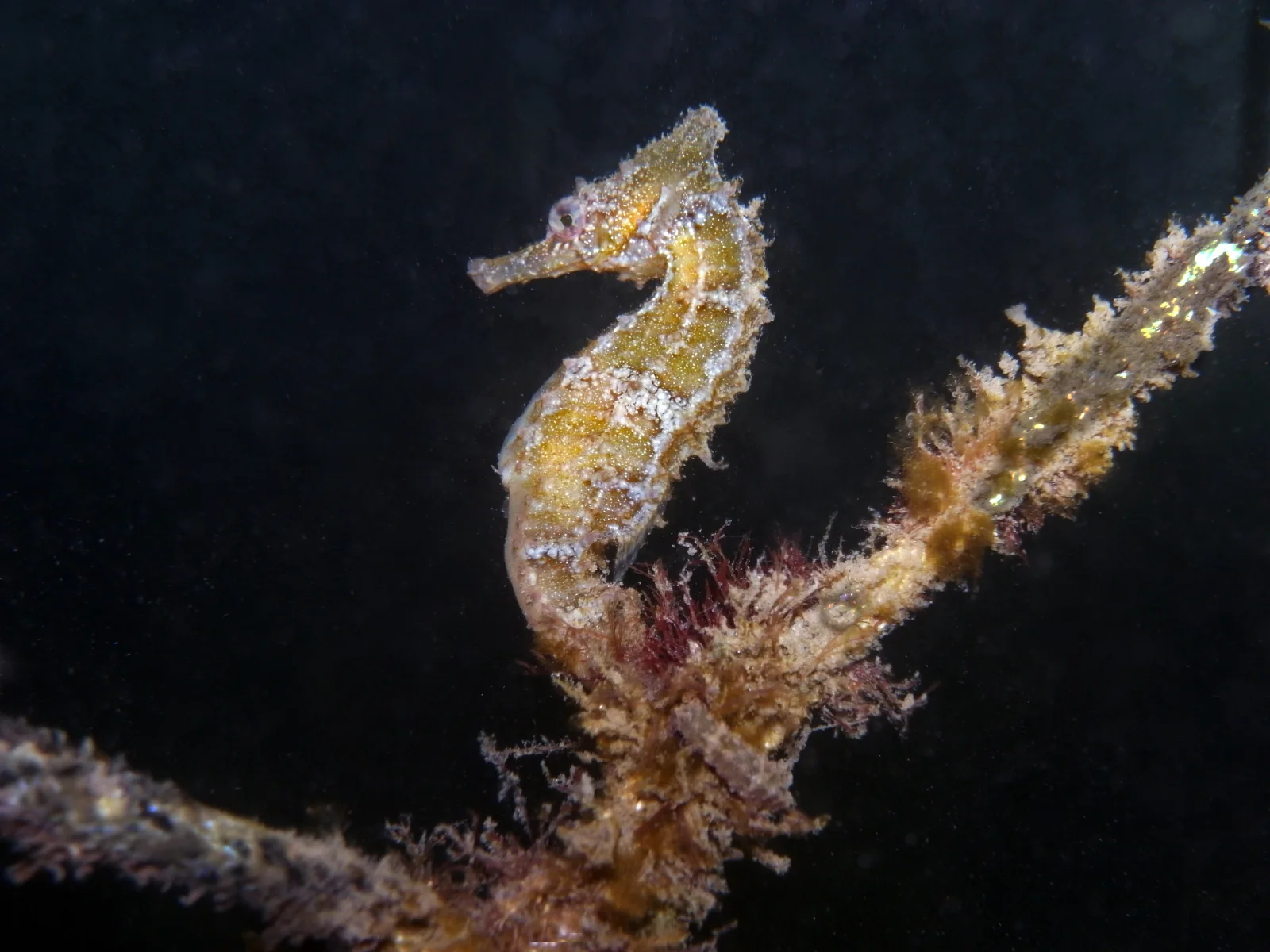
The estuary supports transport, defence, recreation and tourism while retaining habitat. Rocky shores, seagrass and other underwater structure support fish and invertebrates. The endangered White's seahorse is one of the species associated with Sydney Harbour. Its presence demonstrates ecological value; it does not turn a sunrise paddle into a wildlife-spotting guarantee.
The harbour has also received the consequences of urban and industrial use. NSW identifies contaminated sediments, stormwater, litter, habitat modification and other cumulative pressures across urban estuaries. Historical pollution does not mean every part of the harbour is biologically dead. Current habitat does not mean all prior damage has been repaired. The honest ecological picture contains resilience, restoration, persistent contamination and uneven knowledge.
A paddler can learn to notice evidence without pretending to conduct a survey. Hard seawall and living edge support different communities. Floating litter reveals a catchment connection. A bird working a patch of water suggests prey but does not identify it. Seagrass visible in shallows may be habitat and should not be scraped by paddle or landing. Water colour can come from sky, sediment, algae or depth; appearance alone cannot diagnose quality.
The environmental agency notes that comprehensive long-term monitoring for the full harbour remains a developing task. That is a useful limit. Sydney Harbour is famous enough to be photographed constantly and complex enough not to be fully measured by those photographs.

13 · Harbour field guide
Wildlife should be read as habitat, not inventory
Marine life and birds are possibilities, never inclusions. A guided paddle may encounter fish activity, cormorants, gulls, terns or other harbour species. It may not. Dawn affects human attention more reliably than it affects an animal's obligation to appear.
White's seahorse is especially vulnerable to being converted into marketing shorthand. The species uses structured habitat and has been the focus of conservation work in Sydney waters. It is small, camouflaged and underwater. A surface paddler is unlikely to identify one casually from a moving kayak, and a photograph from Watsons Bay does not establish its presence beneath Rushcutters Bay on a particular morning.
The more responsible interpretation is indirect. A harbour capable of supporting an endangered seahorse is not merely architecture reflected in blue water. Habitat quality, seagrass, nets, artificial structures, contamination and restoration decisions matter below the tourist's line of sight. Not seeing the animal can become the reason to think more carefully about what vision excludes.
Birds require similar restraint. Do not drive a kayak toward a resting or feeding bird for a closer frame. Avoid nesting areas and follow seasonal restrictions. A group should not spread across a cove to surround wildlife. A quiet approach is not harmless if it blocks an escape line repeatedly.
No animal sighting validates the tour, and no absence makes it ecologically empty. The best field question is not “What did we collect?” but “What conditions could allow life to use this place alongside a dense city?” That question persists after the paddle and supports better choices about litter, runoff and habitat.
.jpg)
14 · Harbour field guide
Rain connects the street to the paddle
Sydney Water explains that stormwater generally flows untreated from urban surfaces toward waterways. Around Rushcutters Bay, that means rainfall can wash litter, sediment, animal waste, oil and other contaminants from roofs and roads through drains and into the harbour. The old creek relationship has not disappeared; it has been engineered into pipes and channels.
NSW Health classifies activities such as paddling as secondary-contact recreation because immersion is not the intended use, but hands, face and clothing may still contact water. Its general advice includes caution after rain and attention to warning signs and local information. The relevant conclusion is not that every post-rain tour is unsafe. It is that clear-looking water and a commercial departure are not themselves water-quality measurements.
Someone with open cuts, a suppressed immune system or a particular health concern should seek current personal advice before water contact. NSW Health advises covering cuts and avoiding polluted recreational water. Keep hands clean before eating or drinking, and avoid putting wet fingers into eyes or mouth. After landing, change out of wet clothing and attend to any unexpected water contact. The practical response is care with exposure, rather than a blanket description of the harbour as toxic.
Rain also changes physical conditions. Runoff can carry debris. Visibility near drains may decrease. Wind associated with a front can matter more than rainfall itself. A guide may alter the route, while a health advisory may affect contact decisions even if wind is calm. Again, several systems overlap.
NSW Health distinguishes full-immersion swimming from secondary-contact activities such as paddling, where swallowing water is less likely. Its advice is to avoid swimming in estuaries and rivers for three days after heavy rain. That is a swimming precaution, not a universal three-day cancellation rule for every kayak booking. A capsize can turn a mostly dry activity into immersion, so recent runoff, official signs and the operator's assessment still belong in the decision to launch.
The coffee at the end makes this connection unexpectedly practical. Hands that held paddle shafts and touched harbour water should be cleaned before food. The most mundane action can be the point where estuary science changes traveller behaviour.
15 · Harbour field guide
The real tour sequence begins before the photograph
A strong sunrise experience has a visible sequence. Arrival comes first. Find the exact marina meeting point with enough buffer to use toilets, store belongings and resolve a transport delay. Do not plan to walk onto a moving departure at the stated start time. Seasonal sunrise schedules make a late participant especially difficult to absorb.
Check-in should confirm the booked single-kayak format, not merely the passenger name. Tell the operator about relevant injuries, mobility, balance, cold sensitivity, hearing, vision, anxiety around water or communication needs. This is not an invitation for arbitrary exclusion. It is information needed to match equipment, instruction and rescue planning. Ask before payment when an accommodation is essential.
The equipment stage should be deliberate. Fit the PFD. Identify the front and back of the paddle, how the blade is oriented and how the operator wants it held. Learn how to enter and exit the exact kayak without using the paddle as an unstable handrail. Secure only the belongings permitted on the water. Confirm where a phone or camera can be stored without becoming a loose object.
The briefing should name boundaries: where the group forms, what line it follows leaving the marina, how to stop, what to do around traffic, how to respond to a capsize and how the guide modifies the route. A participant who does not understand should say so on shore. A good guide would rather repeat a signal than discover the confusion beyond the pontoons.
Early strokes are for calibration. Notice whether the boat turns consistently to one side, whether the seat or foot position needs adjustment and whether group spacing feels controllable. There is no prize for being the first out of the bay. A guide may reorganise order so a participant who needs more support stays visible.
The middle of the paddle is where landmark attention competes with operating attention. Look, but keep the paddle and boat under control. Stop only when the guide chooses a suitable position. If a photograph requires the entire group to drift across a line, it is the wrong photograph. If the guide cannot safely reach the intended view, accept the modified story.
The return needs its own reserve. Fatigue may reveal a poor grip or seating problem. Light can become brighter and ferry traffic busier. The breeze can oppose the homeward direction. Tell the guide early about pain, nausea, dizziness, cold or loss of confidence. Silence does not protect the group from inconvenience; it only delays the moment when help can be effective.
Landing is still part of the tour. Wait for instruction, stabilise the boat and keep fingers clear of hard edges and pinch points. Account for personal equipment. Clean hands before refreshments. Confirm photographs and privacy expectations rather than assuming every image will be published or supplied in a particular way.
16 · Harbour field guide
Accessibility is a chain of tasks
An age range, weight field or generic “beginner friendly” label cannot answer whether the tour is suitable. Access must be divided into stages: reaching the marina before public transport is fully frequent; moving from drop-off or parking to check-in; using toilets before departure; fitting a PFD; transferring into a low seat; maintaining posture and repetitive rotation; responding to instructions in low light; coping with splash and cold; recovering after capsize; and leaving the boat after fatigue.
For a person with mobility needs, ask about step heights, pontoon movement, transfer assistance, seat width, cockpit opening, back support, foot adjustments and whether an assistive device can be stored securely. “Wheelchair accessible” should never be inferred from a nearby accessible park path. The decisive interface is between person, pontoon and kayak.
For shoulder, wrist or back conditions, total duration is only a rough proxy. Paddle weight, stroke mechanics, static sitting and ability to stop matter. For someone with balance concerns, boarding may be harder than forward paddling. For a person who is not confident in water, the rescue explanation may determine whether the experience is tolerable. None of these concerns should be concealed in the hope that a guide can improvise after launch.
Communication access also matters. In low light, lip-reading and visual signals may be harder. A deaf or hard-of-hearing participant should agree on clear line-of-sight signals and positioning. A blind or low-vision participant may need precise spatial language and consistent partner or guide orientation. A neurodivergent traveller may benefit from knowing the sequence, expected sensory conditions and what happens if the route changes.
Pregnancy, medical history and age require individual, current advice rather than an old blanket claim. The operator can explain equipment and operational limits; a healthcare professional can address personal medical risk. The traveller still makes the decision. Obtain important answers in writing before the cancellation deadline, and do not treat a waiver as a substitute for a conversation.
The single-kayak product may be exactly right for an independent paddler. Someone else may need a tandem, a later daylight session, a land-based harbour route or a different experience altogether. Choosing another format is not failing an adventure test.

17 · Harbour field guide
Photography should follow navigation
The tour's current material includes photographs or video, which can reduce the temptation to handle a phone while paddling. Confirm what that inclusion means: whether images are candid or posed, how and when they are delivered, whether every participant appears and how to opt out. Do not assume a guide can reproduce a specific marketing frame.
If personal cameras are allowed, secure them according to the operator's system. A wrist strap can create entanglement; a neck strap can interfere with a PFD; a loose phone can be lost. Waterproofing protects the device but does not make using it safe in traffic. The guide's stop position is the appropriate moment.
Sunrise exposure is difficult because the sky can be much brighter than the foreground. A phone may silhouette people or overexpose the horizon. That is not a reason to scatter the group into increasingly dangerous angles. Accept a silhouette, reduce exposure, or photograph the changing water rather than demanding a monument and face in the same frame.
The most truthful pictures may not be the widest icons. PFD straps checked at the marina, a navigation light against blue dawn, tile texture beginning to catch light, marina masts layered against apartments, or stormwater infrastructure at the bay's edge can explain more than another postcard. Photography becomes interpretation when it shows relationships rather than only proof of attendance.
Consent matters even on a commercial tour. Ask before publishing close images of other guests. Children and vulnerable participants deserve particular care. A guide's public role does not automatically grant unrestricted use of their likeness or name, and a stranger's enthusiastic review is not permission to turn their experience into another traveller's guarantee.
18 · Harbour field guide
Single, double, guided or land-based: choose the question you want answered
A single kayak offers direct control. It suits someone who wants to find an individual rhythm and can manage the complete hull. A double kayak distributes propulsion and can keep two companions together, but requires cadence and steering cooperation. Neither format is universally easier. The operator should explain which boats are actually available and how it assigns them.
A guided tour concentrates local decisions. The operator supplies equipment, identifies a route, watches weather and traffic, keeps the group together and prepares for rescue. That support is especially valuable before dawn in a busy harbour. It does not guarantee flat water, a private landmark view or suitability for every person.
An independent paddle transfers all of those responsibilities to the paddler: lawful equipment, lighting, weather judgement, tide and traffic awareness, launch permission, route, communication and rescue. Familiarity with a quiet lake is not the same as local competence in Port Jackson. A person capable of paddling the distance may still sensibly choose a guide because the harbour is the unfamiliar part.
A land-based alternative answers different questions. The Sydney Harbour electric-bike route can connect foreshore districts, bridge infrastructure and the Opera House without immersion risk, though it introduces streets, shared paths and crowds. Walking allows the slowest architectural reading. Ferry travel reveals the working network from a vessel with a professional crew. A later harbour cruise may suit someone for whom a kayak transfer is impractical.
Time of day is also a format. Sunrise offers changing light and an early start; daylight improves visibility and may simplify transport; sunset creates another light transition with a different return risk. Do not book dawn merely because it appears more exclusive. Book it when the meeting time, cold, low-light communication and variable imagery match the traveller.
The right experience is not the one with the most dramatic label. It is the one whose responsibilities the participant can understand and accept.
19 · Harbour field guide
Questions worth asking before payment
Current commercial pages are the starting point, not the final contract. Ask the operator to confirm the exact date, meeting time and 1B New Beach Road location. Confirm whether the booking is for a single kayak, how boats are assigned and whether another format exists if fit or ability changes.
Then ask:
- What is the expected group size for this departure, and how many guides will be on the water?
- What PFD, visibility and low-light equipment is supplied, and what must the participant bring?
- How does the operator assess wind, warnings, visibility and harbour traffic?
- What are the current weather cancellation, rescheduling and refund terms in writing?
- What transfer assistance, seat dimensions and equipment adaptations can be confirmed?
- What experience or water confidence is expected, and what happens after a capsize?
- Is there secure storage, and what can be carried in the kayak?
- Are photographs included, how are they delivered, and how can a guest opt out?
- Does the listed duration include briefing and refreshments or only water time?
- Which restrictions or route limits might change the landmark views?
- What is the latest toilet opportunity, and are there any bathroom stops?
- What are the present age, health and participation requirements for the specific guest?
Use the operator's current booking confirmation and checkout for all mutable answers. The calendar, price and inclusions shown there govern the booking rather than any dated description in a magazine or podcast.
On the evening before departure, check the Bureau of Meteorology Sydney Enclosed Waters forecast, then check again before leaving. Review official warnings, not only a consumer weather icon. If heavy rain has occurred, consider current water-quality advice and ask the operator how it affects the plan. Arrange transport that does not depend on abundant pre-dawn parking.
At the marina, treat the guide's briefing as new information. The answer obtained by email a week earlier cannot override a warning, closure or changed group condition. A decision to modify or cancel may be the most accurate delivery of the service.
20 · Harbour field guide
Listen for the questions behind the sales language
The Sunrise Kayak Tour — Single Kayak podcast episode, published on 2 July 2026, runs 20 minutes 24 seconds. Its strongest contribution is a compact set of traveller concerns: the pre-dawn alarm, instruction, water confidence, weather, changing light, wildlife, equipment, photography and the scale of the harbour icons from a small craft.
The audio builds its case through a confident before-and-after: hotel reluctance becomes freedom on the water; the guide absorbs navigational and photographic work; a single kayak promises autonomy; sunrise turns familiar architecture into a new encounter. That structure is worth hearing because it exposes what a buyer hopes the tour will change. It also makes the practical questions sharper. Autonomy still depends on group spacing, quiet still contains working traffic, and a guide reduces cognitive load without making weather or capability irrelevant.
Treat every number in the recording as a snapshot rather than a term of a future booking. Meeting time, group size, age policy, price, cancellation, breakfast and route can change independently. A broad participation claim cannot answer whether one guest can transfer onto a moving pontoon, fit the boat, paddle for the required time or follow low-light signals. Those answers belong in a direct exchange with the operator before payment.
The episode names Garden Island, Fort Denison, the Royal Botanic Garden and the central icons as a flowing route. On the water, that sequence is conditional. Security boundaries, traffic, wind, visibility and group performance decide whether a sightline is sensible. Listen to the geography as orientation, then allow the guide to replace the imagined track with the safe line available that morning.
Kayak language also travels poorly between destinations. A single boat on Sydney Harbour shares equipment vocabulary with a kayak below Hoover Dam, but not the same traffic, access, ecology, water management or rescue context. The craft is only the viewing instrument. The place supplies the actual story and the actual risks.
21 · Harbour field guide
What first light finally reveals
The most famous view in Sydney can survive a less famous morning. Cloud may flatten the sunrise. The route may remain sheltered. A ferry may interrupt the reflection. No seahorse may be seen. The guide may decline the frame that sold the tour. None of those outcomes makes the paddle empty.
Rushcutters Bay reveals a marsh and creek edge rebuilt into park, drain, seawall and marina. The low boat reveals why visibility is an active safety task. Port traffic reveals that the harbour is shared. Opera House tile reveals a surface designed for change rather than permanent white. The bridge reveals scale. Stormwater reveals the catchment inside the water. An unseen seahorse reveals the habitat below a traveller's visual range.
The single kayak makes those lessons personal because the hull responds immediately. Turn the torso and it advances. Sweep badly and it wanders. Stop watching the guide and distance opens. Grip too hard and fatigue arrives early. The craft has no interest in the prestige of the skyline; it responds to force, balance, water and wind.
That is why sunrise is best understood as an operating window. It joins night rules to daylight, city lighting to solar light, transport to recreation, architecture to atmosphere and the booked itinerary to conditions no booking controls. The harbour is not a backdrop waiting to be claimed. It is the system in which the tour has temporarily found a line.
Return to Rushcutters Bay with that relationship intact. Land under instruction. Clean hands before coffee. Accept photographs as records rather than trophies. Recheck the surface behind you: marina, drain, park, apartments, navigation and tide continue after the kayaks are stored.
Sydney Harbour at first light does not become simpler. It becomes briefly easier to notice how many things are happening at once. That is the real privilege of the low seat: not having the harbour to yourself, but learning how little of it ever belonged to one view.