01 · Madrid modern memory
The visit begins before the famous room
Most first-time plans for the Museo Reina Sofía can be written in one line: find Guernica. The painting’s reputation, size and political history deserve that urgency. Yet a route built only around arrival and departure turns the rest of the museum into a corridor. It also hides the first argument the institution makes, before a visitor sees any art.
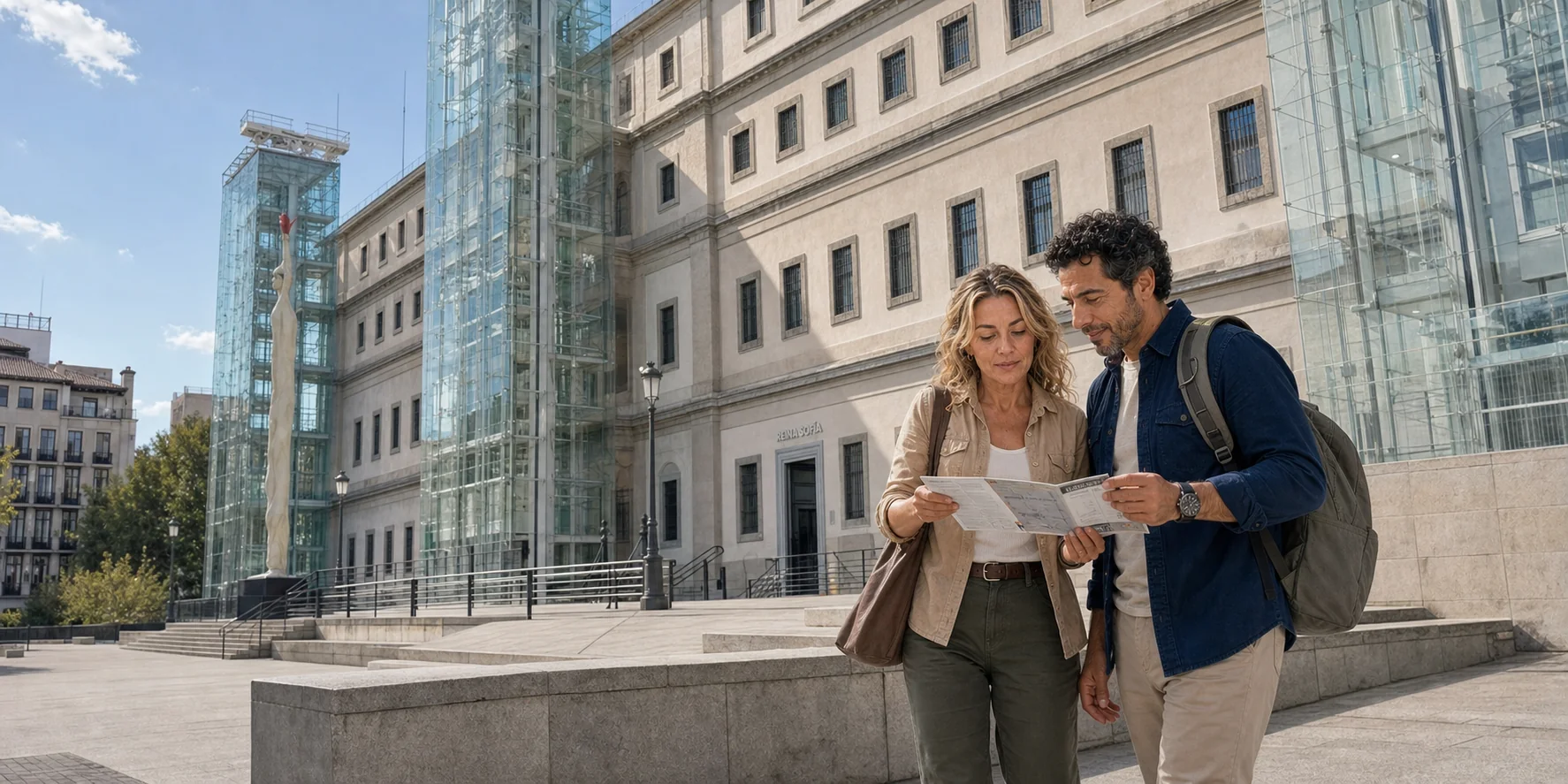
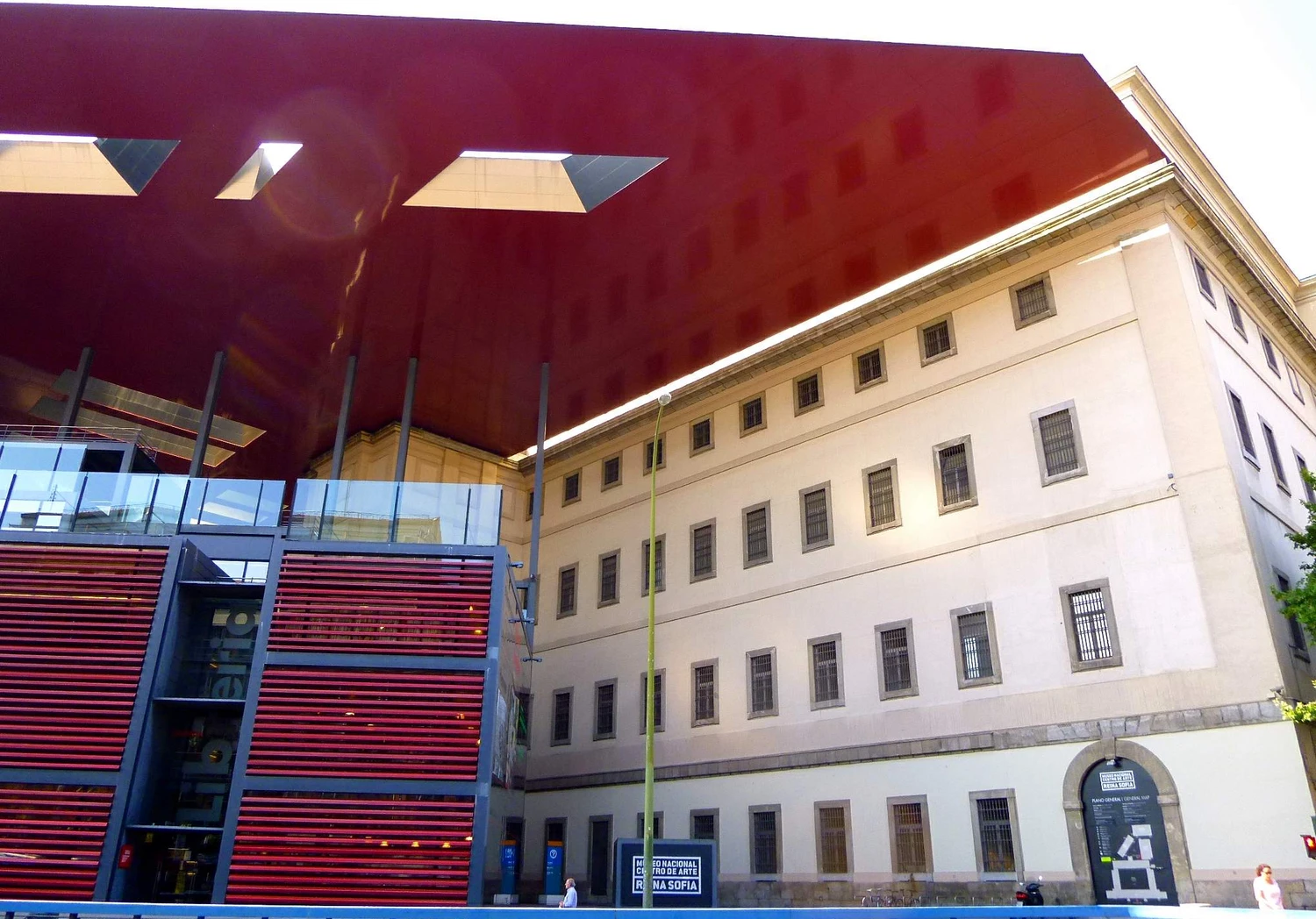
That argument is built in stone, glass and circulation. The main site joins an eighteenth-century hospital, converted for cultural use, to an early twenty-first-century extension that opens a partially covered square toward Lavapiés and Ronda de Atocha. One building inherits the discipline of wards and cloisters; the other uses an enormous red roof, raised walkways and separate volumes to claim urban openness. Exterior glass lift towers make movement visible against the old fabric. Entrances, bridges, stairs, galleries and pauses are not neutral containers. They decide which relationships are easy to see and which require effort.
The most rewarding route follows relationships rather than collecting famous names. Begin with the hospital and its transformation, place the Spanish Republic’s 1937 Pavilion around Guernica, compare the finished canvas with Dora Maar’s photographs, and leave time for other artists. The museum map helps locate these anchors; the transitions explain why they belong together.
There is a practical advantage to this sequence. It gives the famous room a beginning and an aftermath. A painting that can overwhelm attention becomes part of a larger encounter with architecture, artistic experiment and the difficult inheritance of Spain’s twentieth century.
02 · Madrid modern memory
A hospital became a machine for public culture
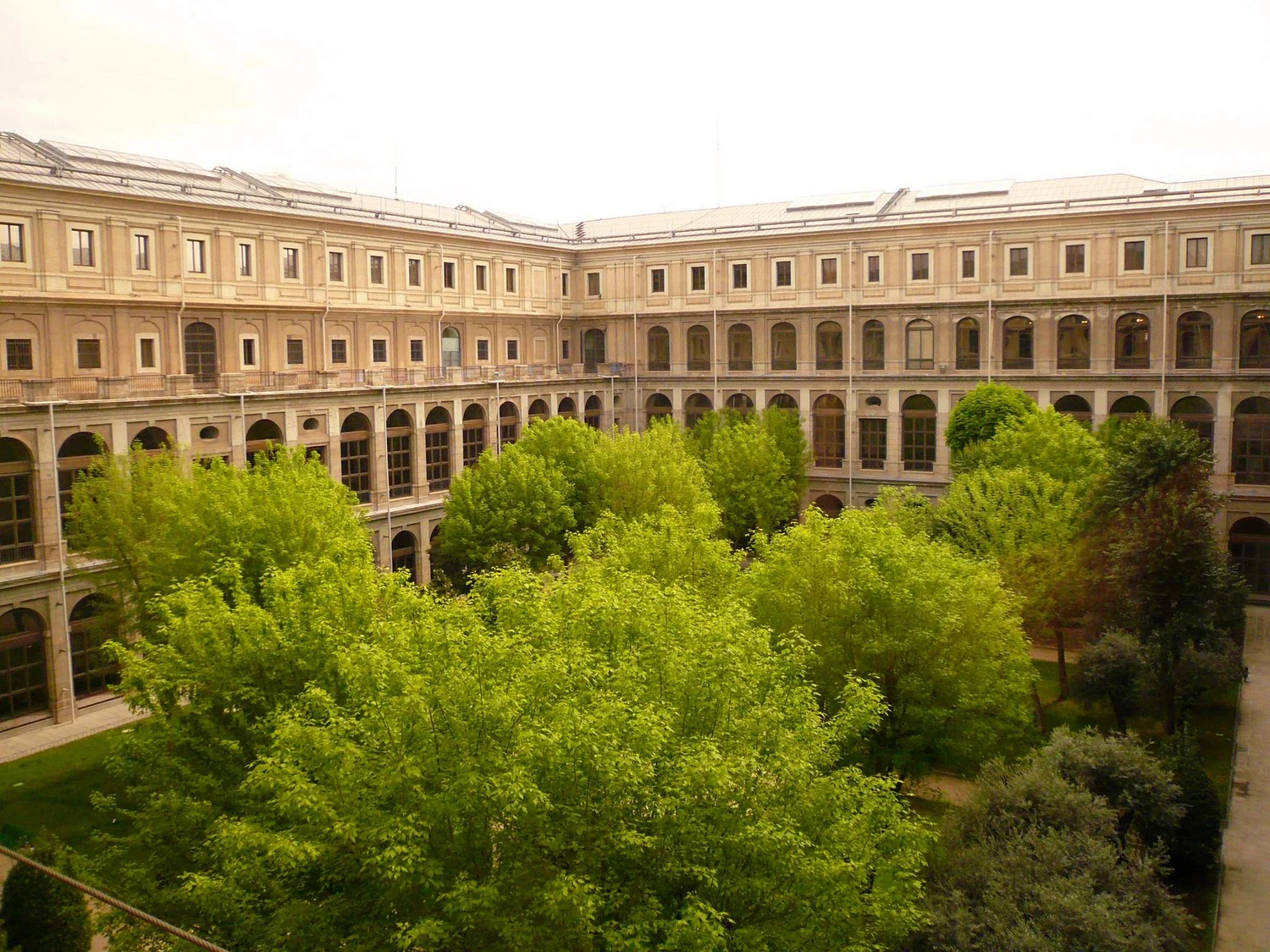
The Sabatini building carries a history that resists the clean origin story implied by a museum opening date. Madrid’s Hospital General grew from Bourbon-era efforts to consolidate care for the poor and sick. José de Hermosilla began the major eighteenth-century project; Francesco Sabatini continued it under Charles III. According to the museum’s architectural history, by 1788 only about a third of Sabatini’s intended scheme had been built. The surviving complex was never an elegant palace waiting to hold art. Its scale, repeated windows and interior courts belonged to an institutional attempt to organise bodies, work and charity.
That past changes how the building feels. Long passages and repeated thresholds preserve the logic of a public complex assembled for another purpose. The central garden offers a pause inside a dense urban district. Outside, the two prominent glass lift towers declare a later intervention without pretending to be eighteenth-century. They form part of a three-tower project designed by José Luis Íñiguez de Onzoño and Antonio Vázquez de Castro in collaboration with British architect Ian Ritchie. Light steel and glass made the new circulation visibly different from the hospital’s heavy masonry.
The conversion was a sustained act of reuse. The former hospital received protected status in 1977; Fernández Alba’s restoration began in 1980. Exhibition rooms opened as the Centro de Arte Reina Sofía in April 1986. National-museum status followed in 1988, the museum was inaugurated in 1990, and its permanent collection opened in 1992. Those dates mark architectural, legal and curatorial decisions rather than the sudden birth of Spain’s modern-art holdings. The institution inherited works from predecessor bodies, including the Museo Español de Arte Contemporáneo, and from state collections whose own categories had changed over decades.
The 2005 Nouvel extension answered practical and symbolic pressures. Jean Nouvel’s project arranged three volumes around a triangular semi-public courtyard. Library, bookshop, offices, galleries, auditoriums, storage and food spaces entered a larger network linked to Sabatini by raised passages. A deep red aluminium roof projects over the courtyard, aligned with the old building yet held apart from its cornice. The result is not a calm stylistic marriage. It is a deliberate contrast between compact historic fabric and a newer institution that wanted more room, more programmes and a more visible relationship with its neighbourhood.
That contrast has consequences for a visitor. Sabatini gives the strongest sense of the former hospital and direct proximity to much of the early twentieth-century collection. Approaching through the Nouvel courtyard makes the expansion’s urban idea legible even when live operations alter which doorway is in use. Neither building supplies a universally “correct” beginning. Check the museum’s current visit page for the operating entrance, then let mobility needs, meeting instructions and the day’s first priority shape the route.
Architecture also explains why an apparently simple request—go straight to Guernica—requires some orientation. Adapted wards, courts and modern connectors do not form a single axial gallery. Note the building, floor and room on the map, then choose a manageable sequence. Starting with the 1920s, crossing into the pavilion context and continuing to a post-war question lets the visitor experience the connections instead of spending the whole visit finding the next doorway.
_01.JPG)
03 · Madrid modern memory
A collection is an argument, not a warehouse
The Reina Sofía is Spain’s national museum for twentieth- and twenty-first-century art, with a collection that also reaches into the late nineteenth century. That description can sound encyclopaedic. In practice, no permanent display can show everything or organise modernity without taking a position. Every route selects beginnings, centres, margins and endings.
The collection’s recent presentation makes that construction visible. The 2021 arrangement called Communicating Vessels replaced a single march of styles with episodes, documents and relationships across art, architecture, politics, popular culture and social movements. A further reorganisation began in 2023 and is scheduled to continue through 2028. The resulting instability is not only an inconvenience. It is evidence that a national collection is being argued over in public.
Consider the familiar canon implied by three surnames: Picasso, Dalí and Miró. All are indispensable. Together, however, they can shrink Spanish modernism into a trio of male geniuses whose differences disappear behind celebrity. A museum route can resist that by placing paintings beside photography, posters, architecture, film, journals and political documents; by restoring women and exiled artists; and by showing that artistic experiments travelled across Barcelona, Madrid, Paris and the Americas rather than remaining inside one national box.
Room adjacency does some of this work silently. A visitor who sees preparatory studies, a pavilion model, photomurals and works by other commissioned artists before reaching Guernica encounters a state exhibition built under emergency conditions, not an isolated masterpiece descending into a white room. A visitor who sees Ángeles Santos and Maruja Mallo near better-known surrealist names encounters different modern imaginations that a three-star route can omit. A label that identifies where a work was shown, published, seized, stored or returned reveals institutions as actors in art history.
This is why “the museum is confusing” can be both a fair practical complaint and an incomplete judgment. Orientation may genuinely fail. Signs, closures and long connectors can tire a visitor. At the same time, a display that refuses one smooth story may be asking the visitor to notice conflict. The solution is not to romanticise confusion. It is to distinguish navigational friction from productive complexity.
A focused visit therefore needs a depth map rather than a trophy list. Give each anchor a job. The building explains institutional reuse. The 1937 Pavilion rooms explain commission and propaganda. Guernica explains how an event, a painting and later political memory became entangled. Dora Maar’s photographs explain process. Dalí, Miró, Mallo, Santos and González test the boundaries of the canon. The current rehang explains that museums make history in the present tense. For a contrasting collection whose route also reveals changing institutional purposes, the ExcursionPass guide to the Vatican Museums, Sistine Chapel and St Peter’s follows the point where museum logic yields to a living church.
04 · Madrid modern memory
Gernika was a place before it became a title
The Spanish Civil War began in July 1936, when a military uprising attempted to overthrow the elected Republic and met resistance. The resulting war drew in foreign states as well as Spaniards with sharply different political commitments. Germany and Italy supplied Franco’s Nationalists; the Soviet Union supported the Republic, and international volunteers joined its defence. The conflict ended with the Nationalist victory in 1939 and a dictatorship that lasted until Franco’s death in 1975. Guernica belongs to that history, but its subject is a particular attack within it.
On 26 April 1937, during the Spanish Civil War, aircraft of Nazi Germany’s Condor Legion and Fascist Italy’s Aviazione Legionaria attacked the Basque town of Gernika in support of General Francisco Franco’s Nationalist forces. Bombs and incendiaries destroyed much of the town. Civilians were killed. The Gernika Peace Museum’s documentary account shows how the attack became internationally notorious through reporting and images, while its history continued to be fought over through propaganda, denial and competing casualty estimates.
A responsible account avoids two shortcuts. The first says simply that “Franco bombed Guernica,” erasing the German and Italian forces that carried out the attack and the military alliance that made it possible. The second supplies one exact death toll as if archival debate had ended. The United States Holocaust Memorial Museum uses a cautious figure of more than 200 killed; other estimates have been higher. The uncertainty should not minimise the violence. It should clarify what is known, what was contested and why false precision is attractive in stories of atrocity.
Gernika also held meaning beyond its physical size. It was associated with Basque political tradition and the assembly tree under which historic liberties were symbolically affirmed. The attack’s destruction therefore registered as violence against civilians, urban fabric and political memory at once. Yet it should not be described as an unprecedented first in the history of aerial warfare. Bombing of cities and civilians had precedents. What made Gernika especially consequential was the combination of destructive technique, international intervention, symbolic place, rapid reporting and an artwork whose title carried the town’s name around the world.
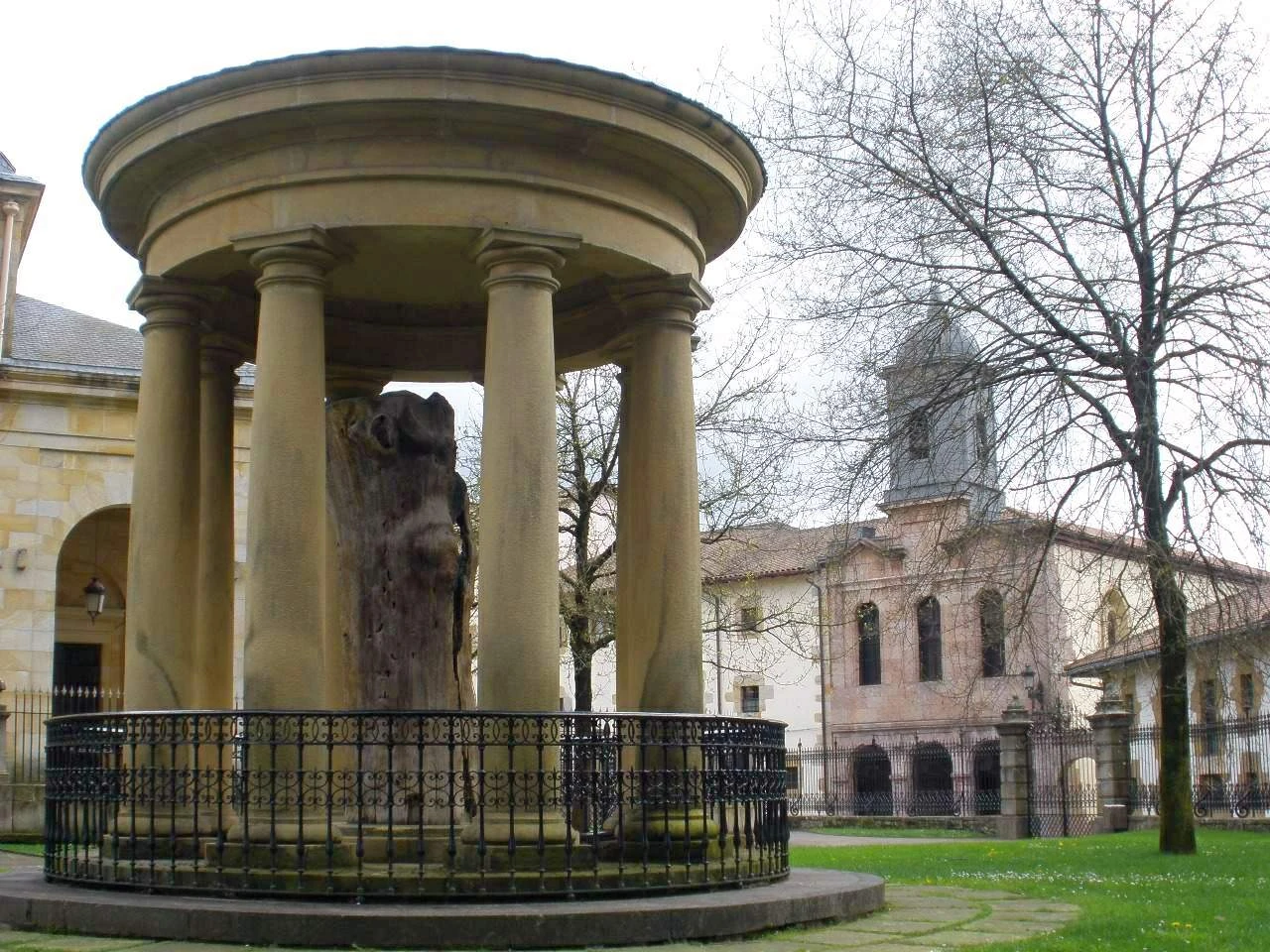
The Tree of Gernika represents institutional continuity rather than one immortal oak. Successive living trees have sheltered the symbolic life of the assemblies. A preserved older trunk stands in a colonnaded shelter beside the Assembly House; it is distinct from the living oak used for ceremonies. That distinction makes the place’s political meaning more tangible. Memory can be carried by a lineage, a surviving fragment and a practice of gathering, rather than by an unchanged object. Picasso’s title therefore named a town with a political history, not a generic place of suffering.

The Spanish Republic had already commissioned Pablo Picasso to produce a large work for its pavilion at the 1937 International Exposition in Paris. The pavilion itself, designed by Josep Lluís Sert and Luis Lacasa, was a cultural and diplomatic intervention by a government fighting for survival. Its programme joined architecture, painting, sculpture, photography, statistics, film and popular culture. Miró, Julio González, Alberto Sánchez, Alexander Calder and many others contributed. Josep Renau’s photomurals made information part of the visual field. The museum’s record for Guernica anchors the commission and the painting’s later custody; the building around it asked an international audience to see cultural modernity and antifascist struggle as connected.
Picasso had not settled on the mural’s subject when news of the attack reached Paris. He began sketches on 1 May and worked on the large canvas through early June in his studio on the Rue des Grands-Augustins. The sequence matters. Guernica was not painted in the bombed town, was not an eyewitness record and does not identify aircraft, uniforms or a street. It transformed news of a specific attack through figures and forms Picasso had been developing across earlier work, including the bull, horse, lamp, dismembered body and grieving woman.
That distinction does not make the painting less historical. It locates its historical action more accurately. A commissioned pavilion work responded to contemporary reporting and entered an exhibition designed to persuade. Its imagery did not illustrate a newspaper report line by line. It created a field of suffering whose relationship to the bombing, the Civil War and longer pictorial traditions has remained open to interpretation.

05 · Madrid modern memory
Dora Maar’s camera makes creation visible
The most valuable way to slow down before the finished canvas is to look at process. Dora Maar photographed Guernica as it developed over a series of sessions from May into June 1937. Her images show the composition changing: positions shift, shapes are clarified, details appear and disappear, and the balance of the enormous surface is repeatedly reconsidered.
Maar was not a neutral device attached to Picasso’s studio. She was an accomplished photographer and artist with her own surrealist practice and political commitments. The physical conditions of the documentation were difficult. The canvas filled a large wall; the studio light was limited. The museum’s record of her photographic reportage describes retouching, internegatives and copies made from prints to strengthen the images. Her work is therefore evidence of Picasso’s revisions and of photographic labour.
That labour complicates the myth of the solitary flash of genius. The photographs do not tell us that Maar co-painted the canvas, and they should not be recruited into a claim the evidence does not support. They do show that a woman artist produced the primary visual record through which later viewers can study the mural’s metamorphosis. Christian Zervos, editor of Cahiers d’art, recognised the importance of documenting the work. Reproduction, publication and interpretation helped create the public object we now call Guernica.
The process images also protect against a rigid symbolic key. If a form changes across stages, its final meaning cannot always be read as the direct transcription of one fixed intention. A hand, light, profile or animal may carry visual memories from earlier Picasso works, respond to compositional pressure and acquire political force in the completed mural. Interpretation becomes stronger when it begins with what changed and what relationships the change produced.
This is one reason a guide can add real value. The useful guide does not recite a code in which bull equals one noun, horse another and bulb a third. The guide directs attention across preparatory studies and Maar’s sequence, distinguishes evidence from hypothesis, and asks what happens when an element is moved. If the route or conservation rules make that comparison impossible in the gallery, the museum’s digital Rethinking Guernica and conservation resources can extend the inquiry later.
06 · Madrid modern memory
How to look without pretending to solve the painting
The painting is nearly 3.5 metres high and more than 7.7 metres wide. Its scale prevents one stable view. From farther back, the horizontal field and strong diagonals organise the scene. Closer, surfaces, outlines, overlaps and passages of paint interrupt the apparent monumentality. A crowded room makes that movement harder but also exposes a practical truth: looking is bodily and social.
Start with observation. A bull stands at the left near a woman holding a dead child. A horse occupies the centre. A fallen body lies below. A woman extends a lamp. Another figure appears caught in an architectural opening or fire. An electric bulb occupies the upper field. Heads, hands and mouths turn the composition into a network of gazes and cries. The palette is largely black, white and grey, with tonal variation rather than newspaper flatness.
Then separate formal relationship from symbolic conclusion. The museum notes the painting’s connections to history painting, film, press photography, Cubism, Surrealism and Picasso’s earlier imagery. Those contexts are visible and documentable. They do not prove one universal dictionary. The bull has been read as brutality, Spain, endurance, the artist and a witness. The horse has been read as people, Republic, victim and suffering animal. The electric bulb and hand-held lamp can stage competing kinds of vision; the Spanish word bombilla may invite wordplay with bomba, but a pun is not proof of a single intended message.
The monochrome field also invites several explanations. Contemporary illustrated newspapers helped shape how distant violence was seen. Grisaille belongs to longer painting traditions. Black, white and grey intensify contrast and refuse the sensuous colour expected from a world’s fair mural. Saying the palette “is ash” converts an effect into a literal fact. Better to ask what colour’s absence does to distance, reproduction, mourning and attention.
Cubist fragmentation is similarly easy to overstate. The horse and human bodies are broken into angular planes and overlapping profiles. That structure can make the scene difficult to stabilise and can heighten a viewer’s sense of dislocation. It does not allow an article to claim that the technique neurologically reproduces panic in every brain. Formal analysis should describe the work, not impersonate neuroscience.
Finally, restore location. The room displaying Guernica is in the former hospital complex. During the Civil War, the building itself served medical functions in a city repeatedly attacked from the air. That resonance is real, but it does not mean the canvas was designed for this wall. The painting was made for Paris, travelled widely, remained for decades in New York, returned to a different Madrid building and moved here in 1992. Its current location adds a layer; it does not erase the others.
07 · Madrid modern memory
The painting’s travels became part of its politics
After the Paris exposition, Guernica travelled to raise awareness and support for the Republican cause and refugees. It was shown in Scandinavia, Britain and the United States. When the Second World War began, Picasso placed it in the care of the Museum of Modern Art in New York. In 1958 he extended the loan until Spain had recovered democratic conditions, a wish that later generated legal and political argument over who could determine when the condition had been met.
The painting’s absence from Franco’s Spain gave it another role. It was not only an image associated with the Civil War; it became an object whose location registered exile, dictatorship and the expectation of return. Activists and artists invoked it in later conflicts. MoMA displayed and interpreted it for generations of visitors. Spain’s transition after Franco’s death created the political circumstances for a return, but the process still required negotiation among the Spanish state, MoMA and Picasso’s heirs and representatives.
The canvas arrived in Spain on 10 September 1981 and was installed in the Casón del Buen Retiro, then associated with the Prado. MoMA’s contemporaneous transfer announcement records the custody decision and the shipment of the mural and studies. In July 1992 the canvas moved to the Reina Sofía. Each home framed it differently: an international museum of modern art, a building linked to Spain’s historic royal collection, then the national museum devoted to modern and contemporary art. The move helped define the Reina Sofía’s authority and public identity.
That history gives the painting a double life. It refers back to a 1937 attack while accumulating meanings through reproduction, protest, custody, return and display. A museum visit should resist collapsing those layers into the sentence “Picasso wanted it back when democracy returned.” The broad condition is documented; the definitions, negotiations and public stakes are the history.
The return also forces a question about national ownership. The Republican government acquired the mural. Picasso worked in Paris and spent much of his life outside Spain. The title belongs to a Basque town. MoMA conserved and exhibited the work for decades. The painting has become a global anti-war image. Calling it a Spanish national treasure is accurate institutionally but incomplete culturally. Its power comes partly from refusing to fit one jurisdiction.
08 · Madrid modern memory
Conservation replaces pilgrimage myth with material fact
Visitors often approach Guernica as though the room protects a relic whose power lies outside material history. Conservation tells a better story. The work is oil paint on a very large canvas that has been rolled, transported, installed and exposed across decades. Its condition is the accumulated result of making, travel, environment and earlier handling.
The Reina Sofía’s Journey Inside Guernica conservation project, developed between 2011 and 2013, brought non-invasive imaging and structured documentation to the surface. A robotic system allowed high-resolution visible-light, ultraviolet and infrared records to be aligned and studied alongside three-dimensional information. Conservators can map cracks, losses, retouching and changes without repeatedly touching or moving the painting. The resulting digital platform makes technical evidence available for research and public interpretation.
The point is not technological spectacle. A robot does not “decode” artistic meaning. It records material information consistently. Imaging may distinguish paint passages, reveal underdrawing or help monitor change; it cannot tell us that one animal stands for one political actor. Conservation and interpretation answer different questions, even when they inform one another.
Limiting the painting’s movement follows from that material biography. The work’s earlier travel helped make its public history, but every major move introduces mechanical risk. Keeping it in a controlled environment is a decision about preserving a vulnerable object, not a declaration that it is too sacred to enter ordinary history. Room temperature, distance barriers, photography rules and staff instructions belong to the same duty of care.
That care applies to other works and to visitors sharing the room. The museum asks everyone to keep a safe distance and follow staff instructions. Leave space for another viewer to approach, make any group discussion quiet enough to share the room, and let a guide organise attention within these common rules. The privilege a good tour offers is sustained explanation.
Photography is generally permitted without flash, tripod, selfie stick or stand unless a room says otherwise. The most useful decision may still be not to photograph. In a crowded space, raising a phone can obstruct someone else’s sightline and convert the encounter into proof of attendance. A private guide’s value is best measured by the quality of looking, not by the number of unobstructed souvenirs secured.

09 · Madrid modern memory
Beyond Picasso: a constellation, not an afterthought
Leaving Guernica should not feel like the end of the museum. The strongest next move is to choose artists who change the question. Salvador Dalí and Joan Miró belong in that route, but not because they are two more Spanish names on a celebrity card. Their works test different relationships between dream, automatism, politics, surface and artistic identity.
Dalí’s 1929 Face of the Great Masturbator assembles a profile-like form, grasshopper, figures and objects into an intensely personal landscape of desire and anxiety. The work belongs to the period in which Dalí entered the Surrealist movement and developed what he later called a paranoiac-critical method. That phrase should not be turned into a clinical diagnosis or the claim that he intentionally induced one medically defined state. It names an artistic strategy of finding multiple and unstable images, promoted with Dalí’s own flair for self-mythology.
Dalí’s later career complicates a simple equation between artistic revolt and political opposition. His relationship with André Breton broke down and he was expelled from the Surrealist group in 1939. The Reina Sofía’s 2013 retrospective chronology records his return to Spain in 1948, the religious subjects of his mystical and nuclear period, and the Grand Cross of Isabel la Católica awarded to him in 1964, during Franco’s dictatorship. These are a different trajectory from Picasso’s exile and the Republican commission. The 1929 painting is best approached through its own date, forms and personal imagery.
Miró offers a different problem. Surrealist rhetoric sometimes spoke of the “assassination of painting,” and Miró repeatedly attacked academic expectations through sparse grounds, signs, unconventional materials and poetic association. It is tempting to summarise this as hatred of art or anti-establishment destruction. His paintings show something more exact: sustained decisions about colour, line, interval and material that questioned what a painting could be while continuing to make paintings.
For the 1937 Spanish Pavilion, Miró made the large mural commonly known as The Reaper or Catalan Peasant in Revolt, now lost. His Aidez l’Espagne design, published in Cahiers d’art that year, likewise expressed Republican solidarity. Yet the museum’s September 1937 Painting (Swallow) takes another direction. Thin lines and patches of colour allow the rough Celotex support to remain visible; the catalogue relates its signs to Parisian graffiti. Beside Dalí’s densely modelled dream imagery, its intervals and exposed surface show how differently Surrealist artists could work, even within the same turbulent year.
Ángeles Santos expands the field again. She painted Un mundo in Valladolid in 1929 at seventeen, constructing a cubical planet populated by figures, cities and rituals. At 290 by 310 centimetres, this imagined world demands bodily attention as well as a reading of its small incidents. It reached Madrid through the Autumn Salon, outside a canonical Paris studio. Santos had encountered reproductions of avant-garde art in magazines and Franz Roh’s writing on contemporary painting; her invention shows how images and ideas could travel to a young artist far from the movement’s supposed centre. Follow the planet’s surfaces and its surrounding figures slowly: the composition offers several kinds of life at once.
Maruja Mallo’s route is one of movement, exile and reinvention. In La verbena, painted in 1927, the fair becomes a compressed theatre of modern Madrid: bodies, machines, popular festivity and social types collide. Shooting-gallery targets, a test-of-strength attraction, a priest and an outsized one-eyed figure make the crowd a satirical world rather than a harmless souvenir. The painting belonged to four fair scenes included in her 1928 exhibition at the offices of José Ortega y Gasset’s Revista de Occidente, a significant platform for a young woman artist.
By 1930, Antro de fósiles had replaced the fair’s density with mineral and skeletal forms, a darker investigation of matter and absence. Mallo later spent years in exile in Argentina as a consequence of the Civil War. The shift from festivity to earth, and then the displacement of the artist herself, resist a single tidy account of Spanish modernity. Popular culture, experiment and exile belong to the same life without producing one unchanging style.
Julio González changes the medium. Trained in metalwork and associated with the development of modern welded-iron sculpture, he turned industrial technique into drawings in space. His contribution to the 1937 Pavilion, La Montserrat, made a Catalan peasant woman holding a child and a sickle into a figure of suffering and resistance. The work belongs to the Stedelijk Museum in Amsterdam; its pavilion history matters here without making it a promised Reina Sofía stop. González’s sculpture asks the viewer to attend to metal, void and the space surrounding a body, extending modern memory beyond a history of canvases.
The value of this constellation is not representational box-ticking. Each artist changes what can be asked of the famous work at the centre. Santos makes scale and imagined world available without war. Mallo connects modernity to festivity, social observation and exile. González makes void and metal political. Miró complicates the line between play and revolt. Dalí exposes the instability of artistic and political identity. The museum’s job is not to make them agree.

10 · Madrid modern memory
Public memory includes the institution’s present labour
A national museum tells political history while being a workplace inside current politics. The distinction between museum employees, external service staff, contractors, security and cultural mediators matters because each group carries a different part of the public encounter. Collapsing them into the word “staff” hides the labour that keeps a large institution intelligible.
This is not a sidebar unrelated to art. Information workers help visitors find rooms, understand programmes and manage a difficult building. Security workers protect art and people. Conservators sustain objects that cannot speak for their own condition. Registrars, technicians, cleaners, librarians and educators make the institution possible. The heroic-masterpiece route often erases them just as a commission story can erase photographers, architects and fabricators.
The museum publishes transparency information, alongside contracting and employment material, because a public institution is accountable through more than exhibition labels. Governance shapes acquisitions, loans, research, staffing, access and the pace of reorganisation. Modern memory depends on budgets, working conditions and the long-term stewardship of a collection.
A visitor encounters this work in small ways: a mediator connects two rooms; a librarian makes a document accessible; a conservator establishes how an object can be shown; an attendant helps a tired visitor find a lift. These roles connect the public to art as surely as a wall label does. Washington’s Civic Triangle offers a useful comparison: law, catalogues and archives likewise show national memory being made through institutional systems, inside buildings that can make the process look timeless.
11 · Madrid modern memory
The practical visit is a chain of decisions
In October 2026, the main Sabatini/Nouvel site’s regular hours are Monday and Wednesday through Saturday from 10:00 to 21:00, Tuesday closed, and Sunday from 10:00 to 14:30. Free individual admission falls in the last two hours of the longer days and from 12:30 to 14:30 on Sunday; a ticket is still required. Use the museum’s visit page for the chosen date, admission categories and current ticket price. Ticket offices normally close thirty minutes before closing, and galleries begin to empty fifteen minutes before it: the final hour is shorter than it looks.
The museum identifies 10:00–12:00 and the beginning of the evening free period as commonly busy. It suggests 14:00–18:00 for a quieter visit, without promising emptiness. Sabatini is in Plaza de Juan Goytisolo and Nouvel is approached from Ronda de Atocha 2, but current operations can change which entrance is available. Check the live page instead of building the day around an undated doorway recommendation.
There are places to pause: the Sabatini cloister and garden, Nouvel’s terrace and the food venues offer different kinds of rest. Use them before attention collapses. The individual-visit information permits exit and re-entry on the same day with an assigned ticket. Keep the ticket and confirm its terms before leaving, particularly if a pause outside forms an essential part of the plan.
Lockers exist at both main entrances but are limited. Suitcases are not admitted and cannot be stored there. Large backpacks and bulky objects are restricted; the museum publishes exact locker and bag dimensions. Arriving light is more reliable than building a plan around storage. Photography is generally allowed without flash or supports unless a specific room says otherwise.
Food and drink are not allowed in art rooms. The museum publishes water-bottle exceptions for accredited tourist guides while guiding, pregnant visitors, people with illnesses and those with justified special needs. Anyone who needs water for a medical or access reason should identify the need clearly and follow staff instructions. Plan ordinary food and drink breaks outside the galleries.
The galleries are kept around 21°C for conservation, so a light layer may be useful even in Madrid heat. Comfortable shoes matter less because the museum is an “adventure” than because a long route crosses hard floors and repeated buildings. Children under 14 must remain with an adult. Free-admission categories have documentation requirements and may be available only at ticket offices; read the current conditions before relying on them.
The museum lists Guernica in Sabatini Room 205.10 (October 2026). Find the pavilion context and process material as well as the mural on the current map. Allow time on both sides of the famous room: history before, another artist afterwards. That sequence gives the painting context while leaving space for a personal discovery.
_01.jpg)
12 · Madrid modern memory
Accessibility begins with the exact route
The Reina Sofía states that almost all areas open to the public are wheelchair accessible. Its detailed account identifies important limits: Sabatini has some heavy doors and ramps without handrails, and the Vaults Room is not wheelchair accessible. The two exterior lift towers connect Floors 1 to 4; the smaller interior lift has a different floor pattern and limited capacity. Nouvel’s lifts and connections offer another route through the campus. Choose the actual entrance-to-gallery sequence with the accessibility team rather than assuming every lift serves every floor.
The museum provides accessible toilets, seating, loan wheelchairs and folding cane seats. Loan equipment requires identification. Hearing loops are available at information and ticket desks, with personal loops also available for loan. Spanish Sign Language interpretation for activities requires fifteen days’ advance notice. Visitors with a recognised disability of at least 33 percent and an essential companion may qualify for free admission under the stated conditions. Contacting the accessibility team before arrival connects these separate services into a usable plan.
For blind visitors and people with low vision, the museum offers programmed visits using tactile sheets of collection works, developed with support from ONCE. These interpretive aids provide a route into an image through touch and description; they do not authorise touching the paintings themselves. The museum also identifies weak contrast around some doors and reflections in marked glass doors. Discuss both the art encounter and the physical journey with the accessibility team, and submit the required documentation for a guide or assistance dog in advance. A useful plan connects arrival, orientation, interpretation and rest rather than treating step-free entry as the whole visit.
Those services do not answer every individual need. Wheelchair dimensions, lift availability, fatigue, low vision, sensory load, sign-language needs, quiet-space use and the distance between a meeting point and an accessible entrance should be confirmed. A visitor who can walk short distances may need a different plan from someone who remains in a chair. A folding seat may help one person and be irrelevant to another.
Any guided arrangement adds its own links to that chain. Confirm the entrance and exact landmark, whether museum admission is included, how much standing is expected, whether a step-free meeting is possible and what happens if a key room is closed. A confident “yes, accessible” is not a substitute for a route that works from arrival to departure.
The museum offers free cultural-mediation tours, including an English-language Rethinking Guernica route. Museum admission is separate, and places are allocated at the programme’s meeting point. Check the particular activity listing for registration, time and access services. Audio guides cover selected works on Floors 2 and 4, with languages differing between routes; Floor 2 also has Spanish audio description and Spanish Sign Language support. A self-guided visit can combine a few anchor rooms with indoor rest points, while a mediation tour supplies a focused conversation.
13 · Madrid modern memory
Private, museum-led or independent: choose the kind of attention
A private guided visit’s strongest proposition is not queue magic or special treatment from guards. It is continuity. One knowledgeable person can connect architecture, Civil War, pavilion, process, painting and later artists, answer questions and adjust emphasis. No responsible guide should pretend to exhaust the museum, override conservation rules or make every room available.
The museum’s own free mediation tours offer a different kind of authority. They are designed around the institution’s curatorial questions and led by its Cultural Mediation team. They can provide a strong focused conversation without a commercial guide fee, but places are first-come at the meeting point, schedules vary and the route follows the announced programme rather than a private group’s interests.
An audio-guided or independent visit offers the most control over pace and pause. It also puts navigation, selection and contextual connection on the visitor. The museum recommends about two hours as a baseline, but a route that includes architecture, Guernica, its context and several adjacent artists can readily take longer. If that exceeds your attention budget, split the subject across separate visits and check the current admission options.
The museum separately sells behind-closed-doors private visits at defined hours. Those are not the same product as an ordinary daytime private guided tour. Their capacity, one-hour duration and external-guide requirement belong to that institutional programme. A commercial listing cannot imply an empty museum merely because it uses the word “private.” Private usually describes the group, not the gallery.
Choose a private guide when a small group wants one conversation across the museum and receives clear meeting, admission, route and access information in advance.
Choose a museum mediation tour when the announced question and schedule fit, and first-come registration is acceptable.
Choose an independent visit with audio support when pace, rest and personal selection matter more than live discussion.
Choose separate visits when one concentrated encounter with Guernica would otherwise consume the attention needed for architecture and other artists.
Choose the separate behind-closed-doors museum programme only when its pricing, hours and institutional terms—not a daytime listing—are what the group intends to buy.
14 · Madrid modern memory
A public image can outgrow its first commission
One question remains after the practical choices: what happens when a painting made for one government and one exhibition becomes an image used around the world? The Reina Sofía’s history of Guernica as a museum object traces the tension between institutional display and political action. MoMA’s 1939 Picasso retrospective made the mural a culminating achievement in a modern artist’s career. Its later custody also made the museum a place to confront the continuing meaning of war.
In 1967, anti-Vietnam War activists associated with Angry Arts brought protest into that relationship. They wanted Guernica to speak to contemporary violence, while its presence in a museum also raised questions about the institution’s own position. The episode illustrates a recurring problem: conserving a political work does not give its custodian exclusive control over the politics people find in it.
The return to Madrid and the transfer between the Prado and Reina Sofía carried a related institutional argument. Beside the historical royal collection, Picasso could join a national lineage of great painters. At a modern-art museum, the same canvas became a centre around which the Republic, avant-garde culture, exile and twentieth-century political conflict could be narrated. The object had not changed; its neighbours, custodian and public setting had.
Reproduction carries it farther still. A poster, newspaper page or protest banner can invoke Guernica without carrying the canvas’s scale, surface or full historical context. The museum restores some of that material specificity. The wider political life prevents the object from becoming merely a protected trophy. Holding both together is the challenge of modern memory: return to the bombing and the commission, attend to the paint and its making, then ask how later publics have used the image.
15 · Madrid modern memory
Listen: Reina Sofía Museum Private Art Tour in Madrid
The complete episode, lasting 22 minutes and 3 seconds, asks whether a private route can turn a large national museum into a coherent encounter with modern Spain. Its conversation moves through Guernica, Dalí, Miró and the practical question of pacing a visit. It accompanies a route whose strongest reward is the connection between the famous painting and the institution around it.
16 · Madrid modern memory
Continue through Madrid’s arguments about power
The Royal Palace of Madrid constructs authority through ceremonial rooms, dynastic objects and a building designed to represent monarchy. The Reina Sofía asks a different question: how does a democratic public institution inherit war, exile, avant-garde experiment and the duty to keep revising a national story? Reading the two together is more revealing than treating “old art” and “modern art” as rival preferences.
Continue through the Madrid destination desk and the Spain country edition. The useful thread is not a list of masterpieces. It is the changing machinery of public memory: who commissions an image, who records its making, who protects it, who works around it, where it is displayed and what each generation asks it to mean.