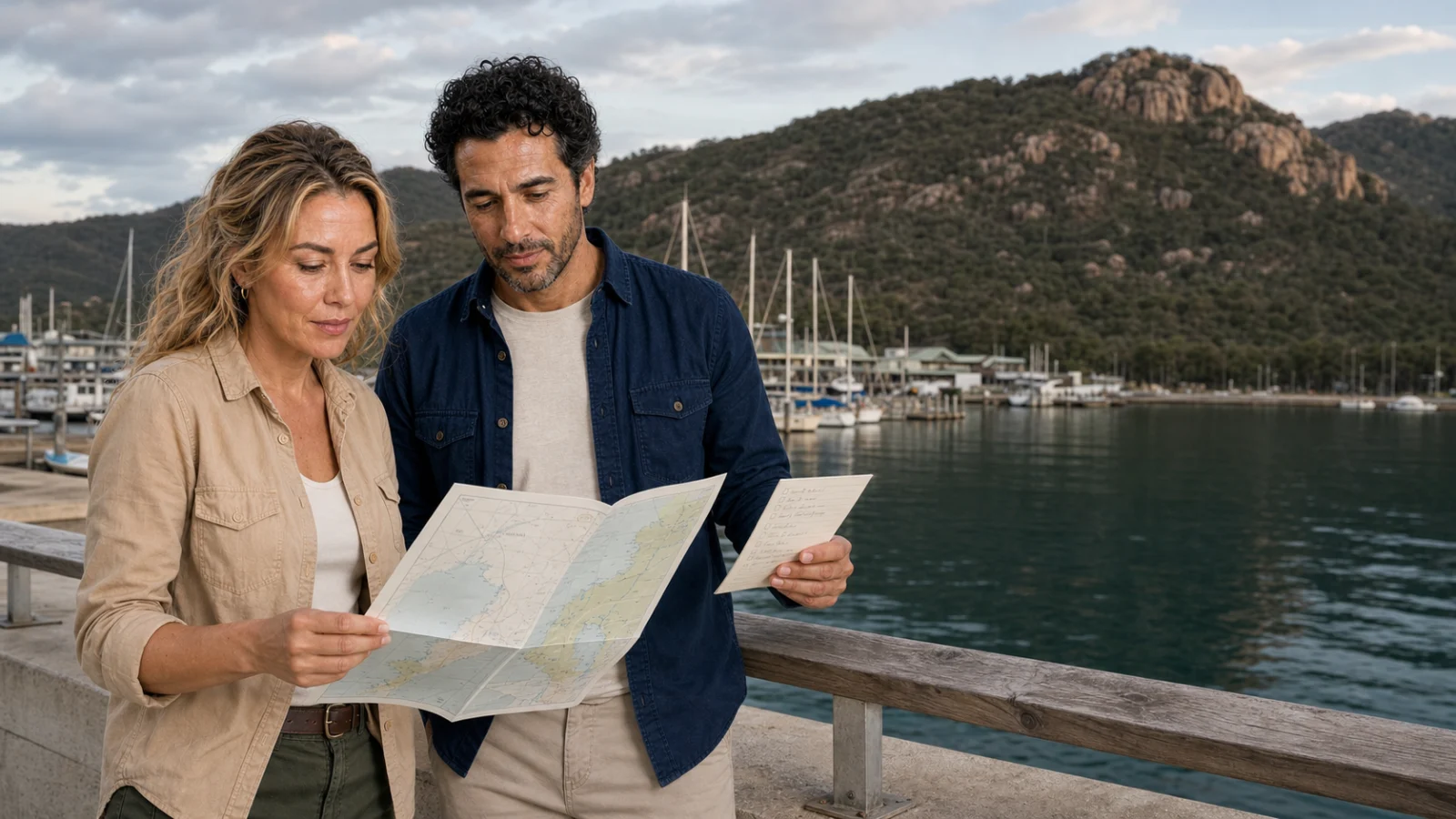
From Nelly Bay to a reef chosen on the day, this is a field guide to the decisions behind the blue: whose Sea Country you cross, how the boat chooses a workable site, what snorkellers and certified divers actually need, what one day can reveal about coral, and which questions must be answered before anyone books.
01 · Magnetic Island reef field guide
The most important reef view is the decision made on land
At Nelly Bay, the Great Barrier Reef is not yet a panorama. It is a sequence of decisions. Has the passenger reached Magnetic Island before check-in? Does the forecast describe a crossing they can tolerate? Is a snorkeller genuinely comfortable in open water? Is a diver’s certification current enough for the conditions? Can every person board the vessel, enter the water and climb out again? Which reef can be visited lawfully and responsibly today? What happens if the safest answer is not the reef somebody hoped to see?
Those questions make a better beginning than the familiar promise of turquoise water. A reef day from Magnetic Island connects an island marina, Cleveland Bay, the Great Barrier Reef Marine Park and a site selected under conditions that can change. Mixed-activity boats may carry both snorkellers and certified divers, but shared transport does not erase the different competence, medical, equipment and supervision systems each activity requires.
The format is real; the route is never a guaranteed script. Weather, sea state, current, visibility, participant ability, marine-park permissions, mooring access and the skipper’s judgement remain more important than a brochure map. A responsible operator should name the possible area without pretending that one reef, one sequence or one visibility level can be promised months ahead.
The distinction matters. A responsible day is not a race to the most distant blue patch. It is a moving safety and interpretation problem: get the right people to a site they can use, without turning a living reef into scenery or a customer review into ecological evidence.

02 · Magnetic Island reef field guide
Yunbenun is Wulgurukaba Country, not a blank launch point
Magnetic Island is Yunbenun in Wulgurukaba language. Queensland Parks’ account, developed with Wulgurukaba people, describes enduring custodianship of the island and nearby mainland. A marina, a channel and a reef sit inside living Country and Sea Country. Understanding whose place this is changes the meaning of the journey before the boat moves.
The island’s granitic hills are visually dominant from Nelly Bay, but water joins rather than separates the cultural landscape. Wulgurukaba knowledge, authority and care extend across land and sea. A Reef Authority report on caring for Sea Country describes reef-survey training for Sea Women on Wulgurukaba Country at Yunbenun. The named participants came from Mamu, Girringun and Torres Strait communities. Hosting, participation and custodianship are distinct relationships; the programme illustrates cooperation between communities, not interchangeable Indigenous identities.
The public history also describes dispossession. Colonial settlement at Townsville began in 1864 to support a port for pastoral exports. As settlers occupied land, Wulgurukaba people lost access to places and food sources; violence and disease compounded that pressure. Queensland’s system of reserves, missions and forced removals broke families’ freedom to remain on Country. The Wulgurukaba account of being forced off Country makes clear that departure from the island was not the end of connection to it. Reading that history before a marina departure gives the coastline a human chronology that a map of reefs alone cannot supply.
Nelly Bay itself carries a documented conflict. A marina and tourism development was proposed in 1984. Wulgurukaba Elder Virginia Wyles helped lead opposition alongside residents and conservation groups. When development exposed ancestral remains in 2001, Wulgurukaba people sought a court intervention so excavation could pause and the remains could be retrieved respectfully. The public account of this struggle connects it to the continuing effort to gain recognition and protect Country. The present marina is therefore also a place where cultural heritage, development and authority collided.
The same account records a 2009 Indigenous Land Use Agreement and a 2022 Memorandum of Understanding with Queensland Parks and Wildlife Service. These established frameworks for Wulgurukaba participation in managing Yunbenun’s protected areas. Rangers, Elders and community organisations continue that work. Their authority belongs to the place and its people; it is not something a visitor acquires by buying an excursion. Cultural belongings and sensitive sites should be left undisturbed, and public interpretation should be followed without seeking out restricted knowledge.
Visitors do not need access to private knowledge to behave differently. They can use the name Yunbenun with care; recognise that a commercial permit is not ownership of Country; follow zoning and site instructions; avoid touching, collecting or feeding; and understand that monitoring, ranger work and cultural governance continue after the visitor boat has gone home.
Acknowledging Country does not entitle a visitor or operator to reproduce cultural motifs, Dreaming narratives or place-specific knowledge without permission. The practical point is simpler and stronger: the reef day begins in somebody’s living Country, and the authority to interpret that Country cannot be invented by a travel brand, a skipper or a podcast host.
03 · Magnetic Island reef field guide
The Great Barrier Reef is a mosaic, not one destination
The rocks behind Nelly Bay belong to a much older landscape than the marina. Queensland Parks dates the island’s granite to about 275 million years ago. Weathering along fractures shaped rounded domes and boulders, or tors, while erosion opened gullies. Before sea level rose around 7,500 years ago, the island was joined to the mainland between Cape Pallarenda and Kissing Point. The present crossing passes over a drowned connection; it is not an ancient, unchanging gap.
The land is chiefly dry-tropical woodland, with hoop pines among granite boulders and smaller sheltered pockets of vine-thicket. That matters to orientation: this departure belongs to Yunbenun’s rocky, relatively dry landscape, rather than the wet-tropical rainforest further north. The English name recalls James Cook’s belief in 1770 that the island affected his ship’s compass. Yunbenun’s Wulgurukaba identity long predates that episode.
“The reef” sounds singular. The system is not. The Great Barrier Reef World Heritage Area extends through roughly fourteen degrees of latitude and includes about 3,000 individual reefs, hundreds of islands and cays, shallow seagrass and mangrove habitats, deeper channels and a continental shelf that changes across its width. Fringing reef near an island, a mid-shelf platform reef and a reef closer to the shelf edge are different settings. Their exposure, water movement, sediment, coral communities and recovery histories can differ even when a map places them in the same region.
From Magnetic Island, the boat first leaves an inshore world influenced by Cleveland Bay, tides, river catchments and coastal weather. An offshore transit can cross changes in water colour and wave pattern. Those changes do not form a reliable health scale. Brown or green water is not automatically degraded; brilliant blue is not automatically healthy. Colour can reflect depth, bottom type, particles, sky, wind and camera processing. A patch that looks uniform from the deck may contain bommies, sand, rubble, living coral, algae and channels at swimmer scale.
This is why a named destination is not enough. A useful briefing identifies the actual site, its zone, expected depth range, entry and exit points, likely current, surface reference, recall signal and the boundaries of the permitted activity. A useful post-trip account records date, place and conditions rather than converting “we saw colour” into a diagnosis of the entire Great Barrier Reef.

04 · Magnetic Island reef field guide
How coral builds a place—and what bleaching actually means
Reef-building corals are animals. Each colony is made of polyps that deposit calcium-carbonate skeleton. Many live in partnership with microscopic algae in their tissues. The algae use sunlight to produce energy-rich compounds; the coral provides shelter and materials for photosynthesis. Layer upon layer of growth, death, erosion and cementation helps build the physical reef, while parrotfish, sponges, microbes, coralline algae, worms and countless other organisms shape and recycle it.
That partnership explains both colour and vulnerability. Under sustained heat stress, the relationship can break down and the algae are expelled or lost. The transparent coral tissue exposes the pale skeleton below: bleaching. A bleached coral is stressed, not necessarily dead. If conditions ease, algae can repopulate the tissue and the colony may recover. If stress is intense or prolonged, the coral can starve, become more susceptible to disease and die. Even survivors can experience reduced growth and reproduction.
The sequence has branches, not a single dramatic ending. Recovery depends on the severity and duration of stress, coral species, local conditions, subsequent storms or poor water quality, and the supply of larvae from surviving colonies. Repeated disturbances narrow the time available for regrowth. Dead skeleton can retain structure for a time, then erode or become dominated by other organisms. New coral recruits can settle, but a return of percentage cover does not prove that the former mix of species, sizes and ecological functions has returned.

The monitoring sequence matters. In its 2024–25 annual report, the Australian Institute of Marine Science recorded central-region average hard-coral cover falling from 33.2 to 28.6 per cent. That decline followed major heat stress and other disturbances. It described one survey period, not an irreversible endpoint for every reef.
The 2025–26 AIMS report, published on 11 August 2026, surveyed 121 reefs between August 2025 and June 2026. Central-region average hard-coral cover rose from 28.6 to 31.6 per cent, although the change remained within the estimate’s margin of error. Northern cover reached 35.1 per cent; southern cover was broadly stable at 26.4 per cent. Across surveyed reefs, 16 per cent declined, 56 per cent showed no net change and 28 per cent increased. These results show uneven recovery and continuing vulnerability. Percentage cover measures how much seabed supports living hard coral; it does not establish which species, ages or ecological functions are present. No regional average promises the condition of a boat’s chosen site.
The Reef Authority’s bleaching guidance adds the long view. Climate change has raised average sea-surface temperature on the Great Barrier Reef by more than 0.8°C since 1880. Local management can improve resilience by reducing additional pressure, but it cannot make ocean heat disappear. A vast living system contains beauty, damage, survival and change at the same time. To understand a particular place, ask which site, on what date, assessed by whom, using what method, and with what follow-up.
05 · Magnetic Island reef field guide
Site choice is a safety decision before it is a scenic one
Site selection begins with the conditions a group can use safely. Skippers and dive staff use forecasts, observations, local knowledge, participant profiles, permitted sites, moorings and operational limits. Researchers use structured surveys, remote sensing and repeated sampling. Those systems can inform one another, but a satellite image is not a live ranking of colourful, healthy snorkelling sites.
Offshore names you may encounter include Keeper, Lodestone, John Brewer and Grubb reefs. Pro Dive Magnetic Island lists these among its possible reefs. They identify a working area, not a four-stop itinerary or a promise for one departure. John Brewer’s Museum of Underwater Art is a distinct attraction with its own trip arrangements; its name on a regional list does not mean that every snorkel-and-dive day includes the sculpture site. Ask for the proposed reef and the actual mooring or entry site, then allow for a different decision on the day.
For a commercial day, wind direction and strength influence wave exposure. Swell period affects boat motion and the way water moves over a reef edge. Tide can change depth and current. Rain and river discharge can affect inshore visibility. Mooring availability and marine-park rules constrain where a boat can secure. A current manageable for experienced divers may be inappropriate for a nervous snorkeller. A calm surface can still conceal movement below; a bright sky can coexist with deteriorating conditions later.
The captain’s authority to change, delay or cancel is therefore part of the product, not a failure of it. Before booking, a passenger should understand whether an altered destination still counts as delivery, when a weather decision is normally made, what refund or rebooking terms apply through the actual seller, and whether staying aboard is possible if they decide against entering the water.

Motion sickness belongs in this decision, too. It can arise when the movement sensed by the inner ear differs from what the eyes perceive. Looking at the horizon rather than a phone can help, but different medicines have different contraindications, side effects and timing. Drowsiness is especially relevant around water and diving. Healthdirect advises speaking with a pharmacist or doctor, particularly when children, other medicines or pregnancy are involved. Follow crew instructions about seating, ventilation and drinking water. Tell the crew early if you feel unwell, and reconsider entering the water rather than trying to push through illness.
06 · Magnetic Island reef field guide
One vessel can contain two very different days
A mixed reef boat may carry snorkellers and certified divers together. Sharing a boat does not make the activities equivalent.
A snorkeller remains at the surface, breathing air through a snorkel and looking down through a constantly moving boundary. Their work includes keeping the airway clear, controlling breathing, managing mask and fins, orienting to the vessel and supervision area, and recognising fatigue or anxiety early. A flotation noodle can support buoyancy; it does not erase current, poor technique, panic or the need to climb back aboard. Queensland’s recreational snorkelling framework requires operators to assess risk, provide lookouts and supervision, identify at-risk snorkellers and apply additional controls where needed. An honest operator does not promise that nervousness becomes “completely safe.”
A certified diver carries a different risk system. Pressure increases with depth. Breathing gas, buoyancy, equalisation, ascent rate, decompression status, buddy contact and post-dive altitude all matter. Certification is evidence of training, not proof of recent competence in every condition. Queensland’s qualification and competency guidance expects commercial operators to assess whether a diver’s qualification, skills and recent experience match the proposed dive. Before departure, the diver therefore needs a clear plan for certification evidence, recent-experience assessment, guide and buddy roles, planned depth, gas, recall and what happens if staff judge that the day’s conditions exceed the diver’s current ability.

Introductory scuba and certified diving are separate products with different training, supervision and medical requirements. A traveller without certification should never assume that a place on a mixed boat can be converted into an introductory dive on the day. The operator must state explicitly whether non-certified diving exists, under which programme and with what medical screening.
Age is only one part of a minor’s suitability. The operator must also state the activity-specific minimum, swimming ability, guardian and supervision rules, equipment fit, medical declaration and whether that exact departure accepts the young person. A booking form that merely allows a child passenger is not the same as an in-water safety assessment.
07 · Magnetic Island reef field guide
Medical fitness, stingers and the exit are not small print
Immersion changes how the body works. Cold, exertion, anxiety, waves and equipment can expose limits that are not obvious on land. Queensland’s medical-fitness guidance identifies cardiac, respiratory, neurological and other conditions that may increase risk in diving or snorkelling, and requires commercial operators to use medical declarations, advice and controls appropriate to the activity. Travellers should not conceal a condition to preserve a booking. If a medical certificate is required, the operator must explain which form, practitioner and validity rule apply to the exact activity.
For certified divers, the day also affects the itinerary after the boat. Lower pressure in an aircraft cabin or at altitude can increase decompression stress. Divers Alert Network’s general flying-after-diving guidance recommends at least 12 hours after a single no-decompression dive and at least 18 hours after repeated dives or multiple days of diving. Those recommendations concern divers without symptoms and typical commercial cabin altitudes. Dives requiring decompression stops call for a substantially longer interval; DAN notes limited evidence and advises more than 18 hours. The operator may require a more conservative interval, which should govern the booked activity. Anyone with symptoms suggestive of decompression illness needs urgent medical advice rather than a timetable calculation.
Marine stingers require the same precision. Queensland Parks says they may be present around Magnetic Island at any time, with greater frequency in warmer months. Protective clothing reduces exposed skin but cannot guarantee protection. Box jellyfish can cause a rapidly life-threatening sting. Irukandji symptoms can develop after an initially mild or unnoticed sting, so delayed severe pain or illness needs urgent assessment. Queensland Poisons Information Centre distinguishes these hazards. Follow local warnings and crew instructions, and immediately report a sting or unusual symptoms. First aid varies by animal and circumstance; the vessel’s trained response and emergency plan matter. Call Triple Zero in a life-threatening emergency.
The less dramatic but equally decisive question is the exit. How high is the step from marina to vessel? Is there a gangway? What handholds exist? How does a snorkeller or diver leave the water—ladder, platform, lift or staff-assisted method? Must they remove fins or equipment in the water? Can they rest before climbing? What happens in surge? A technically “easy” activity can become inaccessible at the final metre.

SeaLink’s accessibility statement specifies a minimum gangway width of 890 mm for its scheduled ferries and distinguishes narrower gangways on some charter and cruise-transfer services. That is useful information for one stage of the journey. It does not establish the reef vessel’s boarding, seating, toilet path, water-entry hardware, mobility-device storage or emergency transfer.
Describe your own requirements before booking: whether you can transfer independently, climb with wet hands, remove fins in the water, stand in a moving boat or use a narrow toilet doorway. Request measurements and a step-by-step description of assistance, including what a companion must do. For someone staying aboard, ask where they can sit safely and what they can see without entering the water. An activity label such as “easy” or “accessible” cannot answer those individual questions.
08 · Magnetic Island reef field guide
A reef site is governed space
The Great Barrier Reef Marine Park uses zones with different permitted activities. Commercial tourism operations require permissions. Public and private moorings, no-anchoring areas and site plans reduce damage and manage use. Around Magnetic Island, the Reef Authority’s site-specific management guidance directs vessels to public moorings and identifies areas where anchoring is prohibited. Farther offshore, rules can differ by location and zone.
That governance is visible in small actions. A mooring avoids dropping an anchor onto coral. A lookout keeps continuous watch over snorkellers. A guide changes the group plan when current or competence demands it. A vessel carries first aid, oxygen and an emergency plan. Logs create an accountable record. Passengers are not passive in this system: they must listen to the briefing, stay within the defined area, maintain buddy contact where instructed, respond to recalls and disclose a problem before it escalates.
The Reef Authority’s responsible-practice guidance is direct:
- float over sand while adjusting equipment rather than standing on coral;
- secure gauges, cameras and alternate air sources so they do not drag;
- control fins and buoyancy, especially over shallow coral;
- never touch, kick, chase, feed or collect marine life;
- keep distance from giant clams and wildlife, and follow any site-specific rule;
- take every item and piece of waste back to the vessel;
- use sunscreen and personal products thoughtfully, while remembering that product choice does not replace climate action or careful behaviour.

No visitor should touch coral to test whether it is alive. No guide should move wildlife to produce a photograph. No review can justify feeding fish because it made an encounter more reliable. The clearest sign of professional interpretation may be the moment staff say there is nothing to handle and no sighting to guarantee.
09 · Magnetic Island reef field guide
What one day can tell you—and what it cannot
A day on the water can teach texture. A snorkeller may notice how the surface bends light, how a bommie changes from sunlit crown to shaded wall, how sand channels break a coral field, or how a school of fish holds position in moving water. A diver may read depth, surge, temperature and three-dimensional structure more directly. Both may learn that the reef is less like a scenic carpet than a city built, grazed, eroded and rebuilt by many organisms.
Those observations are valuable when they remain observations. They do not establish population trends, bleaching mortality, coral recruitment, fish abundance or the success of management. Long-term monitoring works differently. AIMS combines repeated methods such as manta-tow surveys and scuba-based assessments across named reefs and years. The Reef Authority and partners use aerial and in-water surveys during bleaching events. Traditional Owner monitoring contributes place-based capacity and governance. Each method has limits, but repetition and location turn a view into evidence.

This distinction also protects the traveller from two sales tactics. “Last chance” tourism uses climate anxiety to create urgency, sometimes suggesting that a visitor must see the reef before it disappears. “Untouched reef” marketing uses a bright photograph to imply escape from the crisis. Both flatten a dynamic system and reduce conservation to consumption. A more responsible trip treats the reef as a place to understand and behave within, while supporting credible governance and accepting that no purchase grants a guaranteed spectacle.
10 · Magnetic Island reef field guide
The honest day, from alarm clock to rinse rack
An offshore reef day usually begins earlier than the boat’s departure. Travellers starting in Townsville need a ferry that reaches Nelly Bay with enough margin for delays, the walk to the marina and check-in. Travellers staying on Yunbenun still need the exact meeting place and closing time. Ferry timetables and tour departures change independently, and a connection is not protected merely because both appear possible on a screen.
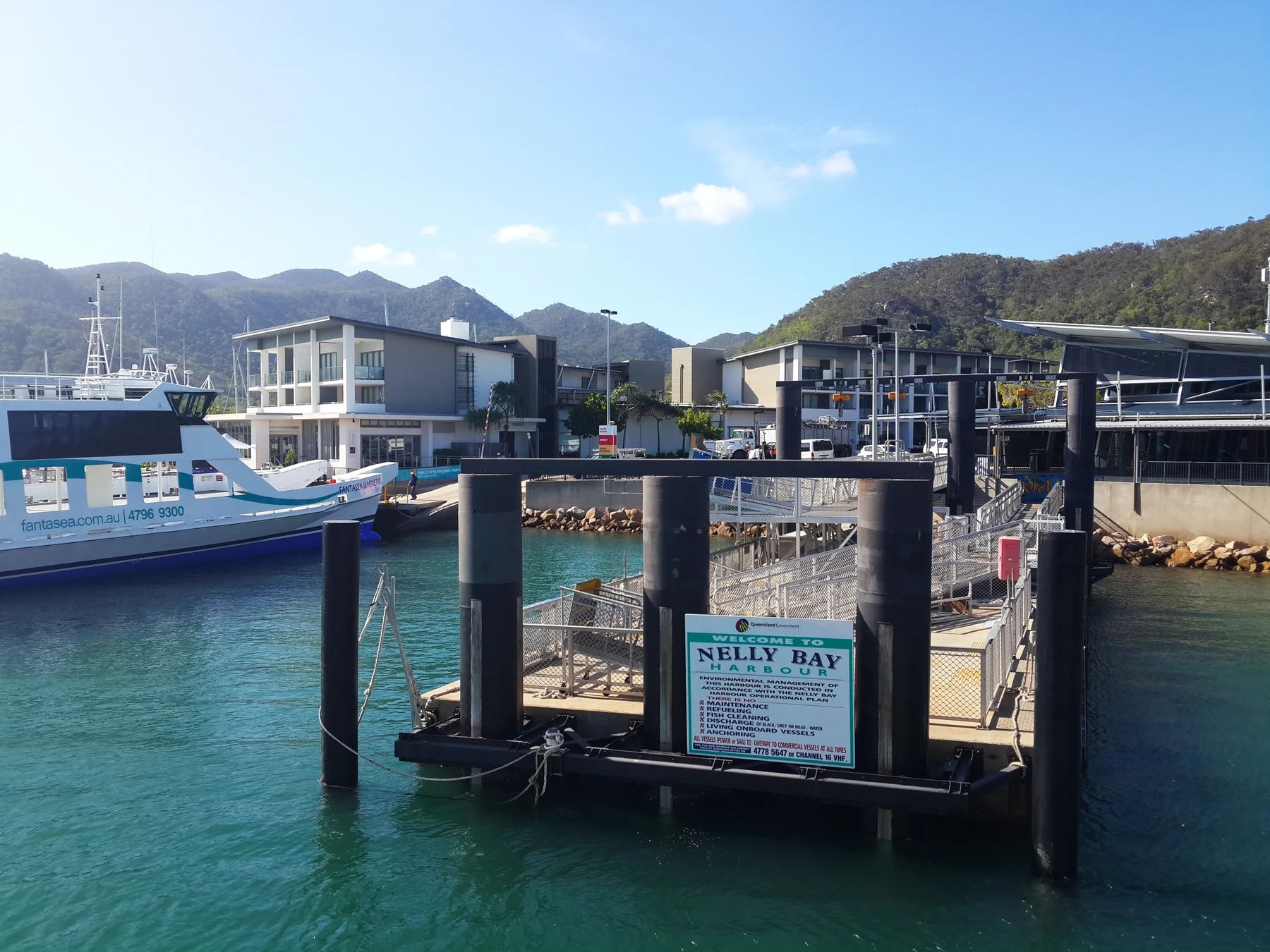

Before leaving accommodation, a traveller should have certification evidence if diving, any completed medical material, sun protection, warm and dry layers, reusable water, and only the baggage the operator permits. They should have eaten appropriately for their needs and sought professional advice about motion-sickness medication in advance. They should know the seller’s missed-departure and weather terms.
At check-in, staff need more than a name. This is where activity choice, age, medical declarations, certification, recent experience, swimming confidence, dietary needs and access requirements should converge. If the operator has not resolved those items in writing, the marina is too late for an expensive surprise.
On the vessel, the safety briefing should identify life-saving equipment, emergency signals, restricted areas, movement while underway, toilet use and what to do if unwell. The in-water briefing should add site boundaries, entry and exit, lookout or guide roles, buddy method, current, recall and environmental conduct. Certified divers need the dive-specific plan and gas-management expectations. Snorkellers need a surface plan they can repeat back.
At the reef, the correct sequence depends on the site and people. The operator should state how many water sessions are planned, how long they normally last and what can change them. Food and a surface interval are practical parts of the day, not filler: cold, fatigue, hydration and changing conditions can alter a second water decision. Choosing to stay aboard after the first session should be treated as legitimate, but the operator must explain what a dry passenger can actually see and where they can sit safely.
The return does not end when the boat touches the marina. Divers need to observe the operator’s altitude and flying rule. Equipment and bodies need freshwater, warmth and rest. A passenger who develops unusual pain, weakness, numbness, breathing difficulty, confusion or other concerning symptoms after diving should seek urgent medical advice and tell clinicians about the dive. A good memory of the reef is not evidence that every risk has passed.
11 · Magnetic Island reef field guide
Compare formats by the question you want answered
An offshore mixed-activity boat day is one way to meet the region, not the default against which every other format fails.
Choose a mixed snorkel-and-certified-dive boat when companions have different qualifications but all want an in-water offshore day; when an early start, long boat day and ladder exit are acceptable; and when the group can accept a conditional site.
Choose a near-shore or island snorkel format when shorter transit, shallower water or a simpler day matters more than reaching an offshore reef. Near-shore does not mean ecologically unimportant, automatically calm or beginner-safe. Ask the same questions about supervision, entry, current and conditions.
Yunbenun has its own fringing reefs. Queensland Parks identifies the northern sides of Florence and Arthur bays as snorkelling areas and also describes reefs at Nelly, Geoffrey and Picnic bays. These are shoreline settings, with visibility and usable depth affected by local weather and tide. Low tide can expose coral and make entry difficult; a shore plan needs a suitable tide, wind and current, a buddy, and a route that avoids standing on living coral. A shorter distance from accommodation does not supply the supervision or exit arrangements of a commercial boat day.
Choose a larger vessel or pontoon when stability, shade, toilets, structured activity zones or a non-swimming experience matters. Larger infrastructure can widen access but does not remove sea motion or guarantee a particular mobility transfer. Compare measurements and assistance, not adjectives.
Choose a dive-only operation when certified divers want profiles and site selection shaped around diving rather than a mixed group. Verify guide ratios, gas, depth, recent-experience requirements and the treatment of a diver whose competence does not match conditions.
Choose an aerial overview when the central question is reef scale and geomorphology rather than immersion. The ExcursionPass reef-to-rainforest story explains why colour from altitude cannot prove ecological condition and why aviation belongs in the environmental account.
Choose no reef trip that day when the forecast, health, water confidence, access chain or seller’s answers do not support it. A conservation-minded itinerary includes the freedom not to force a departure.
12 · Magnetic Island reef field guide
Twelve questions that turn a promise into a plan
- Which legal operator and vessel will deliver the departure, and what are the licensed and working passenger limits?
- Which reef sites are possible, who selects the site, and what changes if wind, swell, tide, current, visibility or mooring availability rule out the first plan?
- How many in-water sessions are planned for snorkellers and certified divers, how long are they, and what depth range applies to divers?
- What certification, logged experience and recent diving evidence are required, and what happens if staff decide a certified diver is not ready for the conditions?
- What swimming skill and open-water confidence must a snorkeller have, and what supervision, flotation and return-to-vessel controls apply to at-risk participants?
- What are the current minimum ages, guardian rules and minor waivers for each activity on this departure?
- Which medical declaration or certificate is required, when must it be supplied, and who decides whether a passenger may enter the water?
- What are the measured boarding steps or gangway, water-entry and exit method, ladder dimensions, handholds, toilet access, seating support and mobility-device storage?
- What assistance can staff safely provide, what must a companion provide, and what meaningful experience remains for someone who stays aboard?
- What are the cancellation, minimum-number, weather, reroute, delay, missed-ferry, rebooking and refund terms for the seller taking payment?
- What food and water are supplied, how are allergies handled, what personal items fit in dry storage, and what protective suit is issued for the expected temperature and stinger conditions?
- What post-dive flying and altitude rule will the operator apply to the planned profiles, and where is the nearest appropriate medical response if symptoms arise?
A useful answer is specific enough to plan around. “We take care of everyone” is not an access specification. “The skipper chooses the best reef” is not a weather remedy. “Suitable for beginners” is not a competence assessment.
13 · Magnetic Island reef field guide
Listen to the field notes with the evidence in view
The episode raises the anxieties behind a reef decision: motion sickness, stingers, a nervous swimmer, bleaching, boat size and whether there will be something worth seeing. It works best as a companion to planning the journey. Keep the distinctions developed here in mind: surface snorkelling and certified diving require different controls; regional reef monitoring cannot promise a particular sighting; and the boarding-to-water-exit chain matters as much as the destination. Those questions help a traveller turn reassurance into an informed choice.
14 · Magnetic Island reef field guide
Podcast: Great Barrier Reef Snorkel and Dive Day Trip
Episode 2994751 of The Travel Podcast by ExcursionPass accompanies this guide. The earlier reef-flight and Mossman Gorge story asks a different question about aerial scale, rainforest and cultural landscape.
15 · Magnetic Island reef field guide
Current checks for the week you travel
Reopen these sources shortly before payment and again before departure:
- the chosen licensed operator’s current page and final voucher for meeting point, activity, equipment, medical declarations, age rules and terms;
- SeaLink’s Magnetic Island timetable and service notices if travelling from Townsville;
- the Bureau of Meteorology’s Queensland marine forecasts, including the relevant coastal waters, remembering that the operator makes the operational call;
- Reef Authority zoning and access guidance, alongside the instructions for the selected site;
- AIMS monitoring summaries for regional context and dated comparisons.
Prices, levies, operating days, ferry times, reef sites, marine conditions, bleaching observations and access arrangements are mutable. Screenshots and old reviews are not confirmation. Ask for the final answers in writing from the seller responsible for the booking.
16 · Magnetic Island reef field guide
A reef day worth taking is one that can still say no
The strongest version of this trip is not a perfect sequence of blue water, compliant wildlife and effortless courage. It is a professionally bounded day: the operator identifies the people and vessel, the skipper chooses within conditions and permissions, staff match each participant to an activity they can actually perform, everyone knows how to get out of the water, and the interpretation distinguishes a beautiful observation from an ecological conclusion.
That standard does not diminish wonder. It makes wonder more precise. Coral is not a backdrop but a living construction. Bleaching is not a white-photo genre but a stress process with uncertain outcomes. Yunbenun is not a convenient pier but Wulgurukaba Country. A stinger suit is not magic; a noodle is not a rescue system; a certification card is not current competence; a turquoise photograph is not a monitoring report.
The reef day begins with a chart at Nelly Bay because the route is conditional. It succeeds when everybody returns with a clearer sense of place, evidence and responsibility—even if the safest, most honest decision changed what they expected to see.