Across the Bernina in One Day
What the railway reveals—and a Milan day trip compresses—between Tirano, the Alpine watershed and St. Moritz
Published 17 July 2026 · Updated 8 October 2026 · 29 min read
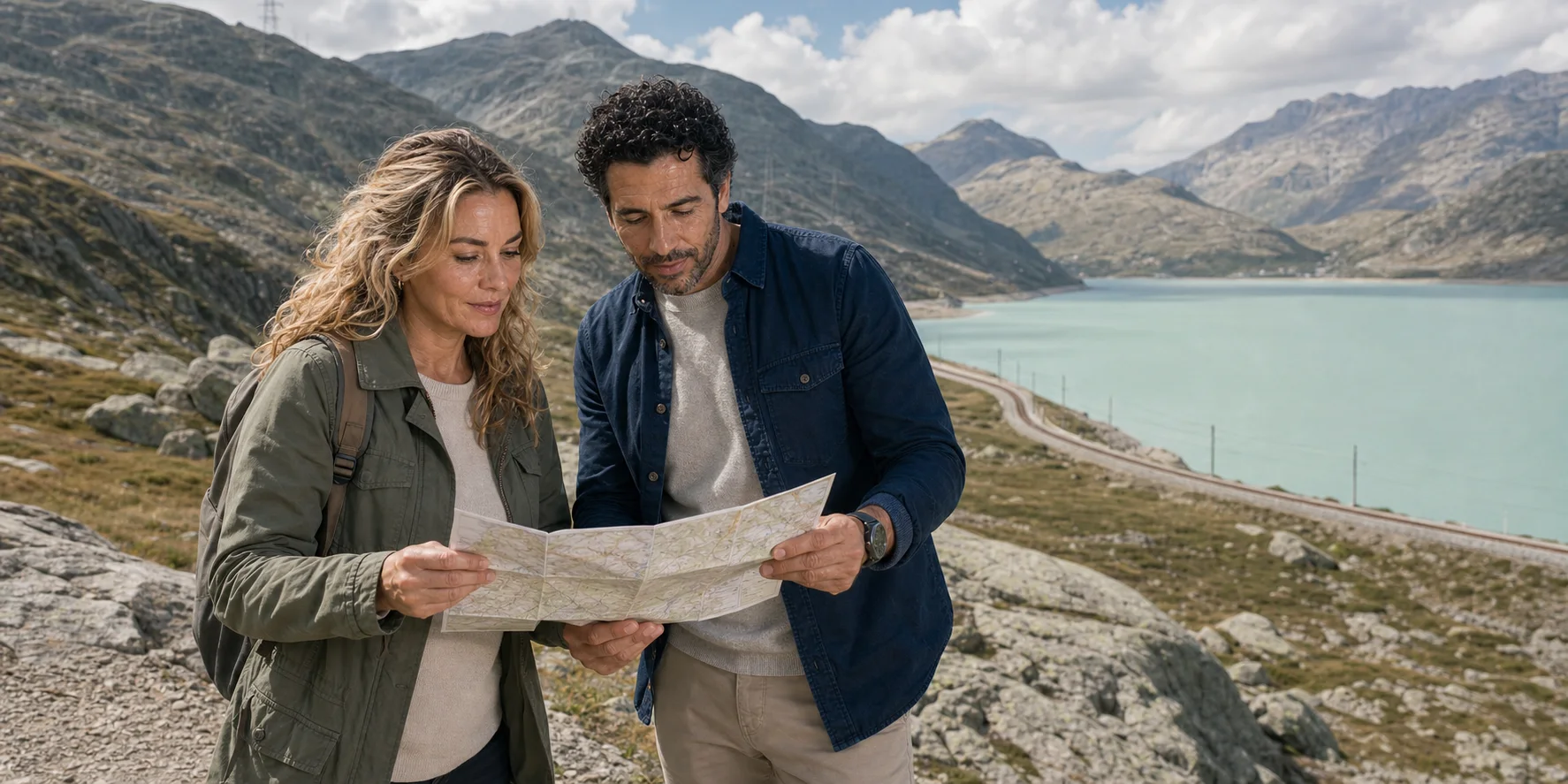
The red train is easy to turn into a postcard: a bright line against rock, lake and snow. The more useful story begins when the postcard is treated as infrastructure. The Bernina railway links an Italian-speaking Swiss valley to the Engadin without a rack rail, crosses a continental watershed at 2,253 metres, depends on continuous maintenance and arrives in a resort whose luxury image rests on mineral water, seasonal labour, housing and an increasingly unstable climate. A long private day from Milan can expose that whole system. It can also hide it behind transfers, glass and a timetable.
The moment the route becomes legible
At Lago Bianco the line does not look as if it has conquered a mountain. It looks negotiated into it. The metre-gauge track follows the reservoir edge on a narrow shelf. Catenary masts repeat the curve. A maintenance road, dam structures and exposed rock make the scene read as a working high-altitude corridor, not untouched wilderness. The lake's pale colour is not a permanent promise; light, sediment, water level and weather change what a passenger sees.
This is the right place to begin because the high basin exposes the shortcuts that scenic-rail marketing tends to make. The Alps are not uniformly white in July. A window cannot be assumed to open. A right-side seat cannot own the view on a railway that loops, reverses orientation and may be travelled in either direction. Switzerland's Schengen membership does not make documents or customs irrelevant. St. Moritz does not become an empty film set on a fixed date each autumn. And a private vehicle does not remove fatigue, road exposure, delay or the need to know exactly which train has been booked.
The useful question is therefore not whether the Bernina is “worth it.” It is what a traveller can genuinely understand in one compressed day. The line can reveal gradient, water, language, labour and climate because all of them meet beside the track. The day-trip format can make those relationships visible quickly. It cannot turn the journey into frictionless luxury, and it should not pretend that two or three hours of rail travel amount to knowing the region.
First map the day: Milan is not on the Bernina line
The Bernina railway runs between St. Moritz and Tirano. Milan is a distant origin that must be joined to one end of the line by road or by ordinary Italian rail. That distinction matters because “Bernina Express from Milan” often describes a package, not a through train. Some one-day formats pair a one-way Bernina rail journey with a vehicle transfer on the other leg; others ask the traveller to connect by ordinary rail. The boarding station, direction and exact RhB service determine what the day actually contains.
Two broad sequences are possible. A south-to-north day reaches Tirano first, boards the Bernina line and crosses into Switzerland before finishing the rail segment at St. Moritz; a vehicle may then return over a road route. A north-to-south day reaches St. Moritz first, uses the railway down to Tirano and returns to Milan from the Italian side. They do not produce the same light, road exposure, border sequence, free time or response to disruption. A serious itinerary must name the sequence rather than calling it flexible.
Independent travellers have more transparent pieces but more responsibility. Italian regional rail can connect Milano Centrale with Tirano; RhB regional and branded panoramic services then cross the Bernina. That removes the private road transfer on at least one side, but an out-and-back Milan day is still connection-sensitive and can leave little time in St. Moritz. An overnight in Val Poschiavo, Pontresina or St. Moritz changes the journey most profoundly: it lets the railway become a corridor through inhabited places instead of a long moving viewpoint.

For any format, calculate the day door to door. Pickup is not departure from the line. “Twelve hours” includes waiting, vehicle travel, station movement, the train, a meal decision, free time and the return. A traveller who is comfortable sitting but needs regular toilet access has a different threshold from a traveller who becomes motion-sick on roads. A child who enjoys trains may still struggle with an early start, uncertain meals and a late return. Private transport changes who controls stops; it does not create more hours.
One heritage property, two engineering characters
UNESCO inscribed the Rhaetian Railway in the Albula/Bernina Landscapes in 2008. The property joins two historic lines, not one uniform work. The Albula section runs from Thusis to St. Moritz and uses tunnels, helical alignments and stone viaducts to enter the Engadin. The Bernina section continues from St. Moritz to Tirano and crosses the pass in the open. UNESCO records 67 kilometres, 42 tunnels or galleries and 144 bridges or viaducts for the Albula component; the 61-kilometre Bernina component has 13 tunnels or galleries and 52 bridges or viaducts.
Those numbers explain why the popular total of bridges and tunnels can mislead a Milan day-tripper. A Tirano–St. Moritz ride uses the Bernina line, while headline totals on Bernina Express marketing often describe a longer Chur–Tirano journey that includes the Albula line. An itinerary must say what section it uses. Seeing the Brusio spiral and Lago Bianco does not mean passing the Landwasser Viaduct or the Albula Tunnel.
The two systems also solve altitude differently. The Albula line is frequently bedded into the mountain, using tunnels and loops to gain height. The Bernina is a high, exposed adhesion railway. Adhesion means ordinary steel wheels transmit traction to ordinary steel rails: there is no central rack to pull the train upward. RhB gives the Bernina line's steepest gradient as 70 per mille, a rise of 70 metres for every horizontal kilometre. Achieving that with workable curves, stations, bridges and winter operations required many local solutions rather than one spectacular invention.
UNESCO's strongest claim is social. The railway reduced isolation and produced long-term economic and cultural change in mountain settlements. That is more important than calling the line “physics-defying.” Physics is exactly what its surveyors, contractors, crews and operators had to respect. The heritage value lies in a functioning network whose structures, landscape and communities remain connected.
Read the journey from the valley upward
For orientation, follow the railway south to north; reverse this sequence when boarding in St. Moritz. Tirano is an Italian town in Valtellina, not a Swiss Alpine resort. Its municipal history places a Marian apparition tradition on 29 September 1504 at the origin of the sanctuary and the town's importance as a pilgrimage destination. The reported apparition belongs to religious tradition; the sanctuary and the movement of pilgrims belong to the town's material history. Arriving only in time to change trains conceals that older reason for travel. Allowing time in Tirano makes the railway's endpoint a place, rather than a station label.
The route crosses the border at Campocologno, passes the spiral near Brusio, and approaches Lago di Poschiavo through Miralago. Between the lake and Poschiavo, the line meets inhabited valley-floor terrain; at Le Prese it shares the road corridor. These are reminders that the train serves towns as well as viewpoints. Above Poschiavo, the climb turns through tighter curves toward the Cavaglia plateau. Altitude is gained through accumulated distance: the valley can reappear from a different angle rather than remaining permanently on one side of the carriage.
Cavaglia offers a way to understand the terrain outside the train. Its Glacier Garden contains deep rock hollows, often called giants' pots, formed through glacial erosion. A path makes the hollows and the adjoining gorge visible. The garden records a further gorge route completed in 2021 and designed by Swiss engineer Jürg Conzett, using steps and passageways to show water's sculpted cavities. That intervention makes a useful counterpart to the railway: engineering can help people read geology rather than merely pass over it. A stop requires a service that calls at Cavaglia, time for the walk and conditions suitable for the actual paths; it is not an excursion that fits automatically inside a booked through journey.
At Alp Grüm, a tight bend opens the relationship between the rail shelf, the Palü basin and Val Poschiavo below. The railway then climbs toward Ospizio Bernina and Lago Bianco. This is the high crossing, not the journey's endpoint. On the north side, the descent passes the Morteratsch area toward Pontresina and continues to St. Moritz. The succession moves from valley settlement through an exposed pass and back into an inhabited Alpine basin.
Do not confuse a station passed with a station visited. A panoramic timetable and a regional stopping service create different opportunities. Nor does passing Morteratsch include walking to the glacier: the valley path is a separate activity with its own time, terrain and conditions. Decide which place deserves a stop before choosing tickets. The through ride supplies a transect; an overnight supplies room to investigate it.
Curves are a form of height
Near Brusio the track draws a circle in stone. The spiral viaduct is often described as a flourish for photographs, but its purpose is measured: extend the route so that a train can gain or lose elevation without exceeding the adhesion railway's gradient and curve limits. The line passes over itself, turning horizontal distance into vertical change. The result is a compromise between slope, available land, structure, traction and settlement.
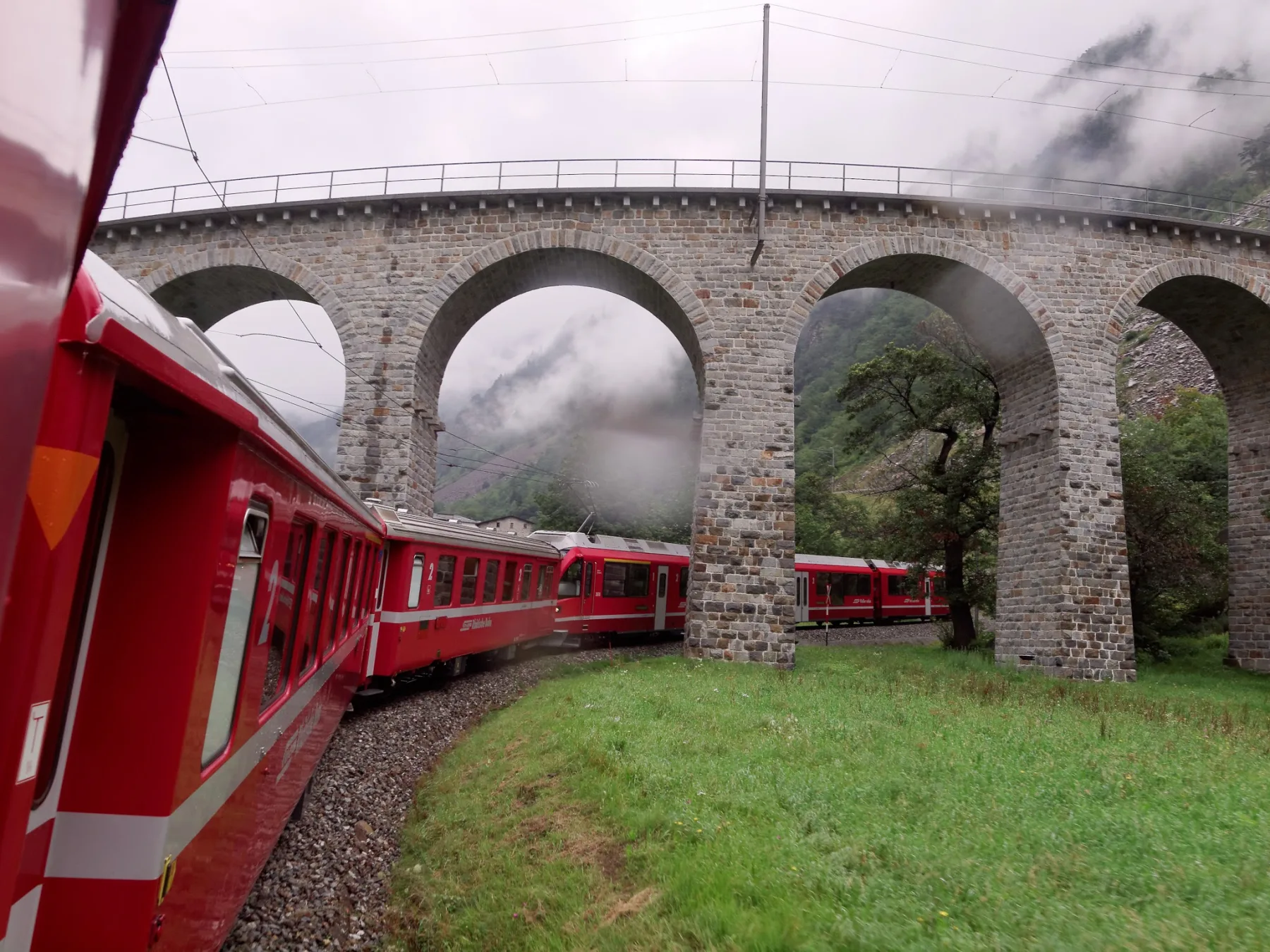
The open arches distribute loads through piers into foundations while allowing the track to sweep across the valley. Stone gives mass, weather resistance and visual continuity with other works along the UNESCO property. The visible viaduct is only part of the system: drainage, retaining works, ballast, rail, catenary, signals and inspection all keep the curve usable. A passenger sees a circle for seconds; maintenance staff inherit it year after year.
Higher on the line, geometry becomes a sequence of ledges, short structures and turns around terrain. At Alp Grüm the railway creates a balcony above Val Poschiavo; at Lago Bianco it crosses a broad, exposed pass landscape; on the Engadin side it descends toward Pontresina and St. Moritz. There is no single “best side” throughout. Light, direction, carriage and other passengers matter, and the train repeatedly changes the relationship between cliff and valley. A seat instruction copied from an anonymous review cannot guarantee an unobstructed view.
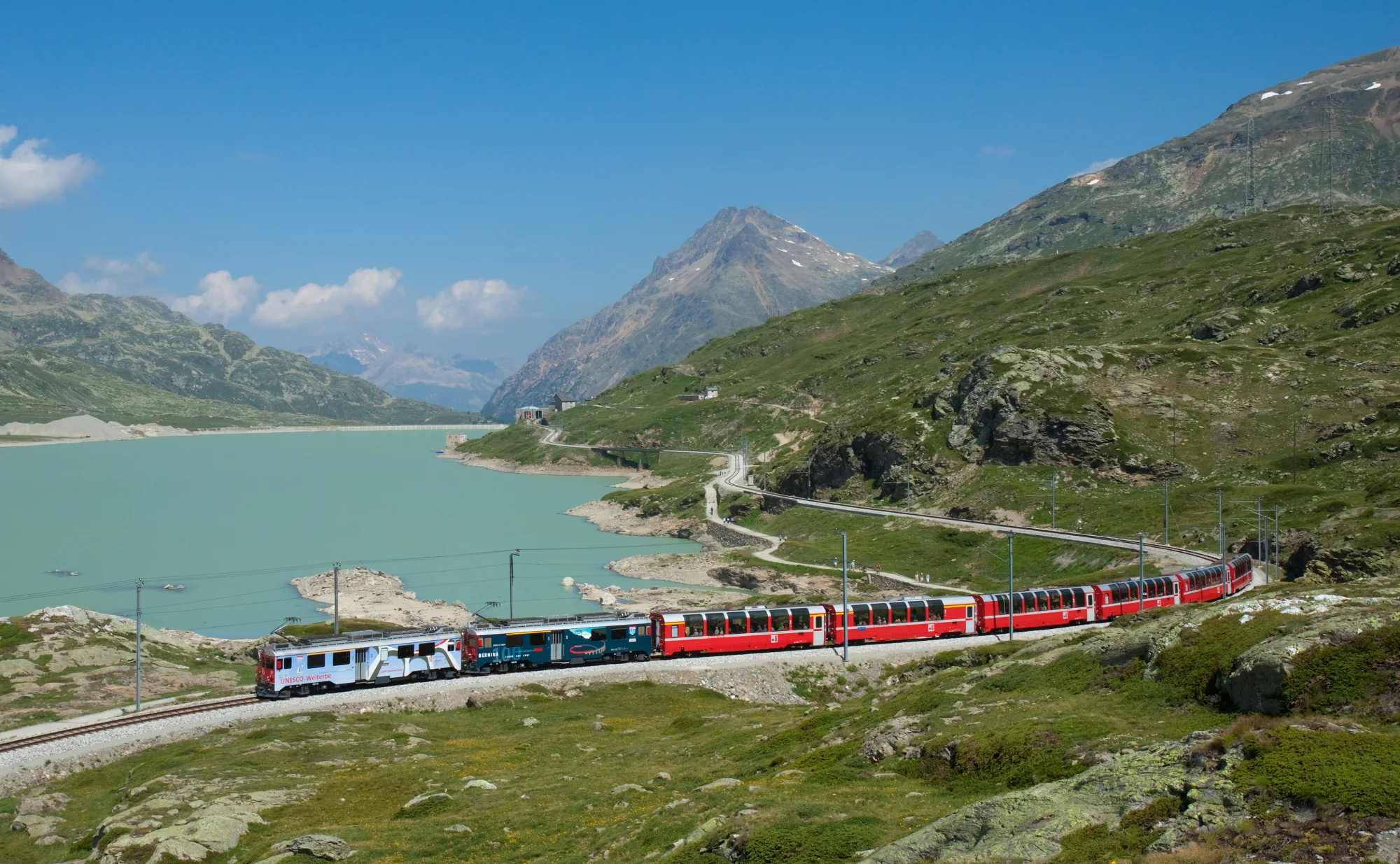
The 2010 view fixes one particular train, water level, snow pattern and weather—not a view that any booking can promise. Its value is spatial: the reservoir, line, service road, catenary and mountain basin occupy the same frame. The railway does not pass through a backdrop; it participates in a managed landscape.
Photography should follow railway rules and courtesy. A regional carriage may sometimes have windows that open; a panoramic coach is designed around sealed glazing. Neither class grants permission to extend a camera outside a moving train. Reflections can be reduced by moving close to the glass, shading the lens and wearing dark clothing. The better practical aim is not to collect every frame. It is to watch long enough to understand how successive curves hold a maximum gradient.
The railway was built by institutions and workers, not willpower
The Albula line reached Celerina in 1903 and St. Moritz in 1904. Engadin's local history explains the extra year through a disagreement over the St. Moritz station's location: the terminus was a civic decision as well as an engineering one. The Bernina Railway opened in stages and ran through in 1910. RhB records its takeover in 1944, with retroactive effect from January 1943. The chronology matters because the two components were promoted, financed and engineered under different conditions. Their later union creates today's through cultural landscape but should not erase those differences.
Construction involved surveying, land negotiation, contracts, quarrying, masonry, earthworks, blasting, track laying, electrical equipment and the daily organisation of labour in steep terrain. Workers built across varied geology with the industrial methods of their period, including explosives, mechanical plant, temporary access, local materials and supply chains. Risks were real, and the structures carry a history of labour as well as of design.
The original Albula Tunnel makes that cost concrete. RhB records more than 1,300 construction workers and sixteen deaths. Its 5,864-metre bore was built between 1898 and 1903. In a roughly 100-metre fault zone, incoming water spread fine dolomite sand over more than 500 metres of tunnel floor. Machine drilling stopped, the contracted company withdrew and RhB took about a year to overcome the ground. This was not a mountain defeated by sheer determination: geology changed the programme, organisation and human cost. A Tirano–St. Moritz passenger does not enter this tunnel, but its story explains why the wider heritage property cannot be reduced to its photogenic structures.
The route itself had already been contested. RhB's history describes a late-nineteenth-century struggle between a proposed Scaletta route serving Davos and an Albula route favoured by Chur and other communities. In 1889, roughly seventy per cent of Graubünden's electorate chose access through the Albula. A line on a map distributes access, business and political influence. The railway seen today was one possible network among alternatives, selected before contractors confronted the rock.
The Bernina was electric from its early operation, an important distinction from a simple steam-era adventure story. Hydropower and electric traction were part of the modernisation of Alpine valleys. Electricity changed gradients, ventilation and operations, while power infrastructure changed water and land relationships. The railway and energy landscape developed together; neither should be treated as invisible support for tourism.
UNESCO values authenticity in a working technological property. That does not mean freezing every component as it stood in 1910. Rails, rolling stock, catenary, signals, tunnels and protection works must change to remain safe. The second Albula Tunnel, inaugurated in 2024 alongside the historic bore, illustrates that balance: a new operational structure can preserve the old tunnel's fabric while improving the system. RhB's management task is to introduce necessary technical innovation without losing the ensemble's historic logic. Conservation here means continued operation with documented change, not turning the line into a museum ride.
At the pass, water chooses two seas
Lago Bianco and Lej Nair sit close together near the high point, but their waters belong to different continental systems. Water on the south side descends through Val Poschiavo toward the Adda and Po, eventually reaching the Adriatic. Water on the north side joins the Inn, then the Danube, and eventually the Black Sea. The pass is therefore more than a summit in a timetable. It is a watershed made visible at walking scale.

The lakes are not untouched glacial ornaments. Lago Bianco is managed within a hydropower system, and its level and colour respond to storage, sediment, season and light. Tracks, dams, power lines and maintenance routes belong in the view. Calling the scene pristine removes the infrastructure that explains why water remains where it does and how the high pass is inhabited and serviced.
Repower's account of the Robbia plant dates its first operation to 1910, the same year as the through railway. Between 1909 and 1912, builders made a storage basin at the pass using stone-faced gravity dams at the north end of Lago Bianco and the south end of Lago della Scala, linking the basins through an underground channel. Later plants extended the system up the valley. The Palü plant, operating from 1927, belongs to a succession through Palü, Cavaglia, Robbia and Campocologno. Water can generate power at successive drops before continuing downstream. The dam beside a scenic railway is therefore part of a valley-wide energy history, not an incidental interruption of the view.
Below, streams, lakes and snow support agriculture, ecosystems, drinking water, energy and tourism. These uses do not align automatically. Winter storage, summer demand, aquatic habitat and landscape expectations create trade-offs. A rail passenger receives a rapid transect from vineyards and valley farms to alpine tundra and back into forest. The speed makes climatic zones legible, but it can also make them look like scenery without owners or competing needs.
Weather changes over hours. Climate is the measured pattern across decades. A cold window, late snow patch or cloudy pass day does not disprove warming. Conversely, one hot day in Milan does not explain a glacier's retreat. The responsible route narration keeps those scales separate.
A glacier is not guaranteed—and its absence is part of the story
The Bernina massif contains glaciers, but the rail line does not carry passengers through a permanent wall of ice. Views toward Morteratsch, Pers and Palu depend on the exact segment, weather, cloud, season, seat and attention. No ticket can guarantee an “ancient glacier view.” A photograph through a window may show ice, snow, rock, moraine or none of them.
Morteratsch makes long-term change unusually legible. A historic image from the Library of Congress shows the glacier tongue filling much more of the valley, seen above a road used by people and horse-drawn vehicles. The scene is evidence of both ice extent and a tourism landscape already being approached and consumed.
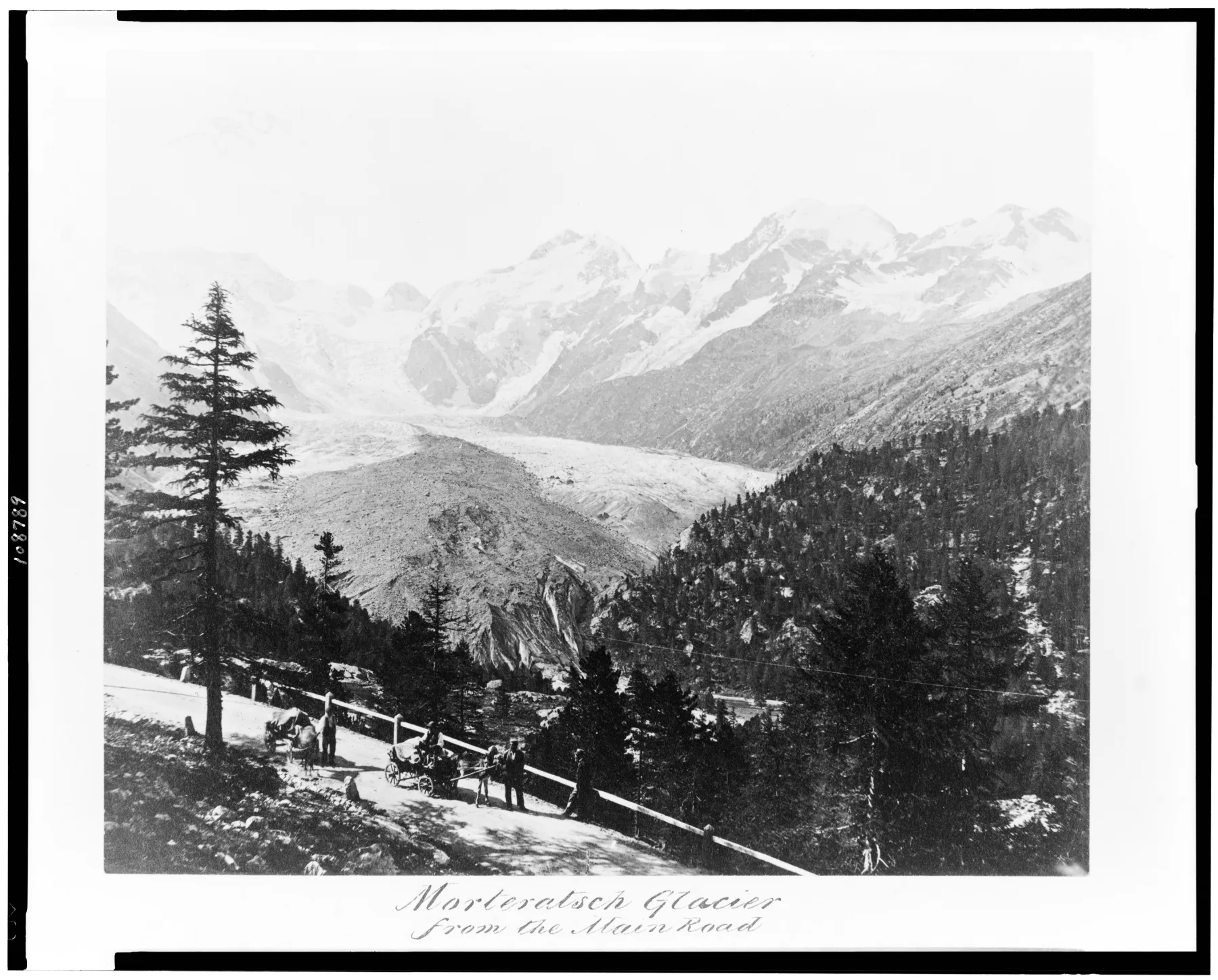
GLAMOS measurements document sustained Swiss glacier loss and long-term retreat at Morteratsch. Terminus change is not a simple thermometer. The tongue's geometry, debris, bedrock and collapse over a rock step can produce a large measured movement in one year. Mass balance, thickness and area are needed alongside length. The honest conclusion is stronger than “the glacier is disappearing before your eyes”: sustained warming is reducing Swiss ice, while the exact visible margin is shaped by local terrain and annual weather.
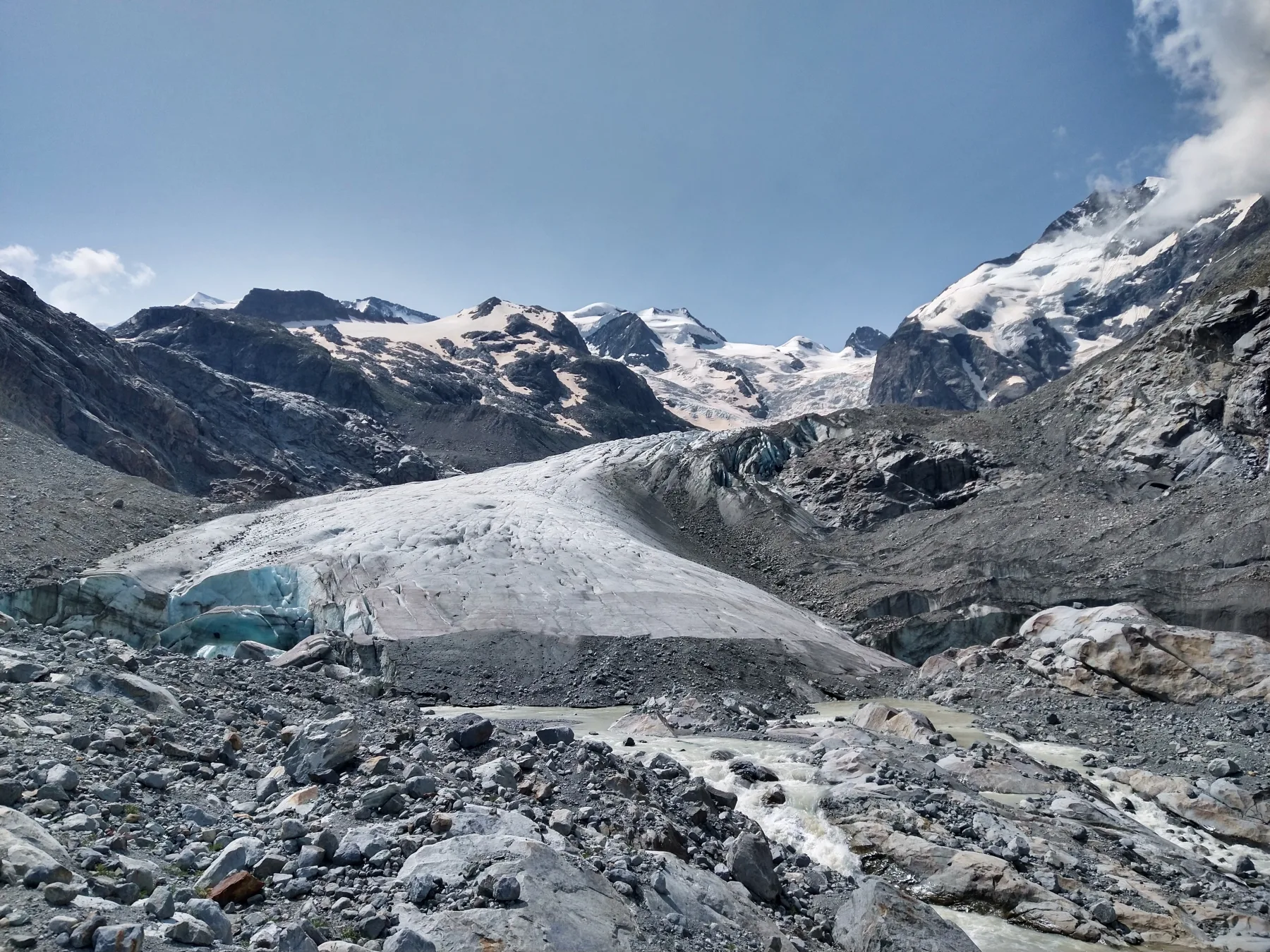
The consequences extend beyond a view. Glacier and snow change alter seasonal runoff. Warming permafrost can reduce stability in high rock and debris. Heavy precipitation, rockfall and slope movement affect paths, protective works and infrastructure. Resorts face less reliable natural snow; hydropower and ecosystems face changing water timing. No scenic train ride cancels the emissions of reaching the route. Rail may be an efficient transport system, but a private van from Milan, empty repositioning and a one-day return belong in the carbon account too.
Visitors should resist “last chance” tourism. The ethical response to retreat is not to race toward a dying spectacle. It is to understand measurement, reduce avoidable transport, stay longer when possible and support the institutions and communities managing change.
Keeping the pass open is the opposite of effortless
The line's continuity depends on work that a panoramic window hides: track inspection, drainage, vegetation control, rock and avalanche monitoring, snow clearance, electrical maintenance, station staffing, timetable control and rapid response. Winter operation is not proof that the Alps have been tamed. It is a managed condition that can still be interrupted.
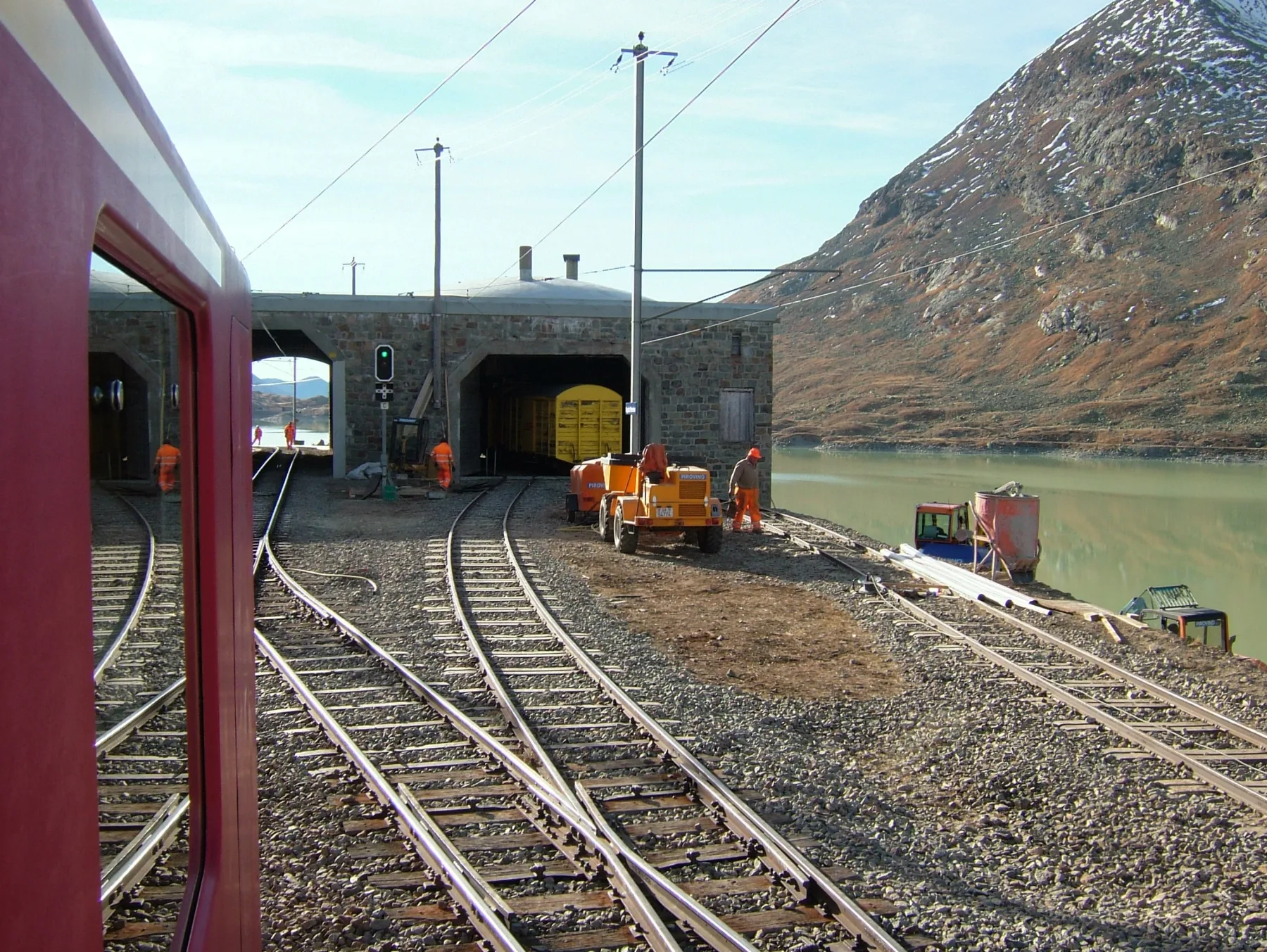
At an exposed station, multiple tracks and maintenance buildings give crews space to inspect, store and repair equipment. The railway requires facilities on the mountain as well as stations at its ends. A passenger experience exists because another timetable governs inspection and repair.
Snow is only one hazard. Freeze-thaw action affects rock and drainage. Wind transports snow unevenly. Wet snow loads, avalanches and debris can close a section even when a town forecast looks benign. Heat can stress track and equipment. Changing permafrost and extreme rainfall can increase slope risk without making every journey dangerous. The correct operational claim is conditional: RhB manages an exposed route, and the live timetable and alerts outrank a tour seller's promise.
That principle should shape contingency planning. If the booked panoramic train is cancelled, a regional service may or may not provide an equivalent connection. If a railway section closes, a road substitute may be slower, less accessible or impossible in the same weather. If the vehicle leg is delayed, a reserved train will not wait indefinitely. The booking confirmation needs a written plan for service substitution, missed connections and a return that reaches Milan after disruption.
Val Poschiavo is not the scenery between Italy and Switzerland
South of the pass, the railway descends through Val Poschiavo, a Swiss valley where Italian is an official and lived language. The border does not divide one cultural world cleanly from another. Families, labour, trade, foodways and transport have long moved through the region. On the north side, the Engadin adds German and Romansh—especially the Puter variety—to the linguistic landscape. Graubünden is Switzerland's only trilingual canton.
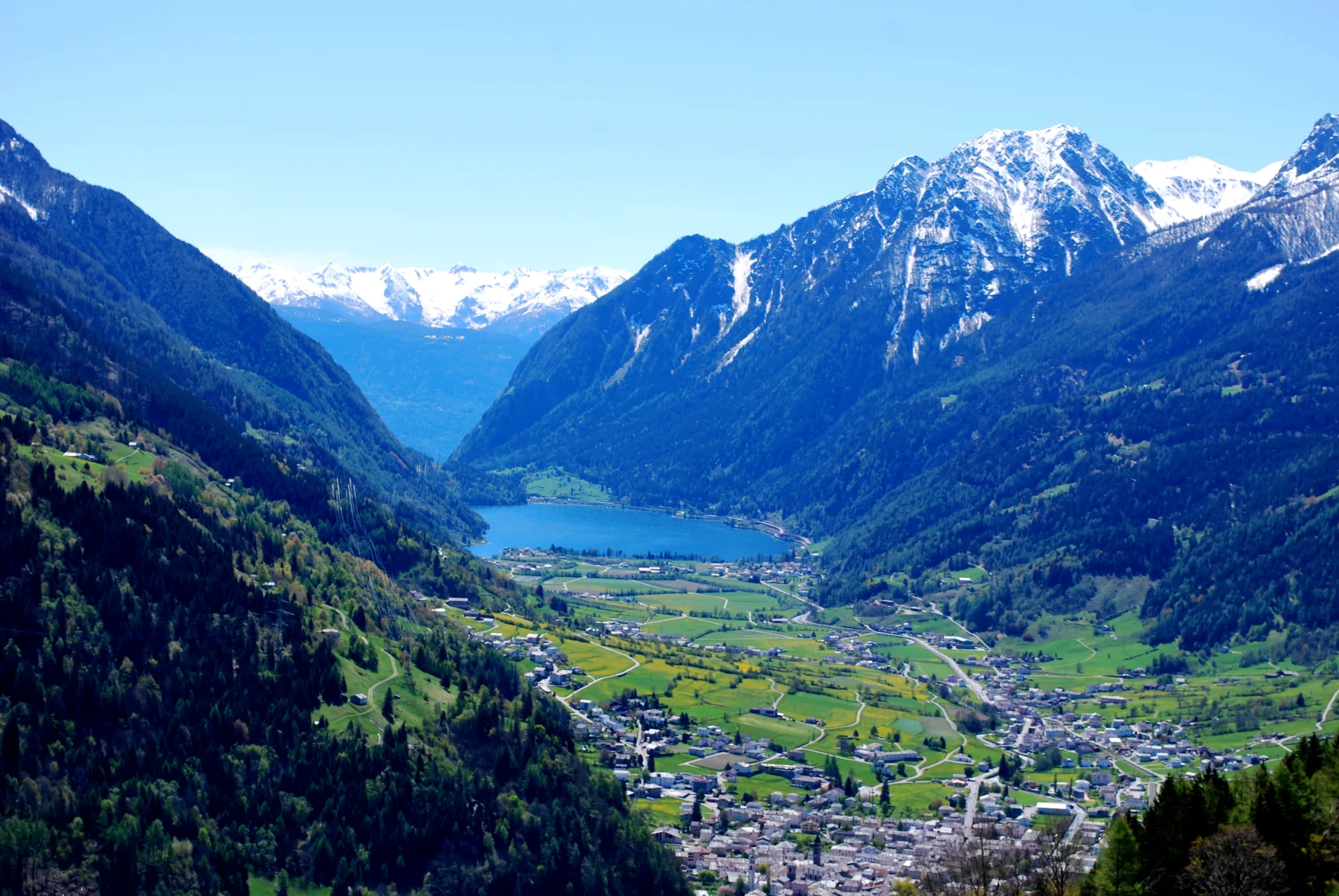
The broad view contains a working valley: clustered settlements, fields, roads, water, forest and steep slopes. Agriculture persists within constraints of elevation and terrain. Hydropower, rail employment, construction, public services and tourism sit beside it. A passenger who calls the valley “empty” is looking past the very activities the railway was built to connect.
Its international connections began well before the railway. Val Poschiavo's local museum account of confectioner emigration follows people who left Graubünden from the mid-eighteenth century into the early twentieth to make sweets, coffee and liqueurs in European cities. Many came from this valley. Their cafés became social spaces for urban customers, while earnings and experience abroad contributed to the architectural renewal of Poschiavo. One small connection travels especially far: the account traces Bilbao's Bollo Suizo, a sweet roll, to two confectioners from Poschiavo in the early nineteenth century. This is a different map of the Alps, drawn through skills, migration, food and returning capital. A town seen briefly from the railway can carry the history of businesses far beyond the mountains.
Rail access transformed markets and mobility but did not produce one simple prosperity. It enabled visitors and goods to move, altered the value of land, and tied mountain economies more closely to external demand. Tourism can maintain transport and employment while intensifying seasonal work, housing pressure and dependence on distant customers. The UNESCO story of reduced isolation is therefore not the end of history. Connection produces choices and vulnerabilities of its own.
The best way to read the valley is through stops, not only windows. Poschiavo's town fabric, farms and institutions need time. Alp Grum reveals the relation between route and valley from above. A night locally changes the economic exchange: money reaches accommodation and food businesses, and the traveller encounters the line as daily transport. A Milan out-and-back day mostly consumes the view.
St. Moritz existed before the luxury logo
St. Moritz sits around 1,856 metres above sea level, above and beside its lake. Its resort history begins with water before snow. The municipality's history traces its importance to mineral springs some three thousand years before the familiar winter-resort story. Later spa culture brought visitors for the waters; hotels and transport then helped turn a summer health resort into a winter experiment. The municipal account dates the famous Johannes Badrutt wager with British guests to 1864. In the familiar telling, summer visitors are invited to discover the pleasures of an Alpine winter. Treat that as a local origin story, not a transcript of a witnessed conversation or the sole cause of winter tourism. Hospitality, transport, sporting organisations and paying guests had to turn an invitation into a season.
The town then became a laboratory for organised winter sport, hospitality and image-making. It hosted the Winter Olympic Games in 1928 and 1948. The natural-ice bobsleigh run toward Celerina preserves one strand of that history. Ski lifts, railways, hotels, shops, sports clubs and events created a seasonal urban system. In 1986, the municipality registered the St. Moritz name as a trademark, a further step in turning a town's reputation into an internationally protected asset.
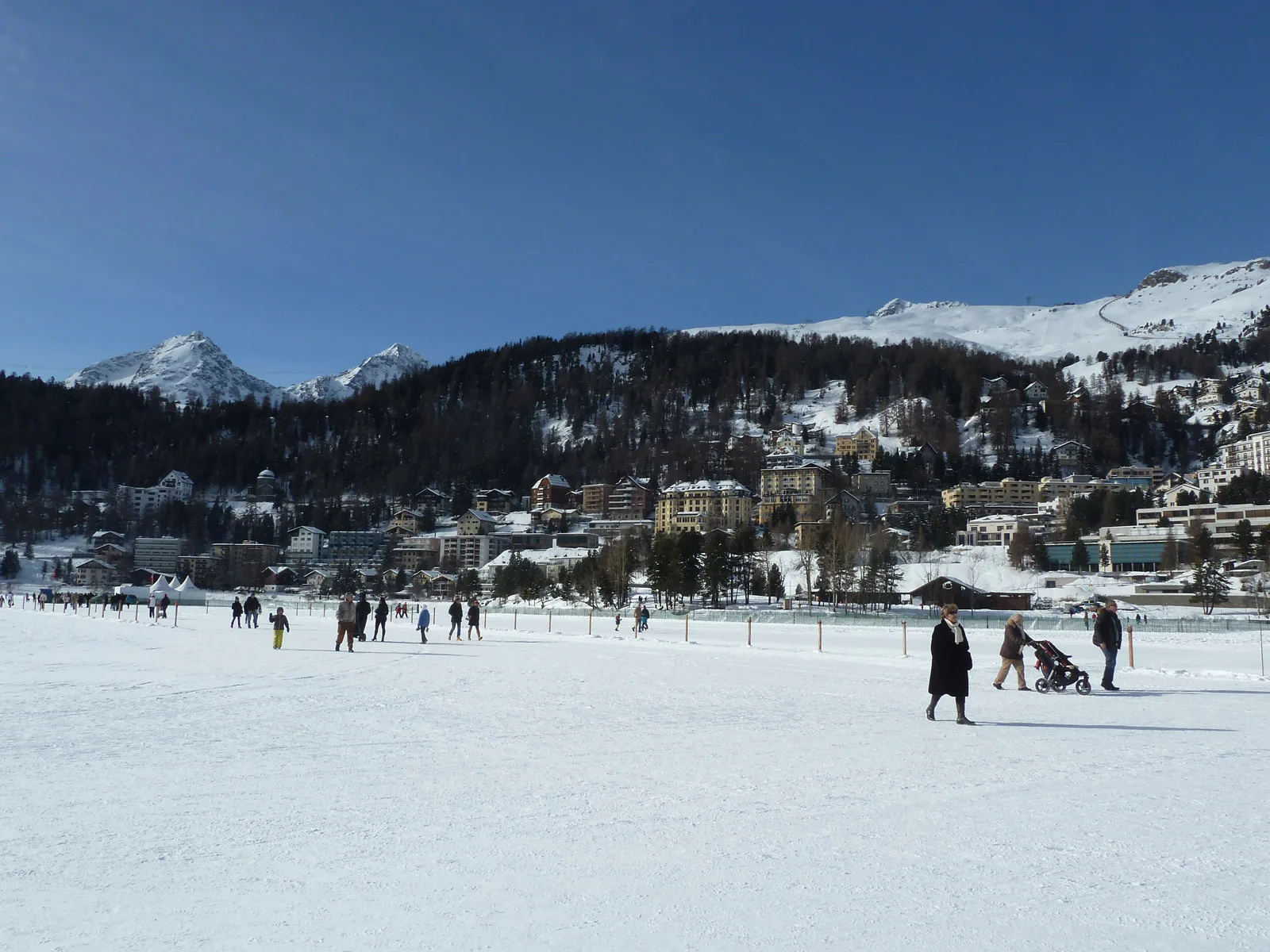
The lake and town should be read together. St. Moritz Dorf occupies the steeper slope, concentrating hotels and retail; St. Moritz Bad lies closer to the mineral-spring and sports landscape. The station sits below the main centre, so “time in St. Moritz” includes vertical movement. A short stop may allow a lakeside walk or a climb into town, not both at depth. Snow, ice safety, construction, weather and the traveller's mobility change that choice.
Luxury is visible, but it is not the whole economy. The municipality describes tourism as its leading income source and the region's major employer. Its profile distinguishes roughly 5,200 year-round residents from thousands of additional seasonal workers. Hotels and holiday apartments greatly expand the sleeping population. Service labour, maintenance, retail, food, transport and care keep the resort functioning. Calling St. Moritz only a billionaire playground makes those workers disappear.
Seasonality is a schedule, not a dead zone
Autumn between summer and winter seasons can bring closed lifts, hotels, restaurants or shops. It can also bring open museums, public services, construction, resident life, walking and rail travel. There is no official rule that September through November is uniformly closed. The exact date matters, and businesses set their own calendars.
The practical response is to check the exact date rather than rely on a label such as “low season.” Ask what will be open during the St. Moritz stop, how long the stop lasts, where food is available and whether the itinerary still makes sense if a preferred venue is closed. The railway remains transport even when part of the resort pauses between seasons.
St. Moritz is actively trying to strengthen year-round and shoulder-season tourism. That strategy may reduce closures, but it also shifts work and infrastructure demands. A municipal housing shortage complicates the resort economy. Primary residences are scarce, and the municipality has pursued housing for local people. The tension is not unique to St. Moritz: high-value second homes and seasonal demand can coexist with difficulty housing the people who operate a destination.
The municipality's 2023 explanation of primary-residence policy identifies a particular problem: older homes without use restrictions can move from resident occupation into the second-home market. The potential loss, it argued, was larger than the supply of new primary homes it could create on its limited remaining land. Building apartments therefore does not automatically secure a resident population. Ownership choices and the use of existing buildings matter too. The resort's service economy depends on people being able to live within reach of their work; the price of property and the prosperity of tourism do not always move together for those residents.
Climate adaptation enters the same debate. Less reliable snow and warmer extremes affect winter sport, ice, energy, water and the calendar of events. Artificial snow can protect selected pistes under suitable conditions; it does not reproduce a winter climate or solve glacier and permafrost loss. Summer tourism can diversify income but adds pressure in another season. A resilient resort must make decisions for residents and ecosystems, not only preserve a brand image.
Crossing the border: Schengen is not the customs union
Italy and Switzerland are both in the Schengen Area. As a rule, people do not undergo systematic checks at their internal border. Switzerland is not, however, part of the European Union customs union. Customs inspections remain possible, and person checks can occur in connection with customs or policing. A journey that felt borderless to one reviewer does not create a rule for the next passenger.
Document requirements depend on nationality, residence status, visa and the wider itinerary. EU and EFTA citizens may normally use an accepted national identity card; many other travellers require a valid passport and, depending on nationality, a visa or residence document. The Swiss State Secretariat for Migration maintains nationality-specific entry guidance and information about travel authorisations such as ETIAS. Check the requirements that apply on the actual travel date, including any authorisation that must be obtained beforehand.
The practical instruction is simple without being universal: identify the rule for every traveller in the party and carry the original accepted travel document. Do not rely on a photograph of a passport, a driver's licence or the assumption that no guard will appear. Check customs allowances when carrying high-value purchases, food, alcohol or other controlled goods. The tour operator should say what it requires, but government rules control entry.
Connectivity and money change too. Switzerland uses Swiss francs, though cards are widely accepted and some businesses may accept euros on their own terms. A short stop does not justify assuming a favourable cash exchange. Mobile roaming depends on the traveller's plan because Switzerland may sit outside EU roaming bundles. Download confirmations and essential contacts before leaving Italy.
“Bernina Express” is a product name, not every red train
RhB operates branded Bernina Express panoramic trains and ordinary regional trains over the Bernina route. Both use the same extraordinary railway. Their carriage, reservation and service patterns differ. A red exterior does not identify the ticket.
The Bernina Express uses panoramic coaches and requires a seat reservation in addition to a valid travel ticket. RhB says luggage space is limited and offers specifically bookable wheelchair places; boarding assistance must be arranged. RhB describes the branded St. Moritz–Tirano journey as about two hours fifteen minutes, a useful planning scale rather than a promised duration. Use the dated timetable and exact train number for connections.
Regional trains can offer more flexible departures and may use conventional windows and low-floor stock on some services. RhB offers a limited number of optional reservations on selected regional Bernina services while unreserved travel remains possible. Regional does not mean inferior. It may be better for stops, openable-window photography where the actual carriage permits it, bicycles or a less packaged schedule. It may also require a change or be crowded.
First class is not synonymous with a panoramic roof. Class describes a fare and seating category; coach type describes the physical carriage. If a day package promises first class without naming the service, obtain the train number, coach type, route direction, class, reserved seat and policy if first class is unavailable. Otherwise a comparison between first-class panoramic isolation and second-class open windows is fiction.
Seat allocation should never be promised by side alone. Ask whether seats are assigned and whether the group sits together. If the journey changes direction or the carriage reverses orientation, a “right side” request may mean something different. The route offers views on both sides; moving respectfully to a vestibule window can sometimes be better than policing a seat.
Accessibility is a chain from Milan pavement to Alpine platform
Rail accessibility cannot be assessed from a wheelchair icon on one station page. The complete chain begins at the Milan pickup point: kerb, pavement, vehicle step, door width, seat transfer, restraint, space for a folded wheelchair or other aid, and the number and duration of road stops. It continues through the unknown boarding station, platform, train gap, carriage, toilet and St. Moritz's slopes. It ends with the return vehicle and a late arrival.
RhB says selected Bernina Express seats are wheelchair-accessible and must be booked through Railservice. Boarding and alighting assistance also require advance arrangement. SBB's accessibility guidance distinguishes independent boarding from journeys needing assistance; platform gaps, steps and the actual rolling stock matter. International assistance can require longer notice. A private tour seller saying “pickup included” does not perform those bookings automatically.
No combined road-and-rail day should be treated as accessible until the provider identifies the vehicle, lift or ramp, door dimensions, mobility-aid space, boarding station, rail coach and St. Moritz route. A person who can climb a vehicle step but not a station stair has different needs from a wheelchair user who cannot transfer. Fatigue, balance, hearing, vision, cold sensitivity and cognitive load belong in the plan as much as wheel dimensions.
Altitude adds another individual decision. Ospizio Bernina reaches 2,253 metres and St. Moritz is around 1,856 metres. CDC travel guidance explains that response depends on elevation, speed of ascent and duration, and that a day visit followed by return to lower altitude is less stressful than sleeping high. That distinction does not certify an individual traveller's fitness. People with relevant heart, lung, pregnancy or medication questions should discuss the actual itinerary with their clinician. Do not dismiss symptoms merely because the journey is by train, or assume that a private vehicle removes the effect of altitude.
Children need an equally specific chain: legal child restraints in the road vehicle, age and rail fare, food, toilet intervals, supervision on platforms and beside the lake, warmth, motion sickness and the ability to tolerate a long return. A child fare tier is not a safety policy. Ask for the minimum age, the restraint supplied and who is responsible for fitting it.
Choose a format by what you are willing to compress
A private Milan day can reduce meeting-point friction and keep a family or small group together. It may help with customised road stops but remains a long road-and-rail day. Ask which parts are exclusive: a private vehicle and guide do not turn a scheduled train into a private carriage. The guide-driver's language and interpretive role also need to be explicit. Compare the complete current price against the control and time the arrangement actually provides.
A group day from Milan spreads transport cost across more passengers and may provide a tour leader. It normally gives the group less control over stops, seats and pace. Compare the current itinerary and conditions rather than inherited review anecdotes. A large coach is not inherently unsafe, and a small van is not inherently sustainable or comfortable.
Independent rail from Milan makes each ticket and connection visible. It can reduce road mileage and lets the traveller choose regional or panoramic service. It demands timetable literacy and disruption planning. A same-day return leaves little margin, particularly when Italian and Swiss assistance or a reserved panoramic train must align.
An overnight in Val Poschiavo, Pontresina or St. Moritz is the best format for depth. It separates the railway from the Milan commute, creates room for a local walk or museum, and makes poor weather less destructive. It can also cost more once lodging and meals are counted. For many readers, the extra night buys more understanding than first-class seating.
A closer Bernina origin—Tirano, Poschiavo or the Engadin—puts the railway at the centre and eliminates the most compressed transfer. A Como–Lugano day offers lakes, towns and borderland mobility with a different balance of terrain and time. For a day spent in Milan itself, the Duomo and its rooftops reveal another system of engineering, craft and conservation. Choose the subject and effort you want to understand.
Use stamina, mobility, children, motion sensitivity, season, documents, photography, emissions, budget and disruption tolerance as criteria. There is no universally superior format. The route rewards the traveller who chooses what to leave out.
The questions a road-and-rail day must answer
A one-day Bernina package is a chain of separate promises: road transport, a specific railway segment, a reservation or ticket, time in St. Moritz and a return to Milan. The label “private” does not answer who operates the vehicle; “first class” does not identify a panoramic coach; “pickup included” does not define the radius; and “accessible” means little without the complete transfer path. Before paying, require one written itinerary that joins the parts.
- Which company operates the road transport, and is the vehicle exclusive to the booking?
- Which Milan addresses are eligible, and when is the pickup confirmed?
- Does the rail run Tirano–St. Moritz or St. Moritz–Tirano?
- What station, train number, coach type, class and reservation are supplied?
- What happens if the named service or railway section is unavailable?
- How much usable time is planned in St. Moritz, and what is the realistic return window?
- What child-restraint, luggage, toilet-stop and mobility arrangements apply?
- What cancellation, delay and missed-connection terms govern the complete chain?
A practical chain for the day
Confirm the route at least a day before departure and keep the written response offline. Check RhB and Italian rail alerts independently. Carry the accepted identity and immigration documents for every traveller, plus any residence card or visa that applies. Keep customs allowances in mind. Do not treat a seller's reminder as legal advice.
Pack for variation rather than a guaranteed temperature: a light insulating layer, wind or rain shell, sun protection and footwear that handles wet platforms and slopes. Bring water and food that comply with vehicle and rail rules, but verify when a meal stop is possible. Keep necessary medication with you and within its safe temperature range. Large luggage is a poor match for limited panoramic-coach racks and an uncertain vehicle.
Download tickets, reservations, pickup details, railway alerts, the operator contact and a simple map. Check whether the phone plan includes Switzerland. Carry a card that works internationally and a small contingency method of payment. Do not rely on a single cafe being open during a short St. Moritz stop.
On the train, confirm the coach before boarding. Store luggage without blocking aisles. Ask staff before changing seats or opening a window. Keep hands, cameras and phones inside. Let other passengers reach the view. At St. Moritz, choose either the lake, town centre or a specific cultural stop according to the actual time and conditions; trying to collect all three turns free time into another transfer.
If weather closes the view, the railway remains legible. Watch the gradient, retaining walls, catenary, stations, water and settlement. If disruption removes the booked service, decide whether a regional substitute preserves the essential journey or merely protects the supplier's timetable. A refund or reschedule may be more honest than a rushed road replacement.
What the field notes reveal about compression
The accompanying episode circles the anxieties that make this route difficult to judge from a booking screen: the length of the day, road discomfort, photography, documents, seasonality, class and the cost of private control. Its most useful contribution is not a promise of snow, a perfect seat or frictionless luxury. It is the recognition that the traveller is choosing what kind of effort to accept.
The railway should make a passenger think about the work beneath effortless movement. The landscape was never empty, hostile ground waiting to be conquered. People lived, worked and moved in these valleys before the train. The railway changed their connections. Today's maintenance crews, residents, seasonal workers, climate scientists and transport planners continue that story.
The Bernina is spectacular because it holds several truths at once. It is a transport line and a heritage object, a climate observatory and a tourism product, a bridge between languages and a route that can reduce places to views. One day can reveal those relationships if the traveller knows what to look for. The price of compression is not only fatigue. It is everything the timetable leaves outside the frame.
Listen to the field notes
The 21-minute episode explores the effort, format choices and expectations behind a Milan-to-Bernina day.
Episode page · Transcript · 21:00